Things to Do in Melaka, Malaysia: Walking Guide
Things to do in Melaka: a self-guided walk through Malaysia’s historic city
The best things to do in Melaka are concentrated around its historic center, where Dutch, Portuguese, Malay, Chinese, and British influences meet in museums, churches, former fortifications, and traditional houses. Red Square, St. Paul’s Hill, Jonker Walk, and the city’s many cultural museums make Melaka especially rewarding to explore on foot. Neywo offers a free audio guide for Melaka with 61 narrated places.
Melaka’s history is closely connected to the Malay Sultanate and to its role as a trading port on the Strait of Malacca. The city’s museums and surviving buildings reveal how different periods and communities shaped its architecture, institutions, and cultural life.
What to see in Melaka
Stadthuys and Red Square
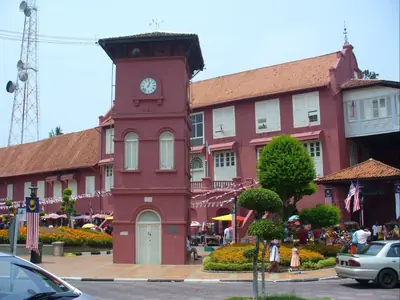
The Stadthuys is one of the defining landmarks of Melaka’s Red Square. Its red façade stands beside the red clocktower and Christ Church, creating one of the city’s most recognizable historic scenes.
Built by the Dutch in 1650, the Stadthuys served as the office of the governor and deputy governor. Its name comes from an old Dutch spelling meaning “city hall.” It is regarded as the oldest remaining Dutch historical building in the Orient and now houses the History and Ethnography Museum, whose displays include traditional costumes and historical artifacts.
The building once stood inside the fortified Dutch city, near the northern entrance and across the river. The fortifications covered much of Bukit Melaka, formerly known as Bukit St. Paul, but the walls were later destroyed after the British ordered their demolition.
Christ Church
Beside the Stadthuys, Christ Church adds another important layer to Red Square. Built by the Dutch around 1753, it was originally a Dutch Reformed church and is now part of the Anglican Diocese of West Malaysia.
It is the oldest functioning Protestant church in Malaysia. Inside, details include handmade pews, a copper Bible, gravestones inscribed in Armenian, and a tile painting of the Last Supper. The ceiling was built without connectors, allowing sunlight to enter the church.
St. Paul’s Hill and its museums
St. Paul’s Hill brings several of Melaka’s historical museums together in a compact area. The Governor’s Museum occupies a former official residence that served Dutch and British governors and continued as an official residence and office after Malaya gained independence. It became a museum in 2002 and presents the history of Melaka’s governors and the institution they represented.
A few steps from the Stadthuys, the Malacca Literature Museum traces literary traditions from the Malacca Sultanate to the modern period. Its displays cover early writing, Malay history, local folklore, Munsyi Abdullah, and the influence of Islam on national laws. Manuscripts, literary works, and Malay letters dating from the sixteenth century are among the material presented there.
The Malacca UMNO Museum focuses on the founding, struggle, and development of UMNO in Malacca City. Nearby, the Malay and Islamic World Museum occupies Bastion House, a building completed in 1910 that was once used by the British rubber company Dunlop. Its English architectural features include a rectangular plan and deep, sloping roofs.
St. Paul’s Church and A Famosa
At the summit of St. Paul’s Hill stands St. Paul’s Church, a historic European church building. According to the supplied historical account, it was originally built between 1566 and 1590 and is described as the oldest surviving church building in Southeast Asia and the Far East, as well as the oldest European building east of India.
The same historic complex leads to A Famosa, the remains of a Portuguese fortress built in Malacca around 1512 after the Portuguese capture of the city. Its name means “The Famous” in Portuguese. The fortress was associated with the hilltop church and the surrounding European buildings.
Education Museum
The Education Museum, or Muzium Pendidikan, occupies a building constructed in 1884. Its architecture combines British, Dutch, Moorish, and Anglo-Chinese influences: Dutch-style windows, British materials, and an Indian double-layered roof construction.
The building once housed Malacca High School, later served as the Malacca Labour and Audit Department, and stood vacant after that department moved elsewhere. It was renovated in 2003 and given its present role as a museum tracing education in the state from the Malacca Sultanate through British Malaya, the Japanese occupation, and the present.
Malaysia Architecture Museum
The Malaysia Architecture Museum is housed in an eighteenth-century Dutch-style building that served as a residence and administrative center for Dutch officials. During British Malaya it became an administrative office, and after 1957 it was used by the Malacca Water Board.
Restored to its original form in 2000, the building became a museum in 2004. Exhibits explore architectural materials, models, building types, carving, and the relationship between architecture and beliefs in Malaysia and beyond.
Proclamation of Independence Memorial
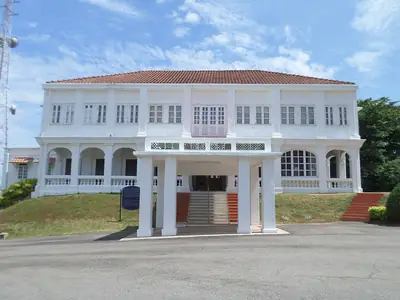
The Proclamation of Independence Memorial stands beside Dataran Pahlawan in a building dating from 1911. Under British colonial rule, it was known as the Melaka Club and served as a social venue for upper-class residents and government officers.
On 31 August 1985, it became a memorial dedicated to preserving documents connected with the country’s independence. Its collections cover the history of the Malay Sultanate of Melaka through to Malaya’s independence in 1957, using photographs, maps, agreements, speeches, recordings, meeting minutes, newspapers, and other artifacts.
Malacca Sultanate Palace Museum
The Malacca Sultanate Palace Museum is a modern reconstruction of the palace of the Malacca Sultanate. Its design draws on the Malay Annals and descriptions of palace architecture during the reign of Sultan Mansur Shah.
Built between October 1984 and April 1986, the reconstruction uses hardwood, belian wood for the roof, and wooden pegs instead of nails. Across three floors, eight chambers, and three galleries, the museum presents a throne room, royal chambers, possessions associated with the sultans, weapons, clothing, regalia, paintings, and historical dioramas. Around 1,350 objects are displayed.
Baba Nyonya Heritage Museum
The Baba Nyonya Heritage Museum explores the history of Melaka’s Baba-Nyonya, or Peranakan, community, whose heritage reflects Chinese and Malay ancestry. It occupies a family house built in 1896 by the great-grandfather of Chan Kim Lay, who helped open the museum in 1986.
The house itself is part of the experience, with elaborate woodwork, furniture, and porcelain. It stands on Jalan Tun Tan Cheng Lock, also known as Millionaire’s Row because of its luxurious residences.
Museums of beauty, kites, and maritime history
The Beauty Museum examines how different societies have defined beauty from prehistoric times to the modern era. It occupies the top floor of the former Historical City Municipal Council building, constructed in the 1960s and believed to stand on the ruins of an earlier Dutch building.
The adjoining Kite Museum looks at kites as objects of leisure, communication, sport, and everyday life. Its displays cover kite-making materials and traditions from different countries, alongside galleries devoted to wau, traditional games, top spinning, and Datuk Wira Haji Md Borhan bin Yaman.
The Cheng Ho Cultural Museum presents the life of Zheng He. It is also a useful starting point for exploring the cultural landmarks around Jonker Walk and Melaka’s multicultural historic center.
Explore Melaka with a free audio guide
For a Melaka self-guided walking tour, Neywo lets you explore without joining a group or following a fixed timetable. The app tells the story of each place as you reach it, at your own pace, with no group and no schedule. Narration is available in 11 languages.
Neywo’s Melaka guide includes three walking tours and one bus route:
- Red Square to St Paul’s Hill: where Melaka’s colonial story began — 1.65 km, 105 minutes, and 12 narrated stops, including Christ Church, the Stadthuys, the Education Museum, St. Paul’s Church, the Malay and Islamic World Museum, the Malacca Sultanate Palace Museum, and the Proclamation of Independence Memorial.
- Forts, warehouses and the Flor do Mar: Melaka’s trading port — 1.08 km, 58 minutes, and 8 narrated stops, including the Malaysia Architecture Museum, the Beauty Museum, and the Maritime Museum.
- Harmony Street: temples, a mosque and a Peranakan mansion — 2.38 km, 79 minutes, and 9 narrated stops, including the Cheng Ho Cultural Museum, Baba Nyonya Heritage Museum, Jonker Walk, Sri Poyatha Moorthi Temple, Kampung Kling Mosque, and Cheng Hoon Teng.
- City bus F100, now M100: from St Peter’s Church to Red Square and Chinatown — 13.3 km, 57 minutes, and 6 narrated stops, including St. Peter’s Church, Christ Church, Bastion Middleburg, the Maritime Museum, and Tamil Methodist Church.
Download Neywo’s free Melaka audio guide and discover the city’s historic streets, museums, churches, and cultural landmarks as you walk or ride through them. If you are planning a wider trip around Malaysia, the app also covers destinations such as Miri, Langkawi, and Putrajaya.
Places with an audio guide in Melaka
8 places in Melaka with a Neywo audio guide. Each one starts telling its story as you reach it.
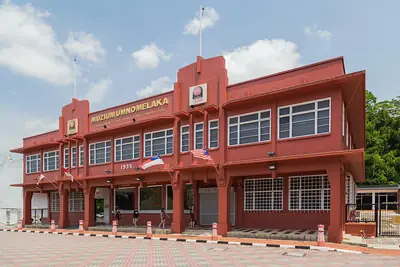
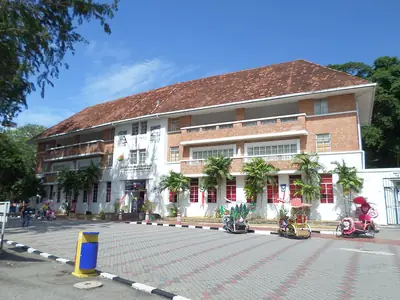
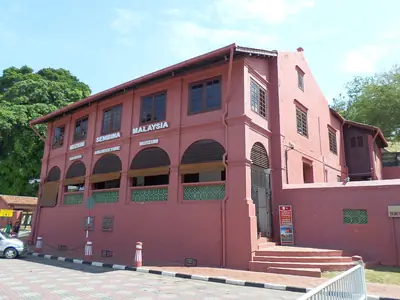
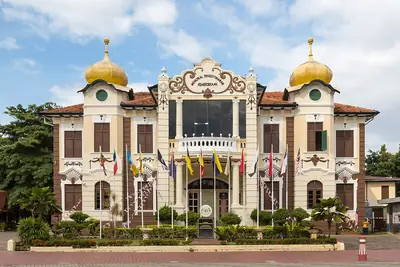
Self-guided tours in Melaka
4 tours in Melaka, free in the Neywo app. Each stop tells its story as you reach it.
- Bus ride
City bus F100 (now M100): from St Peter's Church to Red Square and Chinatown
Melaka's city feeder bus loops from Melaka Sentral through the old town. Ride it from St Peter's Church, the oldest Catholic church in Malaysia, past St Francis Xavier, the red Christ Church and the Dutch bastion by the river, then on to the Flor do Mar replica and Chinatown. A cheap way to cover the historic centre when it is too hot to walk; the route was renumbered M100 in 2024.
St. Peter's Church · Church of St. Francis Xavier · Christ Church, Malacca · Bastion Middleburg · Maritime Museum · Tamil Methodist Church
Open this tour: City bus F100 (now M100): from St Peter's Church to Red Square and Chinatown - Walk
Red Square to St Paul's Hill: where Melaka's colonial story began
Begin at the red Stadthuys and Christ Church, the oldest Dutch buildings in the East, and browse the museums of Red Square. Climb St Paul's Hill past the old governor's residence and the former state assembly to the ruined Portuguese church where Saint Francis Xavier once lay. Come down through a timber replica of the Sultan's palace and the colonial club that became the Proclamation of Independence Memorial, and finish at the largest church in Melaka.
Christ Church, Malacca · Malaysia Youth Museum · Stadthuys · Democratic Government Museum · Education Museum · Malacca Literature Museum …
Open this tour: Red Square to St Paul's Hill: where Melaka's colonial story began - Walk
Forts, warehouses and the Flor do Mar: Melaka's trading port
Melaka grew rich because ships stopped here. Follow the old river mouth from the restored Dutch bastion of A Famosa through a cluster of small museums, from architecture and Islamic art to stamps and the Museum of Enduring Beauty, to a British customs warehouse, a naval museum and the giant replica of the Portuguese ship Flor do Mar, which sank carrying the spoils of the city.
Bastion Middleburg · Malaysia Architecture Museum · Malacca Islamic Museum · Beauty Museum · Malacca Stamp Museum · Royal Malaysian Customs Department Museum …
Open this tour: Forts, warehouses and the Flor do Mar: Melaka's trading port - Walk
Harmony Street: temples, a mosque and a Peranakan mansion
Cross the river into Chinatown and walk the street where a Chinese temple, a Hindu temple and a mosque stand within a few hundred metres of each other. Start at the museum of the Chinese admiral Zheng He, step into a Peranakan family mansion on Millionaire's Row, then visit one of the oldest mosques in Malaysia and end at the 15th-century well said to have been dug for a Chinese princess.
Cheng Ho Cultural Museum · Baba Nyonya Heritage Museum · Jonker Walk · Sri Poyatha Moorthi Temple · Kampung Kling Mosque · Cheng Hoon Teng …
Open this tour: Harmony Street: temples, a mosque and a Peranakan mansion
Walk Melaka with Neywo
Neywo turns Melaka into a self-guided audio tour. Stories arrive as you reach the place they belong to, and the route reshapes when you wander off it.

