What to See in Nijmegen, Netherlands: Free Audio Guide
Things to Do in Nijmegen: Historic Churches, Forts and the Waal
Nijmegen is a historic city in Gelderland, shaped by churches, medieval remains, defensive forts and the River Waal. Its landmarks range from the eleventh-century Sint Nicolaaskapel to former military sites north of the river, making it a rewarding destination for anyone deciding what to see in Nijmegen. Neywo has a free audio guide for Nijmegen with 93 narrated places.
What to See in Nijmegen
Sint Nicolaaskapel and Valkhof Hill
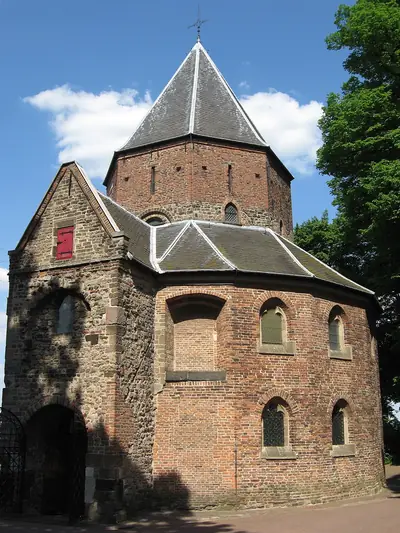
The Sint Nicolaaskapel, also known as the Valkhofkapel, stands on Valkhof Hill beside the Voerweg. This small medieval stone chapel is the oldest surviving building in Nijmegen and one of the oldest stone buildings in the Netherlands. It was probably built in the first half of the eleventh century.
From the middle of the twelfth century, Valkhof Hill was also home to the Valkhof castle of Emperor Frederick Barbarossa. The chapel is commonly regarded as one of the surviving parts of the castle, although its exact structural relationship to the fortress remains uncertain. Today, the hill is a city park, with the Barbarossa ruin marking the remains of the apse of the Sint-Maartenskapel.
St Steven’s Church
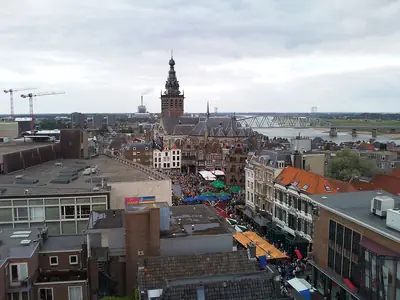
St Steven’s Church, or the Stevenskerk, is one of Nijmegen’s defining landmarks. It stands on the Hundisburg, a small hill in the heart of the city, and is the oldest and largest church in central Nijmegen. Built in the thirteenth century, it is a Protestant church dedicated to Saint Stephen.
The historic synagogues and churches
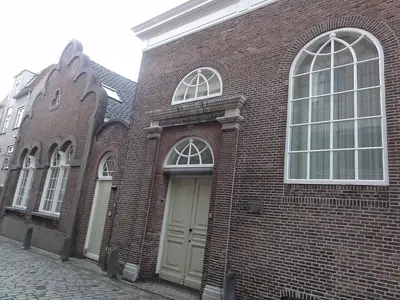
Nijmegen’s religious buildings reflect several centuries of local history. On Nonnenstraat in the Benedenstad, the synagogue known as Beth Knesset Jitzchak dates from 1756 and has roots reaching back to the eighteenth century.
The Lutheran Church on Prins Hendrikstraat dates from 1896, but it preserves important features from an older Lutheran church on Grotestraat. Its oldest organ was made in 1756 by Nijmegen organ builder Matthijs van Deventer, while the pulpit dates from 1671. A small tower was added in 1929.
The Titus Brandsma Memorial at Keizer Karelplein is a Roman Catholic church built in 1908 and 1909. Originally known as the Sint-Jozefkerk, it was dedicated to Titus Brandsma in 2004. Its three-aisled cross-basilica design gives the building a spacious and distinctive form.
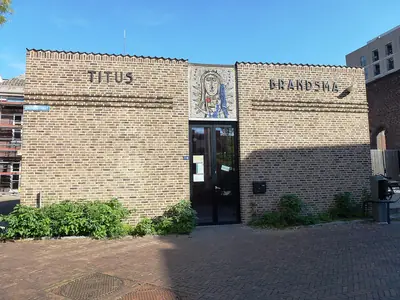
Other churches add further variety to the city’s architectural landscape. The Neo-Gothic Maria Geboortekerk in the Hunnerberg district was designed by Johannes and Jules Kayser. The Groenestraatkerk, also called the Heilige Antonius van Padua-Sint Annakerk, stands at the corner of Groenestraat and Dobbelmannweg in Hazenkamp. In Hees, the Petruskerk is a Protestant church, while the Titus Brandsmakapel on Kroonstraat is a small municipal monument built in 1960 in the style of the Bossche School. Architect Pieter Dijkema designed both the chapel and its accompanying pylon.
The White Church of Neerbosch
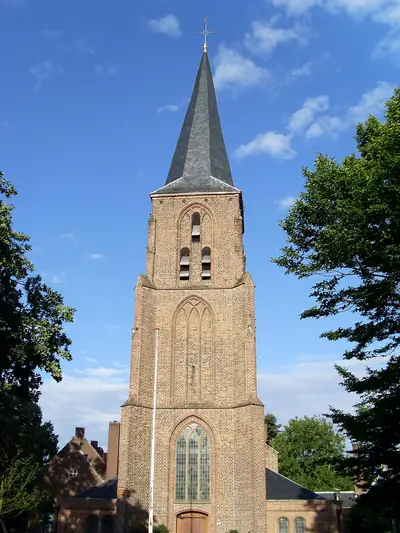
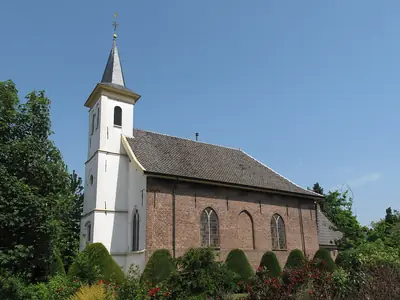
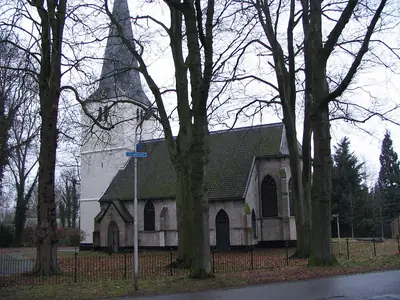
The Nederlands Hervormde kerk Neerbosch, known as the White Church of Neerbosch, is one of Nijmegen’s historic landmarks. The building dates from the end of the fourteenth century and was originally a Roman Catholic church dedicated to Saint Antonius Abt. Since the Reformation, it has served as a Dutch Reformed church.
Quack monument
The Quack monument, also known as the Marie-Adolf Fountain, is a distinctive red granite landmark. Designed by Willem Bijlard, it has four fountains and four bells at its base, with four lanterns rising above an Art Deco-decorated obelisk. The bronze lanterns and bells contrast with the granito lower section and the red granite of the obelisk.
The monument was erected in 1926 using a legacy from Arnoldus Burchard Adolphus Quack, who was an alderman of Nijmegen from 1902 to 1919. He stipulated that a fountain named after his twin sister, Maria Christina, should be built. The monument was removed in 1958 to make way for traffic and was later rebuilt in 2000.
Fort Beneden-Lent
North of the Waal, west of Lent, Fort Beneden-Lent—also known as Nieuw Knodsenburg—illustrates Nijmegen’s military history. Built in 1862, it was first intended to defend Nijmegen. After a railway bridge was built across the Waal and Nijmegen was connected to the Dutch rail network, its role shifted to protecting the strategically important bridge.
The fort consists of a bombproof lodging building surrounded by an earthen redoubt and moat. It was manned during the First World War and again at the beginning of the Second World War. From the 1970s, the site was repeatedly occupied by squatters before becoming the property of Staatsbosbeheer.
Fort Boven-Lent
Further along the Waal, Fort Boven-Lent, also called Sprokkelenburg, was built in 1862 for the defense of Nijmegen. Together with Fort Beneden-Lent, it later protected the railway bridge across the river.
Its defensive design includes casemates, a tower and a moat surrounded by a glacis. The fort was occupied by soldiers during the First World War and at the beginning of the Second World War. After the war, it was used to store ammunition and materials for possible dike damage. Its military role ended in 1959, and it is now used for hospitality.
Maria Geboortekerk in Lent
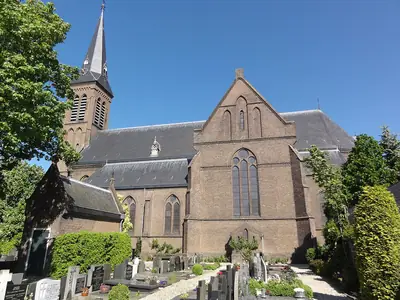
The Maria Geboortekerk in Lent is a parish church and listed national monument in the municipality of Nijmegen. Designed by Gerard te Riele, it opened in 1879. Two side aisles were added in the middle of the 1920s, forming part of the building’s present appearance.
Explore Nijmegen with a self-guided audio tour
Neywo lets you turn these sights into a Nijmegen self-guided walking tour. The app tells the story of each place as you reach it, at your own pace, with no group and no schedule. Narration is available in 11 languages.
The Nijmegen audio guide includes:
- Five walking tours, including Valkhof Hill: Emperors, Romans and the River Waal at 1.56 km and 97 minutes with 12 stops, and Gunpowder, Lions and Memory: Nijmegen’s Old Town at 2.5 km and 106 minutes with 11 stops.
- A 2.24 km, 78-minute walk through the city’s religious and Roman heritage, with 8 stops.
- A 0.51 km, 30-minute walk around Keizer Karelplein, with 4 stops.
- A 5.07 km, 114-minute walk across the Waal in Lent, with 6 stops.
- One bus route, covering 7.1 km in 30 minutes with 11 narrated stops.
- One bike route, covering 10.2 km in 51 minutes with 6 narrated stops.
Download Neywo for free and explore Nijmegen’s churches, monuments, river landscape and forts while the city’s stories play exactly where they happened. You choose the route and the pace; the app provides the narration.
Nijmegen is part of Gelderland in the Netherlands.
Places with an audio guide in Nijmegen
8 places in Nijmegen with a Neywo audio guide. Each one starts telling its story as you reach it.
Self-guided tours in Nijmegen
7 tours in Nijmegen, free in the Neywo app. Each stop tells its story as you reach it.
- Bike ride
West to the Waal: Dukenburg to the Snelbinder bridge
A 7 km ride on Nijmegen's cycle paths, from the Takenhofplein roundabout in the west across the centre to the railway bridge on the Waal, where the Snelbinder cycle bridge carries bikes over to Lent. A commuter-style route past two public artworks, not a scenic loop.
Takenhofplein · De Blauwe Diender · Quack-monument · Joris Ivens Monument · Labyrinth · Nijmegen railway bridge
Open this tour: West to the Waal: Dukenburg to the Snelbinder bridge - Bus ride
Bus 2: from the Valkhof to Nijmegen's sculpture streets
A regular Breng city bus that runs from the Keizer Traianusplein to the Valkhof museum and the riverfront, then west through the city centre past the railway monument and public artworks: Surveillant la Riviere, the Labyrinth, the Joris Ivens Monument and the Blue Policeman, out to the Dukenburg railway bridge.
Keizer Traianusplein · Museum Het Valkhof · Railway monument · Velorama · Brouwershuis · Surveillant la Riviere …
Open this tour: Bus 2: from the Valkhof to Nijmegen's sculpture streets - Walk
Valkhof Hill: Emperors, Romans and the River Waal
Climb the hill where Charlemagne and Barbarossa once held court. See the only two chapels left from the imperial castle, the Roman story at Museum Het Valkhof, and the old bastion on the Waal that now holds a bicycle museum.
Museum Het Valkhof · Valkhofburcht · Barbarossa ruïne · Sint Nicolaaskapel · Museum De Bastei · Velorama …
Open this tour: Valkhof Hill: Emperors, Romans and the River Waal - Walk
Gunpowder, Lions and Memory: Nijmegen's Old Town
A walk through the medieval walls and the lower city. Start at a red obelisk fountain, meet the stone lion and the Powder Tower in Kronenburger Park, then pass the Jewish memorial and the 1756 synagogue on the way to the Stevenskerk, the city's oldest and largest church.
Quack-monument · Kronenburger park · Kronenburgertoren · Joris Ivens Monument · Sint-Jacobskapel · Titus Brandsmakapel …
Open this tour: Gunpowder, Lions and Memory: Nijmegen's Old Town - Walk
Faiths and Romans on the Hunnerberg
Nijmegen's quieter eastern quarter, where a Mennonite church, a Lutheran church with the city's oldest organ and a Neo-Gothic Catholic church stand within a few streets. End at the former archaeological museum where the city's Roman finds were once kept.
Vierdaagsemonument Julianapark · Doopsgezinde kerk · Noorderkerk · Lutheran Church · Nieuwe Synagoge · Keizer Traianusplein …
Open this tour: Faiths and Romans on the Hunnerberg - Walk
Keizer Karelplein: Concert Hall, Stage and Saint
Around the broad square named after Charlemagne: the Art Nouveau and Art Deco concert hall with famous acoustics, the post-war city theatre and the basilica-style church that became a memorial to Titus Brandsma.
Titus Brandsma Memorial · Concertgebouw de Vereeniging · Keizer Karelplein, Nijmegen · Nijmegen city theater
Open this tour: Keizer Karelplein: Concert Hall, Stage and Saint - Walk
Across the Waal in Lent: Bridge, Forts and Churches
Cross to the northern bank, where the railway bridge meets the Snelbinder cycle bridge. Visit the nineteenth-century forts that once guarded it, and the village churches of Lent.
Nijmegen railway bridge · Fort Beneden-Lent · Het Gezicht van Nijmegen · Hervormde Kerk · Maria Geboortekerk · Fort Boven-Lent
Open this tour: Across the Waal in Lent: Bridge, Forts and Churches
Walk Nijmegen with Neywo
Neywo turns Nijmegen into a self-guided audio tour. Stories arrive as you reach the place they belong to, and the route reshapes when you wander off it.

