Visiting Nuwara Eliya, Sri Lanka: Top Sights on Foot
Things to Do in Nuwara Eliya: Highland Landscapes, Churches and Mountain Views
Nuwara Eliya is a highland city in Sri Lanka’s Central Province, set 1,868 metres above sea level in a cool, temperate landscape of hills, forests and waterfalls. The city is overlooked by Pidurutalagala, Sri Lanka’s highest mountain, while the surrounding district includes important river sources and historic churches. Neywo has a free audio guide for Nuwara Eliya with seven narrated places, available in 11 languages.
As part of the island’s central highlands, Nuwara Eliya has a very different character from Sri Lanka’s coastal cities. It is also a useful base for discovering the wider landscape of the Central Province, including nearby destinations such as Kandy and Ella.
What to see in Nuwara Eliya
The most important places to visit around Nuwara Eliya range from Sri Lanka’s highest mountain to Anglican churches and a Buddhist monument dedicated to peace. The sites are spread across the district, so they are best understood as part of the wider highland area rather than a single compact walking route.
Pidurutalagala
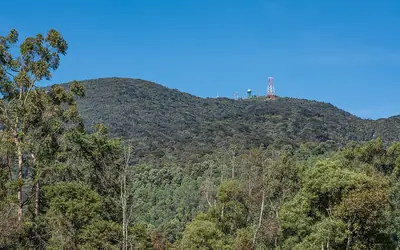
Pidurutalagala rises to 2,524 metres above sea level and is the highest mountain in Sri Lanka. Its name is also explained as “Straw Plateau Rock”. The mountain stands north-northeast of Nuwara Eliya and is visible from much of Sri Lanka’s Central Province.
Its broad summit is surrounded largely by forest, giving it a powerful presence above the hills around the city. That forest cover has also faced danger: on 1 March 2010, a small wildfire burned 1.2 hectares before being extinguished by the Sri Lanka Air Force and nearly 300 local residents.
Nuwara Eliya and its highland setting
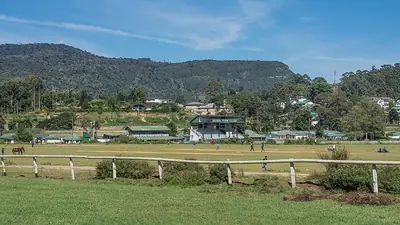
Nuwara Eliya itself sits among the hills at 1,868 metres. It is known for its cool, temperate climate and is considered the coolest area in Sri Lanka. The city’s setting combines highland slopes, forests and waterfalls, with Pidurutalagala forming a distinctive backdrop.
The surrounding landscape is one of the defining reasons to visit. Rather than being only an urban destination, Nuwara Eliya offers access to the natural features of the district and to the mountain environment of Sri Lanka’s Central Province.
The source area of the Mahaweli River
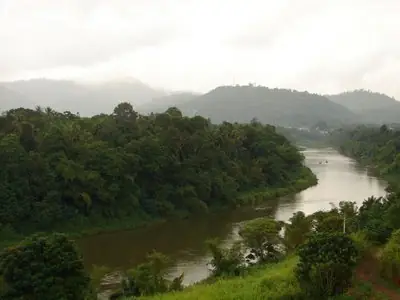
The Nuwara Eliya District lies near the source area of the Mahaweli River, known in Sinhala as Mahaweli Ganga. Its name means “Great Sandy River”, and it is Sri Lanka’s longest river.
The supplied source information places the river’s source waters in Horton Plains and the Thotupola mountain range. From the highlands, the river forms part of a much larger system that eventually reaches the Bay of Bengal on the southwestern side of Trincomalee Bay. Although Sri Pada Mountain is often described as the river’s source, this account identifies Horton Plains and the Thotupola mountain range instead.
Christ Church Warleigh
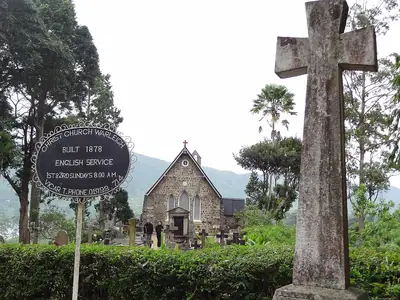
Christ Church Warleigh is one of Sri Lanka’s prominent Anglican churches. Built during the nineteenth century by the British, it stands in Dickoya, in the Central Province, along the Hatton to Norwood road through the Warleigh Division.
The church reflects the historic religious architecture found across the central highlands. The wider Nuwara Eliya area also includes another Anglican church, Holy Trinity Church, located in Nuwara Eliya itself.
Holy Emmanuel Church, Hanguranketha
A few kilometres south of Hanguranketha, beside Hanguranketha C. C. Vidyalaya, Holy Emmanuel Church has stood since 1886. This Anglican stone church is regarded as one of the oldest churches in the district and is also recognised as part of the area’s heritage.
The story of the building began in 1855, when Reverend E. T. Higgins proposed a church near the school. Land was donated by Gammuladani and Wijeratne, and a semi-permanent structure was built on 4 August 1880 by Mudaliyar Susew de Soysa. After his death, his nephew Charles Henry de Soysa funded the permanent church, including its altar and wooden pews.
The building continued to develop over the following decades. In 1938, Father Don Lewis Welikala added a new bell tower and became the church’s first Sinhalese priest. A weaving centre was established near the church in 1944 by C. S. Koraya. On 6 July 2007, the Government formally declared Holy Emmanuel Church an Archaeological Protected Monument.
Japan Peace Pagoda
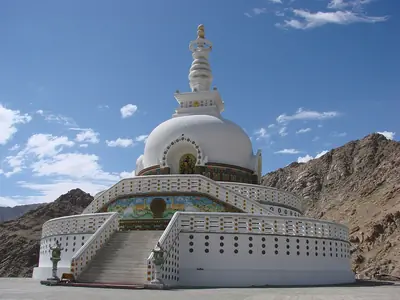
The Japan Peace Pagoda is a Buddhist stupa created as a monument to peace. Its purpose is to inspire peace and provide a focus for people of all races and creeds in their search for world peace.
The Peace Pagoda movement grew after the Second World War. Many of the pagodas were built under the guidance of Nichidatsu Fujii, a Japanese Buddhist monk and founder of the Nipponzan-Myōhōji Buddhist Order. Inspired by his meeting with Mahatma Gandhi in 1931, Fujii devoted his life to promoting non-violence. He began building Peace Pagodas in 1947, and the first was inaugurated at Kumamoto in 1954.
St. Margaret’s Church, Kotagala
St. Margaret’s Church is a heritage-listed Anglican church in Kotagala. Built from stone in the nineteenth century, it is one of the town’s heritage landmarks.
The stone construction gives the church a particularly solid and enduring character. Like Christ Church Warleigh and Holy Emmanuel Church, it forms part of the historic Anglican heritage of Sri Lanka’s central highlands.
Explore Nuwara Eliya with Neywo
Neywo’s free Nuwara Eliya audio guide includes seven narrated places. The app tells the story of each place as you reach it, at your own pace, with no group and no schedule. Narration is available in 11 languages.
Download Neywo to explore Nuwara Eliya while keeping the city’s mountains, river landscapes and historic churches connected as part of one highland journey. You can also continue discovering Sri Lanka through destinations including Dambulla, Colombo and Galle.
Places with an audio guide in Nuwara Eliya
5 places in Nuwara Eliya with a Neywo audio guide. Each one starts telling its story as you reach it.
Walk Nuwara Eliya with Neywo
Neywo turns Nuwara Eliya into a self-guided audio tour. Stories arrive as you reach the place they belong to, and the route reshapes when you wander off it.

