Visiting Monterey, United States: Top Sights on Foot
15 Things to Do in Monterey: History, Art and the Pacific Coast
Looking for things to do in Monterey? This coastal California city brings together the history of Alta California, historic adobe buildings, art museums, Cannery Row and the marine life of Monterey Bay. A visit is especially rewarding for travellers who want to combine a compact historic centre with waterfront views and places connected to literature, music and science. Neywo offers a free audio guide for Monterey with 45 narrated places.
What to see in Monterey
Old Customhouse
The Old Customhouse is one of Monterey’s most important historic landmarks. Built around 1827 by Mexican authorities, the Spanish Colonial adobe building served as the port’s customs house while Monterey was the capital of Alta California, then part of Mexican territory.
It is the oldest surviving government building in California. In 1846, U.S. Commodore John Drake Sloat raised the American flag here and declared California part of the United States. The building was later restored through efforts led by the Native Sons of the Golden West and a state commission created in 1901.
Colton Hall
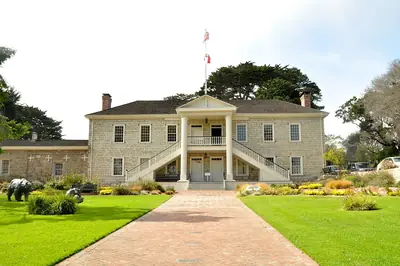
Colton Hall was built between 1847 and 1849 by Walter Colton and became California’s first seat of government. Its original design combined a public school on the ground floor with a government assembly hall above.
The building’s most important chapter came in 1849, when delegates from ten districts met here to draft California’s first constitution. The convention began on September first, the constitution was ratified on October thirteenth, and it was sent to Congress in January 1850. Monterey did not become the state capital because the first Legislature was assigned to San Jose.
Monterey Maritime and History Museum
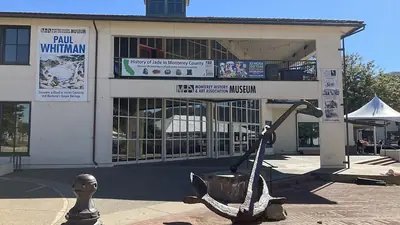
At Custom House Plaza, the Monterey Maritime and History Museum—also known as the Museum of Monterey—combines local history and fine art. Its permanent displays include paintings, drawings and sculptures by artists such as Jo Mora, Ferdinand Burgdorff, E. Charlton Fortune, Paul Whitman and Armin Hansen.
The museum also explores the Rumsen people, the fishing industry and John Steinbeck. A distinctive collection focuses on the period when Salvador Dalí and Gala lived in Monterey, including paintings, drawings, sculptures, photographs and Dalí’s original printing press.
Monterey Museum of Art
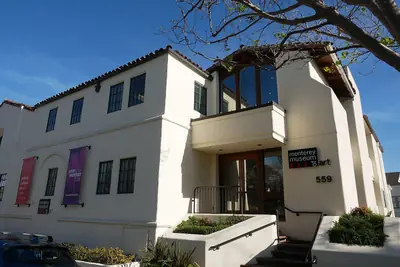
The Monterey Museum of Art, at 559 Pacific Street, is devoted to California art from the nineteenth century to the present. Its collection includes painting, sculpture, photography and mixed media, with particular attention to Northern and Central California.
The Pacific Street site has eight galleries. Visitors can find early California images, works associated with the Carmel Art Colony, photography, contemporary art, Asian art and American art. Artists represented include Armin Hansen, William F. Ritschel, Joan Miró, Henri Matisse, Pablo Picasso, Edward Weston and Ansel Adams.
Cathedral of San Carlos Borromeo
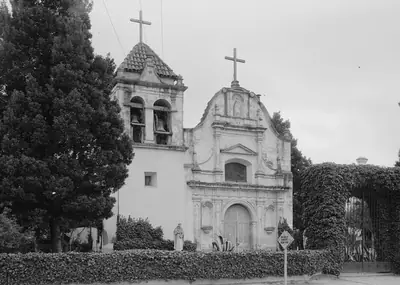
The Cathedral of San Carlos Borromeo, also known as the Royal Presidio Chapel, is the oldest continuously operating parish and the oldest stone building in California. Its story began in 1770, when Franciscan Father Junípero Serra founded Mission San Carlos Borromeo de Carmelo.
After the mission moved away from the presidio in 1771, its earlier building became the chapel of the Presidio of Monterey. The original church was destroyed by fire in 1789. The present sandstone building was constructed between 1791 and 1794 by Indigenous workers. Its Latin-cross plan and Spanish Colonial design make it one of Monterey’s defining historic landmarks.
Lower Presidio Historic Park
Lower Presidio Historic Park combines panoramic views across the bay and harbour with a history that spans the Native American, Spanish, Mexican and American periods. The site also recalls the deployment of Buffalo Soldiers and the establishment of the Defense Language Institute.
A path leads uphill towards the Sloat Monument, a large granite eagle. The accessible Harbor Trail introduces the Esselen and Rumsien Ohlone communities and leads to monuments dedicated to Bouchard and Junipero Serra. The Presidio of Monterey Museum provides a closer look at the area’s many historical layers.
Pacific House
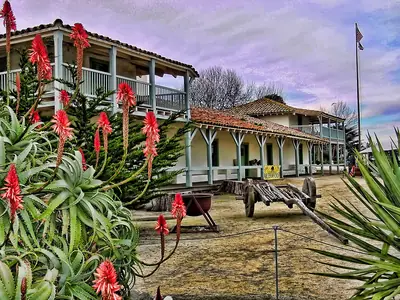
Pacific House is a two-story adobe building constructed in 1847. It has served as a home for seafarers, a courthouse and a law office. Today, the property includes historic architecture, museum displays and gardens.
One unusual detail is a well enclosed within the walls. Outside, the walled garden is the setting for the city’s annual Merienda celebration.
First Theater
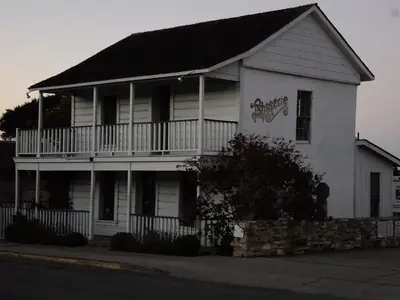
The First Theater is a modest adobe and wood building with an important place in California’s theatrical history. English seaman and pioneer Jack Swan built the original lodging house and tavern between 1845 and 1847, using shipwreck lumber for the smaller wooden section.
In late 1847, Swan added an adobe section intended for sailors’ lodging. Four soldiers from Santa Barbara and three local comedians soon turned the space into a theatre. Their performances are regarded as California’s earliest theatrical presentations.
MY Museum
MY Museum, the Monterey County Youth Museum, is designed for hands-on learning. Since 1997, it has offered interactive experiences for children and adults, with exhibits focused on the industries and activities central to Monterey County.
After a fundraising campaign, the museum moved from Cannery Row to a larger downtown building in November 2008. It now has nine gallery areas and more than 50 exhibits, making it a useful stop for families.
St. John’s Chapel
St. John’s Chapel in Del Monte was founded in 1891 for guests of the Hotel Del Monte. Its land was donated by railroad tycoon Charles Crocker, and it remains a parish of the Diocese of El Camino Real.
The one-story church is built in the Late Victorian Shingle Style. Its steeple and bell tower rise 110 feet above the building. President Theodore Roosevelt attended services here in 1903, and the chapel later hosted weddings for Brian Aherne and Joan Fontaine, and for Brooke Shields and Andre Agassi.
Cannery Row Monument
The Cannery Row Monument stands in Steinbeck Plaza, with bronze figures set against views of Monterey Bay. Created by sculptor Steven Whyte, it honours writers, scientists and local business owners connected with Cannery Row.
The figures include Ted Balestreri, Bert Cutino, Hary Davidian and George Zarounian, whose work helped revive the district and increase tourism.
Thomas Kinkade Gallery of Monterey
The Thomas Kinkade Gallery of Monterey was established in 1994 and is designed to resemble a grand mansion. Its collection includes Kinkade’s oil paintings, detailed sketches and landscapes, as well as works by Blend Cota, Zac Kinkade and Marjolein Bastin.
The gallery also presents a large collection of rare and sold-out Kinkade paintings, offering an intimate look at the artist’s work and connection with Monterey.
Monterey Bay Aquarium
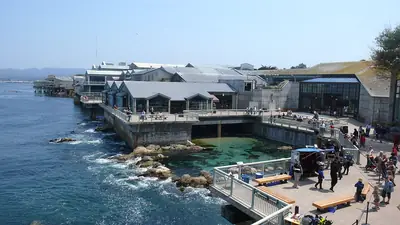
At the northwestern end of Cannery Row, Monterey Bay Aquarium focuses on marine life from around the world while recreating habitats such as dunes and kelp forests. When it opened in October 1984, it became the first aquarium to display a living kelp forest.
Its exhibits include sharks, jellyfish, stingrays, sea otters, penguins and many other animals. The building occupies the site of a former sardine cannery, and the aquarium’s creation helped revitalise Cannery Row. One of its largest aquariums has a huge acrylic window offering a broad view into the water.
Monterey International Pop Festival
The Monterey International Pop Festival took place over three days in June 1967 at the Monterey County Fairgrounds. Organised by Lou Adler, Alan Pariser, John Phillips of the Mamas & the Papas and publicist Derek Taylor, it became a landmark event in modern music.
Almost all the artists performed without payment; Ravi Shankar was the exception, receiving three thousand dollars. The festival’s organisation, performances and public attention helped make it a model for future events, including Woodstock two years later.
Explore Monterey with a free audio guide
Neywo turns a Monterey self-guided walking tour into a narrated walk through the city. The app offers three walking tours, one bus route and one bike route, with 45 narrated places in total. The walking tours cover 1.65 km in 72 minutes, 1.93 km in 63 minutes and 2.34 km in 54 minutes. The bus route covers 8.3 km in 36 minutes, and the bike route covers 1.8 km in 9 minutes.
Choose a route according to your interests: the history of the waterfront, the place where California wrote its constitution, or Steinbeck’s Cannery Row from the wharf to the aquarium. Neywo tells the story of each place as you reach it, at your own pace, with no group and no schedule. Narration is available in 11 languages.
Continue exploring California and the United States with Neywo, or discover other destinations such as Los Angeles and Oceanside.
Places with an audio guide in Monterey
8 places in Monterey with a Neywo audio guide. Each one starts telling its story as you reach it.
Self-guided tours in Monterey
5 tours in Monterey, free in the Neywo app. Each stop tells its story as you reach it.
- Bike ride
Monterey Bay Coastal Trail: Custom House to Cannery Row
Ride the car-free recreation trail along Monterey Bay from the Old Customhouse to the Aquarium. Pass Cannery Row's plaza and the bronze monument to John Steinbeck and Ed Ricketts before the Aquarium.
Old Customhouse · Cannery Row Park Plaza · Cannery Row Monument · Monterey Bay Aquarium
Open this tour: Monterey Bay Coastal Trail: Custom House to Cannery Row - Bus ride
Jazz C: Lake El Estero to Cannery Row Through Old Monterey
Monterey-Salinas Transit's Jazz C shuttle runs from the El Estero lakeshore through downtown. Ride past the cathedral, the first frame house and the Golden State Theatre to the House of the Blue Gate, then on to Cannery Row's plaza and the Old Customhouse.
Lake El Estero · First Frame House · Cathedral of San Carlos Borromeo · Golden State Theatre · Casa Soberanes · Cannery Row Park Plaza …
Open this tour: Jazz C: Lake El Estero to Cannery Row Through Old Monterey - Walk
Capital of Alta California: The Waterfront Path of History
Walk where California changed flags. Climb to the Presidio's granite eagle, then follow the adobes of Old Monterey from the House of the Blue Gate to the Custom House where Commodore Sloat raised the Stars and Stripes in 1846, ending at Fisherman's Wharf.
Presidio of Monterey Museum · Casa Soberanes · First Theater · Monterey State Historic Park · Casa del Oro · Custom House Plaza …
Open this tour: Capital of Alta California: The Waterfront Path of History - Walk
Where California Wrote Its Constitution
From the oldest stone cathedral in California to the hall where delegates drafted the state's first constitution in 1849. Pass the first frame house, Robert Louis Stevenson's lodging, the Larkin House that gave a style its name, a Castilian-castle movie palace and the Monterey Museum of Art.
Lake El Estero · Cathedral of San Carlos Borromeo · First Frame House · Stevenson House · Golden State Theatre · Larkin House …
Open this tour: Where California Wrote Its Constitution - Walk
Steinbeck's Cannery Row: From the Wharf to the Aquarium
Follow the waterfront from Fisherman's Wharf to the sardine canneries John Steinbeck made famous. See the plaza and bronze monument on Cannery Row, the laboratory of his friend Ed Ricketts, and end at the Monterey Bay Aquarium.
Fisherman's Wharf, Monterey, California · Cannery Row Park Plaza · Cannery Row Monument · Pacific Biological Laboratories · Monterey Bay Aquarium
Open this tour: Steinbeck's Cannery Row: From the Wharf to the Aquarium
Walk Monterey with Neywo
Neywo turns Monterey into a self-guided audio tour. Stories arrive as you reach the place they belong to, and the route reshapes when you wander off it.

