Things to Do in San Luis Obispo, United States: Walking Guide
Things to Do in San Luis Obispo
San Luis Obispo, often called SLO, is a historic mission city on California’s Central Coast where Spanish heritage meets a lively downtown and scenic surroundings. Visitors can explore adobe homes, museums, parks and quirky landmarks that together tell the story of the region’s past and present. Neywo offers a free audio guide for San Luis Obispo with 19 narrated places to help you discover the city at your own pace.
Exploring San Luis Obispo’s Highlights
Dallidet Adobe (museum)
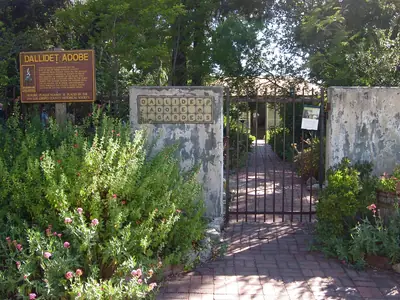
The Dallidet Adobe and Gardens, a California Historical Landmark (#720), was established in 1856 by Pierre Hypolite Dallidet after his arrival in San Francisco seeking gold. He built the home with his wife Maria Ascension Salazar and their seven children, and the adobe’s rooms and furnishings illustrate daily life for a mid‑19th‑century family. Surrounding gardens feature manicured lawns, colorful plantings and winding walkways that invite a leisurely stroll. In 1953 Pierre’s youngest son Paul donated the property to the San Luis Obispo County Historical Society to mark the centennial of his father’s arrival; Paul continued to live there until his death in 1958, just shy of his 87th birthday. Today the History Center of SLO County operates the site, offering educational tours, events and wedding venues while preserving the Dallidet story.
History Center of San Luis Obispo County (museum)
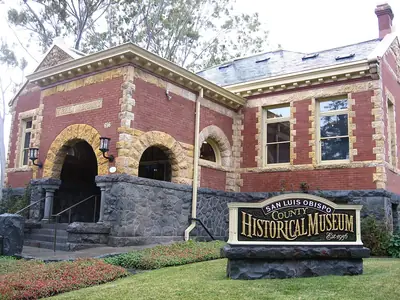
The former San Luis Obispo Carnegie Library, erected in 1905 with funding from the Carnegie Foundation, now houses the History Center of San Luis Obispo County. Its Richardsonian Romanesque façade combines red brick and yellow sandstone trim, topped by a tall hipped roof, two gabled wings and gargoyles perched at the gable ends. A portico of round arches marks the entrance, while the basement is faced in dark gray granite. Inside, rotating exhibits explore the area’s history and culture, and a research room supports those digging deeper into local stories. The building served as the city’s subscription library from 1894 until 1855 before becoming a county historical museum the following year.
Historic Jack House & Gardens (museum)
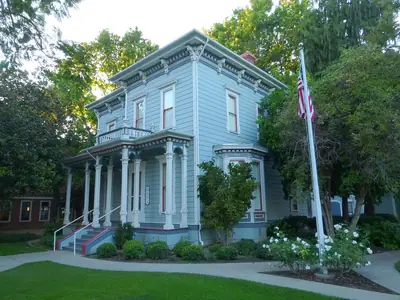
At 536 Marsh Street stands the Historic Jack House, a two‑story Italianate‑style home built for banker, land developer and wool grower Robert Edgar Jack. He resided there from 1882 until his death in 1916, linking the house to one of the region’s leading citizens. The property, listed on the National Register of Historic Places in 1992, exemplifies Italianate architecture with its balanced proportions and decorative details. When open, volunteer docents lead guided tours on Sundays from April through November, as well as during holiday celebrations and special events, offering insights into the Jack family’s legacy.
Ah Louis Store (other)
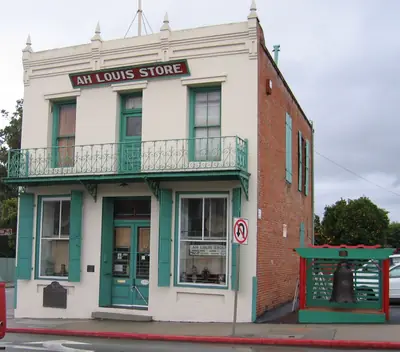
The Ah Louis Store on the corner of Palm and Chorro Streets is a tangible link to San Luis Obispo’s historic Chinatown. Opened in 1874 by Wong, known as Ah Louis, it was the first East Asian mercantile in the county, supplying the local Chinese community with rice, rum and, at the time, legal opium. The original wooden structure was replaced in 1885 by a sturdy brick building made from bricks produced in Ah Louis’s own brickyard, giving the shop a lasting presence in downtown SLO.
Mission Plaza (park)
Mission Plaza stretches outside Mission San Luis Obispo de Tolosa, serving as a lively public space where history, relaxation and community life intersect. The plaza took shape in 1971 when Monterey Street in front of the mission was closed; what began as a dusty street evolved into grassy areas, benches and a fountain through community effort. Rather than recreating the past, the plaza offers an accessible setting to connect with the mission’s heritage while hosting festivals, markets and quiet moments. Just west of the mission, the San Luis Obispo Museum of Art occupies a spot in this cultural setting, presenting rotating exhibitions of contemporary California artwork.
Higuera Street and the Farmers’ Market
Higuera Street forms the heart of downtown San Luis Obispo, lined with shops, restaurants and the popular weekly farmers’ market. It is the main destination for experiencing the city’s lively atmosphere, where locals and visitors mingle over fresh produce, crafts and street food.
San Luis Obispo Railroad Museum (museum)
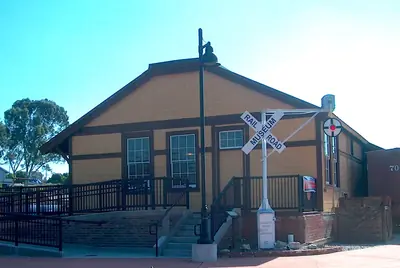
Housed in a restored 1894 freight house, the San Luis Obispo Railroad Museum preserves the rail heritage of California’s Central Coast. Inside, visitors can see a Southern Pacific boxcar, a classic Pullman café and observation car, express wagons, signal equipment, early telegraph devices, switch stands and locomotive bells. Archival photographs line the walls, adding a human dimension to the artifacts. Beyond the exhibits, the museum maintains a research library, document and photographic archives and an developing oral history program to support study of regional railroad history. It is open Saturdays from 10 a.m. to 4 p.m., with group visits available by arrangement, and hosts special events each May and October.
San Luis Obispo Children’s Museum (museum)
Designed for kids aged two to ten, the San Luis Obispo Children’s Museum spreads hands‑on play across three floors. The first floor features an archaeological dig zone, a simulated volcano and exploration caves, complemented by games that introduce basic science and problem‑solving through motion, sound and trial and error. The second floor encourages imaginative role‑play with a mini doctor’s office, a grocery setup complete with cash registers and food‑themed areas that foster social interaction and storytelling. The third floor offers a quieter retreat for younger children, complete with a reading nook, oversized puzzles and colorful train sets that support independent discovery and motor‑skill development. Outside, an open‑air playscape continues the self‑directed experience.
First Presbyterian Church (church)
The stone First Presbyterian Church at the corner of Marsh and Morro Streets has served its congregation and the wider community for over a century. Founded in 1875 by Civil War veteran and SLO County judge McDowell Reid Venable with eleven charter members, it became the area’s third Protestant church. The original wooden sanctuary was replaced in 1884 by a Victorian Stick‑Eastlake building capable of holding about two hundred worshippers. The present church, erected in 1905 after its cornerstone was laid in 1904, reflects the English Arts and Crafts style and is constructed of granite quarried from nearby Bishop Peak. Its stonework conveys a sense of permanence while revealing the careful craftsmanship of the era; later additions include an Educational Unit dedicated in 1929 and a fellowship hall added in 1987.
Mission San Luis Obispo de Tolosa (museum)
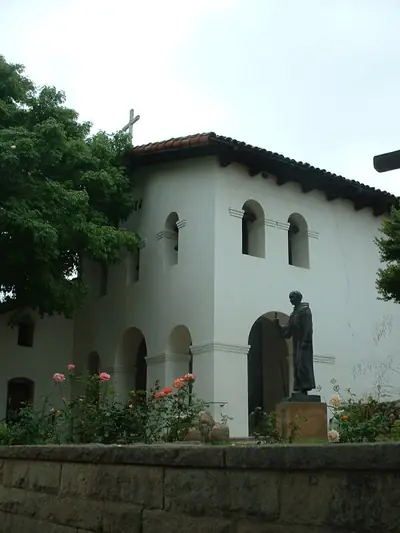
Mission San Luis Obispo de Tolosa stands out among California’s Spanish missions for its unique layout: the bell tower and entrance are combined in a design found nowhere else, and the interior forms an L‑shape, the only such configuration in the state. Founded on September 1, 1772 by Father Junípero Serra as the fifth mission in the California chain, it was named for Saint Louis, Bishop of Toulouse. The mission has remained on its original site throughout its history and today operates as a parish of the Diocese of Monterey. Its walls rise between fifty and sixty feet, built to match the height of the local pine trees, and its location was chosen after explorers encountered the Valley of the Bears (La Cañada de Los Osos).
Saint Anne Catholic Church of the Byzantine Rite (church)
Saint Anne Catholic Church of the Byzantine Rite is a parish that belongs to the Byzantine Ruthenian Tradition, giving it a distinct place within the Catholic community of San Luis Obispo. Established in 1986, it now falls under the Holy Protection of Mary Byzantine Catholic Eparchy of Phoenix, serving those who worship according to the Eastern Christian rites.
Bubblegum Alley (street)
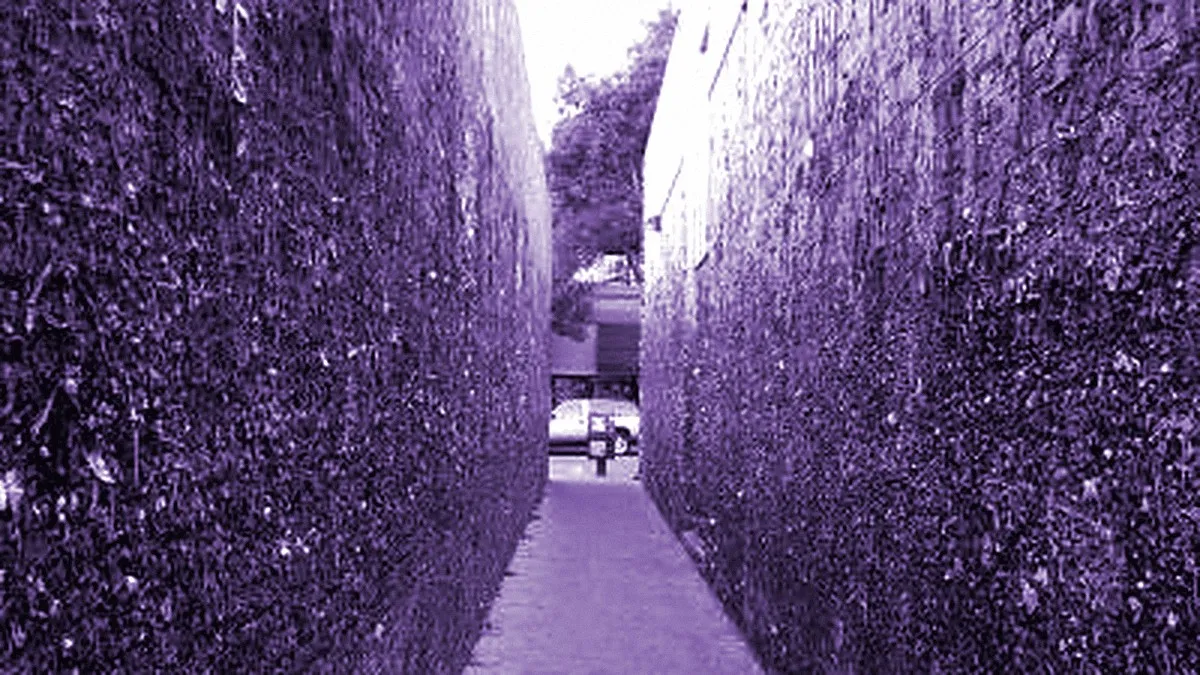
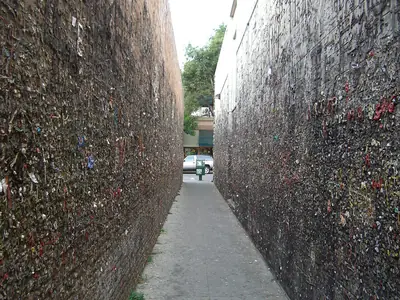
Bubblegum Alley, tucked between 733 and 734 Higuera Street in the 700 block of downtown, is one of San Luis Obispo’s quirkiest attractions. The narrow passage’s walls rise about fifteen feet and stretch roughly seventy feet, covered in layer upon layer of chewed bubble gum left by passers‑by. As visitors add their own pieces, the colors, textures and shapes continually shift, with some leaving fraternity or sorority Greek letters that turn the gum into a spontaneous sign of affiliation and decoration.
Fremont Theater (cinema)
The Fremont Theater, opened in 1942, is a historic venue whose Streamline Moderne design captures the excitement of early‑twentieth‑century entertainment. Designed by architect S. Charles Lee, it remains one of the few surviving examples of this style in the region, securing a special place in San Luis Obispo’s cultural and architectural heritage. From its inaugural years the theater showed both films and live performances, including war‑bond events during World War II. Although it once faced demolition to make way for a new multiplex, public opposition saved the original building; a multiplex was erected next door, and the extra screens provided financial support that helped preserve the Fremont.
Mitchell Park (park)
Mitchell Park offers a well‑equipped community space centered on a distinctive hexagonal gazebo. The open lawn is crossed by paved walkways and surrounded by picnic tables, a barbecue area, a playground and horseshoe pits, providing varied options for outdoor recreation, relaxation and local gatherings. Whether you’re here for a family get‑together or a casual break, the park is designed for everyday community use.
Madonna Inn (other)
The Madonna Inn, opened on December 24, 1958, is famous for its extravagant pink décor, themed rooms and a striking exterior inspired by the Swiss Alps. Situated on the west side of U.S. Route 101 near the lower eastern part of Cerro San Luis Obispo, the inn includes a restaurant and bakery, with every room and suite featuring its own design and motif. Pink appears throughout the property—from the dining room to lamp posts and trash cans—reflecting the vision of founders Alex Madonna and his wife Phyllis. The original twelve‑room operation quickly expanded to forty rooms, and the main building was completed in 1960, giving the inn its theatrical, chalet‑like appearance.
Myron Angel House (other)
A short walk from downtown brings you to the Myron Angel House, a historic residence linking San Luis Obispo to the early story of California Polytechnic State University. Built around 1880, the two‑story wood‑frame structure features redwood siding, a shingled gable roof and Eastlake details around the windows and gable ends. Though its design is described as vernacular—without adherence to a single architectural style—the house was added to the National Register of Historic Places in 1982 due to its combination of distinctive vernacular architecture and its association with Myron Angel’s educational vision and public service.
Explore with Neywo
Neywo’s free audio guide for San Luis Obispo includes two walking tours and one bike route. The “Mission Town: Padres, Pigtails and Gum Walls” walk covers 2.18 km in about 78 minutes with eight stops, including the Museum of Art, the mission, the Carnegie Library, Ah Louis Store, Bubblegum Alley, the Fremont Theater, Mitchell Park and the Dallidet Adobe. The “Gilded‑Age Homes, Wooden Churches and the Railroad” walk spans 1.34 km in roughly 37 minutes with four stops at the Robert Jack House, St. Stephen’s Episcopal Church, the Myron Angel House and the Railroad Museum. The bike route “Adobe Gardens to the Railroad Museum by Bike Lane” travels 6.4 km in about 32 minutes, stopping at the Dallidet Adobe, Mitchell Park and the Railroad Museum. Each story plays automatically as you reach the location, allowing you to move at your own pace with no group and no schedule. Narration is available in 11 languages. Download Neywo today and let the city’s stories guide your walk.
Places with an audio guide in San Luis Obispo
8 places in San Luis Obispo with a Neywo audio guide. Each one starts telling its story as you reach it.
Self-guided tours in San Luis Obispo
3 tours in San Luis Obispo, free in the Neywo app. Each stop tells its story as you reach it.
- Bike ride
Adobe Gardens to the Railroad Museum by Bike Lane
A short ride on San Luis Obispo's marked bike lanes from the Dallidet Adobe, past the lawns of Mitchell Park, to the railroad museum by the tracks.
Dallidet Adobe · Mitchell Park · San Luis Obispo Railroad Museum
Open this tour: Adobe Gardens to the Railroad Museum by Bike Lane - Walk
Mission Town: Padres, Pigtails and Gum Walls
Start at the only L-shaped mission church in California and wander through the plaza and creek beside it. Move on to the Carnegie library, the brick store of a Chinese pioneer, the famously sticky Bubblegum Alley and a streamline cinema, ending with a gazebo park and a gold-rush adobe garden.
San Luis Obispo Museum of Art · Mission San Luis Obispo de Tolosa · San Luis Obispo Carnegie Library · Ah Louis Store · Bubblegum Alley · Fremont Theater …
Open this tour: Mission Town: Padres, Pigtails and Gum Walls - Walk
Gilded-Age Homes, Wooden Churches and the Railroad
A quieter south-side walk through San Luis Obispo's residential past: an Italianate banker's mansion, the city's oldest wooden church, the house of the man who campaigned for Cal Poly, and the railroad museum that recalls how the Central Coast got connected.
Robert Jack House · St. Stephen's Episcopal Church · Myron Angel House · San Luis Obispo Railroad Museum
Open this tour: Gilded-Age Homes, Wooden Churches and the Railroad
Walk San Luis Obispo with Neywo
Neywo turns San Luis Obispo into a self-guided audio tour. Stories arrive as you reach the place they belong to, and the route reshapes when you wander off it.

