Things to Do in Topeka, United States: Walking Guide
Things to Do in Topeka: History, Heritage, and Historic Buildings
Topeka, the capital of Kansas, is a city shaped by the state’s political, cultural, and social history. The most important things to do in Topeka include exploring museums, visiting places connected with the struggle for civil rights, and discovering historic churches, railway buildings, and mission sites. Neywo offers a free audio guide for Topeka with 13 narrated places, available in 11 languages.
What to See in Topeka
Kansas Museum of History
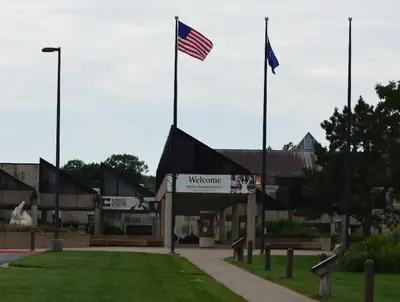
The Kansas Museum of History is one of the best places to begin understanding the state. Its galleries cover Kansas history from prehistoric times to the modern era across about 30,000 square feet of exhibits.
Large displays make the past tangible. Visitors can see an Atchison, Topeka and Santa Fe locomotive with two cars, enter a full-sized Southern Cheyenne-style tipi, and visit a 1950s diner. The museum also explores Native American tribal history, westward movement along the Oregon and Santa Fe trails, the lives of early settlers, Bleeding Kansas, the Civil War era, and the rise of Populism.
Cedar Crest
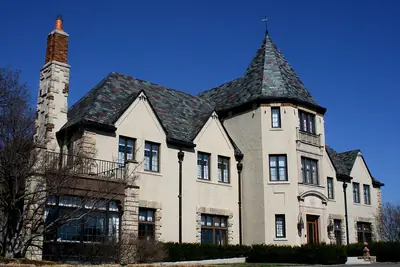
Cedar Crest is the official residence of the governor of Kansas. The mansion was built in 1928 as a private home and was bequeathed to the state in 1955. Since 1962, it has been home to Kansas governors and a setting for hosting important guests.
Its formal appearance reflects its role in the state’s civic life, while its history offers a glimpse into how a private residence became an official gubernatorial home.
Kansas Historical Society
The Kansas Historical Society is the state’s official historical society and is headquartered in Topeka. Its work extends beyond a single museum: it preserves and shares Kansas history through the Kansas Museum of History, the Kansas State Archives and Library, the Kansas State Capitol Tour Center, and 18 state-owned historic sites across Kansas.
For anyone planning what to see in Topeka, the society provides useful context for understanding the city’s place in the wider history of the state.
Brown v. Board of Education National Historical Park
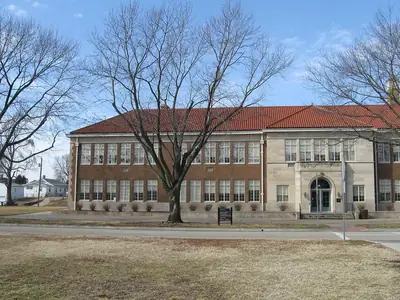
The Brown v. Board of Education National Historical Park commemorates one of the most significant turning points in American history. The park centers on Monroe Elementary School, one of four segregated elementary schools that served African American children in Topeka.
On May 17, 1954, the United States Supreme Court issued a unanimous ruling in Brown v. Board of Education, declaring that separate educational facilities are inherently unequal and that segregation in public schools violated the Fourteenth Amendment’s guarantee of equal protection under the law.
The case combined five school-segregation cases from different parts of the country: Brown, Briggs v. Elliott, Davis v. County School Board of Prince Edward County, Gebhart v. Belton, and another case connected with school segregation. The preserved school and its grounds allow visitors to experience the setting linked to this landmark legal decision.
Church of the Assumption and Rectory
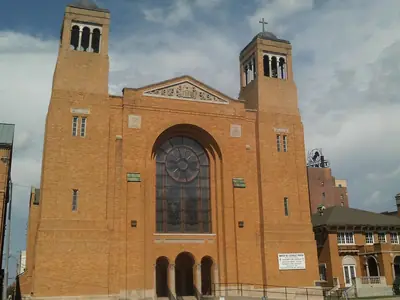
The Church of the Assumption and Rectory is a historic church complex at 204 Southwest 8th Street. The church was built in 1924, while the adjacent rectory was completed in 1929.
The rectory is a notable example of Renaissance Revival architecture. Together, the two buildings form a significant historic presence in Topeka and were recognized through the church’s listing on the National Register of Historic Places in 2008.
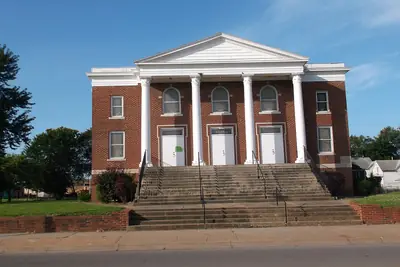
North Topeka Baptist Church
Built in 1921, North Topeka Baptist Church has been part of the community for more than a century. The building survived the major flood that affected much of the area in 1951 and was later added to the National Register of Historic Places in 2011.
Its history connects the architecture with the experiences of the North Topeka community over the decades.
St. John African Methodist Episcopal Church
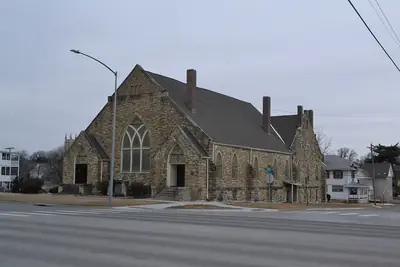
St. John African Methodist Episcopal Church stands out for its exterior of square-cut native limestone. Construction took place over nearly two decades, with stages completed in 1918, 1920, and 1926.
The church was listed on the National Register of Historic Places in 2008. Its carefully built stone façade and long construction history make it one of Topeka’s distinctive religious landmarks.
St. Joseph’s Catholic Church
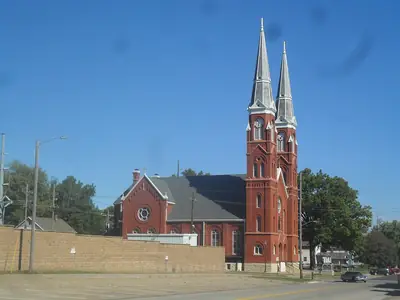
St. Joseph’s Catholic Church is a large 19th-century red-brick church associated with Topeka’s Volga German community. Its most striking feature is the pair of identical steeples, which rise above the surrounding buildings and change from square forms to octagons at clock level.
The church was added to the National Register of Historic Places in 1971 and is considered an outstanding Kansas example of its type.
Grace Episcopal Cathedral
Grace Episcopal Cathedral is the seat of the Episcopal Diocese of Kansas. Its importance comes not only from its architecture but also from its role in the religious life of the state.
As one of Topeka’s historic churches, it adds another layer to the city’s civic and cultural landscape.
Pottawatomie Baptist Mission Building
The Pottawatomie Baptist Mission Building is one of the oldest structures in Kansas and the only surviving building from the pioneering Baptist missions in the state. Built in 1849, it served Pottawatomie Native Americans who had been forcibly removed from the Ohio region along the Potawatomi Trail of Death in 1838 and relocated to a reservation on the Kansas River west of Topeka.
The three-story ashlar-stone building originally contained 12 rooms and 60 windows and doors. The mission operated for just over a decade before closing in 1861. It was later remodeled into a race horse barn, and today it is owned by the Kansas Historical Society and serves as a museum component.
Westminster Presbyterian Church of Topeka
Westminster Presbyterian Church was built between 1924 and 1926 and designed by architect Charles Cuthbert. Its Late Gothic Revival style is comparatively restrained, with a smoother appearance, minimal ornamentation, and little tracery.
The building was listed on the National Register of Historic Places in 2004. It is a good example of how Topeka’s historic churches represent different architectural interpretations of religious design.
Westboro Baptist Church
Westboro Baptist Church is associated with a small, unaffiliated Primitive Baptist congregation founded in 1955 by pastor Fred Phelps. The group became known for public protests against gay people and for hate speech directed at several communities, including atheists, Jews, Muslims, transgender people, and other Christian denominations.
Its protests at funerals, public events, sports games, and concerts made the group one of the most controversial religious organizations in the United States. The site is best understood in the context of Topeka’s modern social and political history.
Great Overland Station
Great Overland Station is a restored railway station that now serves as a museum. It is listed on the National Register of Historic Places under its original name, the Union Pacific Railroad Passenger Depot.
Built between 1925 and 1927 and designed by Gilbert Stanley Underwood, the station is a fine example of Neoclassical Revival architecture. Terra cotta features prominently in the design, while the façade is organized around a large central pavilion flanked by smaller pavilions, creating a symmetrical appearance.
Passenger service began in January 1927, and nearly 20,000 people attended the grand opening. The preserved building offers a direct connection with Topeka’s railway history.
Explore Topeka with Neywo
There are no scheduled tours or groups to join. Neywo’s free Topeka audio guide includes 13 narrated places, and each story plays as you reach the place, at your own pace, with no group and no schedule. Narration is available in 11 languages.
Download Neywo and turn your visit into a self-guided exploration of Topeka. The app tells the story of each place as you arrive, so you can move through the city independently and spend as much time as you like at its museums, churches, historic buildings, and heritage sites. Topeka’s audio guide is a simple way to discover the city while walking.
Places with an audio guide in Topeka
8 places in Topeka with a Neywo audio guide. Each one starts telling its story as you reach it.
Walk Topeka with Neywo
Neywo turns Topeka into a self-guided audio tour. Stories arrive as you reach the place they belong to, and the route reshapes when you wander off it.

