Things to Do in Wichita, United States: Walking Guide
Things to Do in Wichita: Museums, Aviation and Riverside History
Looking for things to do in Wichita? Kansas’s largest city brings together cattle-trail history, Indigenous heritage, aviation, railroads, art and science. Its museums and historic buildings reveal how Wichita developed from a frontier settlement into the “Air Capital of the World.” Neywo also offers a free audio guide for Wichita with 49 narrated places.
What to See in Wichita
Old Cowtown Museum
Old Cowtown Museum recreates life in a nineteenth-century cattle town on 23 acres beside the Arkansas River and the original Chisholm Trail. Its 54 buildings include a blacksmith shop, general store, saloon, working farm and homes furnished to reflect different moments in Wichita’s early history. Some structures are historic buildings moved for preservation; others were recreated to complete the frontier streetscape.
The site connects directly with Wichita’s cattle-driving past: the Chisholm Trail carried millions of longhorn cattle north from Texas toward Kansas railheads.
Wichita-Sedgwick County Historical Museum
Housed in Wichita’s former City Hall, the Wichita-Sedgwick County Historical Museum traces the city’s development through four floors of exhibits. The Romanesque Revival building was completed in 1890 and is marked by a clock tower and arched windows.
The collections cover Wichita’s early settlement, the Chisholm Trail and cattle trade, oil discoveries and the growth of the aircraft industry. The museum itself was founded in 1939 as the Wichita Public Museum.
Museum of World Treasures
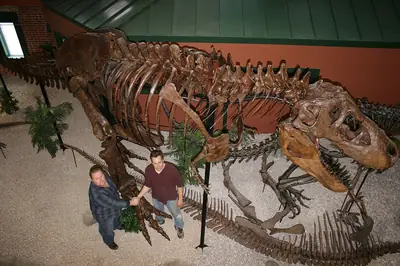
The Museum of World Treasures is a broad journey through natural and human history. Its first floor focuses on paleontology and geology, with dinosaur specimens including a Tyrannosaurus rex named Ivan, a Daspletosaurus and a Tylosaurus.
Other galleries explore ancient civilizations, military history, world leaders, royalty and American history. Egyptian mummies and a section of the Berlin Wall are among the collection’s notable objects.
Great Plains Transportation Museum
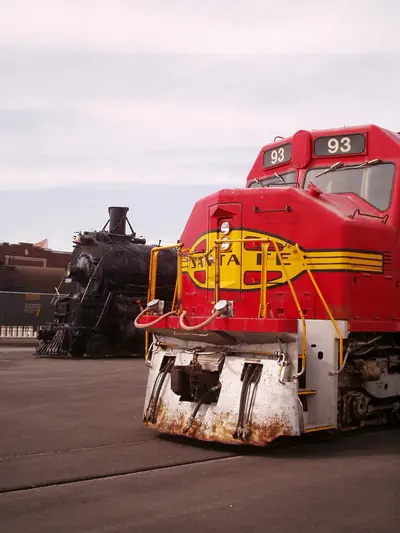
At the Great Plains Transportation Museum, railroad history is presented beside an active railroad line in downtown Wichita. The museum is home to the Kansas Railroad Hall of Fame and displays six locomotives outside.
Two standouts are a Santa Fe steam locomotive and a Santa Fe FP45 diesel, described as the last of their kind built for the Santa Fe Railway. Visitors can climb aboard several locomotives and cars, including the cabs, while the interior contains lanterns, tools, historic signs and a mechanical stoker mock-up.
Exploration Place
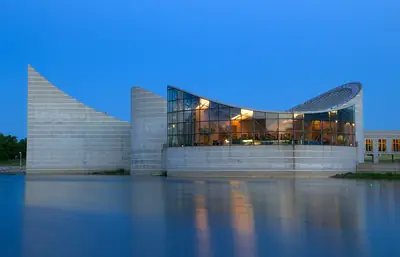
Exploration Place stands on the west bank of the Arkansas River in the Delano neighborhood. Designed by architect Moshe Safdie, the building has a distinctive futuristic profile, with its tallest point rising nearly 70 feet above the floor.
Its permanent exhibits focus on aviation, Kansas geography and health science. The center also hosts rotating exhibitions and has a dome theater with a 60-foot-high, 360-degree screen. The interior layout covers roughly a mile around its perimeter, making the building itself part of the experience.
The Keeper of the Plains and the riverside
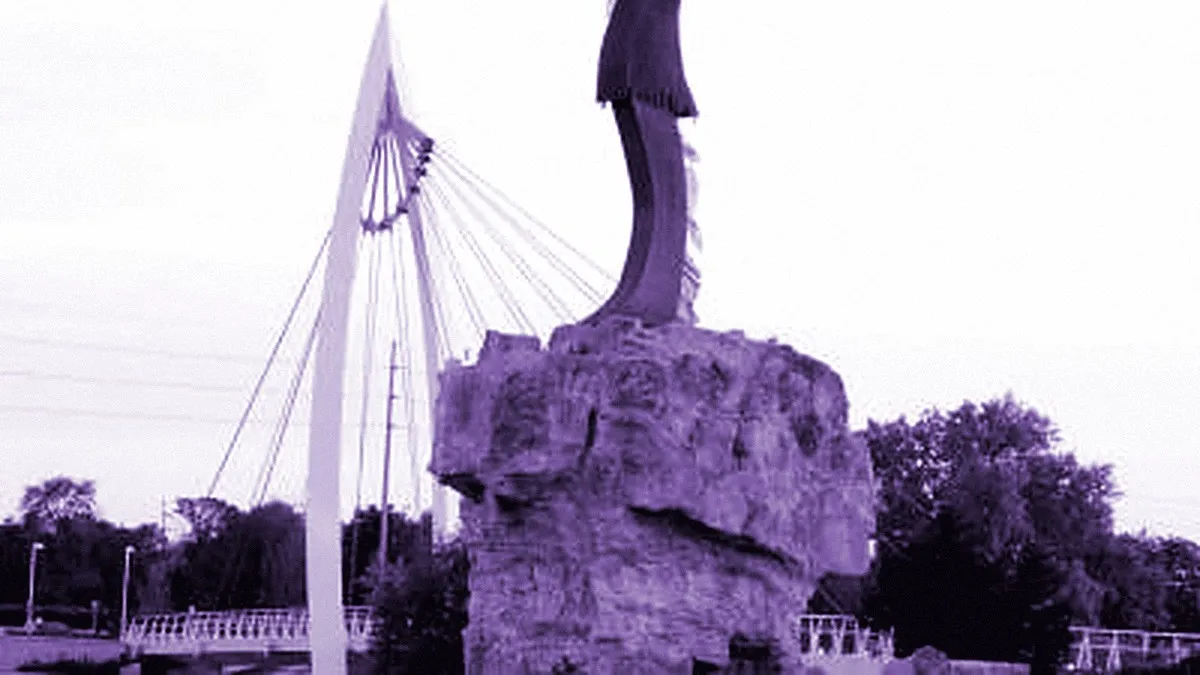
The Keeper of the Plains is one of Wichita’s defining landmarks. The sculpture stands beside the river and honors the region’s Indigenous heritage. The site is particularly striking after dark, when the surrounding flames are lit.
The Arkansas and Little Arkansas Rivers are central to Wichita’s geography and identity. To explore more of this area on foot, the Kansas region page provides a wider view of the state’s destinations.
Kansas Aviation Museum
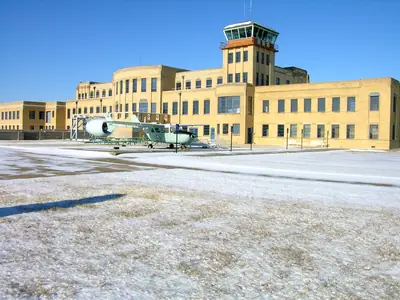
The Kansas Aviation Museum occupies Wichita’s former municipal airport terminal, an Art Deco building that opened in 1935. Designed by Glen H. Thomas, it served as the city’s airline terminal until 1954.
The preserved architecture reflects the optimism of the early aviation era, while the museum’s collection tells the story of Kansas’s major contribution to aircraft production and Wichita’s emergence as the “Air Capital of the World.” The building was added to the National Register of Historic Places in 1990 as the Administration Building.
B-29 Doc Hangar, Education and Visitors Center
At Eisenhower National Airport, the B-29 Doc Hangar, Education and Visitors Center combines a hangar, education space and visitors center devoted to aviation history. It adds another perspective to Wichita’s long relationship with aircraft and flight.
Allen-Lambe House
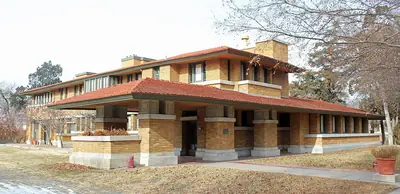
The Allen-Lambe House is one of Frank Lloyd Wright’s later Prairie Style masterpieces. Wright designed it in 1915 while also working on the Imperial Hotel in Tokyo, and Japanese influence can be seen in its horizontal lines, projecting roof and use of natural materials.
Its rust-colored brick contains iron. The house also incorporated an innovative residential firewall, as well as conveniences that were advanced for the period, including a central vacuum system, an alarm system and gas fireplace logs. Henry Justin Allen and his wife Elsie commissioned the house; Allen later served as governor of Kansas.
Wichita Art Museum
The Wichita Art Museum focuses on American art and holds more than 12,000 works by American painters, sculptors, potters and textile artists. Its galleries occupy a complex that has expanded several times since the first building opened in 1935.
The collection began with a trust left by Louise Caldwell Murdock in memory of her husband, Roland P. Murdock. The museum’s later expansions include a larger climate-controlled facility completed in 1977 and a further enlargement in 2003.
Ulrich Museum of Art
On the Wichita State University campus, the Edwin A. Ulrich Museum of Art presents modern and contemporary art. Its collection reflects changing artistic conversations from the mid-twentieth century to the present.
Kansas African American history at Calvary Baptist Church
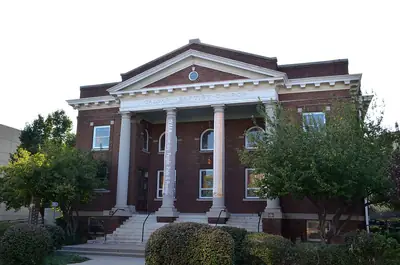
The historic lines of Calvary Baptist Church remain visible on North Water Street, while the building now houses the Kansas African American Museum. Calvary Baptist Church served Wichita’s Black community as a spiritual home and gathering place for generations.
Since 1997, the building has been the state’s premier repository of African American art, culture and history. Exhibitions and programming examine subjects including civil rights, community leadership, politics, education, arts and sports.
Kansas Firefighters Museum
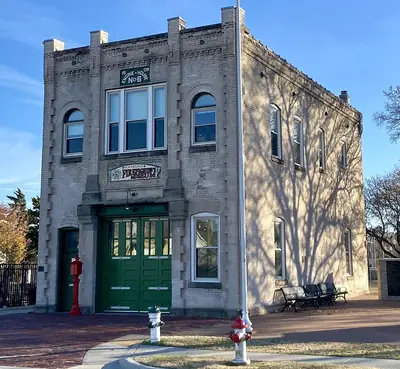
The Kansas Firefighters Museum is housed in Engine House Number Six, a 1909 firehouse that was Wichita’s last horse-drawn station. After operating until 1953, the building was saved and restored by local volunteers and reopened as a museum in 1994.
Inside are antique helmets and uniforms, original logbooks and dispatch equipment, steam-powered engines and early twentieth-century fire trucks. Visitors can see the former bunk rooms and stables, ring the old fire alarm and try on firefighting clothing.
Cathedral of the Immaculate Conception
The Cathedral of the Immaculate Conception, also known as St. Mary’s Cathedral, is the mother church of the Diocese of Wichita. Its Renaissance Revival design features a 135-foot central dome and twin towers. Granite columns at the entrance were salvaged from a former Chicago post office.
Inside, the dome depicts God the Father surrounded by seven stars, while the pendentives show the Four Evangelists. White marble, a decorated altar screen and stained-glass windows illustrating the Joyful and Glorious Mysteries of the Rosary complete the richly detailed interior.
Explore Wichita with Neywo
Neywo turns a visit into a Wichita self-guided walking tour: the app tells the story of each place as you reach it, at your own pace, with no group and no schedule. The Wichita audio guide includes five walking tours and one bus route, with narration available in 11 languages.
The walks include:
- Where the Rivers Meet: Wichita’s Riverside Culture Walk — 5.39 km, 119 minutes, 9 narrated stops.
- Old Town: Rails, Warehouses and Mansard Roofs — 1.07 km, 37 minutes, 5 stops.
- Downtown Wichita: Temples, Theatres and a Cathedral — 2.52 km, 77 minutes, 9 stops.
- Wright, Books and the Wichita State Campus — 5.63 km, 104 minutes, 5 stops.
- Boathouse to Engine House Six — 2.64 km, 57 minutes, 4 stops.
There is also the Route 17 Riverside-Waco-Twin Lakes: Downtown Landmarks bus route, covering 3 km in 13 minutes with 4 stops.
Download Neywo to explore Wichita as you move through it, combining the freedom of a free walking tour in Wichita with the context of a narrated guide. For more destinations in the country, continue with the United States page.
Places with an audio guide in Wichita
8 places in Wichita with a Neywo audio guide. Each one starts telling its story as you reach it.
Self-guided tours in Wichita
5 tours in Wichita, free in the Neywo app. Each stop tells its story as you reach it.
- Bus ride
Route 17 Riverside-Waco-Twin Lakes: Downtown Landmarks
Wichita Transit's route 17 runs through the downtown core. Ride it past a Gothic Revival five-and-dime, the Depression-era Federal Building, the cathedral under its 135-foot dome and the Scottish Rite Center's Romanesque arches.
Sutton Place · United States Post Office and Federal Building · Cathedral of the Immaculate Conception · Wichita Scottish Rite Center
Open this tour: Route 17 Riverside-Waco-Twin Lakes: Downtown Landmarks - Walk
Where the Rivers Meet: Wichita's Riverside Culture Walk
Begin at the Century II hall on the Arkansas River, then walk to the confluence of the Arkansas and Little Arkansas rivers beneath the Keeper of the Plains. Continue through Native American history, American painting under Chihuly glass, the cattle-town streets of Old Cowtown and a living museum of gardens, and end at a Scottish castle and a quiet city park.
Century II Performing Arts & Convention Center · Exploration Place · The Keeper of the Plains · Mid-America All-Indian Museum · Wichita Art Museum · Old Cowtown Museum …
Open this tour: Where the Rivers Meet: Wichita's Riverside Culture Walk - Walk
Old Town: Rails, Warehouses and Mansard Roofs
Wichita's brick warehouse district: a cinema among the Old Town cafes, the Keen Kutter hardware warehouse with its water tower, dinosaurs and mummies at the Museum of World Treasures, locomotives you can climb aboard, and the mansard-roofed Carey House.
Boulevard Theatres at Old Town · Keen Kutter Building · Museum of World Treasures · Great Plains Transportation Museum · Carey House
Open this tour: Old Town: Rails, Warehouses and Mansard Roofs - Walk
Downtown Wichita: Temples, Theatres and a Cathedral
Walk from the city's first City Hall past a Gothic five-and-dime and a vanished skyscraper hotel to the first atmospheric theatre in America, a Masonic temple, a cathedral under a 135-foot dome, a Depression-era post office, a Civil War monument crowned by Liberty and the Kansas African American Museum.
Wichita-Sedgwick County Historical Museum · Sutton Place · Lassen Hotel · Orpheum Theatre · Wichita Scottish Rite Center · Cathedral of the Immaculate Conception …
Open this tour: Downtown Wichita: Temples, Theatres and a Cathedral - Walk
Boathouse to Engine House Six
South of Century II: the hall where the Wurlitzer organ from New York's Paramount Theatre plays, the Kansas Sports Hall of Fame in the old Boathouse, a Classical Revival church and the 1909 horse-drawn firehouse that is now the Kansas Firefighters Museum.
Century II Performing Arts & Convention Center · Kansas Sports Hall of Fame · Grace Methodist Episcopal Church · Kansas Firefighters Museum
Open this tour: Boathouse to Engine House Six
Walk Wichita with Neywo
Neywo turns Wichita into a self-guided audio tour. Stories arrive as you reach the place they belong to, and the route reshapes when you wander off it.

