Visiting Baton Rouge, United States: Top Sights on Foot
Things to do in Baton Rouge: what to see in Louisiana’s capital
Baton Rouge is Louisiana’s capital, a Mississippi River city where political history, military heritage, university life, and ancient Native American sites come together. The city is worth visiting for its contrasting landmarks: a Gothic Revival “castle,” the tallest state capitol in the United States, historic churches, an intact World War II destroyer, and the richly designed campus of Louisiana State University. Neywo has a free audio guide for Baton Rouge with 41 narrated places, available in 11 languages.
For more context as you plan your trip, explore Louisiana and the wider United States.
What to see in Baton Rouge
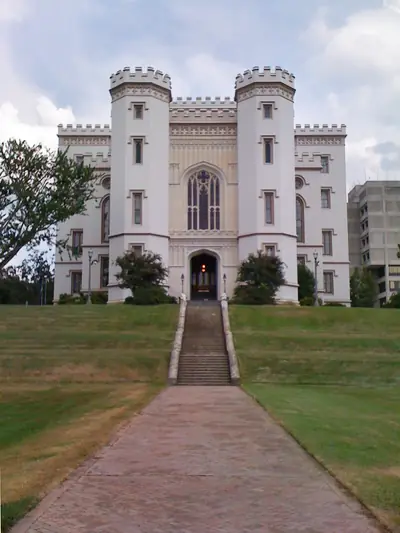
Old Louisiana State Capitol
The Old Louisiana State Capitol is one of Baton Rouge’s most distinctive landmarks. Built between 1847 and 1852, it was designed by James H. Dakin in the Gothic Revival style, with turrets and battlements that give it the appearance of a medieval fortress. The building stands on a bluff overlooking the Mississippi River.
Its history is as dramatic as its architecture. Union forces seized it during the Civil War and used it as a prison before it became a garrison for African-American troops. A fire in 1862 gutted the interior, but architect William A. Freret later rebuilt it and added a stained-glass dome.
Louisiana State Capitol
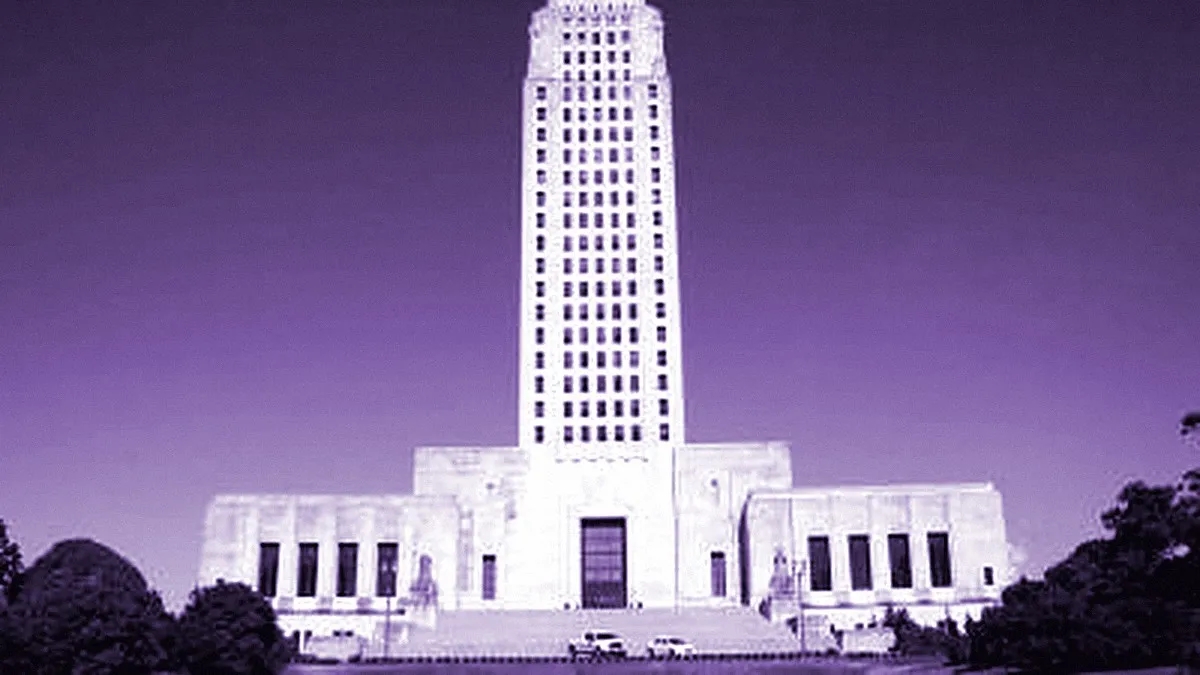
The modern Louisiana State Capitol offers a striking contrast. This 34-story Art Deco tower rises 450 feet above downtown Baton Rouge, making it the tallest state capitol in the country. Construction began in 1930 and finished two years later, following the efforts of former governor and U.S. senator Huey Long.
The exterior is covered with sculptures, reliefs, and friezes representing Louisiana’s history and notable figures. Four statues on the tower symbolize Art, Law, Philosophy, and Science. Inside, the Senate Chamber still contains a pencil driven into the ceiling by the force of a 1970 dynamite explosion.
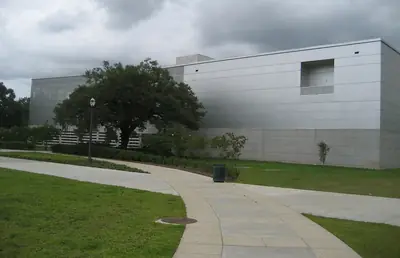
Capitol Park Museum
The Louisiana State Museum – Baton Rouge, also known as the Capitol Park Museum, sits at 660 North Fourth Street in the state capitol complex. Its permanent exhibitions follow Louisiana’s story from the lives of the region’s first inhabitants through colonization, industry, music, and the civil rights struggle.
The displays also explore the state’s industries and plantation economy. Among the objects are a 48-foot shrimp trawler and a two-row sugar cane harvester, giving the museum a particularly tangible approach to Louisiana’s past.
Pentagon Barracks
Pentagon Barracks occupies a historic site that has passed through French, British, Spanish, West Floridian, and American control. The surviving buildings were constructed between 1819 and 1825, according to Captain James Gadsden’s plan for five structures arranged around a central courtyard. Four remain today.
The two-story brick buildings face inward toward what was once a parade ground. Covered galleries were added in 1834, providing the complex with its characteristic columns and shaded walkways. The site served both Union and Confederate forces during the Civil War and remained a military post until 1879.
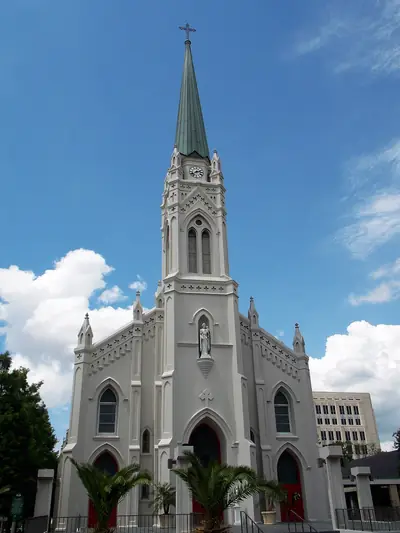
St. Joseph Cathedral
St. Joseph Cathedral is the mother church of the Diocese of Baton Rouge and the oldest church building still standing in the city. The parish began in 1792 as the Parish of Our Lady of Sorrows, serving a Spanish-speaking community, and later took the name St. Joseph as English became more common.
The present Gothic Revival building dates from 1853. Cannon fire damaged it during the Civil War, after which the original red brick was covered with stucco and a steeple was added. Later expansions brought stained-glass windows and a large mahogany crucifix sculpted by Croatian artist and architect Ivan Mestrovic.
St. James Episcopal Church
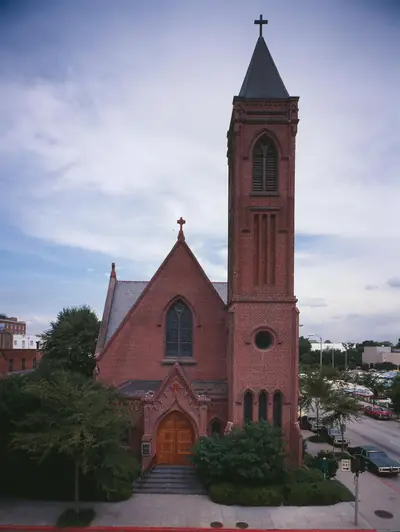
St. James Episcopal Church has stood in downtown Baton Rouge since before Louisiana became a state. Episcopalians first gathered on the site in 1819, while the congregation was formally organized in 1844 with important support from Margaret MacKall Taylor, the wife of President Zachary Taylor.
The church’s worship tradition also changed over time. It began as a Low Church parish during most of the nineteenth century before becoming a Broad Church parish in the early to mid-twentieth century.
Hilton Baton Rouge Capitol Center
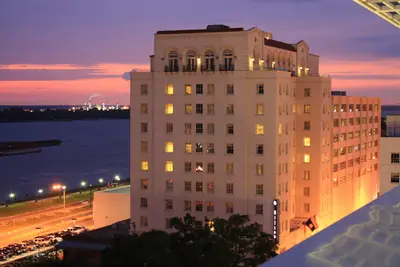
The Hilton Baton Rouge Capitol Center opened in 1927 as the Heidelberg Hotel and is listed on the National Register of Historic Places. The building was also recognized as a member of Historic Hotels of America. Its best-known long-term resident was Governor Huey Long, who maintained a fourth-floor suite during his political career.
The hotel has also hosted John F. Kennedy, Hubert Humphrey, Jimmy Carter, Will Rogers, and Fidel Castro. After closing in 1985, it stood largely empty for two decades before a 70-million-dollar restoration led to its reopening on August 30, 2006.
USS Kidd
The USS Kidd is a Fletcher-class destroyer that has rested on the Mississippi River in Baton Rouge since 1982. Launched in February 1943, it was named for Rear Admiral Isaac C. Kidd, who was killed on the bridge of the USS Arizona during the attack on Pearl Harbor on December 7, 1941.
The ship served in the Pacific during World War II, screening carriers, bombarding shore targets, and rescuing downed aviators. It later served in the Korean War before being decommissioned in June 1964. Because it was never modernized, the USS Kidd preserves the appearance of a World War II destroyer and functions as a remarkable historical time capsule.
Magnolia Cemetery
Magnolia Cemetery is a ten-acre historic cemetery in central Baton Rouge. The city acquired the land in August 1852, but its most defining episode came during the Battle of Baton Rouge on August 5, 1862, when Union and Confederate forces fought among its tombstones and pathways.
A commemorative ceremony is held there every August to remember the battle and those affected by it.
Baton Rouge National Cemetery
Baton Rouge National Cemetery has held burials since as early as 1830. During and after the Civil War, soldiers who died in Baton Rouge and nearby battles, including Plaquemine and Camden, were buried here. The site became an official United States National Cemetery in 1867.
The cemetery covers 7.7 acres and contains more than 5,000 interments.
Beauregard Town
Beauregard Town is the second-oldest neighborhood in Baton Rouge, after Spanish Town. Elias Beauregard commissioned its layout in 1806, asking Arsène Lacarrière-Latour to organize the plantation in what he called the Grand European Manner.
Government Street runs through the district as its central axis, while four diagonal streets cross it to form a large X. Other streets bear the names of rulers, countries, and continents. The neighborhood’s boundaries are North Boulevard, South Boulevard, East Boulevard, and Saint Louis Street. It was added to the National Register of Historic Places in 1980.
Louisiana State University
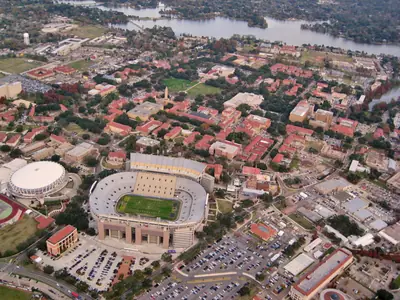
Louisiana State University occupies a 650-acre plateau beside the Mississippi River. Its roots reach back to 1860, when it opened near Pineville as the Louisiana State Seminary of Learning and Military Academy. The institution moved to Baton Rouge in 1870, and the current main campus was dedicated in 1926.
More than 250 buildings share a unified architectural style inspired by the Italian Renaissance architect Andrea Palladio. LSU is also an R1 doctoral university with very high research activity. Its sports identity is represented by Mike the Tiger, the live mascot of the LSU Tigers.
LSU Campus Mounds
The LSU Campus Mounds, also called the LSU Indian Mounds, are two ancient Native American earthworks on the university grounds. They belong to the Archaic Period and rise about 20 feet above the surrounding land. Together, they cover approximately two acres.
Construction began more than 11,000 years ago, making them among the oldest surviving human-made structures in the Americas. Built on high ground overlooking the Mississippi River, the mounds served ceremonial purposes and were places for rituals and community gatherings.
Explore Baton Rouge with Neywo
Neywo offers three walking tours and one bus route in Baton Rouge:
- The Castle, the Cathedral and the Capitol: a 3.45 km walk lasting 114 minutes, with 11 narrated stops.
- Spanish Town, Beauregard Town and the Red Stick Streets: a 3.37 km walk lasting 81 minutes, with 7 narrated stops.
- LSU: Palladian Quads, Ancient Mounds and a Live Tiger: a 3.47 km walk lasting 84 minutes, with 7 narrated stops.
- Downtown Baton Rouge by Bus 22: a 14.3 km bus route lasting 61 minutes, with 6 narrated stops.
Download Neywo and explore Baton Rouge at your own pace. The app tells the story of each place as you reach it, with no group and no schedule.
Places with an audio guide in Baton Rouge
8 places in Baton Rouge with a Neywo audio guide. Each one starts telling its story as you reach it.

Self-guided tours in Baton Rouge
4 tours in Baton Rouge, free in the Neywo app. Each stop tells its story as you reach it.
- Bus ride
Downtown Baton Rouge by Bus 22
CATS route 22 runs along Winbourne Avenue into the heart of downtown, passing the city's oldest church, the Main Street and Third Street historic districts and the old Yazoo and Mississippi Valley depot, now the Louisiana Art and Science Museum. A cheap, easy way to see the historic core with a stop at Spanish Town on the way.
St. Joseph Cathedral · St. James Episcopal Church · Spanish Town · Main Street Historic District · Yazoo and Mississippi Valley Railroad Company Depot · Downtown Baton Rouge Historic District
Open this tour: Downtown Baton Rouge by Bus 22 - Walk
The Castle, the Cathedral and the Capitol
Climb from a World War II destroyer on the Mississippi to the Gothic Revival 'castle' that gave Louisiana its first seat of government. Then walk up through downtown past a Huey Long hotel, Baton Rouge's oldest church and a fire station dressed as a cathedral, to the Pentagon Barracks and the tallest state capitol in the United States.
USS Kidd · Yazoo and Mississippi Valley Railroad Company Depot · Old Louisiana State Capitol · Shaw Center for the Arts · Hilton Baton Rouge Capitol Center · Central Fire Station …
Open this tour: The Castle, the Cathedral and the Capitol - Walk
Spanish Town, Beauregard Town and the Red Stick Streets
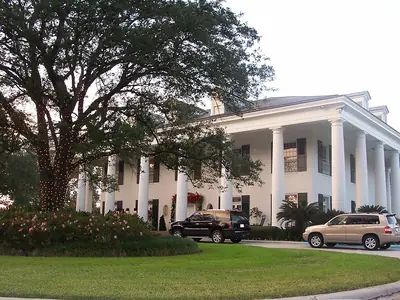
A walk through the neighbourhoods where Baton Rouge was planned and lived. Start in Spanish Town, the oldest quarter, cross the commercial streets of old downtown and the site of a lost movie palace, then follow Beauregard's grand X of diagonal streets to the Lincoln Theater and its Black history hall.
Spanish Town · Main Street Historic District · Downtown Baton Rouge Historic District · Paramount Theatre · Old Louisiana Governor's Mansion · Beauregard Town …
Open this tour: Spanish Town, Beauregard Town and the Red Stick Streets - Walk
LSU: Palladian Quads, Ancient Mounds and a Live Tiger
Louisiana State University is a sight on its own: a campus of Italian Renaissance buildings, a campanile built for World War I's fallen, a tiger habitat, and two earthen mounds more than eleven thousand years old. A flat, shaded walk across the quad from the field house to the law school and the theatre called Swine Palace.
Louisiana State University · Swine Palace · Paul M. Hebert Law Center · Memorial Tower · LSU Campus Mounds · Huey P. Long Field House …
Open this tour: LSU: Palladian Quads, Ancient Mounds and a Live Tiger
Walk Baton Rouge with Neywo
Neywo turns Baton Rouge into a self-guided audio tour. Stories arrive as you reach the place they belong to, and the route reshapes when you wander off it.

