Things to Do in Worcester, United States: Walking Guide
Things to Do in Worcester, Massachusetts
Worcester is a Massachusetts city with a rich industrial history, striking historic architecture, museums, parks, and cultural landmarks. The best things to do in Worcester include exploring its historic houses, discovering former manufacturing sites, visiting major art and science collections, and walking through neighborhoods shaped by the city’s growth. Neywo offers a free audio guide for Worcester with 99 narrated places.
What to See in Worcester
From downtown landmarks to quiet residential streets, these are some of the most interesting places to include in a visit.
Salisbury Mansion and Store
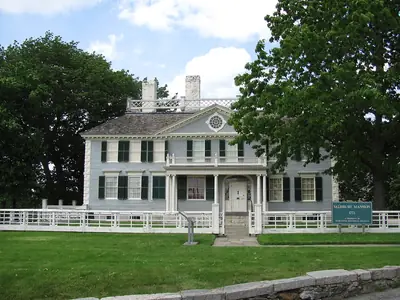
Salisbury Mansion is Worcester’s only historic house museum. Built in 1772 by merchant Stephen Salisbury, the building originally combined a family residence with a store. The commercial space later became part of the home, and the entire structure was eventually moved from Lincoln Square to Highland Street.
The mansion has been restored to reflect its appearance in the 1830s, when Elizabeth Tuckerman Salisbury lived there. Original furnishings, period decoration, and family documents help explain how a prominent Worcester household lived through more than two centuries of change.
Mechanics Hall
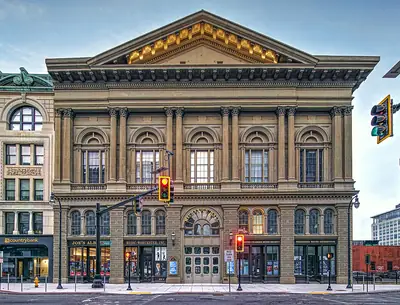
Mechanics Hall has stood on Main Street since 1857 and is one of Worcester’s most important architectural and cultural landmarks. Its Renaissance Revival design reflects the ambitions of the Worcester Mechanics Association, an organization founded to help mill workers develop technical skills.
The third-floor concert hall is especially notable for its acoustics. Charles Dickens and Susan B. Anthony appeared here, while performers including Enrico Caruso, Ella Fitzgerald, Yo-Yo Ma, and Mel Tormé have also taken the stage. The building combined education, meetings, culture, and music in a way that reflected Worcester’s industrial society.
Union Congregational Church
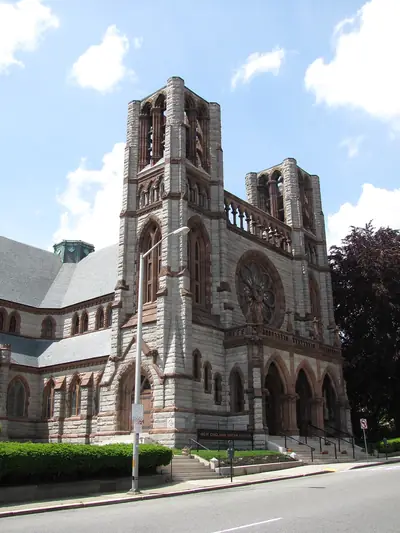
Union Congregational Church, also known as Chestnut Street Congregational Church, is a Victorian Gothic Revival landmark dating from 1895 to 1897. Its facade features twin towers, three trefoil arches, a large rose window, and an arcade connecting the towers.
Crenellations and gargoyles give the upper levels a medieval character, while the slate roof and pointed-arch openings complete the Gothic impression. Designed by Stephen C. Earle and C. Fisher, the church was listed on the National Register of Historic Places in 1980.
Worcester Art Museum
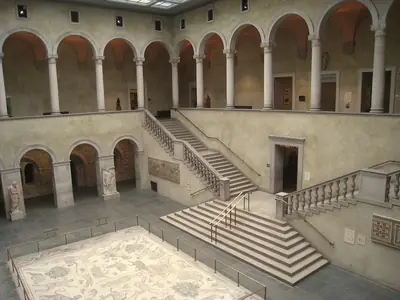
The Worcester Art Museum has welcomed visitors since 1898 and holds more than 38,000 works dating from antiquity to the present. Its collection ranges from Roman mosaics and European masterpieces to American paintings and Japanese prints.
The museum is also home to the second-largest collection of arms and armor in the Americas, following the acquisition of the John Woodman Higgins Armory Collection in 2013. Its history includes early support for photography as an art form and the acquisition of works by Monet and Gauguin. Inside the galleries, the Chapter House offers an unusual experience: a medieval architectural space brought into the museum in 1932.
Bancroft Tower
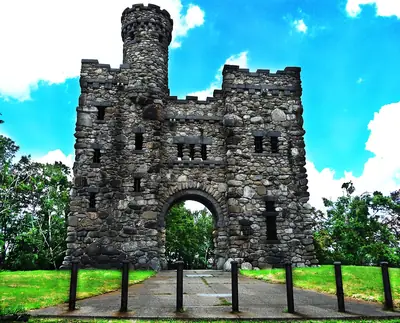
Bancroft Tower rises 56 feet above Salisbury Park in the form of a miniature stone castle. Built in 1900, it is a folly—a structure created for beauty and commemoration rather than defense or everyday use.
Stephen Salisbury the Third gave the tower to honor his friend George Bancroft. Designed by Stephen C. Earle and C. Fisher, it uses a Romanesque style with granite walls, rounded arches, and a rugged silhouette. Its setting in a city park makes it one of Worcester’s most distinctive landmarks.
Crompton Loom Works
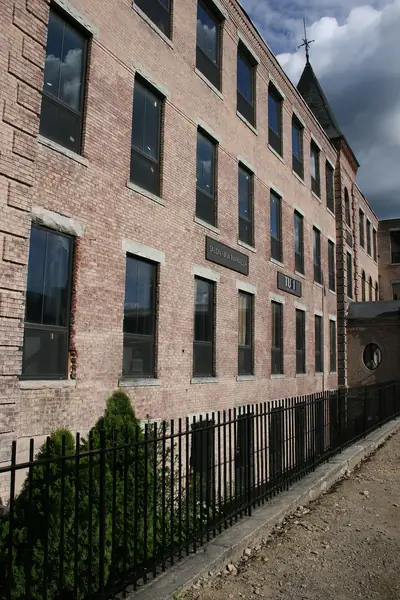
The Crompton Loom Works is one of Worcester’s oldest surviving industrial sites. The connected brick buildings date from 1860 and were established by George Crompton, whose business developed from his father William’s invention of the first power loom for weaving fancy fabrics.
The company became one of Worcester’s major employers, producing looms into the 1960s. The complex later supported machining, forging, iron casting, woodworking, pattern making, materials testing, and the manufacture of can-packaging machines and bowling pinsetters. Its connected one- to three-story brick buildings are an important example of industrial Italianate architecture.
EcoTarium
The EcoTarium is an indoor-outdoor museum of science and nature set on 60 acres. Its attractions include the Alden Planetarium, a narrow-gauge railway pulled by a working scale model of an 1860s steam locomotive, and habitats for native and exotic animals.
The institution began in 1825 as the Worcester Lyceum of Natural History. After moving between several locations, it established its permanent home on donated land in 1971. The combination of science exhibits, nature, wildlife, and outdoor exploration makes it one of the city’s most varied museums.
Elm Park
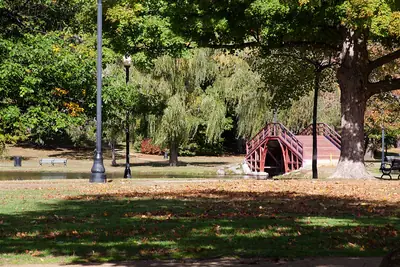
Elm Park is among the earliest municipal parks in the United States. Worcester purchased the land in 1854, when it was still pasture. The Olmsted Brothers redesigned the grounds in 1909 and returned in the late 1930s to add further improvements.
The park’s pond and two footbridges are among its most recognizable features. The Newton Hill section, added after the city acquired the land in 1888, has a wilder character, with walking trails, basketball courts, and tennis courts. Elm Park was listed on the National Register of Historic Places in 1970.
Worcester Historical Museum
The Worcester Historical Museum is the only institution in the area devoted entirely to local history. Founded in 1875 as the Worcester Society of Antiquity, it has collected and preserved the city’s story for nearly 150 years.
Its permanent and temporary exhibitions cover the colonial era through the twentieth century. Manuscripts, textiles, paintings, and ceramics form part of the collection, while the research library contains more than 7,000 titles.
Cathedral of Saint Paul
The Cathedral of Saint Paul is the mother church of the Roman Catholic Diocese of Worcester and one of the city’s finest Victorian Gothic buildings. Construction began in 1868 and was completed in 1889.
Rock-faced granite gives the cathedral a powerful exterior, joined by a tall square tower, a gabled nave end, and a smaller tower with a round turret. Gothic-arched entrances and tall windows bring light into the interior. The building measures 168 feet in length, 91 feet across, and 96 feet at its highest point.
Masonic Temple
The Worcester Masonic Temple on Ionic Avenue is a grand example of Classical Revival architecture. Its facade is organized around eight tall Ionic columns, four on each side of the central entrance—an arrangement associated with the name of the street.
The building contains several distinct interior spaces: a drill hall and banquet hall on the ground floor, a Grecian chamber on the second level, an Egyptian chamber on the third, and a Gothic chapel. Construction began in 1913, and the temple was dedicated in 1914.
More historic buildings to look for
Worcester’s architectural interest continues beyond its major museums and monuments. The Abbott Street School, built in 1894, is a Romanesque Revival building that served local families until 1981 before becoming residential apartments.
The Amos Flagg House, built around 1748, is one of the city’s rare surviving colonial-era structures. The Armsby Block, built in 1885 by architect Stephen Earle, preserves a Victorian Panel Brick facade above a mixed-use arrangement of shops and residences.
The Bancroft Hotel, opened in 1913 and expanded in 1929, is a ten-story Beaux Arts landmark with brick, terracotta, stone, and a marble arcade. Today it has been converted into luxury residences known as Bancroft on the Grid, while retaining its historic exterior.
Explore Worcester with Neywo
Download Neywo to explore Worcester with a self-guided audio tour at your own pace. The app includes 5 walking tours and 1 bus route, covering routes from 1.32 to 7.4 km and lasting from 32 to 96 minutes, with 8 to 12 narrated stops per tour. Narration is available in 11 languages.
Choose a walk through Worcester Common, follow Main Street’s story of money, music, and mills, explore Salisbury’s Hill, visit the mansions around Harvard and Elm Street, or discover the Canal District’s industrial heritage. You can also take the bus route between Harvard Street, Union Station, and Highland Street.
Neywo tells the story of each place as you reach it, at your own pace, with no group and no schedule. It is a practical way to connect Worcester’s museums, churches, parks, mansions, and former factories while exploring independently.
Worcester is part of Massachusetts in the United States. For more city ideas in the region, continue to Boston or explore Salem, Massachusetts.
Places with an audio guide in Worcester
8 places in Worcester with a Neywo audio guide. Each one starts telling its story as you reach it.
Self-guided tours in Worcester
6 tours in Worcester, free in the Neywo app. Each stop tells its story as you reach it.
- Bus ride
Route 3: Harvard Street to Union Station and Highland Street
A regular WRTA city bus that threads Worcester's mill-baron mansions on Harvard Street, the Common, the 1911 Union Station, Main Street's churches, a rock palace and the Salisbury house on Highland Street. A cheap way to see how the city fans out from its rail hub.
Otis Putnam House · Union Congregational Church · Soldiers' Monument (Worcester, Massachusetts) · Union Station · St. John's Catholic Church · Church of Our Savior, Worcester …
Open this tour: Route 3: Harvard Street to Union Station and Highland Street - Walk
Worcester Common: Where the Revolution Was Read Aloud
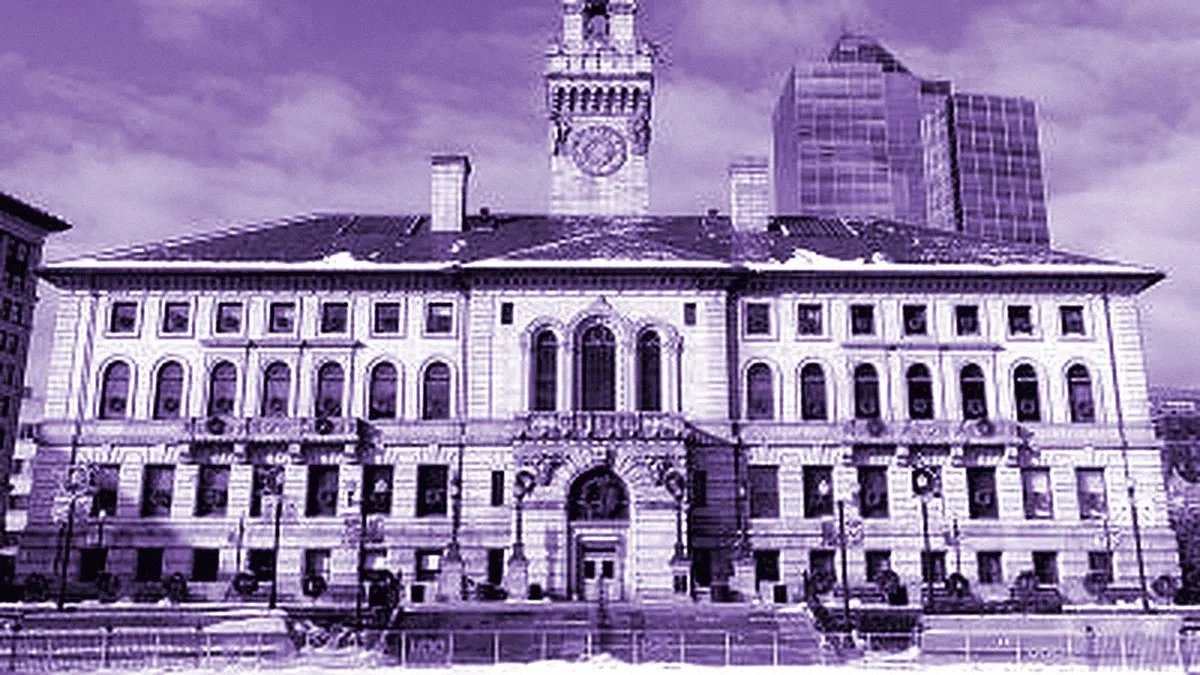
Start at the Renaissance Revival City Hall, where New England first heard the Declaration of Independence. Circle the Common past a Minute Man's monument, a soaring Civil War column and the famous Turtle Boy fountain, then climb through downtown past the Hanover Theatre, an early skyscraper and a glass tower to a Beaux Arts hotel, a Victorian Gothic cathedral, a columned Masonic temple and the only Norman church in town.
Worcester City Hall and Common · Bigelow Monument · Soldiers' Monument (Worcester, Massachusetts) · Burnside Fountain · Worcester Public Library · Bancroft Hotel …
Open this tour: Worcester Common: Where the Revolution Was Read Aloud - Walk
Main Street Money, Music and Mills
Worcester's Main Street is a lesson in how a mill city got rich and spent it well. See a Victorian brick block, the first Armenian church in the Americas, a Second Empire bank, the world-famous acoustics of Mechanics Hall and a granite savings bank, a legendary rock palace, then the Historical Museum and a Gothic Revival church with twin towers.
Armsby Block · Church of Our Savior, Worcester · Worcester Palladium · Old State Mutual Building · Mechanics Hall · WCIS Bank …
Open this tour: Main Street Money, Music and Mills - Walk
Salisbury's Hill: Art, Mansions and Monuments
The north end belonged to the Salisbury family, and their legacy is a cluster of cultural landmarks. Start at the war memorial arena and a bronze general on horseback, walk past Victorian mansions to the 1772 house that started it all, then take in a women-designed concert hall and a world-class art museum. Finish with a Tudor Revival house, the national library of America's printed past and a miniature castle on the hill.
Worcester Memorial Auditorium · Equestrian statue of Charles Devens · Whitcomb Mansion · Salisbury House · Salisbury Mansion and Store · Tuckerman Hall …
Open this tour: Salisbury's Hill: Art, Mansions and Monuments - Walk
Harvard and Elm Street: Mansions of the Mill Barons
West of downtown, Worcester's industrialists and governors built their houses side by side. See a Greek Revival governor's house, an Italianate and a Second Empire mansion, a Queen Anne brick home and a remodelled carpet-magnate villa, then end in Elm Park, one of the first public parks in America.
Henry Goulding House · Otis Putnam House · Jerome Marble House · Gov. Levi Lincoln House · Charles Allen House · William Hogg House …
Open this tour: Harvard and Elm Street: Mansions of the Mill Barons - Walk
Canal District: Looms, Boots and Envelopes
Worcester's industrial birthplace along the old Blackstone Canal. Start at the grand 1911 Union Station, then walk past the oldest Catholic parish in New England, brick shoe and envelope factories, a former synagogue and the loom works that powered the city, to Kelley Square and the ballpark that is rebuilding the district.
Union Station · St. John's Catholic Church · Harding-Winter Street Manufacturing District · Shaarai Torah Synagogue · Goldberg Building · Crompton Loom Works …
Open this tour: Canal District: Looms, Boots and Envelopes
Walk Worcester with Neywo
Neywo turns Worcester into a self-guided audio tour. Stories arrive as you reach the place they belong to, and the route reshapes when you wander off it.

