What to See in Nancy, France: Free Audio Guide
Things to Do in Nancy: What to See in the City
The best things to do in Nancy include exploring Place Stanislas and the other royal squares, discovering the city’s Art Nouveau architecture, and following the historic gateways and churches of the Old Town. Nancy brings together eighteenth-century urban design, Lorraine’s ducal heritage, and the creative work of the École de Nancy. Neywo offers a free audio guide for Nancy with 128 narrated places, available in 11 languages.
Nancy is in Grand Est, in northeastern France, and its most memorable sights are close enough to connect in a series of walks. From monumental squares to intimate historic buildings and experimental modern houses, the city rewards travellers who take time to look closely.
What to See in Nancy
Place Stanislas and Nancy’s royal squares
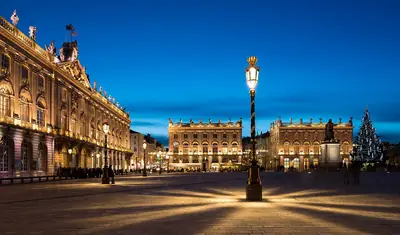
Place Stanislas is Nancy’s defining landmark: a grand pedestrian square created in the eighteenth century at the request of Stanislas Leszczyński, Duke of Lorraine. Architect Emmanuel Héré directed its construction, and the square has carried its present name since 1831.
The square measures about 106 by 124 metres, but its impact comes from the unity of the surrounding architecture rather than its dimensions. Its monumental design helped connect two neighbourhoods that had previously been independent, creating a more coherent urban centre.
Place Stanislas forms part of Nancy’s UNESCO World Heritage ensemble with Place de la Carrière and Place d’Alliance. Place d’Alliance offers a quieter contrast, with a central fountain, two rows of lime trees, and elegant town houses arranged around a restrained classical design.
Nancy Cathedral
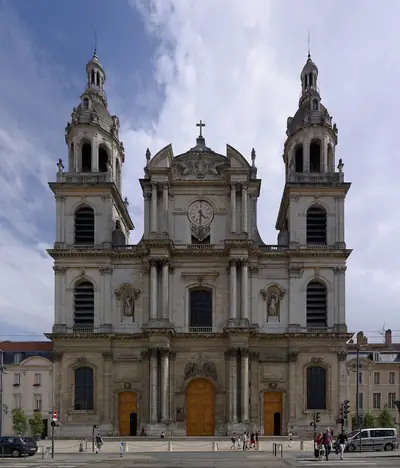
Nancy Cathedral, officially the Cathedral of Our Lady of the Annunciation and Saint Sigisbert, is an eighteenth-century Baroque church and one of the city’s principal landmarks. It is the seat of the Bishop of Nancy and Toul and has been protected as a historic monument since 1906.
The cathedral is dedicated to the Virgin Mary and Saint Sigisbert. King Sigebert III of Austrasia was buried here, and after his canonisation the building became a place of pilgrimage. Its Baroque architecture gives it a distinctive presence among Nancy’s historic buildings.
Villa Majorelle and the École de Nancy
Nancy is closely associated with Art Nouveau, particularly through the École de Nancy, a movement that brought together architects, designers, glassmakers, and furniture makers. Their work is visible in façades, interiors, furniture, ceramics, and glass across the city.
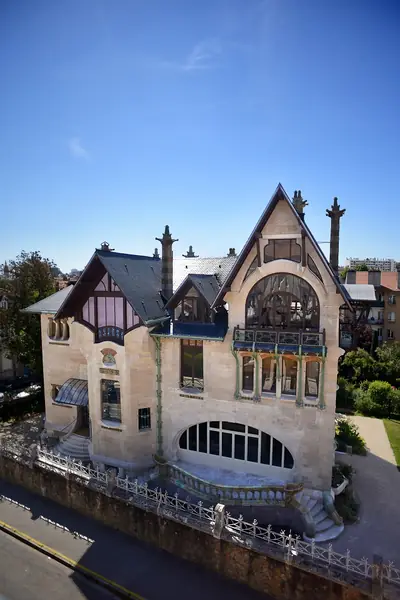
Villa Majorelle is one of the movement’s most important houses. Built between 1901 and 1902, it was designed by Henri Sauvage, with interiors and decoration involving artists such as ceramist Alexandre Bigot and stained-glass artist Jacques Gruber. Formerly known as Villa Jika, the house was conceived as a complete artistic setting in which architecture, furniture, ceramics, and glass work together.
For a broader introduction to Nancy’s Art Nouveau heritage, the city’s dedicated museum is included in Neywo’s Art Nouveau route, along with the Immeuble Lombard, L’Excelsior, Maison Houot, and other buildings associated with the movement.
The Old Town and the Church of Saint-François-des-Cordeliers
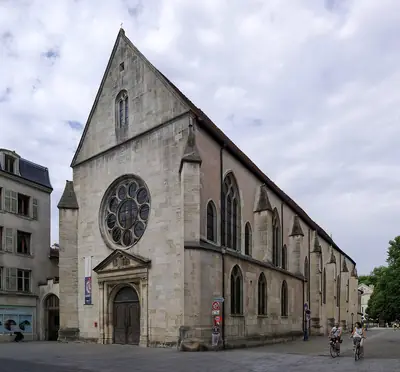
The Church of Saint-François-des-Cordeliers stands beside the former Palace of the Dukes of Lorraine in Nancy’s Old Town. Since 1743, it has housed the tombs of the Dukes of Lorraine, giving the church a particularly close connection with the city’s ducal history.
The adjoining convent buildings now form part of the Musée Lorrain, while the church remains in use for worship as part of the Saint-Epvre parish. The chapel containing the ducal tombs has been protected as a historic monument since 1840, with additional protections added in 1945 and 2005.
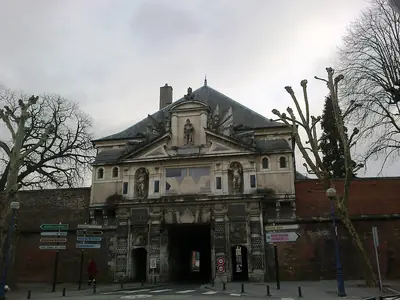
Porte de la Citadelle
Porte de la Citadelle is a Renaissance-style gateway marking the boundary between the Ville-Vieille, or Old Town, and the Faubourg des Trois Maisons. Its position makes it a useful point for understanding how Nancy’s historic areas connect.
The gateway is close to Porte de la Craffe and features on Neywo’s walk through the city’s ducal heritage.
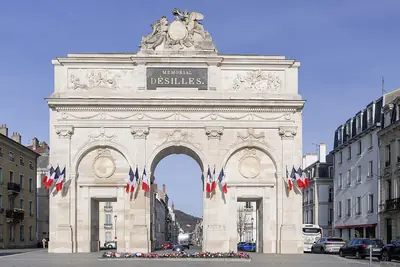
Porte Désilles
At the northern end of Cours Léopold, Porte Désilles forms a triumphal arch at the western edge of the Old Town. Built between 1782 and 1784 to designs by Didier-Joseph-François Mélin, it is considered the oldest war memorial in France.
The monument commemorates citizens of Nancy who died during the American Revolutionary War, particularly at the Siege of Yorktown in 1781. Its position was chosen both to close the view along Cours Léopold and to open a route towards the Route de Metz. Before taking its current name, the gateway was known as Porte Saint-Louis and Porte Stainville.
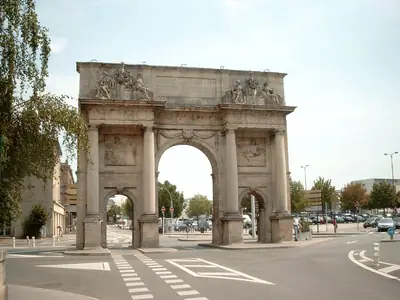
Porte Stanislas
Porte Stanislas marks the western end of Rue Stanislas, at the boundary between the old and new parts of the city. Commissioned in 1761 by Duke Stanislaus I Leszczyński, it was dedicated to Saint Stanislaus of Krakow.
Architect Richard Mique designed the gateway as a Doric triumphal arch inspired by the Arch of Constantine in Rome. Flat reliefs decorate the attic, while statues continue the vertical lines of the columns. During the French Revolution, it was briefly called Porte de la Montagne; that name remains visible in an inscription on the attic.
Nancy’s other historic gateways
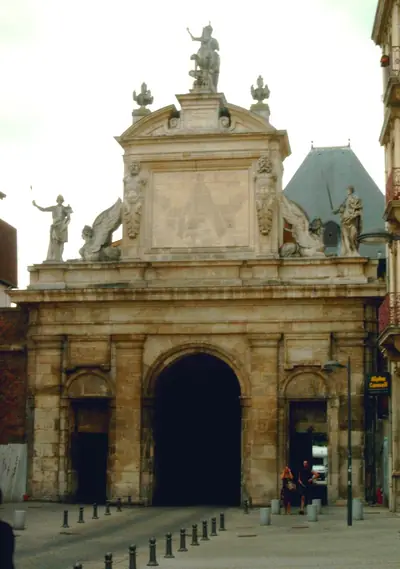
Several other gateways help reveal the shape of Nancy’s historic city. Porte Saint-Georges stands at the eastern edge of the Ville-Neuve and was erected at the beginning of the seventeenth century. Porte Sainte-Catherine, built in the eighteenth century, is another reminder of the city’s past.
Together with Porte Désilles and Porte Stanislas, these monuments make Nancy particularly rewarding to explore on foot. Their locations connect different neighbourhoods while showing how the city expanded and changed over time.
Synagogue of Nancy
The Synagogue of Nancy stands at 17 Boulevard Joffre. Designed by Augustin Charles Piroux and built in the late eighteenth century, it is described as the second-oldest synagogue in the former Kingdom of France still in service. Only the synagogue in Lunéville is older, and it was also designed by Piroux.
The building was enlarged in 1841 and 1861, while its present façade was created by Alfred Thomas in 1935. The façade is larger than the building behind it, giving the synagogue an imposing appearance. It was listed as a historic monument in 1984 and remains an important witness to Nancy’s Jewish history.
Jean Prouvé House
The Jean Prouvé House presents a different side of Nancy’s architectural heritage. Built in 1954 as a home for Jean Prouvé and his family, it was also a personal experiment in modern architecture and family living.
The house belongs to the International Style, contemporary architecture, and the Modern Movement. The city acquired it in 1990, and it has been administered by the Musée des beaux-arts de Nancy since 2013. It is open to visitors as a museum from June to September.
Churches of Nancy
Nancy’s churches reflect several periods of architecture and history. Notre-Dame-de-Bonsecours was designed by Emmanuel Héré and built in the eighteenth century. Its façade includes a clock tower and a stone relief bearing the coat of arms of the Polish-Lithuanian Commonwealth. It was once the resting place of Stanisław Leszczyński, the Polish king who was also the last duke of Lorraine.
Saint Epvre Basilica is a nineteenth-century landmark in Rayonnant Neo-Gothic style. Built by Prosper Morey in Euville stone, it is dedicated to Saint Aper, bishop of Toul, whose relics are preserved in a shrine on the high altar. The basilica has the title of minor basilica and has been listed as a historic monument since 1999.
Saint-Sébastien Church stands in the Neustadt. It was built in Nancy during the sixteenth century and is also described as a Baroque parish church, combining early origins with the architectural character associated with it today.
Explore Nancy with a Free Audio Guide
Neywo has five walking tours and one bus route in Nancy, covering 128 narrated places in total. Each story plays as you reach the place, at your own pace, with no group and no schedule.
The walks include:
- Place Stanislas and the Royal Squares: 2.08 km, 103 minutes, 10 narrated stops.
- Dukes of Lorraine: The Old Town: 1.91 km, 96 minutes, 10 narrated stops.
- Art Nouveau: The School of Nancy: 2.74 km, 102 minutes, 10 narrated stops.
- Triumphal Arches and Place Maginot: 2.07 km, 95 minutes, 10 narrated stops.
- Parc de Saurupt: Villas of the Belle Epoque: 1.41 km, 55 minutes, 7 narrated stops.
- Line 11: Art Nouveau by Bus: 4.1 km, 18 minutes, 8 narrated stops.
Download Neywo and explore Nancy independently: the app tells the story of each place as you reach it, so you can follow the city’s history and architecture at your own pace, without a group or a schedule.
Places with an audio guide in Nancy
8 places in Nancy with a Neywo audio guide. Each one starts telling its story as you reach it.
Self-guided tours in Nancy
6 tours in Nancy, free in the Neywo app. Each stop tells its story as you reach it.
- Bus ride
Line 11: Art Nouveau by Bus
A regular Keolis Grand Nancy bus that threads the Art Nouveau district: the Lourdes basilica, the Musée de l'École de Nancy, Art Nouveau houses on Avenue Foch and Rue Jeanne d'Arc, the Excelsior brasserie and the Stanislas library, ending at Place Charles III.
Basilique Notre-Dame-de-Lourdes de Nancy · Musée de l'École de Nancy · Immeuble Lombard · Maison du Docteur Paul Jacques · Spillmann's house · L'Excelsior …
Open this tour: Line 11: Art Nouveau by Bus - Walk
Place Stanislas and the Royal Squares
Nancy's UNESCO trio of squares, built in the 1750s by Stanislas, the exiled king of Poland and last Duke of Lorraine. Start at the Opéra and the fine arts museum on Place Stanislas, pass through Héré's triumphal arch into the long Place de la Carrière and finish at the Government Palace, then walk to the lime-shaded Place d'Alliance, the Baroque cathedral and the house of the Adam sculptors.
Opéra national de Lorraine · Stanislas Square · Museum of Fine Arts of Nancy · Arc Héré · Hôtel de Craon · Place de la Carrière …
Open this tour: Place Stanislas and the Royal Squares - Walk
Dukes of Lorraine: The Old Town
Medieval Nancy north of Place Stanislas. Walk from the fortified Porte de la Citadelle and Porte de la Craffe down the Grande Rue past noble town houses to the Cordeliers church, where the Dukes of Lorraine lie buried, the Musée Lorrain in the ducal palace and the Neo-Gothic basilica of Saint-Epvre. Finish at the Renaissance Hôtel de Rogéville and the ducal Chapel of the Visitation.
Porte de la Citadelle · Porte de la Craffe · Hôtel Ferraris · Church of Saint-François-des-Cordeliers · Musée Lorrain · Saint Epvre Basilica …
Open this tour: Dukes of Lorraine: The Old Town - Walk
Art Nouveau: The School of Nancy
Around 1900 Nancy was Europe's Art Nouveau capital. Visit the museum in Eugene Corbin's mansion, Henri Sauvage's Villa Majorelle, a pharmacy and a house in the Nancy style, the brasserie Excelsior of 1911 and a seed store with an exposed iron frame.
Musée de l'École de Nancy · Villa Majorelle · Immeuble Lombard · Maison du Docteur Paul Jacques · Pharmacie Victor-Jacques · Immeuble Georges Biet …
Open this tour: Art Nouveau: The School of Nancy - Walk
Triumphal Arches and Place Maginot
From the Porte Désilles, France's oldest war memorial, down the Cours Léopold past the Carnot obelisk, the Stanislas library and Porte Stanislas, a Doric triumphal arch, to Place André-Maginot. See a concert hall and gallery, a Protestant temple built as an abbey church, a bronze monument to the lost provinces and one of the oldest working synagogues in France.
Porte Désilles · Immeuble, 52 cours Léopold, Nancy · Obélisque de Nancy · Bibliothèque municipale de Nancy · Porte Stanislas · Ensemble Poirel …
Open this tour: Triumphal Arches and Place Maginot - Walk
Parc de Saurupt: Villas of the Belle Epoque
A quiet walk through the Art Nouveau villa district at the south of Nancy. Pass the Conciergerie of the Saurupt estate, villas Marguerite, Les Glycines, Fruhinsholz and Lang, then Villa Bonnabel on Avenue du Général-Leclerc, and end at the basilica of Our Lady of Lourdes.
Villa Marguerite · Conciergerie de Saurupt · Villa Les Glycines · Villa Fruhinsholz · Villa Henri-Emmanuel Lang · Villa Bonnabel …
Open this tour: Parc de Saurupt: Villas of the Belle Epoque
Walk Nancy with Neywo
Neywo turns Nancy into a self-guided audio tour. Stories arrive as you reach the place they belong to, and the route reshapes when you wander off it.

