Strasbourg, France: Self-Guided Walking Tour
Things to do in Strasbourg: what to see in the historic city
Strasbourg is a city shaped by French and German history, with a UNESCO-listed centre, Gothic landmarks, waterways and distinctive Alsatian architecture. The best things to do in Strasbourg include exploring the Grande Île, visiting its churches and palaces, and following the Ill through Petite France. Neywo has a free audio guide for Strasbourg with 152 narrated places.
As the capital of Grand Est, Strasbourg is a rewarding place to explore on foot. Its compact historic centre brings together medieval streets, German imperial architecture and riverside views, while its churches and public buildings reveal the city’s complex religious and political past.
What to see in Strasbourg
Grande Île
The Grande Île is the historic island at the heart of Strasbourg, enclosed by the main channel of the Ill to the south and the Fossé du Faux-Rempart to the north. Together with Petite France, it was added to the UNESCO World Heritage List in 1988—the first time an entire city centre received that honour.
This is the natural starting point for discovering Strasbourg. The island brings together the cathedral, historic churches, public squares and some of the city’s most important architectural landmarks.
Strasbourg Cathedral
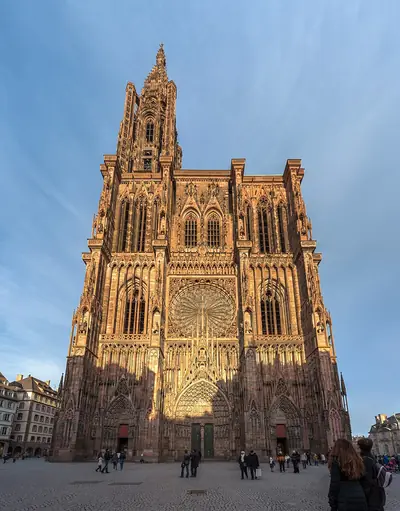
The Cathedral of Our Lady of Strasbourg is the city’s defining landmark. Construction began in 1015 on the site of an earlier cathedral, before work resumed in the Gothic style from 1220. The building was essentially complete by 1365, while the space between its two towers was filled in by 1388. Its spire was added in 1439.
The cathedral’s single tower gives it its distinctive appearance. At 142 metres, it was the tallest building in the world from 1647 to 1874. Its reddish colour comes from pink sandstone quarried in the Vosges mountains.
Palais Rohan
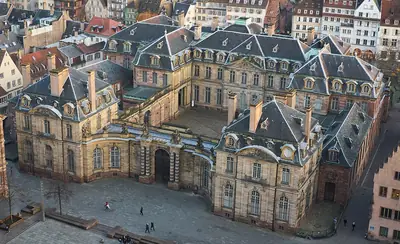
Immediately beside the cathedral, the Palais Rohan was built in the 1730s to designs by Robert de Cotte and completed in 1742. It is regarded as a masterpiece of French Baroque architecture and was once the residence of the prince-bishops and cardinals of the House of Rohan.
The palace now houses three museums: the Musée des Arts Décoratifs, the Musée des Beaux-Arts and the Musée Archéologique. French monarchs including Louis XV, Marie Antoinette, and Napoleon and Joséphine stayed here, adding a royal dimension to the building’s history.
Saint Thomas Church
Near Petite France, Saint Thomas Church is known as the Protestant Cathedral of Alsace. After Strasbourg Cathedral returned to Catholic use following the French annexation of the city in 1681, Saint Thomas became the region’s principal Lutheran church.
It is also the only example of a hall church in Alsace, giving it a distinctive architectural character. The building has been classified as a historic monument since 1862.
Old Saint Peter’s Church
Old Saint Peter’s Church is a rare example of a building shared by Catholic and Lutheran congregations under a simultaneum. Records mention the church as early as 1130, while the present building was constructed between 1381 and 1428.
The church became Lutheran during the Reformation, but part of the building was returned to Catholic worship after Strasbourg was annexed by France. A dividing wall remained until 2012, when a door was opened through it. The complex still reflects the city’s changing religious history.
Saint-Pierre-le-Jeune Protestant Church
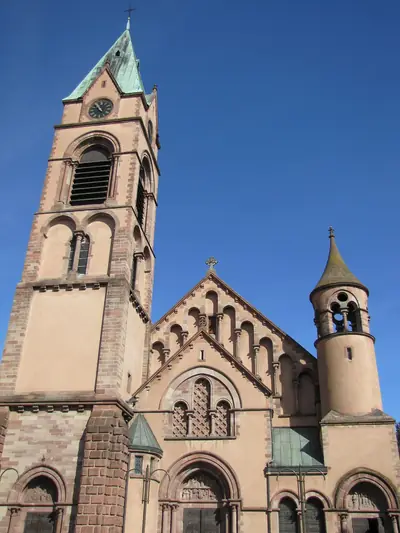
On Place Saint-Pierre-le-Jeune, this church is one of Strasbourg’s most important sites for religious and architectural history. It has been Lutheran since 1524, when Wolfgang Capiton preached the Reformation here.
The church was later divided between Catholic and Protestant worship. That arrangement ended in 1893, when a separate Catholic Saint-Pierre-le-Jeune was built nearby. The baptistry is also associated with Charles de Foucauld, who was baptised there.
Barrage Vauban and Petite France
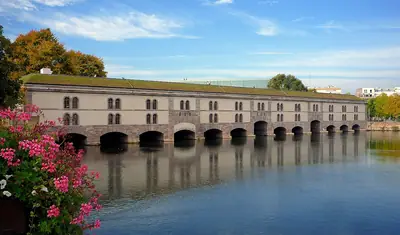
At the edge of Petite France, the Barrage Vauban spans the River Ill in pink sandstone. Built between 1686 and 1690 by Jacques Tarade, following plans by Vauban, it combined the functions of bridge, dam and defensive structure.
Its sluice gates could raise the level of the Ill and flood land south of the city. The structure has thirteen arches and extends 120 metres across the river. Inside, a lapidarium displays plaster casts and copies of sculptures and gargoyles from Strasbourg Cathedral and the Palais Rohan.
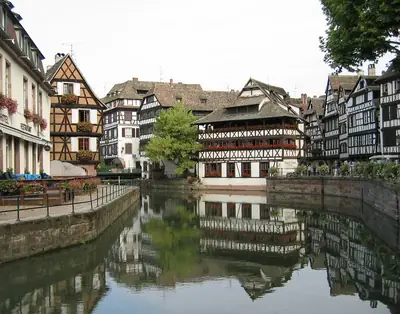
The rooftop terrace provides views over the Ponts Couverts and the surrounding waterways. Together with the former tanners’ and millers’ quarter, it makes Petite France one of the most atmospheric parts of Strasbourg to explore.
Palais du Rhin and Place de la République
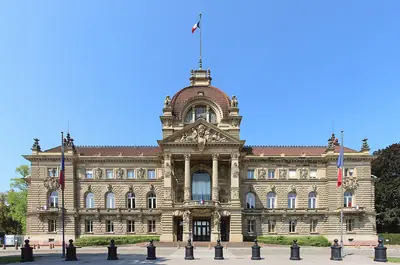
The Palais du Rhin dominates Place de la République with its large dome. Built as the official Imperial Palace during the German redevelopment of Strasbourg after the annexation of Alsace-Lorraine, it later served as a military hospital, the headquarters of the Nazi occupation and the headquarters of General Leclerc.
Since 1920, it has housed the Central Commission for the Navigation of the Rhine. With its formal garden, ornate gates and former stables, the palace forms one of the most complete surviving examples of late-19th-century German architecture.
St. Paul’s Church
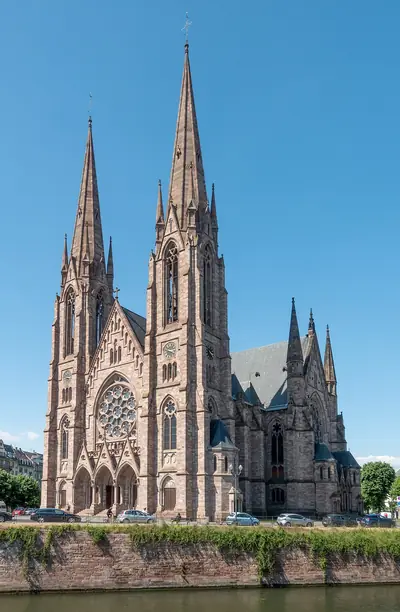
At the meeting point of the Quai Zorn and Quai Mullenheim, St. Paul’s Church stands where the Aar and the Ill meet. Its two 76-metre spires are reflected in the river, making the site one of Strasbourg’s most photographed views.
Built between 1892 and 1897 during the German annexation, it was designed as a garrison church for the Lutheran soldiers of the Imperial German garrison. The church has nineteen entrances, an unusually high number intended to accommodate everyone from ordinary soldiers to the Emperor.
Other churches and historic sites
Strasbourg’s religious heritage extends well beyond its best-known landmarks. Saint Aurelia’s Church in the Gare district combines traces of Romanesque and Gothic work with a white-and-gold Baroque interior, an 18th-century nave, a 17th-century altar and pulpit, and an organ built by André Silbermann in 1713.
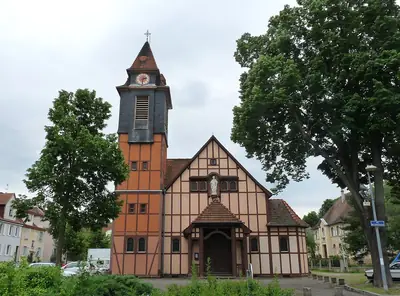
The Gothic Église Saint-Jean stands on the Quai Saint-Jean, while the Église Saint-Arbogast in Montagne Verte is notable for its unusual half-timbered structure, built in 1910. In Robertsau, the Château de Pourtalès stands in the park that shares its name. The 18th-century château has been listed as a historic monument since 1984.
Explore Strasbourg with a self-guided tour
A Strasbourg self-guided walking tour is a practical way to connect the city’s main landmarks without joining a group. Neywo offers four walking tours, one bus route and one bike route in Strasbourg:
- Cathedral, Palace and Old Strasbourg: 1.27 km, 100 minutes and 11 narrated stops.
- Petite France: Canals, Churches and a Fortified Dam: 2.95 km, 110 minutes and 10 narrated stops.
- The Kaiser’s New Town: Neustadt: 2.84 km, 115 minutes and 11 narrated stops.
- Capital of Europe: The European Quarter: 4.98 km, 111 minutes and 8 narrated stops.
- Bus 15: From Robertsau to the Kaiser’s Palace: 6 km, 26 minutes and 5 narrated stops.
- The Kaiser’s New Town by Bike: Diet to Saint-Bernard: 3.3 km, 16 minutes and 8 narrated stops.
The routes cover the cathedral and Palais Rohan, Petite France and the Barrage Vauban, the imperial Neustadt, the European Quarter and the Robertsau. They also include churches, museums, public squares and institutions that are easy to miss when visiting only the most famous sights.
Download the Strasbourg audio guide
Neywo’s free Strasbourg audio guide includes 152 narrated places. The app tells the story of each place as you reach it, at your own pace, with no group and no schedule. Narration is available in 11 languages, and the city includes four walking tours, one bus route and one bike route.
Strasbourg is a natural starting point for discovering France, while other cities in the region offer a different perspective on Grand Est. You can also continue your trip to Colmar, Nancy, Reims or Metz.
Places with an audio guide in Strasbourg
8 places in Strasbourg with a Neywo audio guide. Each one starts telling its story as you reach it.
Self-guided tours in Strasbourg
6 tours in Strasbourg, free in the Neywo app. Each stop tells its story as you reach it.
- Bike ride
The Kaiser's New Town by Bike: Diet to Saint-Bernard
Strasbourg is France's cycling capital. Ride the Neustadt's bike lanes from the old Diet and the twin-spired garrison church past the Art Nouveau bathhouse and the Palais U, then east by the Dominican church and Saint-Maurice to the round church of Saint-Bernard.
Palace of the Alsace-Lorraine Diet · St. Paul's Church, Strasbourg · Bains municipaux · Palais Universitaire, Strasbourg · Église des Dominicains, Strasbourg · Saint-Maurice …
Open this tour: The Kaiser's New Town by Bike: Diet to Saint-Bernard - Bus ride
Bus 15: From Robertsau to the Kaiser's Palace
A public CTS city bus that runs from the leafy Robertsau district past the circular Saint-Bernard church and Goethe's monument at the university to the Diet building and the great dome of the Palais du Rhin on Place de la République.
Église protestante de la Robertsau · Église Saint-Bernard de Strasbourg · Monument à Goethe de la place de l'Université, Strasbourg · Palace of the Alsace-Lorraine Diet · Palais du Rhin
Open this tour: Bus 15: From Robertsau to the Kaiser's Palace - Walk
Cathedral, Palace and Old Strasbourg
Strasbourg's medieval heart in one loop: from Kléber's square and Gutenberg's statue to the red-sandstone cathedral that was the tallest building on Earth, past the prince-bishops' Baroque palace, the cathedral's own workshop museum, the old slaughterhouse and the timber-framed Alsatian houses on the Ill.
Statue of Jean-Baptiste Kléber on Place Kléber in Strasbourg · Place Gutenberg · Büchmesser · Cathedral of Our Lady of Strasbourg · Werner Cathedral · Palais Rohan, Strasbourg …
Open this tour: Cathedral, Palace and Old Strasbourg - Walk
Petite France: Canals, Churches and a Fortified Dam
Follow the Ill through the half-timbered quarter: Albert Schweitzer's church, Saint Thomas where Mozart is said to have played, an old ice factory turned hotel, Vauban's pink-sandstone dam, the former school of France's top civil servants, and the old Saint Peter's church.
Pont Saint-Nicolas · Saint-Nicolas Church · Saint Thomas Church, Strasbourg · Galerie Pascale Froessel · Anciennes glacières · Barrage Vauban …
Open this tour: Petite France: Canals, Churches and a Fortified Dam - Walk
The Kaiser's New Town: Neustadt
After 1871 Germany built a whole imperial city beside the old one. Walk from the grand Place Broglie and its Opera across the canal to the emperor's palace, the Diet, a garrison church with nineteen doors and the university palace.
Saint-Pierre-le-Jeune Protestant Church · Place Broglie · Strasbourg Opera House · Palais du Rhin · Place de la République · Palace of the Alsace-Lorraine Diet …
Open this tour: The Kaiser's New Town: Neustadt - Walk
Capital of Europe: The European Quarter
Strasbourg hosts the Council of Europe, the European Court of Human Rights and the European Parliament. Walk the quarter where the continent's rights and laws are made, ending in the Orangerie park.
Arte · United Earth · European Court of Human Rights · Council of Europe · Parc de l'Orangerie · Église orthodoxe de tous les saints de Strasbourg …
Open this tour: Capital of Europe: The European Quarter
Walk Strasbourg with Neywo
Neywo turns Strasbourg into a self-guided audio tour. Stories arrive as you reach the place they belong to, and the route reshapes when you wander off it.

