What to See in Metz, France: Free Audio Guide
Things to Do in Metz: What to See in the Historic City Centre
The best things to do in Metz include exploring a Gothic cathedral filled with stained glass, discovering some of France’s oldest religious buildings, and seeing how medieval, French, German, and contemporary architecture meet across the city. Metz is a rewarding destination for a self-guided visit, with major landmarks, quiet chapels, historic streets, and cultural venues within easy reach of one another. Neywo also offers a free audio guide for Metz with 91 narrated places.
Metz is the capital of the Moselle department in Grand Est, in northeastern France. Its heritage is particularly visible in the contrast between ancient churches, medieval remains, the Imperial Quarter, and the modern Centre Pompidou-Metz.
What to See in Metz
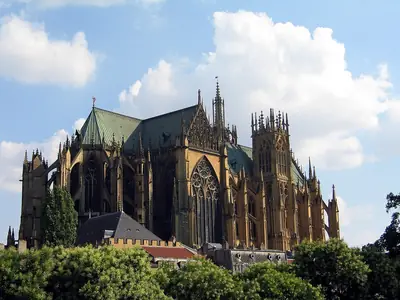
Metz Cathedral
Cathédrale Saint-Étienne is the city’s defining landmark and one of France’s great Gothic churches. Dedicated to Saint Stephen, it was built over roughly three centuries, beginning in 1220, and was completed between the fifteenth and sixteenth centuries.
Its most remarkable feature is the light entering through nearly 6,500 square metres of stained glass—the largest expanse in a French cathedral. This explains its nickname, La Lanterne du Bon Dieu, or the Good Lord’s Lantern. The interior is equally impressive: the vaults rise more than 41 metres, making the nave the third highest among French cathedrals after Amiens and Beauvais. The cathedral has been protected as a historic monument since 1930.
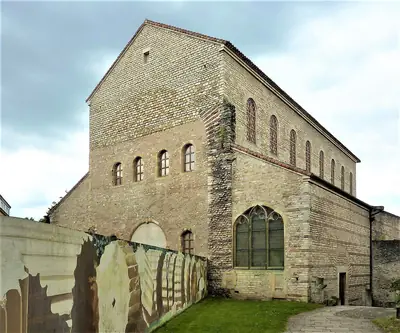
Basilica of Saint-Pierre-aux-Nonnains
Saint-Pierre-aux-Nonnains is regarded as the oldest surviving church building in France and one of Europe’s oldest churches. Its construction began in the fourth century, when Metz was an important Gallo-Roman city.
The building may originally have been a palaestra connected with a thermal complex, or a civic basilica. Before the seventh century, it was converted into an abbey church. By the seventh century, it belonged to a Benedictine abbey established on the site, giving the building a long and complex religious history.
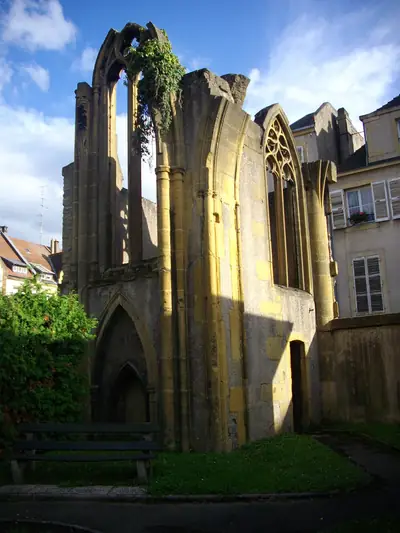
Church of the Grands-Carmes
The remains of the Church of the Grands-Carmes offer a glimpse of Metz’s medieval religious heritage. Built at the end of the fourteenth century, the former church now survives as ruins. They are also known as the apse chapel of the former Grands-Carmes convent.
Saint-Genest Chapel
The former Chapelle Saint-Genest stands on the slopes of Sainte-Croix Hill, behind Fournirue. No longer used for worship, it remains an important historic landmark.
The chapel was dedicated to Saint Genest, a comedian who was martyred in Rome. Its heritage value was officially recognized when it was listed as a protected historic monument on December 9, 1930.
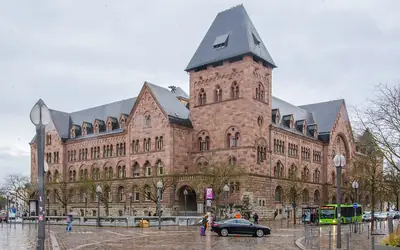
Hôtel des Postes
Opposite Metz-Ville station, the Hôtel des Postes is one of the most prominent buildings in the Imperial Quarter. Construction began in 1905 and continued until 1911, commissioned by the German authorities for the German Imperial Post.
Designed by Berlin architect Ewald von Rechenberg, the building was once known as the Neue Oberpostdirektion, or Higher Post Directorate. Its neo-Romanesque style and position on Place du Général-de-Gaulle make it a striking example of the city’s German-era architecture.
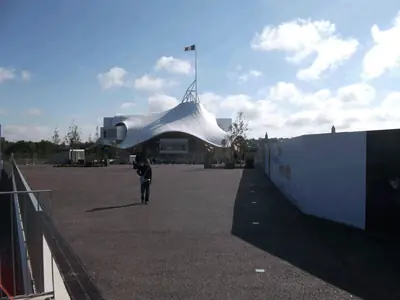
Centre Pompidou-Metz
For a very different experience, visit the Centre Pompidou-Metz, a major venue for modern and contemporary art. Opened on May 12, 2010, it is a partner institution of the Centre Pompidou in Paris and draws on the collection of the French National Museum of Modern Art.
The centre was France’s first example of decentralising a public cultural institution. Its building is an attraction in its own right, with a roof structure designed by Shigeru Ban, Jean de Gastines, and Philip Gumuchdjian. Shigeru Ban drew inspiration from a Chinese hat he found in Paris. Inside, the centre has 5,000 square metres of exhibition space across three galleries, as well as a theatre and an auditorium.
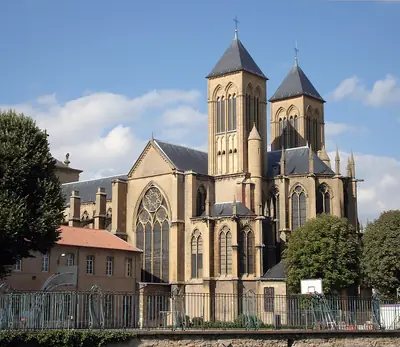
Saint-Vincent Basilica
The basilique Saint-Vincent de Metz began as an abbey church, with construction starting in 1248 under Abbot Warin. It was consecrated in 1376 by Thierry V Bayer de Boppard, Bishop of Metz.
Its architecture combines Gothic and classical styles, reflecting building work that continued from the thirteenth century into the eighteenth. The church became a Temple of Reason in 1791, and Catholic Mass returned in 1804. It was abandoned by the monastery in the 1980s before becoming city-owned. Deconsecrated in 2012, it now serves as a cultural and event space.
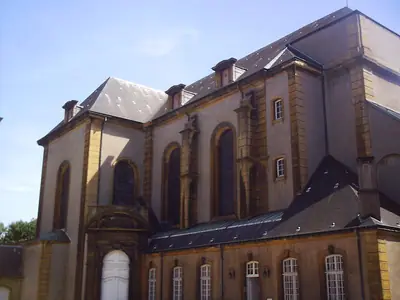
Sainte-Glossinde Chapel
Chapelle Sainte-Glossinde is the surviving church of a Benedictine abbey founded around the year 604. The abbey was established by Glossinde of Champagne, who lived from about 580 to 610, when Metz was the capital of the kingdom of Austrasia.
Its early foundation makes it one of the city’s significant religious landmarks and an important reminder of Metz’s role in the early medieval period.
Trinitarians Church and Hôtel Saint-Livier
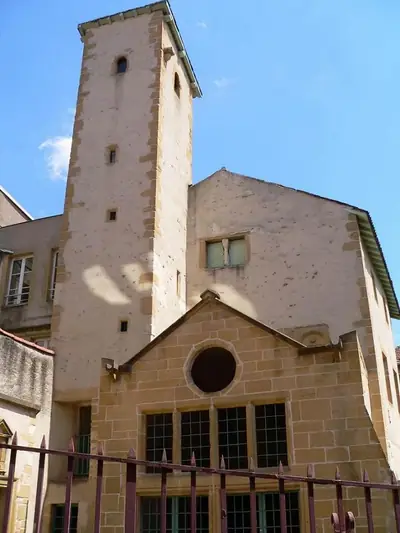
Église des Trinitaires is part of a historic setting that also includes the Hôtel Saint-Livier at 1 Rue des Trinitaires. The Hôtel Saint-Livier is described as the oldest civil building in Metz.
Its unusual character comes from its double role: it served both as a defensive stronghold and as a luxurious residence. The building complex is protected as a historic monument, making this one of the most revealing places to see how civic and defensive architecture could overlap in medieval Metz.
Notre-Dame de l’Assomption
Notre-Dame de l’Assomption, also known as Notre-Dame, stands on Rue de la Chèvre in central Metz. This Roman Catholic church has a long connection with devotion to the Virgin Mary and is regarded as one of the clearest examples of a building with a distinctly Jesuit character.
Churches across the historic city
Metz’s religious heritage continues beyond its principal monuments. In the Outre-Seille quarter, Saint-Eucaire Church stands between Rue Saint-Eucaire and Rue des Allemands. Saint-Martin Church, at 25 Rue des Huiliers, is one of the city’s oldest Catholic churches and parishes, dedicated to Saint Martin, Bishop of Tours.
Saint-Maximin Church in the Old Town honours Maximin, Bishop of Trier, who died in 347. Its history reaches back to the twelfth century, although the Romanesque building was not completed until 1753. In the Îles district, Saint-Simon Church was built in 1735 in the Neoclassical style and dedicated to Saints Simon and Jude.
Outside the central streets, Église Sainte-Lucie de Vallières stands in the former village district of Vallières, now part of Metz. Dedicated to Saint Lucy, the patron saint of blind people, it has been classified as a historic monument since 1991.
Exploring Metz with a Self-Guided Tour
A Metz self-guided walking tour is a practical way to connect the city’s landmarks without joining a group. Neywo’s routes cover the cathedral and old squares, the Moselle and former abbeys, the Imperial Quarter and Centre Pompidou-Metz, medieval religious buildings, Pontiffroy, and the noble houses and fountains of Old Metz.
If you are comparing Metz with other destinations in the region, Nancy, Colmar, Reims, Strasbourg, and Troyes offer different perspectives on northeastern France.
Explore Metz with Neywo’s Free Audio Guide
Download Neywo to explore Metz with six walking tours, one bus route, and one bike route. Together, the walks range from 1.61 to 3.37 km and last between 56 and 119 minutes. The bus route covers 4 km in 17 minutes, while the bike route covers 1.3 km in 6 minutes. The tours include 65 narrated stops in total, and the city guide contains 91 narrated places.
The app tells the story of each place as you reach it, at your own pace, with no group and no schedule. Narration is available in 11 languages, so you can explore Metz independently while moving from one landmark to the next.
Places with an audio guide in Metz
8 places in Metz with a Neywo audio guide. Each one starts telling its story as you reach it.
Self-guided tours in Metz
8 tours in Metz, free in the Neywo app. Each stop tells its story as you reach it.
- Bike ride
Metz Cycle Ride: Porte Serpenoise to the Station Quarter
A short ride on Metz's cycle lanes from Place du General de Gaulle past Sainte Glossinde and the bust of King Albert to the Sainte-Therese church.
Place du Général de Gaulle · Chapelle Sainte-Glossinde de Metz · Buste du Roi Albert · Église Sainte-Thérèse-de-l'Enfant-Jésus de Metz
Open this tour: Metz Cycle Ride: Porte Serpenoise to the Station Quarter - Bus ride
Liane 6: From Maud'huy to the Germans' Gate
Metz's frequent Liane 6 bus runs from Devant-les-Ponts through the heart of the city: Porte Serpenoise, Saint Martin, the chapel of Saint Charles Borromee, the Germans' Gate and the Grands Carmes church. Ride it to sample five centuries of Metz in nine stops.
Place de Maud'huy · Place du Général de Gaulle · Porte Serpenoise · Église Saint-Martin de Metz · Place Saint-Thiébault · Chapelle Saint-Charles-Borromée de Metz …
Open this tour: Liane 6: From Maud'huy to the Germans' Gate - Walk
The Good Lord's Lantern: Metz Cathedral and the Old Squares
Start under the largest expanse of stained glass in any French cathedral, then wander the old squares around it. Spot the five stone heads of the Maison des Têtes, the medieval arcades of Place Saint-Louis and the Gothic towers of Sainte-Ségolène.
Église Sainte-Ségolène de Metz · Grange de Chèvremont · Musée de la Cour d'Or · Place d'Armes · Metz Cathedral · Place Saint-Jacques …
Open this tour: The Good Lord's Lantern: Metz Cathedral and the Old Squares - Walk
Opera, Abbeys and Citadel: Metz by the Moselle
Follow the river from the oldest theatre in continuous use in France to the oldest surviving church in France. Pass Charlemagne's family abbey, a former arsenal turned concert hall, the old citadel and the Porte Serpenoise triumphal arch.
Temple de Garnison · Basilique Saint-Vincent de Metz · Opéra-Théâtre de Metz Métropole · Place de la Comédie · Temple Neuf, Metz · Abbey of Saint-Arnould …
Open this tour: Opera, Abbeys and Citadel: Metz by the Moselle - Walk
Imperial Quarter, Verlaine and Pompidou
From the futuristic roof of the Centre Pompidou-Metz to the German-era station district, this walk crosses 120 years of Metz. End in the old town at the abbey church of Sainte-Glossinde and the birthplace of the poet Paul Verlaine.
Hôtel des Postes · Centre Pompidou-Metz · Chapelle Saint-Charles-Borromée de Metz · Place Saint-Thiébault · Buste du Roi Albert · Hôtel des Arts et Métiers de Metz …
Open this tour: Imperial Quarter, Verlaine and Pompidou - Walk
Medieval Metz: Convents, Synagogue and the Germans' Gate
Cross the eastern old town from the oldest civil building in Metz to the one medieval gate that survives. Pass convent ruins, the Romanesque Revival synagogue and the Seille river, ending on the bridge-gate itself.
Église des Trinitaires de Metz · Couvent des Récollets de Metz · Fontaine de la place Sainte-Croix · Synagogue in Metz · Eglise des Grands Carmes de Metz · Chandellerue Gate …
Open this tour: Medieval Metz: Convents, Synagogue and the Germans' Gate - Walk
Pontiffroy: Abbey, Ruins and the Banks of the Moselle
North of the cathedral lies the Pontiffroy district. Walk from the square named after Eugene Rolland to the ruins of Saint Livier and the Benedictine abbey of Saint Clement, then on to Saint Simon church by the river.
Place Eugène Rolland · Église Saint-Livier de Metz · Abbaye Saint-Clément · Église Saint-Clément de Metz · Église Saint-Simon de Metz
Open this tour: Pontiffroy: Abbey, Ruins and the Banks of the Moselle - Walk
Noble Houses and Fountains of Old Metz
A quiet loop around Saint Martin church and Place Coislin, where patrician townhouses such as the Hotel de Heu, the Hotel de Gournay and the Hotel de Burtaigne line the old streets.
Église Saint-Martin de Metz · Hôtel de Heu · Fontaine Coislin · Hôtel de Burtaigne · Hôtel de Gournay · Hôtel de la Bulette
Open this tour: Noble Houses and Fountains of Old Metz
Walk Metz with Neywo
Neywo turns Metz into a self-guided audio tour. Stories arrive as you reach the place they belong to, and the route reshapes when you wander off it.

