Things to Do in Calais, France: Walking Guide
Things to do in Calais
Calais is a port city on the narrowest stretch of the English Channel, where French and English histories meet beside sandy beaches and cultural sites. It is worth visiting for its medieval fortifications, churches, museums and the famous Burghers of Calais sculpture, all easily explored on foot. Neywo offers a free audio guide for Calais with 44 narrated places.
Exploring Calais on Foot
Fort Risban
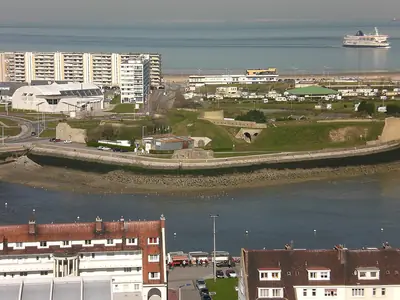
Standing on Avenue Raymond Poincaré at the entrance to the port, Fort Risban has guarded the harbour through centuries of military change. It first appears in records of the English siege of Calais in 1346, when Edward III’s forces erected a wooden tower to cut off supplies. By the early fifteenth century this was replaced by the more permanent Lancaster Tower, which controlled access and stored gunpowder for English ships. The fort changed hands several times; France reclaimed it in 1558 under the Duke of Guise, it was briefly held by the Spanish Netherlands, and the Treaty of Vervins returned it to French control in 1598. In the late seventeenth century Vauban found the fort neglected and made only modest changes. A major overhaul was carried out by French engineers in the nineteenth century, the fort was dismantled in 1908, and during the Second World War it was refortified and used as an air raid shelter.
Église Notre-Dame de Calais
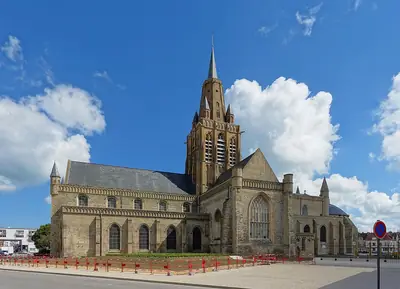
Located on Rue de la Paix, the Church of Our Lady is the oldest and most important religious building in Calais. It is regarded as possibly the only church in France built in the English Perpendicular style, with major parts dating from the fourteenth and sixteenth centuries. The church has been protected as a historic monument since 13 September 1913. Its story reflects the long connection between Calais and England, a theme explored in the Tudor Garden created around the building. The garden also recalls the marriage of Captain De Gaulle and Yvonne Vendroux at the church and looks back to Marie Tudor’s legacy and Calais’s final years under English rule in 1558.
Citadelle de Calais
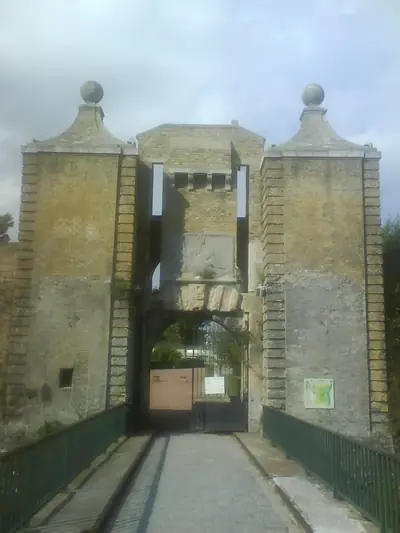
The Citadel of Calais is a defensive fortress built on the ruins of a medieval castle. The present structure was initially constructed in the sixteenth century, while beneath it lie the remains of a thirteenth‑century castle that had already served to protect the town.
Tour du Guet
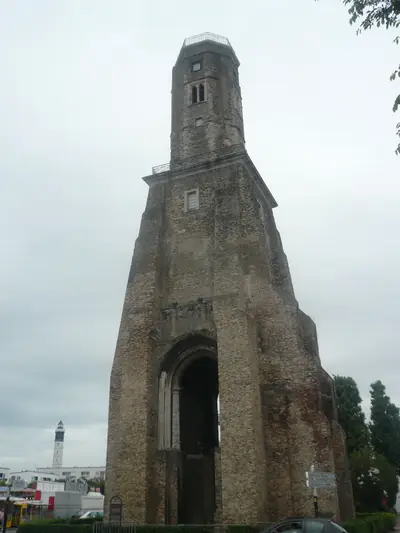
Rising 39 metres above Place d’Armes, the Tour du Guet is one of Calais’s oldest surviving monuments. Dating from the thirteenth century, it was erected as part of the town’s fortifications. Local tradition once linked it to Charlemagne, but it is more likely a product of later defensive strengthening. The tower was badly damaged by an earthquake in 1580 and later suffered damage during a bombardment by the English fleet in 1696. In the first half of the nineteenth century it served as a lighthouse until 1848, and during the First World War it was used as a military post. Today it stands beside Place d’Armes and Rue de la Paix, has official protected status as a historic monument and is classified as a lighthouse; visitors cannot enter, but its preserved stone silhouette offers a glimpse of Calais’s medieval defences.
Le Channel
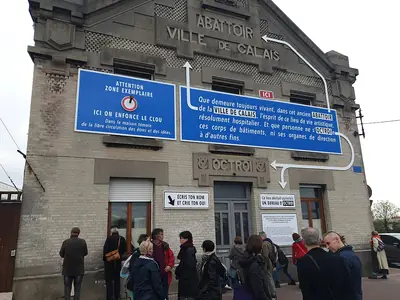
Also known as the Scène nationale de Calais, Le Channel occupies the former municipal slaughterhouse site, a transformation completed in 1994. The venue now houses several performance spaces, a bar, a restaurant and a bookshop run by Actes Sud. It is one of 76 venues in France to hold the official designation Scène nationale from the Ministry of Culture, offering a programme that brings performance and everyday life together.
Musée de mémoire 1939‑1945
Set inside a thick‑walled concrete bunker built in 1941 as a command post for the German Navy, this museum explores Calais during the Second World War. The bunker lay hidden in Saint Pierre Park and remained undetected throughout the conflict; it was rediscovered by Canadian forces in September 1944 and turned into a museum in 1962. A central corridor leads through twenty‑two themed rooms—eleven on each side—showing both the local experience of the German occupation and wider war events. Visitors can see a Russian 76.2‑millimetre cannon captured by the Germans at the entrance, dioramas and uniformed mannequins representing Axis and Allied soldiers, and small arms, uniforms and aero engines recovered from crash sites. One of the museum’s most moving themes is the Resistance in Calais, illustrated by the story of Claude Waroquier, who wrote letters to his family during the occupation.
Musée des Beaux-Arts de Calais
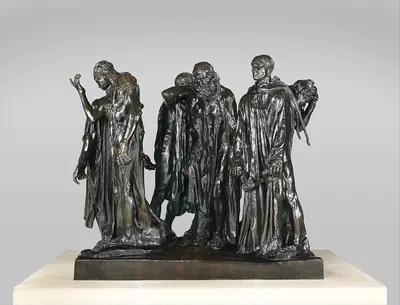
Established in 1966 and housed in a building designed by architect Paul Pamart, the Musée des Beaux-Arts brings together fine art and the local heritage of lace‑making. Its collection spans paintings, sculptures, watercolours, drawings and photographs from the sixteenth to the twenty‑first century, featuring works by Flemish artists, François Clouet, Nicolas de Largillière, Jean‑Honoré Fragonard and Pablo Picasso. A major highlight is devoted to Auguste Rodin, including his celebrated bronze sculpture The Burghers of Calais and related studies. The museum also displays sculpture by Antoine‑Louis Barye, Émile‑Antoine Bourdelle, Anthony Caro and Germaine Richier, preserves works connected with the Calais region by artists such as Louis Francia, Henri Lhotellier and Jean Roulland, and presents Gallo‑Roman objects alongside its art and lace collections.
Les Bourgeois de Calais (The Burghers of Calais)
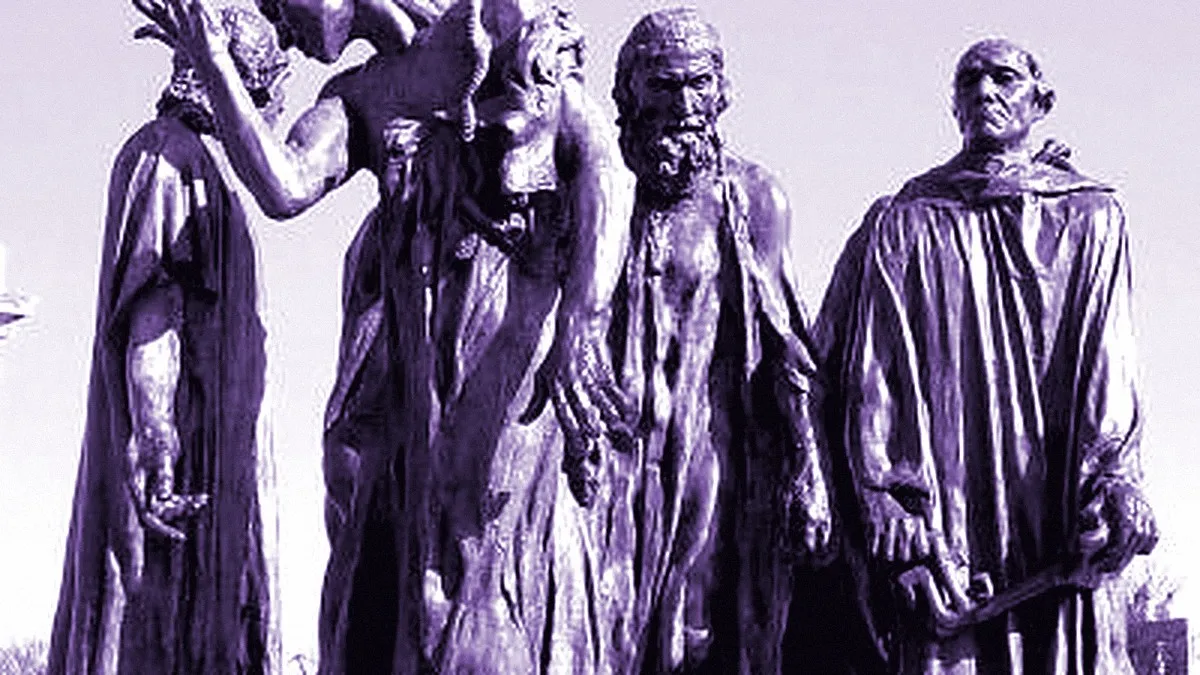
This powerful bronze group by Auguste Rodin shows six citizens stepping forward with nooses around their necks and the keys to the city and castle in their hands. It captures the moment of fear, sacrifice and extraordinary resolve during the surrender of Calais in 1347, after an eleven‑month siege by English forces. Rodin presents the six burghers as individuals facing the same fate, their solemn expressions and tense, exhausted bodies conveying the emotional weight of their decision. The keys mark their submission, while the ropes make the danger unmistakable. Although Queen Philippa of Hainault persuaded Edward III to spare their lives, Rodin’s work preserves the scene as one of imminent death, turning a formal act of surrender into a deeply human drama.
Calais lace museum
Housed in the former Boulart lace factory, the Cité internationale de la dentelle et de la mode de Calais opened on 11 June 2009. The museum tells the industrial and fashion story of lace, connecting machine‑made techniques with lingerie, haute couture and contemporary design. Founded in the 1870s, the factory remained active until 2000; the city bought the site in 1988 to preserve and showcase local lace‑making expertise. Exhibits show how lace is made on Leavers looms—a technique invented in England in the nineteenth century and still mainly produced in northern France—and display lingerie, haute couture and contemporary creations that illustrate both the industrial and fashion sides of the subject.
Explore Calais with Neywo
Neywo’s free audio guide lets you discover the city at your own pace, with no group and no schedule. In Calais you can choose from:
- Walking tour: “Rodin’s Burghers and the Lace City: Calais Town Centre” – 2.78 km, about 85 minutes, 9 narrated stops (place d’Armes, Église Notre‑Dame de Calais, Musée des Beaux-Arts, War memorial of Les deux guerres mondiales, Les Bourgeois de Calais, Town hall of Calais, Parc Saint‑Pierre, temple protestant de Calais, Calais lace museum).
- Walking tour: “Ramparts, Fishermen and Lighthouses: Calais Port and Courgain” – 3.12 km, about 87 minutes, 8 stops (Citadelle de Calais, Casino de Calais, Fort Risban, Monument des sauveteurs, faubourg of Courgain, Louis XVIII column, Calais Lighthouse, Tour du Guet).
- Bus route: “Balad’in: Free Shuttle from the Temple to the Harbour” – 2.3 km, about 10 minutes, 6 stops (temple protestant de Calais, Les Bourgeois de Calais, War memorial of Les deux guerres mondiales, Tour du Guet, Louis XVIII column, Monument des sauveteurs).
- Bike route: “Lace, Rodin and Culture by Bike” – 3.2 km, about 16 minutes, 4 stops (Calais lace museum, Les Bourgeois de Calais, Calais‑Ville railway station, Le Channel).
As you reach each point, the app tells the story of that place, allowing you to linger or move on as you wish.
If you enjoy discovering Calais on foot, you might also like to explore nearby destinations such as Boulogne-sur-Mer or Lille, both within the Hauts-de-France region of France. Happy travels!
Places with an audio guide in Calais
8 places in Calais with a Neywo audio guide. Each one starts telling its story as you reach it.
Self-guided tours in Calais
4 tours in Calais, free in the Neywo app. Each stop tells its story as you reach it.
- Bike ride
Lace, Rodin and Culture by Bike
A flat ride on Calais's cycle lanes from the lace museum past Rodin's burghers and the station to the Le Channel arts centre in the old slaughterhouse.
Calais lace museum · Les Bourgeois de Calais · Calais-Ville railway station · Le Channel
Open this tour: Lace, Rodin and Culture by Bike - Bus ride
Balad'in: Free Shuttle from the Temple to the Harbour
The free Balad'in shuttle links the town centre with the ferry terminal. Ride it from the Protestant temple past Rodin's burghers, the war memorial and the Tour du Guet to the Courgain waterfront, and get off at the sailors' monument.
Temple protestant de Calais · Les Bourgeois de Calais · War memorial of Les deux guerres mondiales of Calais · Tour du Guet · Louis XVIII column · Monument des sauveteurs
Open this tour: Balad'in: Free Shuttle from the Temple to the Harbour - Walk
Rodin's Burghers and the Lace City: Calais Town Centre
Calais gave Rodin one of his greatest sculptures. Walk from the market square to the English-style church of Notre-Dame, the museum that holds Rodin and lace, and the six burghers who offered their lives in 1347. Then see the town hall belfry, Parc Saint-Pierre and the old lace factory that is now a museum of fashion.
Place d'Armes · Église Notre-Dame de Calais · Musée des Beaux-Arts · War memorial of Les deux guerres mondiales of Calais · Les Bourgeois de Calais · Town hall of Calais …
Open this tour: Rodin's Burghers and the Lace City: Calais Town Centre - Walk
Ramparts, Fishermen and Lighthouses: Calais Port and Courgain
Follow the Calais waterfront from the old citadel to the fort that guarded the harbour since the English siege of 1346. Wander the red-tiled lanes of the fishermen's quarter of Courgain, see the column that welcomed a king and the sailors' monument, then climb to the lighthouse and the watchtower it replaced.
Citadelle de Calais · Casino de Calais · Fort Risban · Monument des sauveteurs · Faubourg of Courgain · Louis XVIII column …
Open this tour: Ramparts, Fishermen and Lighthouses: Calais Port and Courgain
Walk Calais with Neywo
Neywo turns Calais into a self-guided audio tour. Stories arrive as you reach the place they belong to, and the route reshapes when you wander off it.

