Things to Do in Barcelos, Portugal: Walking Guide
Things to Do in Barcelos: What to See in the City of Roosters
Looking for things to do in Barcelos? This city in the Braga region of northern Portugal combines medieval monuments, archaeological sites, historic churches and a deeply rooted pottery tradition. Its most distinctive cultural symbol is the colourful Barcelos rooster, while its museums and heritage sites reveal a much broader story shaped by craft, noble families and centuries of settlement. Neywo has a free audio guide for Barcelos with 23 narrated places.
What to See in Barcelos
Castle of Faria
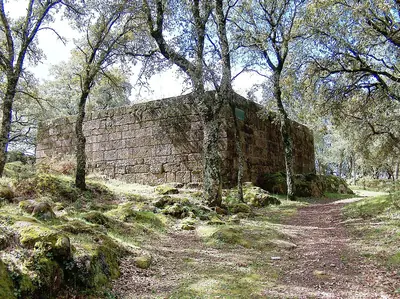
The Castle of Faria stands high on the northern slope of Monte da Franqueira, where its ruins overlook the historic route linking Barcelos with the port of Viana. The medieval fortress was built on an elevated position for strategic control, but the site is older still: an Iron Age settlement occupied the same hilltop before the castle was constructed. It is a place where several layers of Barcelos’s past remain visible in one landscape.
Palácio, Solar dos Pinheiros
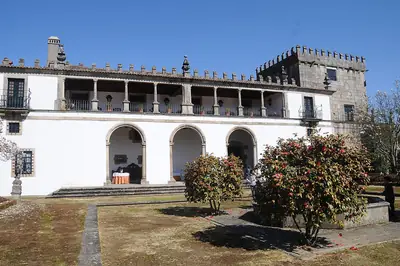
The Solar dos Pinheiros, also known as the Palácio dos Pinheiros, has watched over Barcelos since the fifteenth century. Tristão Gomes Pinheiro, a nobleman whose family prospered through the Portuguese discoveries and overseas trade, built the palace around the 1400s. Rebuilding and alterations over the centuries left the building with a mixture of architectural styles, making it an especially interesting example of aristocratic civil architecture.
Paço dos Duques and its archaeological museum
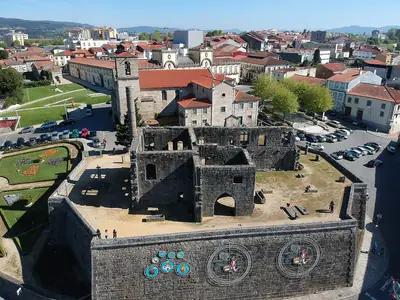
The Paço dos Duques de Bragança, or Paço dos Condes de Barcelos, occupies a prominent position in the heart of the city. The former noble residence has been protected as a National Monument since 1910, although the official classification refers to the surviving structure as ruins.
The Museu Arqueológico Paço dos Duques is housed within the palace complex. Its collection presents archaeological finds from the region inside the historic walls of the former residence, connecting Barcelos’s material heritage with the building that preserves it.
Solar de Azevedo
The Solar de Azevedo, also called the Solar dos Azevedos, is a designated cultural heritage monument in Barcelos. It adds another example of the historic residences that form part of the municipality’s architectural heritage.
Church and Tower of Manhente
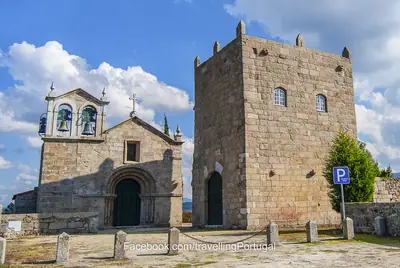
The Igreja de São Martinho de Manhente has carried several names during its history. It began as the Monastery of São Martinho de Manhente and was also known for a time as the Castle of Manhente. Today, the church and tower are recognized as a National Monument, a status held since 1915.
Monumento Castrejo de Santa Maria de Galegos
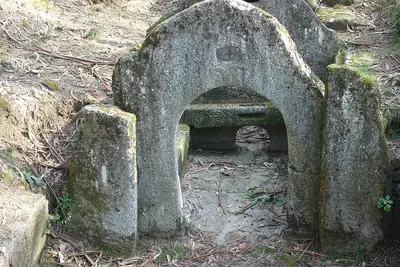
At the foot of Monte do Facho, in Galegos Santa Maria, the Monumento Castrejo de Santa Maria de Galegos preserves a much older chapter of the region’s history. It is also known locally as the Forno Castrejo and has been classified as a National Monument since 1986.
Laje dos Sinais
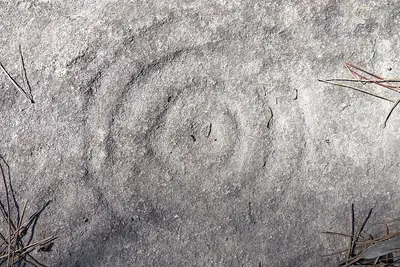
The Penedo chamado a Laje dos Sinais is a large boulder hidden among woodland at the foot of Monte da Saia. Ancient rock engravings cover its surface, with grooves and motifs carved into the stone thousands of years ago. The quiet setting makes the contrast especially striking: the markings are a direct surviving trace of people who once moved through this landscape, even though the reasons for the carvings remain unknown.
Museu de Olaria
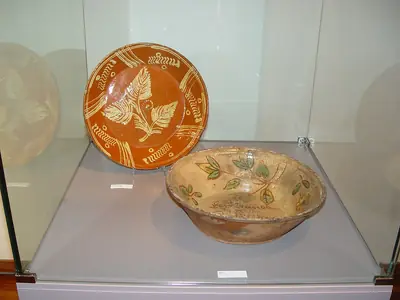
For anyone interested in what to see in Barcelos beyond its monuments, the Museu de Olaria is essential. The museum is devoted to Portuguese pottery and brings together ceramics from across the country, as well as works from Portuguese-speaking countries abroad.
The institution began in 1963 as the Regional Museum of Popular Ceramics, using a collection assembled by the ethnographer Joaquim Sellès Paes de Villas Boas. Its holdings later expanded, leading to the name Museu de Olaria. The collection includes utilitarian pottery, construction ceramics and the tools used in their production, alongside figurado pieces: clay figures inspired by daily life, folklore and imagination.
The work of Rosa Ramalho is one of the highlights. Her figurado figures are often fantastical or humorous, and show how a traditional craft could become highly personal and inventive.
Torre da Porta Nova
The Torre da Porta Nova is the last surviving tower of Barcelos’s medieval walls. The square-plan granite structure was once the strongest point of a defensive circuit that had three towers. On its northern side, the walls reach two metres in thickness.
The tower later became the residence of the local alcalde, or chief magistrate. From the seventeenth century until 1932, it served as the town prison. Its other names — Torre do Cimo da Vila, Torre da Cadeia and Postigo da Muralha — reflect the different roles it has played. It has been a National Monument since 1926.
Monastery of São Salvador de Palme
The Mosteiro de São Salvador de Palme lies in the village of Aldreu, around twelve kilometres from Barcelos, with the Neiva River to the south. Its origins go back more than a thousand years. A nobleman named Lovezendo founded the monastery around 1025 before transferring it to Benedictine monks, who remained there until the dissolution of religious orders in Portugal in 1834.
The complex preserves several periods of architecture. The original Romanesque structure has largely been replaced by later changes, but the fourteenth-century Gothic main chapel and the cloisters remain. The façade is a nineteenth-century reconstruction. A descendant of the founding family still lives there as co-owner of the monastery and its grounds.
Church of Santa Maria do Abade
The Igreja de Santa Maria do Abade is the parish church of Abade de Neiva, just outside Barcelos. Its church and tower have stood as local landmarks for generations, and the building has been recognized as a National Monument since 1927.
Aborim Tower
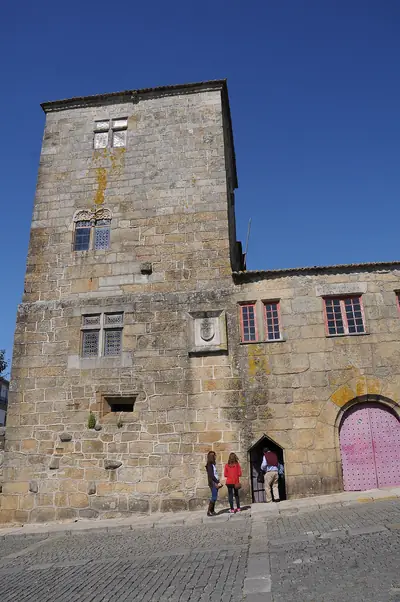
The Aborim Tower is a medieval manor house in the parish of Quintiães e Aguiar. Its tower and chapel combine defensive, domestic and religious functions in one noble residence. The property has been protected as a Property of Public Interest since 1978.
Chafariz do Campo da Feira
In the centre of Campo da Feira stands the Chafariz do Campo da Feira, a fountain built in 1621 to a design by João Lopes de Amorim. Its round stone basin supports two tiered basins, crowned by a royal coat of arms and the original emblem of Barcelos, flanked by eagles.
Four smaller fountains surround the column, each reached by a short staircase. Water emerges from the mouths of carved stone masks, an expressive detail that has survived from the seventeenth century. The fountain was moved to the centre of the square in 1920, following a design by José Marques da Silva, whose later stone base supports the ensemble.
Other churches in Barcelos
The Fonte Coberta church is a historic place of worship in the Fonte Coberta area. The Igreja de Nossa Senhora do Terço is another church in Barcelos and forms part of the city’s religious heritage.
Explore Barcelos with a self-guided audio tour
A Barcelos self-guided walking tour is an easy way to connect the city’s monuments and stories without joining a group. Neywo’s walking tour, “The Rooster Town: Counts, Pillories and Clay Figures,” covers 1.21 km in about 77 minutes and includes 10 narrated stops.
The route features the Palácio, Solar dos Pinheiros, Pelourinho de Barcelos, Paço dos Duques de Bragança, Igreja Matriz de Barcelos, Teatro Gil Vicente, Museu de Olaria, Torre da Porta Nova, Igreja do Bom Jesus da Cruz, Igreja de Nossa Senhora do Terço and Chafariz do Campo da Feira.
Download Neywo and explore Barcelos at your own pace. The app tells the story of each place as you reach it, with no group and no schedule. Narration is available in 11 languages. Barcelos is part of Braga, in Portugal, and makes a rewarding stop alongside Guimarães or Braga.
Places with an audio guide in Barcelos
8 places in Barcelos with a Neywo audio guide. Each one starts telling its story as you reach it.
Self-guided tours in Barcelos
1 tour in Barcelos, free in the Neywo app. Each stop tells its story as you reach it.
- Walk
The Rooster Town: Counts, Pillories and Clay Figures
Barcelos is the town of the legendary Rooster and of Portugal's most playful pottery. Start among the ruins of the counts' palace, the Gothic mother church and the old pillory, then follow the lanes to the last medieval tower, two churches and the great fountain on the Campo da Feira. Allow a relaxed hour and a half, with time for the Museu de Olaria.
Palácio, solar dos Pinheiros · Pelourinho de Barcelos · Paço dos Duques de Bragança · Igreja Matriz de Barcelos · Teatro Gil Vicente · Museu de Olaria …
Open this tour: The Rooster Town: Counts, Pillories and Clay Figures
Walk Barcelos with Neywo
Neywo turns Barcelos into a self-guided audio tour. Stories arrive as you reach the place they belong to, and the route reshapes when you wander off it.

