Things to Do in Albufeira, Portugal: Walking Guide
Things to Do in Albufeira: Historic Churches, Old Town and Beaches
The best things to do in Albufeira include exploring its historic churches, old-town streets and Atlantic beaches. The town combines a long connection with fishing and the sea with whitewashed architecture, religious landmarks and coves framed by ochre cliffs. Neywo has a free audio guide for Albufeira with 18 narrated places.
Albufeira is in the Algarve, in the Faro region of Portugal. Its historic centre is the natural place to begin, but the municipality also includes beaches, coastal chapels and the inland Castle of Paderne.
What to see in Albufeira
Castle of Paderne
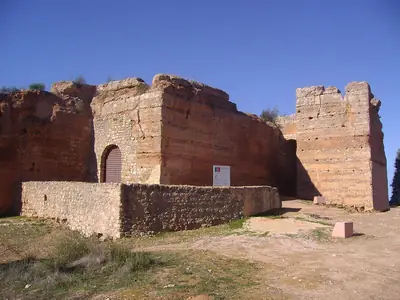
The Castle of Paderne, also known as Castelo de Paderne, is a historic fortification in the civil parish of Paderne, in the municipality of Albufeira. Berbers constructed it in the later 12th century on higher ground about 7.5 kilometres inland.
The reddish ruins still shape the surrounding landscape and are considered one of the most significant examples of Muslim military architecture on the Iberian Peninsula. The castle is also believed to be one of the original fortifications represented on the shield of the Portuguese national flag. After dark, lighting installed by the Algarve Tourism Region gives the ruins a different atmosphere.
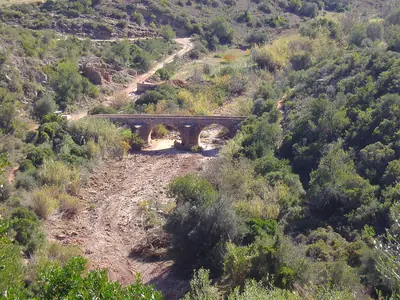
Nearby, the Bridge of Paderne—Ponte de Paderne or Ponte medieval de Paderne—is another historic monument in the parish.
Igreja Paroquial de Albufeira
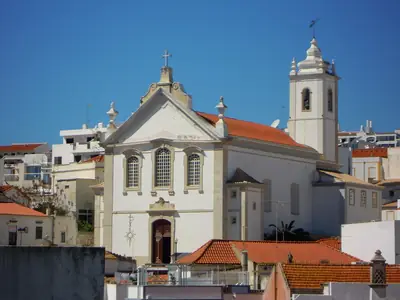
The Parish Church of Albufeira, also called the Igreja Matriz or Church of Our Lady of the Conception, has roots reaching back to the period of Moorish rule. After the Christian Reconquest in 1249, an earlier building was adapted for Christian worship and became the town’s principal parish church.
The 1755 earthquake and tsunami severely damaged the church, which was largely rebuilt in the late 18th and early 19th centuries. Its whitewashed exterior is restrained and Neoclassical, while the interior has a single nave, four side chapels, a choir, a baptistry, two pulpits and side halls arranged around the main altar.
The bell tower dates from 1869, rises to about 92 feet and contains a carillon of eight bells tuned to F major. A spiral staircase leads to the top.
Igreja de São Sebastião
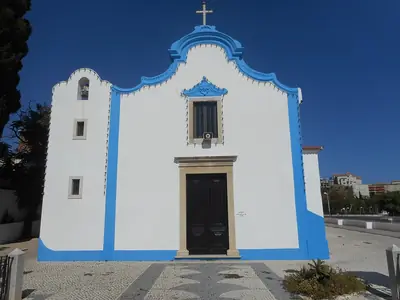
On Miguel Bombarda Square, the Igreja de São Sebastião is a small whitewashed church that combines Manueline and Baroque influences. It was originally built in the 16th century and reconstructed in the early 1700s, retaining features such as its Manueline side door.
The Baroque façade is marked by elaborate volutes. Inside, the church’s carved wooden details and sacred art take centre stage, including a gilded altar with polychrome carvings and statues of São Sebastião, São Francisco Xavier and São Domingos. Another notable work is the statue of Nossa Senhora da Piedade, probably from the 16th century.
The building now also houses the Museum of Sacred Art, or Museu de Arte Sacra. Its single nave and decorative tiled panels create a quiet setting for the sculptures and carved details.
São Vicente de Albufeira
The bronze statue of Saint Vincent stands on a stone pedestal and offers views across Albufeira and the Atlantic. Vincent was born in Albufeira in 1590, when the settlement was still a small village clustered around a castle.
He later became an Augustinian missionary, travelling through Spain, Mexico, the Philippines and Japan. He was martyred by fire in the 17th century and became a symbol of faith and sacrifice. The statue shows him in priestly clothing, holding a crucifix aloft. At certain times of day, sunlight can pass through the crucifix, creating a striking beam of light.
Igreja da Misericórdia
The Igreja da Misericórdia, also known as the Misericordia Chapel or Governor’s Chapel, occupies the site of a former Moorish mosque. In 1499, after the Christian reconquest, the structure became the Capela da Misericórdia and was redesigned in the late Gothic style.
The 1755 earthquake damaged the chapel, but the main doorway, apse and triumphal arch survived. These elements preserve links with the building’s 15th-century origins, while the visible pediment reflects reconstruction in the 18th century.
Inside, a single nave opens into a small chancel covered by a groin vault. A Manueline-style triumphal arch frames the chancel, and a carved wooden altarpiece completes the compact altar space.
Casa Samora correia
Casa Samora correia, also known as the Galeria de Arte Pintor Samora Barros, brings contemporary art to Albufeira’s historic centre. The gallery occupies a former early 20th-century power station, converted into an art space in 1988.
Arched doorways, high ceilings and whitewashed walls preserve traces of the building’s industrial past. Exhibitions range across painting, sculpture and multimedia installations, presenting both local and international creators.
Ermida Nossa Senhora da Orada
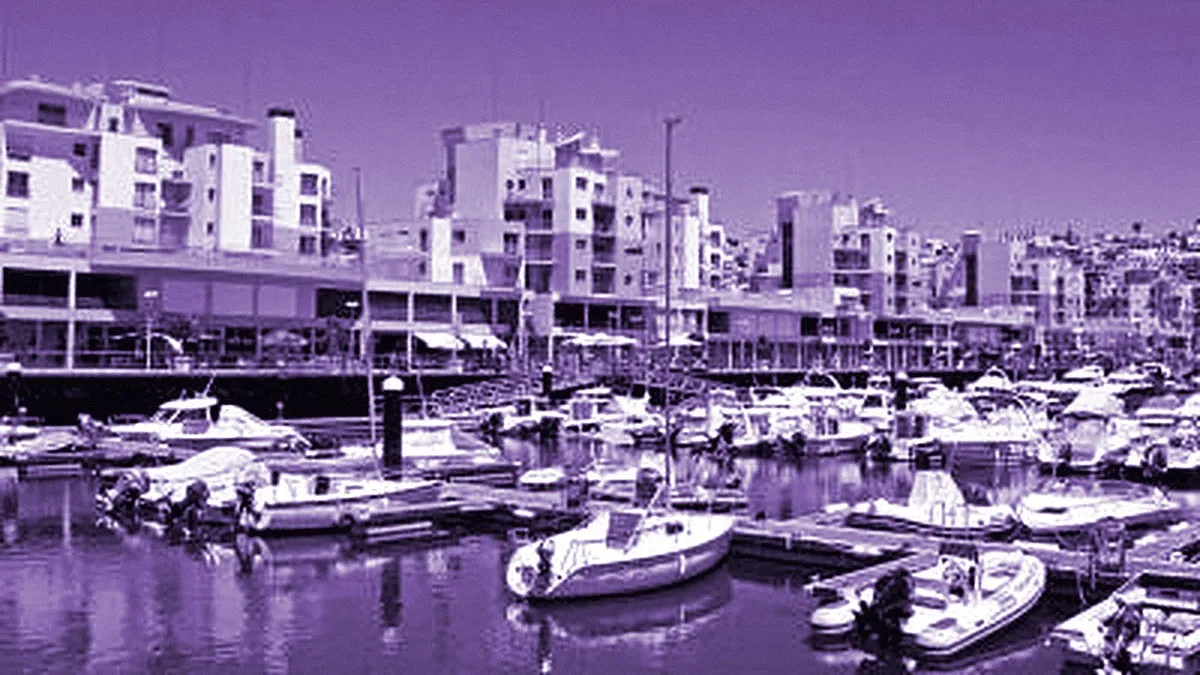
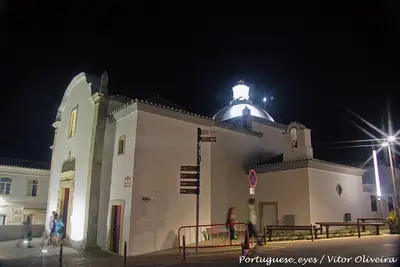
Near Albufeira’s marina, the Ermida de Nossa Senhora da Orada is a chapel with a strong connection to local devotion, particularly among the fishing community. Its origins date to the 15th or early 16th century, and it once formed part of the Convent of Our Lady of Orada.
The chapel was reconstructed in the second half of the 18th century after the 1755 Lisbon earthquake. Inside, ex-voto offerings recall prayers believed to have been answered. The single-nave building has a traditional Algarve design, with a lively pediment and a Neoclassical doorway outside. Its main chapel contains an 18th-century Rococo gilded altarpiece and mural panels depicting acts of divine intercession.
Praia dos Pescadores
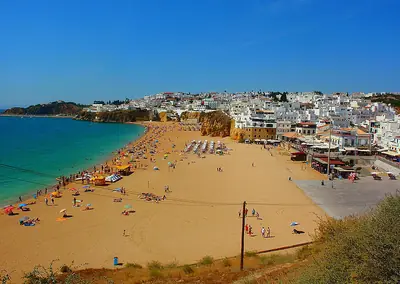
Praia dos Pescadores, or Fishermen’s Beach, lies directly below Albufeira’s old town. For generations, small fishing boats were pulled onto the sand and nets were repaired along the shore. The 1755 earthquake and tsunami reshaped the coastline and destroyed much of the town above, but fishing continued here before tourism gradually changed the beach’s role.
Today, the sand is framed by an amphitheatre of multi-coloured houses to the west and a pier to the east. Its calm waters make it suitable for swimming, although its central location can make it very crowded, particularly in summer.
Praia dos Arrifes
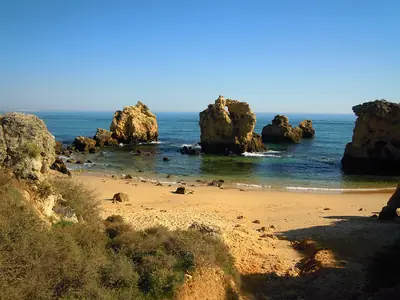
Praia dos Arrifes is a compact cove on Albufeira’s southern Atlantic coast. Three tall rock formations rise from the sea, giving the beach its local name, “Três Penecos.”
Low cliffs surround the golden sand and contain natural pools, arches and galleries carved by erosion. Wooden stairs lead down to the beach, while low tide reveals more tide pools and rocky outcrops. A smaller adjoining beach to the east has further eroded coves and fossilized bedrock.
Praia da Coelha
Praia da Coelha, or Rabbit Beach, is a small cove near Sesmarias. Cliffs and rocky outcrops shelter its golden sand, while the shoreline leads to nearby rock formations and coves.
The protective setting generally keeps the water calm, making the beach suitable for swimming and snorkeling. A wooden boardwalk connects the shore with a beachside restaurant and bar. Care is needed near the base of the cliffs because of the possibility of falling rocks.
Praia do Castelo
West of Albufeira’s old town, Praia do Castelo is enclosed by high, rugged cliffs and pine trees. The name, meaning Castle Beach, is linked either to the castle-like rock at the eastern end or to the remains of a 16th-century watchtower built to defend the coast from Barbary pirate raids.
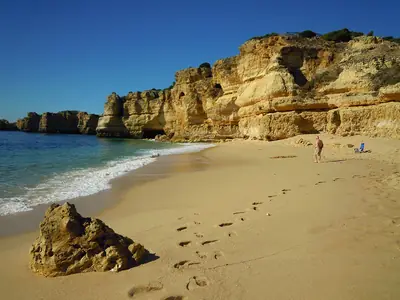
The beach is about 200 metres long, with small coves and inlets formed by erosion. Its golden sand, sheltered setting and generally calm water make it appealing for swimming and snorkeling. At low tide, sea caves, sinkholes and tide pools become visible among the rocks.
Praia de Santa Eulália
Praia de Santa Eulália has a wide shoreline and sheltered corners formed by nearby rock formations. Its calmer atmosphere makes it a quieter alternative to some of the busier beaches around Albufeira, while the sand extends further at low tide.
The beach was designated a Blue Flag beach in 2012. It is often described as a relaxed setting for couples, families and visitors looking for a slower beach day.
Praia dos Alemães and Praia dos Aveiros
Praia dos Alemães, or Germans’ Beach, is a roughly 500-metre-long stretch framed by gently eroded low cliffs and Mediterranean greenery. Its name recalls a German-owned fish canning factory that once operated nearby and was later converted into a hotel. The beach is known for a calmer atmosphere than the busier areas farther west.
Praia dos Aveiros is a smaller Blue Flag beach in the Areias de São João area. It occupies a cove between cliffs and rock formations, close to Praia da Oura and Praia dos Alemães. At low tide, natural pools and small coves appear along the shore.
Explore Albufeira with a free audio guide
Neywo offers two walking tours in Albufeira. The shorter route covers 0.55 kilometres in about 30 minutes and has 5 narrated stops. The longer route covers 2.3 kilometres in about 67 minutes and has 8 narrated stops, linking the old town with Marina de Albufeira, Ermida Nossa Senhora da Orada and Praia dos Pescadores.
With Neywo, each story plays as you reach the place, at your own pace. There is no group and no schedule: the app tells the story of each landmark while you explore independently. Narration is available in 11 languages.
Albufeira is also a useful base for discovering other destinations in the Algarve, including Lagos, Loulé and Faro.
Places with an audio guide in Albufeira
8 places in Albufeira with a Neywo audio guide. Each one starts telling its story as you reach it.
Self-guided tours in Albufeira
1 tour in Albufeira, free in the Neywo app. Each stop tells its story as you reach it.
- Walk
Albufeira old town churches
Half a kilometre through what is left of the town beneath the resort: three churches, a chapel and an eighteenth-century house, all within a few streets of each other above the fishermen's beach.
Marina de Albufeira · Ermida Nossa Senhora da Orada · São Vicente de Albufeira · Igreja Paroquial de Albufeira · Igreja de São Sebastião, Albufeira · Casa Samora correia …
Open this tour: Albufeira old town churches
Walk Albufeira with Neywo
Neywo turns Albufeira into a self-guided audio tour. Stories arrive as you reach the place they belong to, and the route reshapes when you wander off it.

