What to See in Alcobaça, Portugal: Free Audio Guide
Things to Do in Alcobaça: Monastery, Castles and Historic Churches
The best things to do in Alcobaça centre on its extraordinary monastery, historic churches and the ruins of medieval castles in the surrounding area. In this quiet town in the Leiria district of Portugal, monumental religious heritage sits alongside smaller villages and landscapes shaped by the region’s long history. Neywo offers a free audio guide for Alcobaça with 17 narrated places, available in 11 languages.
What to See in Alcobaça
Alcobaça Monastery
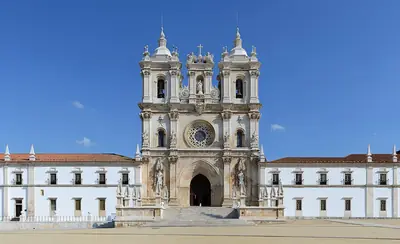
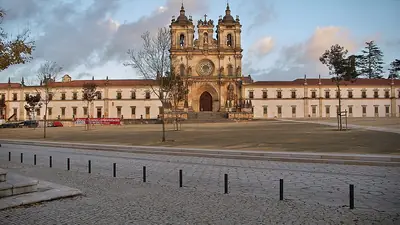
The Monastery of Alcobaça, also known as the Royal Monastery of Santa Maria de Alcobaça, is the city’s essential sight. Construction began in 1178 under the Cistercian Order, and the building is considered the first fully Gothic monument erected in Portugal. Its design reflects the ascetic simplicity associated with Saint Bernard, expressed through the scale of the complex, the clarity of its architecture and the quality of its stonework.
The monastery was founded in the 12th century by Portugal’s first king, Afonso Henriques. It became one of the country’s most important spiritual centres and once presided over a vast clerical territory extending from the Serra dos Candeeiros to the Atlantic Ocean. The complex has been a UNESCO World Heritage Site since 1989, a Portuguese National Monument since 1910 and one of the Seven Wonders of Portugal since 2007.
The monks were forced to leave in 1834, ending the monastery’s religious life. Its architectural character, however, still preserves the sense of simplicity that shaped the original Cistercian foundation.
Alcobaça Abbey
The Alcobaça Abbey forms part of the same historic monastic complex and illustrates the influence the Cistercians once held across the region. Its story began in 1153, when Afonso Henriques granted land to Bernard of Clairvaux, the abbot of the Cistercian Order. Over the centuries, the abbey accumulated land and wealth, including through later royal donations.
The monastery’s former domain covered almost 500 square kilometres and included what is now the municipality of Nazaré, most of Alcobaça and the northern part of Caldas da Rainha. The abbey is therefore not only a monument in the city but also a key to understanding the historical development of the surrounding region.
Castle of Alcobaça
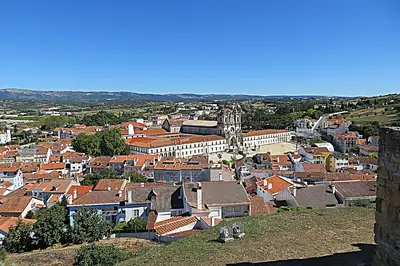
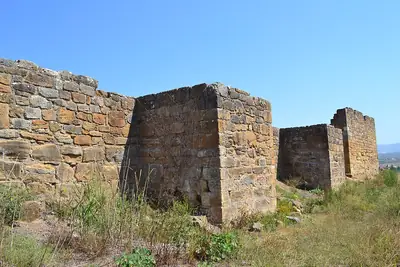
The ruins of the Castle of Alcobaça stand northwest of the town, on the left bank of the Baça River. Although only fragments of the fortress remain, its elevated position provides views across Alcobaça, the monastery, the surrounding countryside and the Candeeiros mountain range.
It is a worthwhile stop for visitors interested in the relationship between the town’s religious centre and its defensive history. The ruined walls also offer a different perspective on the city from the monumental architecture below.
Castle of Alfeizerão
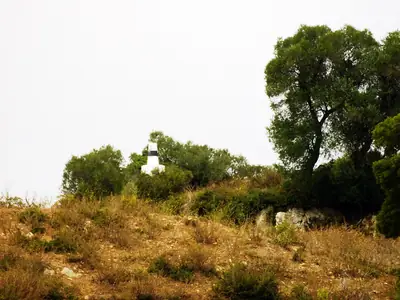
The ruins of the Castle of Alfeizerão occupy a hilltop that once overlooked a seaport. Today, the site is around three kilometres from the bay of São Martinho do Porto, making the location a reminder of how the coastline has changed over the centuries.
The remains are part of the wider historical landscape around Alcobaça, where former religious territories, villages and fortifications connect the inland town with the western coast.
Capela de Nossa Senhora do Desterro
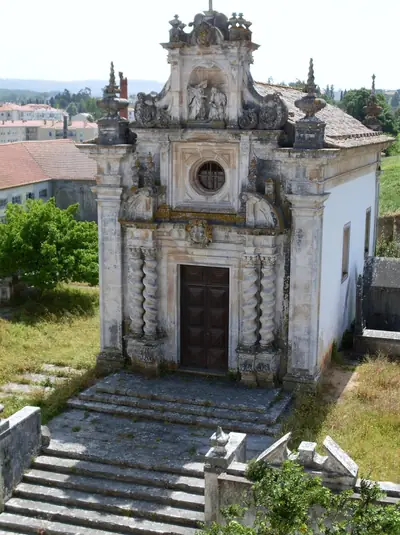
Within the walled grounds of the Alcobaça Monastery, in the Jardim das Murtas, stands the Capela de Nossa Senhora do Desterro. This small Baroque chapel was designed in 1716 by Father Frei Luís de São José and has been classified as a National Monument since 1910.
The chapel is not accessible to visitors and remains closed to the public, but its presence adds another layer to the historic monastery grounds.
Igreja de Nossa Senhora da Ajuda
The Igreja de Nossa Senhora da Ajuda is a cultural heritage monument and a quieter religious landmark in the Alcobaça area. It offers a chance to look beyond the city’s famous monastery and discover the smaller buildings that form part of the region’s architectural heritage.
Igreja de Santa Maria de Cós
The Igreja de Santa Maria de Cós belongs to the former Monastery of Santa Maria de Cós, once known as the Royal Monastery of Santa Maria de Cós and part of the Congregation of Alcobaça. The monastery’s importance was officially recognised when it was classified as a National Monument in 2021.
Its connection with Alcobaça’s monastic congregation makes it an important stop for understanding the wider religious network that developed around the main abbey.
Igreja Paroquial de São Vicente de Aljubarrota
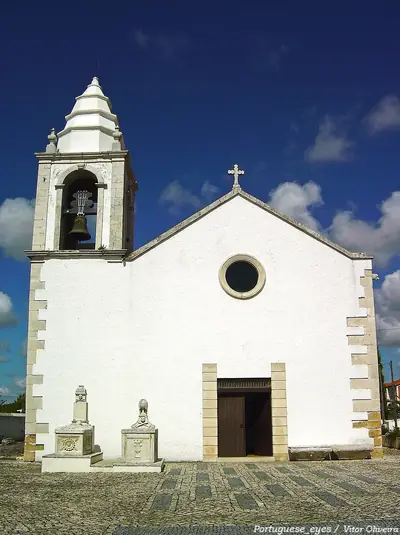
The parish church of São Vicente in Aljubarrota was established in 1549, replacing a smaller 12th-century hermitage dedicated to the same saint. Its simple façade contrasts with its unusual 16th-century bell tower, which is topped by a spire shaped like a papal tiara, with three crowns stacked one above another.
Inside, the Núcleo de Arte Sacra de Aljubarrota presents a collection of sacred art associated with the church and the local community. The church was remodelled in the early 20th century and rebuilt in 1972, with changes to both its interior and exterior.
Igreja Paroquial de Évora-de-Alcobaça
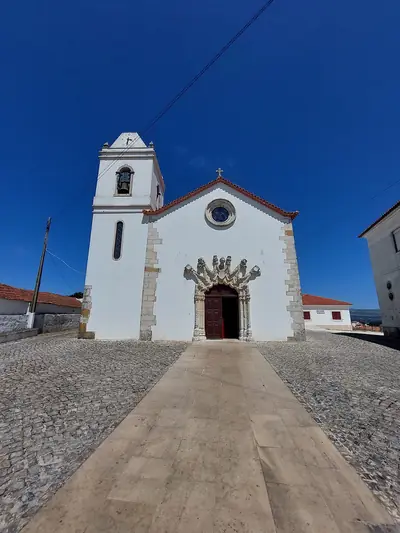
The Igreja de São Tiago is a Gothic parish church later altered in the 16th century. Its main façade features a Manueline portal decorated with plant-like forms, smooth cylindrical columns and a royal coat of arms incorporating a crown, an armillary sphere and the cross of Christ.
The south façade contains an especially distinctive detail: a bas-relief of Saint James as an armoured knight on horseback. The rider’s harness is decorated with scallop shells and crosses, while a sun, half moon and star appear behind him. The church also has a single nave, a wooden ceiling and side chapels.
Smaller heritage landmarks
Several smaller monuments add detail to an exploration of the Alcobaça area. The Igreja Paroquial de Nossa Senhora dos Prazeres is a recognised cultural heritage monument, while the Igreja Paroquial de Alfeizerão is the parish church of São João Baptista.
In Póvoa de Cós, the Capela de Nossa Senhora da Graça is a small chapel built between 1601 and 1637. Its construction was made possible by a legacy from Pêro Neto, a local man born in the village.
The Pelourinho de Alfeizerão, classified as a Property of Public Interest since 1933, is another historic landmark. In Alpedriz, the village pillory recalls the settlement’s royal charters, first granted in 1150 and renewed in 1515. The exact construction date of the surviving pillory is unknown.
Explore Leiria and the Surrounding Region
Alcobaça makes a rewarding base for discovering the wider Leiria region. Nearby Nazaré adds a coastal dimension to an itinerary, while Óbidos offers another historic town to explore. For a broader journey, see the Portugal destination guide.
Explore Alcobaça with Neywo
Neywo’s free audio guide for Alcobaça includes 17 narrated places. The app tells the story of each site as you reach it, at your own pace, with no group and no schedule. It is a simple way to explore the monastery, churches, castles and smaller heritage landmarks while keeping your attention on the city around you.
Places with an audio guide in Alcobaça
8 places in Alcobaça with a Neywo audio guide. Each one starts telling its story as you reach it.
Walk Alcobaça with Neywo
Neywo turns Alcobaça into a self-guided audio tour. Stories arrive as you reach the place they belong to, and the route reshapes when you wander off it.

