Things to Do in Guimarães, Portugal: Walking Guide
Things to Do in Guimarães: A Walk Through Portugal’s Medieval Heritage
The best things to do in Guimarães include exploring its medieval castle, historic squares, Gothic churches and museums. Traditionally regarded as the birthplace of Afonso Henriques, Portugal’s first king, the city is known as the “Cradle of Portugal” and offers a remarkably concentrated journey through the country’s early history. Neywo has a free audio guide for Guimarães with 46 narrated places, available in 11 languages.
Guimarães lies in the region of Braga, in northern Portugal. Its historic center combines stone lanes, arcaded squares and religious monuments with the atmosphere of a living city. The Battle of São Mamede in 1128 is associated with Portugal’s movement towards independence, while the city’s monuments preserve much older and later chapters of its story.
What to See in Guimarães
Castle of Guimarães
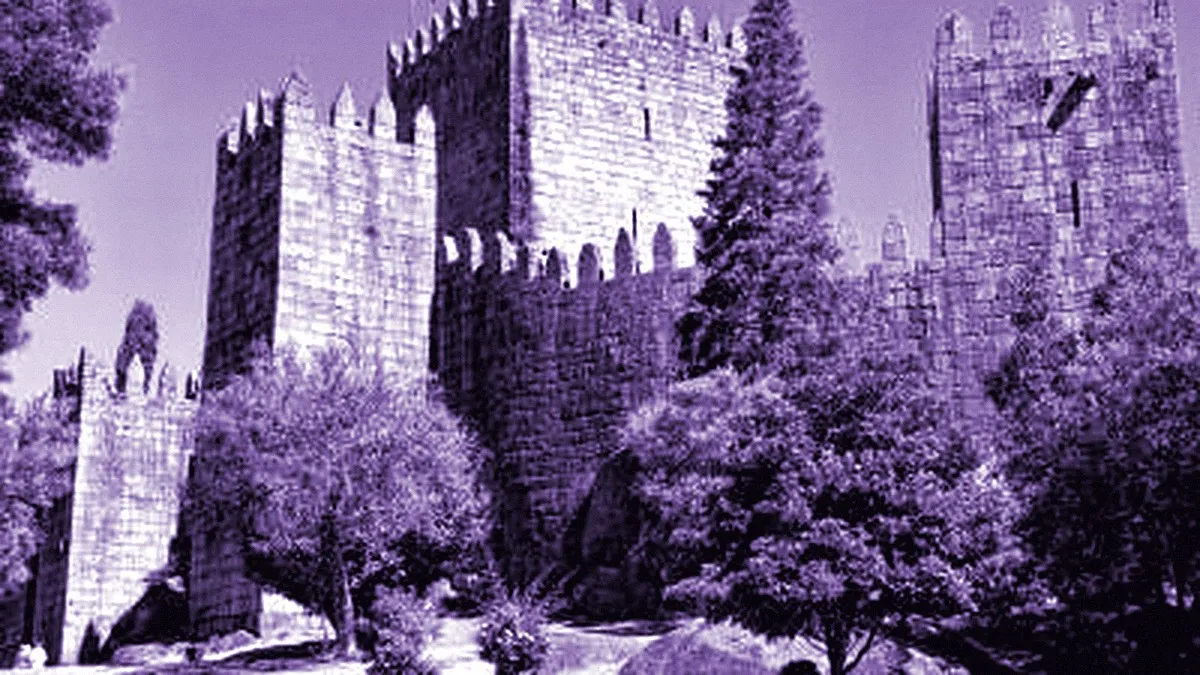
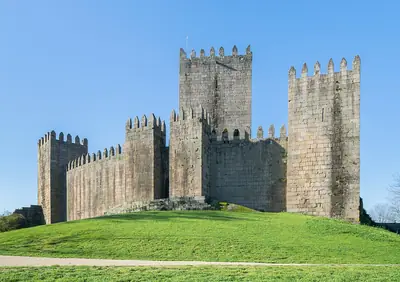
Begin with the Castle of Guimarães, standing above the Campo de São Mamede. Its history reaches back to around 968, when Mumadona, Countess of Galicia, ordered a castle to be built to protect the local population from Viking raids from the north and Muslim forces from the south.
When Count Henry took charge of the Portucalense province, he ordered a larger and more heavily fortified structure. The castle’s square keep and four corner towers show the defensive design of this medieval stronghold. Its association with the foundation of the County of Portugal and the struggles for independence explains why it is popularly called the cradle of the nation.
Church of São Miguel do Castelo
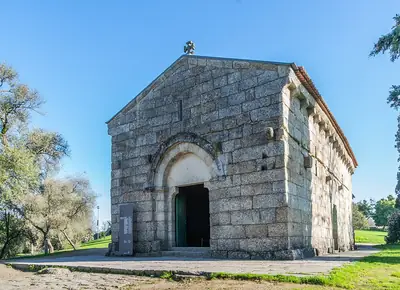
A short distance from the castle stands the Church of São Miguel do Castelo, a small late-Romanesque building whose forms already anticipate the Gothic period. It was commissioned by the Collegiate Church of Our Lady of Oliveira and consecrated in 1239 by Silvestre Godinho, the primate of Braga.
The church later fell into ruin before being restored in the nineteenth century by the Martins Sarmento Society. A famous tradition says that Afonso Henriques was baptized here, although the story is considered unfounded because the present church dates from the thirteenth century. The baptismal font connected with the tradition remains inside.
Palace of the Dukes of Braganza
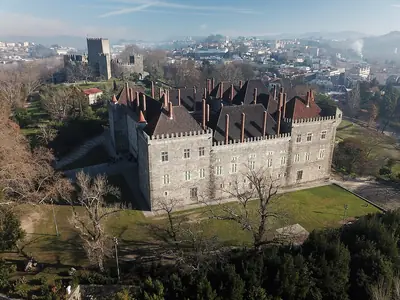
The Palace of the Dukes of Braganza connects Guimarães with Portugal’s regal history. Known in Portuguese as the Paço dos Duques de Bragança, it was commissioned in the fifteenth century by D. Afonso, the first Duke of the House of Braganza and the eighth Count of Barcelos.
The palace was mainly inhabited during the fifteenth century, then gradually abandoned and left in ruin. A major reconstruction took place between 1937 and 1959, following a project by architect Rogério de Azevedo. Today, its first floor houses a museum, the second floor of the main façade includes an area intended for the Presidency of the Republic, and the ground floor hosts cultural activities.
Rua de Santa Maria and the medieval squares
Walking through Rua de Santa Maria is one of the simplest ways to experience Guimarães’s historic center. The street links different parts of the old town and passes historic buildings, including the former Santa Clara convent.
Continue towards Largo da Oliveira and Praça de São Tiago, where the city’s medieval character is especially concentrated. Beneath the stone canopy beside the Church of Nossa Senhora da Oliveira stands the Padrão do Salado, a fourteenth-century monument commemorating the Battle of Salado, fought in 1340. Portuguese and Castilian forces defeated forces from Granada and North Africa in that battle.
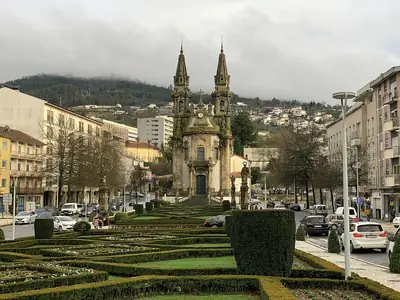
Nearby, the Cruzeiro da Senhora da Guia is associated with the Church of Nossa Senhora da Oliveira. The church developed from a monastery founded by Countess Mumadona Dias in the tenth century and later became a collegiate church. Its present form is one of the notable examples of northern Portugal’s Gothic architecture, and the building is recognized as a National Monument.
Convento e Igreja de São Francisco
The Church and Convent of Saint Francis brings together medieval origins and rich Baroque decoration. King Dinis ordered the original church beside the medieval wall to be demolished in 1325. King João I later authorized its reconstruction on the present site, a process that lasted 75 years.
The interior was extensively transformed in the eighteenth century with carvings, tiles, paintings, sculptures and other sacred art. After religious orders were dissolved in 1834, the church was given to the Third Order of Saint Francis. The sacristy contains an Italian Renaissance-style marble table with colorful inlays.
Museums and cultural places
The Alberto Sampaio Museum forms part of the historic ensemble around Largo da Oliveira and the Church of Nossa Senhora da Oliveira. The wider religious complex grew into an important center on the Iberian Peninsula during the Middle Ages, helped by pilgrims travelling to Santiago de Compostela. The church also preserves the memory of King João I and his connection with the Battle of Aljubarrota.
The Museu da Sociedade Martins Sarmento belongs to an institution founded in 1881 in honor of Francisco Martins Sarmento. The Sociedade Martins Sarmento oversees two museums, a library and a newspaper archive, and has published the Revista de Guimarães since 1884.
For a broader view of Guimarães’s cultural life, look for Palácio de Vila Flor, an elegant eighteenth-century palace. The city’s cultural circuit also includes the Teatro Jordão and the Centro Internacional das Artes José de Guimarães.
Padrão de D. João I
Opposite the Chapel of São Lázaro, the Padrão de D. João I commemorates the Battle of Aljubarrota. Tradition places its origins in 1386 or the following year, after King João I entered Guimarães.
The monument standing today is not the original fourteenth-century structure. Its form dates from the first half of the sixteenth century and may have been created after a charter granted by King Manuel I in 1517.
Igreja Matriz de São Martinho de Candoso
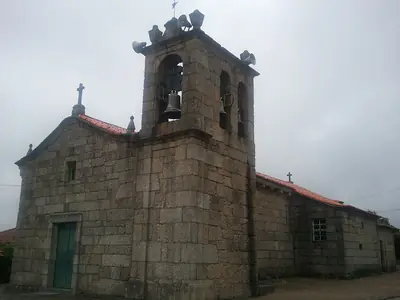
Outside the central historic ensemble, the Igreja Matriz de São Martinho de Candoso is a National Monument and one of Portugal’s Romanesque buildings. It is counted among the 203 Romanesque buildings identified across Portugal, making it a notable example of the country’s architectural heritage.
Paço de São Cipriano and Santa Marinha da Costa
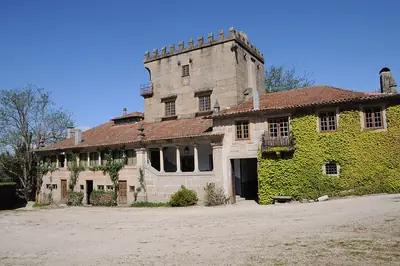
The fifteenth-century Paço de São Cipriano, in Tabuadelo and São Faustino, is a historic manor surrounded by richly planted gardens. Its sober architecture and peaceful setting make the gardens an important part of the visit.
On the slope of Penha, the former Mosteiro de Santa Marinha da Costa overlooks Guimarães. The old monastic complex now houses the Pousada de Guimarães, Santa Marinha, and combines a historic religious setting with a hillside landscape. The monastery and church were classified as Property of Public Interest in 1936.
Citânia de Briteiros
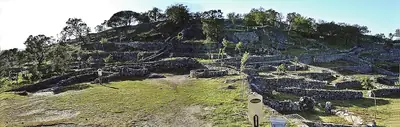
For a look further back than medieval Guimarães, visit Citânia de Briteiros, one of Portugal’s major archaeological sites. The Iron Age settlement occupies São Romão Hill and preserves the remains of a fortified community organized with streets, lanes, houses, public areas, defensive walls, bathing buildings and a central meeting building.
The excavated area measures roughly 240 by 300 meters and is enclosed by three lines of walls. Stone foundations, paved routes, water channels and drainage grooves remain visible, while two reconstructed round houses with thatched roofs help illustrate the settlement’s appearance. Citânia de Briteiros reached its height between the second and first centuries before Christ and declined after the Roman conquest.
Citânia de Sabroso
Nearby Citânia de Sabroso, also known as Castro de Sabroso, preserves another ancient fortified settlement on the wooded slopes of Monte do Couto de Sabroso. Its walls and the remains of about 39 circular and rectangular houses belong mainly to an Iron Age community occupied between approximately 800 and 300 before Christ.
Some wall sections still rise to four meters, making Sabroso one of the most monumental pre-Roman settlements in northern Portugal. Roman-period remains are rarer here than at Citânia de Briteiros, and the settlement was eventually abandoned during the process of Romanization.
Explore Guimarães with Neywo
Neywo’s Guimarães audio guide includes two walking tours and one bus route, covering 46 narrated places in total. The walks are:
- Cradle of the Nation: Castle, Palace and Medieval Squares — 1.74 km, 95 minutes and 11 stops.
- European Capital of Culture: Theatres, Archaeologists and Art — 2.28 km, 83 minutes and 10 stops.
There is also the bus route Linha Cidade: Guimabus 004 Through the Cultural Quarter, covering 2.9 km in 12 minutes with five stops.
Download Neywo and explore Guimarães at your own pace. The app tells the story of each place as you reach it, with no group and no schedule.
Places with an audio guide in Guimarães
8 places in Guimarães with a Neywo audio guide. Each one starts telling its story as you reach it.
Self-guided tours in Guimarães
3 tours in Guimarães, free in the Neywo app. Each stop tells its story as you reach it.
- Bus ride
Linha Cidade: Guimabus 004 Through the Cultural Quarter
Guimabus's city loop runs from the House of Memory through the Capital-of-Culture quarter, past the archaeological society, Teatro Jordão and Vila Flor Palace, then out to the old market square under Penha. An everyday local bus, a cheap way to cover the town beyond the castle.
Casa da Memória de Guimarães · Sociedade Martins Sarmento · Teatro Jordão · Palácio de Vila Flor · Largo da República do Brasil
Open this tour: Linha Cidade: Guimabus 004 Through the Cultural Quarter - Walk
Cradle of the Nation: Castle, Palace and Medieval Squares
Portugal says it was born in Guimarães. Climb from the castle where Afonso Henriques is said to have been born, past the Romanesque chapel and the Dukes' palace, then drop down the oldest street in town to the cobbled squares of São Tiago and Oliveira. Finish at the old market square under Penha mountain and two quiet churches on the way out. A UNESCO World Heritage old town, all within a leisurely two hours.
Castle of Guimarães · Church of São Miguel do Castelo · Palace of the Dukes of Braganza · Rua de Santa Maria · Praça de Sao Tiago, Guimaraes · Padrão do Salado …
Open this tour: Cradle of the Nation: Castle, Palace and Medieval Squares - Walk
European Capital of Culture: Theatres, Archaeologists and Art
From the baroque Misericórdia and the Toural, the town's living-room square, to the creative quarter that made Guimarães European Capital of Culture in 2012. Visit a theatre by the architect of Porto's Rivoli, an eighteenth-century palace, two churches, the archaeological society that unearthed the hill forts, a museum of African and Chinese art, the House of Memory and a monument to a royal victory.
Edifício da Misericórdia de Guimarães (conjunto da parte setecentista, incluindo a igreja, a sacristia e os restos da construção inicial) · Largo do Toural · Teatro Jordão · Palácio de Vila Flor · Igreja de São Sebastião · Igreja de São Domingos (Guimarães) …
Open this tour: European Capital of Culture: Theatres, Archaeologists and Art
Walk Guimarães with Neywo
Neywo turns Guimarães into a self-guided audio tour. Stories arrive as you reach the place they belong to, and the route reshapes when you wander off it.

