What to See in Óbidos, Portugal: Free Audio Guide
Things to do in Óbidos: what to see in the medieval town
Looking for things to do in Óbidos? This hilltop town in the Leiria region of Portugal is known for its castle, fortified walls, historic churches, and compact medieval streets. Its landmarks reveal layers of Roman, medieval, royal, religious, and civic history, making Óbidos a rewarding place to explore on foot.
Neywo has a free audio guide for Óbidos with 12 narrated places, available in 11 languages. Each story begins as you reach the place, so you can discover the town at your own pace.
What to see in Óbidos
Village Gate and the historic town
The Village Gate, or Porta da Vila, is the main entrance into Óbidos’s historic urban ensemble. Its two staggered entrances were designed to prevent a direct cavalry charge, a feature associated with Portuguese Gothic castles.
Between the gateways, a balcony once served as an oratory. Blue-and-white tile panels from 1740 depict scenes from the Passion of Christ and include an inscription dedicated to Our Lady of Sorrows, the town’s patron saint. The ceiling above is decorated with a painted crown of thorns.
After passing through the gate, steps on the left lead towards the walls. The climb offers panoramic views across the town.
Rua Direita
The Village Gate opens onto Rua Direita, Óbidos’s main street. It leads through the centre of the walled town and connects several of its most important historic sites.
The street provides a natural route for exploring Óbidos on foot, with the town’s churches, civic buildings, and castle unfolding along and around it.
Church of Santa Maria
The Church of Santa Maria stands in Óbidos’s main square and is the town’s principal church. Its origins are uncertain: tradition connects the site with the Visigothic period and later with a mosque during the Muslim occupation. The first firmly recorded moment came in 1148, when D. Afonso Henriques consecrated the church after the conquest of Óbidos.
Much of the medieval building was transformed between the late fifteenth and early sixteenth centuries. The church has three naves, with the central nave higher than the others, and arches resting on Doric columns. Among its surviving features are the bell tower and the Chapel of Nossa Senhora da Piedade, which contains a tomb by Nicolau Chanterene holding the remains of D. João de Noronha and D. Isabel de Sousa.
A major reconstruction began on 15 August 1571 after the church had been threatened with ruin, possibly following an earlier earthquake.
Church of Saint Peter and the Chapel of Saint Martin
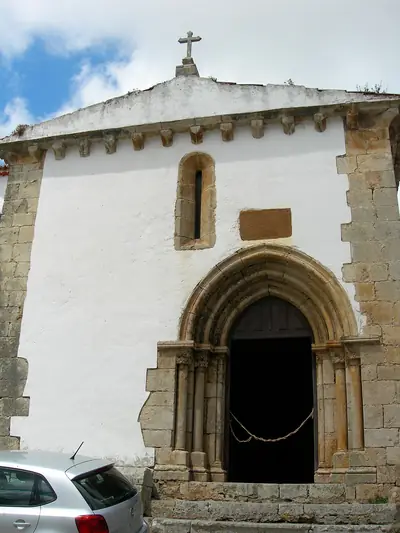
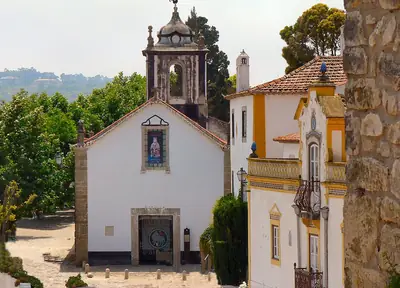
The Parish Church of Saint Peter began as a Gothic building in the thirteenth century and was altered repeatedly over the centuries, particularly after the earthquakes of 1531 and 1755.
Its entrance dates from the seventeenth century, while much of the interior is eighteenth-century. The richly gilded retable, made between 1690 and 1705, is a notable example of Portuguese Baroque craftsmanship. The side altars are dedicated to Our Lady of Piety, Our Lady of the Rosary, and Our Lady of Fátima.
Next to the church is the Gothic Chapel of Saint Martin, adding another historic religious site to the same setting.
Church of Saint James
The Church of Saint James was established in 1186 by decree of King Sancho the First. Built within the castle walls, it served as a Gothic sanctuary for the royal family during visits to Óbidos and welcomed pilgrims travelling to Santiago de Compostela.
The 1755 earthquake destroyed much of the church. After its rebuilding in 1772, the orientation was changed so that it faced Rua Direita. Today, the former church houses the Livraria de Santiago, where the space once occupied by the altar is lined with books in several languages. The building also hosts literary events, discussions, and book signings.
The original sixteenth-century retable depicting Saint James is now displayed in the Municipal Museum.
Pillory and Municipal Museum
The Pillory of Óbidos is a cylindrical limestone monument and a symbol of the town’s medieval justice system. It has been classified as a National Monument since 1910.
Its decoration includes the royal arms on one side and the camaroeiro of Queen Leonor on the other. The latter commemorates the net fishermen used to bring her son to her after his death in a hunting accident.
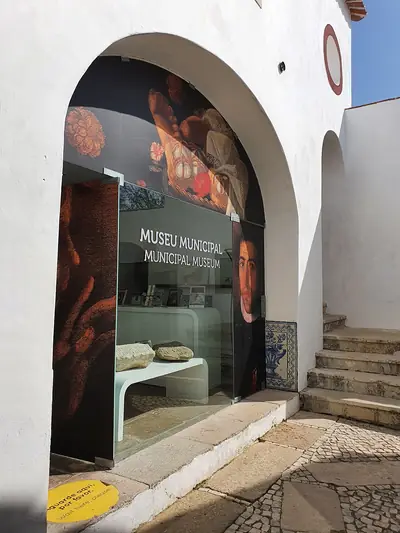
The Municipal Museum occupies a former sixteenth-century prison. Its collection includes archaeological objects, religious art, paintings, decorative pieces, antique furniture, household items, and religious statues. Medieval tapestries showing scenes from the life of Saint Peter are among its highlights; they once hung in Óbidos Castle.
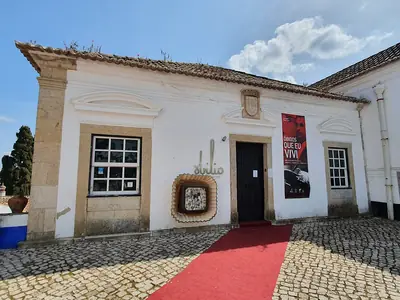
The nearby House of the Chain Arch, or Casa do Arco da Cadeia, was the Town Hall in the fourteenth and fifteenth centuries before becoming a prison. Its Gothic arch and windows make it one of the area’s distinctive civic buildings. In the twentieth century, it became the residence of painter and scenographer Abílio de Matos e Silva, and parts of his home formed the original site of the Municipal Museum.
Church of Mercy
The Church of Mercy was formerly known as the Chapel of the Holy Spirit. Its story began in 1498, when Queen Leonor founded the local almshouse. The chapel became a refuge for sick and impoverished people, and it was rebuilt in the seventeenth century as both a place of worship and a sanctuary for the poor and infirm.
Óbidos Castle
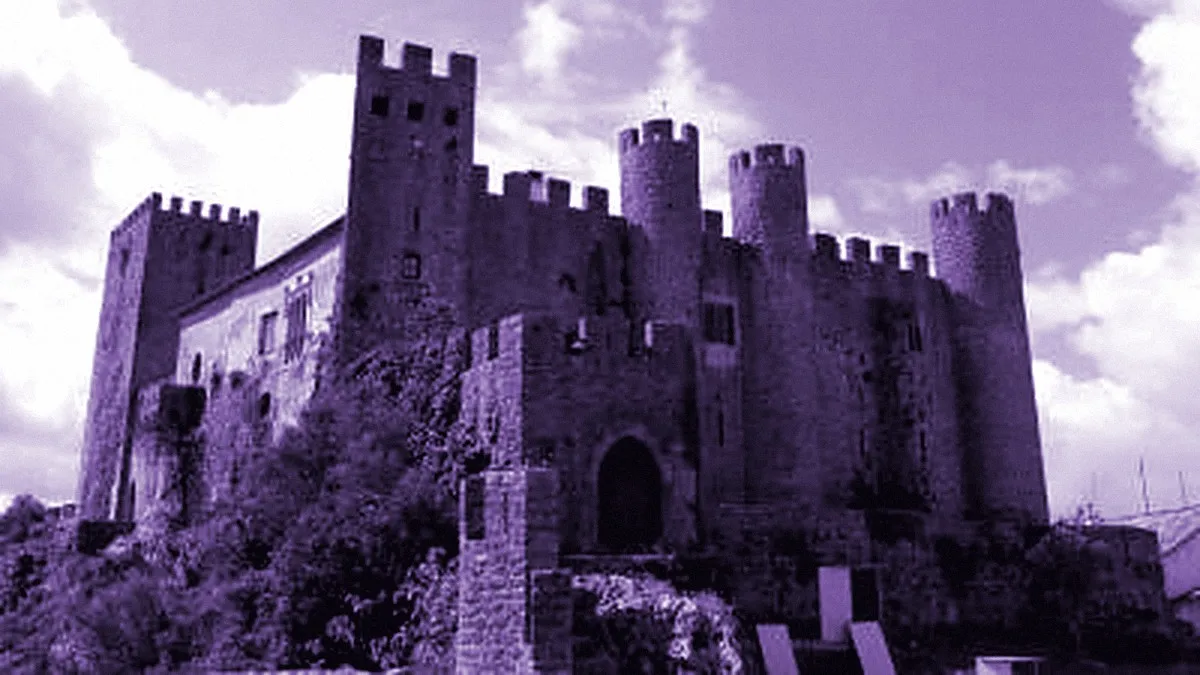
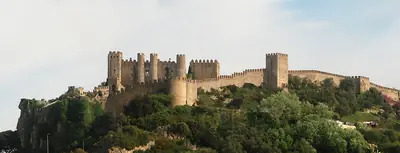
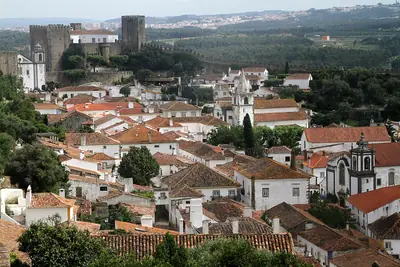
At the highest point of the town, Óbidos Castle brings together defensive walls, towers, and the former Palace of the Alcaides. Built in the twelfth century on a small hill, the castle was later altered through several architectural campaigns.
Its trapezoidal form, crenellated walls, towers, and defensive projections reflect the importance of fortification here. Romanesque, Gothic, Baroque, and Manueline elements can all be identified in the ensemble. The defences include towers associated with Dom Dinis and Dom Fernando, a barbican, and rounded and rectangular corbels. A wall dividing the courtyards contains an elegant rectangular arch known as the Tower of Albarrã.
The former medieval castle now also houses the Pousada Castelo de Óbidos, a hotel belonging to the Pousadas de Portugal network and classified as a Historic Pousada. From the castle, views extend across the surrounding plain and the River Arnoya.
Óbidos Aqueduct
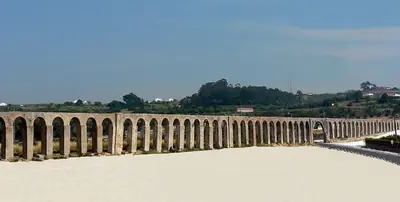
The Óbidos Aqueduct, also known as the Aqueduct of Usseira, is a sixteenth-century work of historic engineering. It crosses the landscape through the parish areas of Santa Maria, São Pedro, and Sobral da Lagoa, within the town and municipality of Óbidos.
Its length and practical design offer a different perspective on the town’s past, beyond the castle and its religious buildings.
Eburobrittium
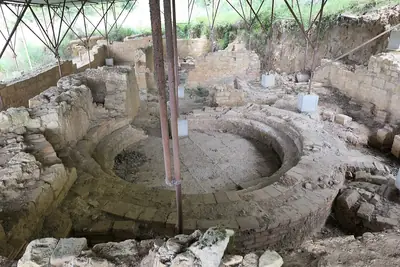
Near the Church of Senhor da Pedra in Gaeiras, the archaeological remains of Eburobrittium reveal a much older chapter in the region’s history. This Roman city was situated between Olissipo, present-day Lisbon, and Collipo, present-day Golpilheira.
Its location was unknown for centuries until road construction brought Roman remains to light in 1994. The city is thought to have been founded during the time of Augustus, at the end of the first century BC, and to have survived until the second half of the fifth century AD.
Archaeologists uncovered the forum in 1995, although the full extent of the residential areas remains unknown. The site also contains remains of two medieval buildings, showing how the location was reused after the Roman period.
A-da-Gorda and its historic chapels
Outside the walled centre, Largo de Santo António is one of the main gathering places in the village of A-da-Gorda. The square brings together religious, civic, cultural, and recreational life in a traditional Portuguese village setting.
Other heritage stops include the Palácio da Vigararia, Capela de São Martinho, and Capela de São Vicente dos Gafos.
Explore Óbidos with a self-guided walking tour
Neywo’s Inside the Queen’s Gift: Walled Óbidos from Gate to Castle is a 0.77 km walking tour lasting 57 minutes, with 8 narrated stops. It follows the Village Gate and the historic town, the Palácio da Vigararia, the Parish Church of Saint Peter, the pillory, the Town Hall and prison, the Church of Santa Maria, the Church of Saint James, and Óbidos Castle.
Download Neywo and explore Óbidos with a self-guided walking tour: the app tells the story of each place as you reach it, at your own pace, with no group and no schedule. If you are continuing through the region, you can also discover Nazaré, Alcobaça, or the city of Leiria.
Places with an audio guide in Óbidos
8 places in Óbidos with a Neywo audio guide. Each one starts telling its story as you reach it.
Self-guided tours in Óbidos
1 tour in Óbidos, free in the Neywo app. Each stop tells its story as you reach it.
- Walk
Inside the Queen's Gift: Walled Óbidos from Gate to Castle
Óbidos was given to queens as a wedding present, and this walk follows Rua Direita from the zigzag Village Gate up to the castle. On the way you see a pillory carved with a queen's grief, a tiled Church of Mercy, a church turned into a bookshop and the walls that once guarded a royal town.
Castelo de Óbidos e todo o conjunto urbano da vila · Palácio da Vigararia · Igreja Paroquial de São Pedro de Óbidos · Pelourinho de Óbidos · Câmara Municipal e Cadeia de Óbidos · Igreja de Santa Maria de Óbidos …
Open this tour: Inside the Queen's Gift: Walled Óbidos from Gate to Castle
Walk Óbidos with Neywo
Neywo turns Óbidos into a self-guided audio tour. Stories arrive as you reach the place they belong to, and the route reshapes when you wander off it.

