Visiting Sintra, Portugal: Top Sights on Foot
Things to Do in Sintra: Palaces, Castles and Romantic Landscapes
Sintra is a historic town in the Serra de Sintra, known for Romanticist palaces, a Moorish hilltop fortress, mystical gardens and dense mountain scenery. The town’s cultural landscape is a UNESCO World Heritage Site, making it one of the most rewarding places to visit near Lisbon. Neywo has a free audio guide for Sintra with 81 narrated places.
What to See in Sintra
Pena Palace
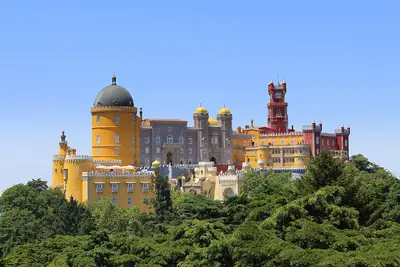
Pena Palace is Sintra’s most famous landmark, perched on a hill above the town. Built in the nineteenth century, it is regarded as one of the major expressions of Romanticist architecture worldwide and was the first palace of its kind in Portugal.
Its colorful, theatrical design stands among the Sintra Mountains, with views over the town and, on a clear day, as far as Lisbon and much of its metropolitan area. Pena Palace is a UNESCO World Heritage Site, one of the Seven Wonders of Portugal and a National Monument since 1910.
Castle of the Moors
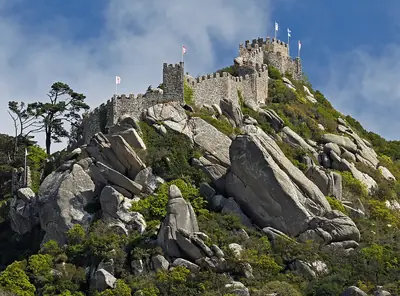
The Castle of the Moors, or Castelo dos Mouros, follows the rocky ridge above Sintra. The Moors built the fortress in the eighth and ninth centuries, and it later became an important stronghold during the Reconquista before falling to Christian forces after the capture of Lisbon in 1147.
The castle walls stretch across an isolated peak in the Serra de Sintra. Their position creates broad views over the surrounding countryside and towards the Atlantic Ocean. The site has been protected as a Portuguese cultural heritage monument since 1910 and forms part of Sintra’s UNESCO-listed Cultural Landscape.
Sintra National Palace
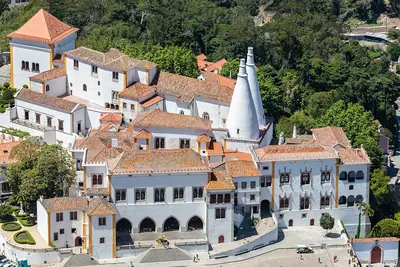
In the historic center, Sintra National Palace—also known as the Palácio da Vila—was once a royal residence and is now a historic house museum owned by the Portuguese state.
The palace developed over several centuries, bringing together medieval, Gothic, Manueline, Renaissance and Romantic elements. Courtyards, staircases, corridors and galleries connect sections that might otherwise appear separate. The building also incorporates an older structure from the Muslim period.
Its royal history is unusually rich. The Portuguese royal family used the palace almost continuously until the end of the monarchy in 1910. King Manuel I received news here of the discovery of Brazil; King Afonso V was born and died here; King Afonso VI was imprisoned here; and King John II was acclaimed king here.
Quinta da Regaleira
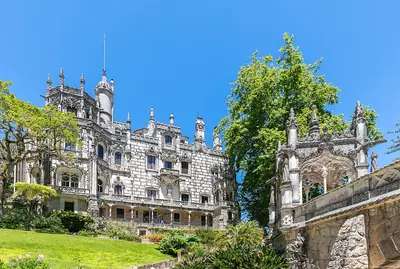
Quinta da Regaleira is a historic estate on the slopes of the Serra de Sintra, recognized for its mystical atmosphere and symbolic gardens. The property covers about four hectares and forms part of Sintra’s UNESCO World Heritage landscape.
Its architecture combines Romantic eclecticism with strong neo-Manueline influences, as well as neo-Gothic and neo-Renaissance elements. Construction began in 1904 and ended around 1910. António Augusto de Carvalho Monteiro commissioned the estate, which was designed by the Italian architect Luigi Manini.
The gardens and buildings contain symbols associated with alchemy, freemasonry, the Knights Templar and the Rosicrucian tradition. Lakes, grottoes, wells, fountains, benches and underground paths are woven into the dense vegetation, making the estate one of the most distinctive places to explore in Sintra.
Monserrate Palace
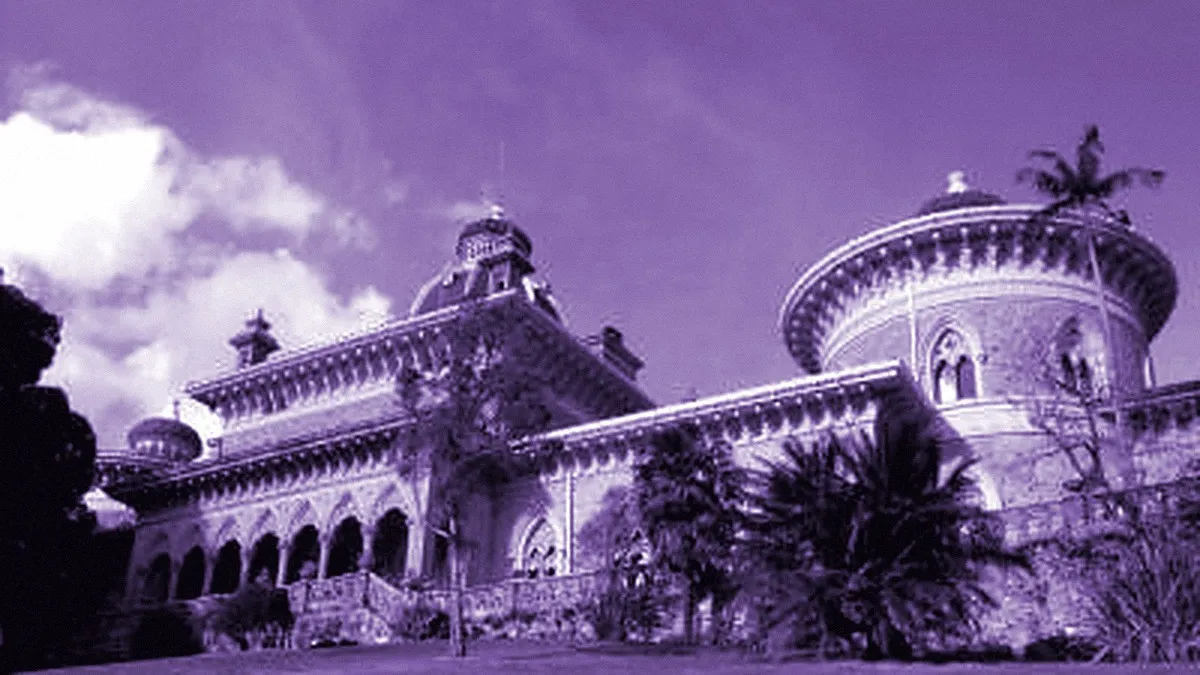
Monserrate Palace is a Romantic villa in the hills of Sintra, built as a summer estate for the English textile magnate Francis Cook, Viscount of Monserrate. Its circular tower, domes and exotic façade decorations give it an especially distinctive appearance.
Architect James Knowles designed the palace in 1858 on the ruins of an earlier neo-Gothic mansion built by the English merchant Gerard de Visme. Lord Byron visited that earlier mansion in 1809 and later praised its beauty in Childe Harold’s Pilgrimage.
Convent of the Capuchos
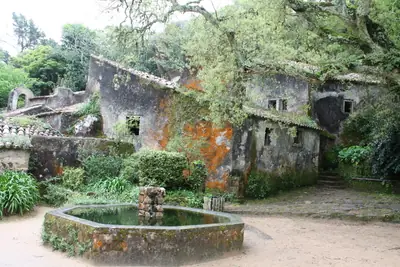
The Convent of the Capuchos, also called Convento da Santa Cruz, is a small Franciscan retreat built into the Sintra mountains. Founded in the sixteenth century for friars of the Strict Observance, it was linked to the Portuguese Viceroy of India, D. João de Castro, and his family.
The complex consists of modest cells and communal spaces fitted into the rocky landscape. Its austere architecture and cramped, intimate rooms reflect the simplicity of the reclusive clergy who lived there for centuries, until religious orders were abolished in Portugal.
Chalet da Condessa de Edla
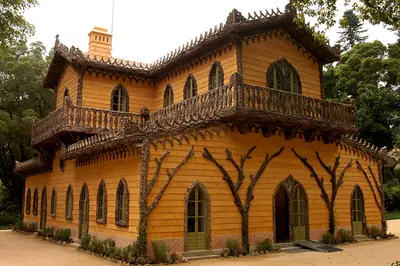
The Chalet of the Countess of Edla, also known as Casa do Regalo, stands on the western side of the park surrounding Pena Palace. Its location makes it a natural companion to a visit to the palace and its grounds.
Palace of Queluz
The Palace of Queluz lies in the town of Queluz and is one of the last great Rococo palaces built in Europe. Its ornamental façades have earned it the nickname “the Portuguese Versailles.”
Work began in 1747 under the architect Mateus Vicente de Oliveira. Queluz later became the official residence of Prince Regent João VI and his family, a role it retained until the royal court fled to Brazil in 1807 following the French invasion. The palace passed into state ownership in 1908, and after a serious fire in 1934, extensive restoration returned it to public use.
Convento da Penha Longa
The Convento da Penha Longa is a former monastery of the Order of St. Jerome. Its church, the Igreja da Penha Longa, has been protected as a National Monument since 1910, as has the wider convent ensemble.
The church was built through successive campaigns from the fifteenth to the eighteenth century. Dedicated to Nossa Senhora da Saúde, it has a Latin-cross plan, a single nave, a narthex, a narrow vestibule with ogival arches and lateral chapels opening onto the nave.
Sintra’s Archaeological Heritage
Sintra’s heritage extends beyond palaces and monasteries. Near Belas, the Anta da Estria is a Late Neolithic and early Chalcolithic dolmen dating roughly from 4000 to 2500 BC. The polygonal chamber is reached by a limestone-lined corridor, and excavations uncovered arrowheads, bone artifacts and pottery.
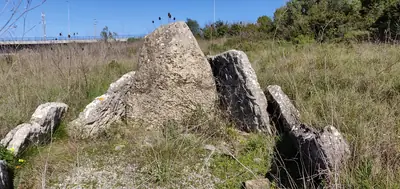
The Anta do Senhor da Serra is another prehistoric dolmen near Belas, dating from approximately the same period. Its chamber is formed by three large upright stones. The site was recorded by the geologist Carlos Ribeiro in 1856, excavated in 1876 and protected as a national monument in 1910.
At Catribana, the Roman ensemble includes a paved road, a single-arch limestone bridge over the Bolelas stream and the remains of watermills. The bridge was restored most recently in 2019, and traces of a Roman-era cemetery and a Neolithic settlement reveal the area’s long history of human activity.
The Tholos do Monge is another cultural heritage monument in Sintra. At the Ponte Filipina de Carenque de Baixo, a seventeenth-century stone bridge still carries an inscription dated 1631, when it was built under the Lisbon Senate as part of the historic Royal Road between Lisbon and Sintra.
Explore Sintra with a Free Audio Guide
Neywo offers three walking tours and one bus route in Sintra, with narration available in 11 languages. Each story plays as you reach the place, at your own pace, with no group and no schedule.
- Pink Palaces and a Moorish Ridge: Sintra’s Greatest Hits — a 2.93 km walk lasting 112 minutes, with 6 narrated stops.
- Sintra Vila Slow: Fountains, Clock Tower and Small Museums — a 1.02 km walk lasting 51 minutes, with 6 narrated stops.
- The Romantic Hill: Pena Palace and the Countess’s Chalet — a 1.87 km walk lasting 75 minutes, with 4 narrated stops.
- Bus 434: The Pena Circuit from Sintra Station — a 7 km bus route lasting 30 minutes, with 5 narrated stops.
Download Neywo and explore Sintra while the app tells the story of each palace, fortress, church or historic site as you reach it. It is a free, self-guided way to discover the town, whether you are planning a Sintra self-guided walking tour or adding Sintra to a wider trip through Portugal.
Places with an audio guide in Sintra
8 places in Sintra with a Neywo audio guide. Each one starts telling its story as you reach it.

Self-guided tours in Sintra
4 tours in Sintra, free in the Neywo app. Each stop tells its story as you reach it.
- Bus ride
Bus 434: The Pena Circuit from Sintra Station
Scotturb's one-way loop 434 leaves Sintra station for the hilltop Moorish Castle and Pena Palace, then returns through the old town. Hop on to see Casa do Cipreste, the town's Gothic church and the villas, museums and sculptures of the historic centre, with the two hilltop monuments on the same route.
Casa do Cipreste, incluindo a cerca · Igreja de Santa Maria (Sintra) · Casa Biester · NewsMuseum · Museu Anjos Teixeira
Open this tour: Bus 434: The Pena Circuit from Sintra Station - Walk
Pink Palaces and a Moorish Ridge: Sintra's Greatest Hits
One walk through the heart of the UNESCO landscape: a pink neoclassical palace, the mystical gardens of Regaleira, a hillside villa covered in frescoes, the royal palace in town where Brazil's discovery was announced, a Gothic church and, to finish, the walls of the Moorish castle high above it all.
Seteais Palace · Quinta da Regaleira · Casa Biester · Sintra National Palace · Igreja de Santa Maria (Sintra) · Castle of the Moors
Open this tour: Pink Palaces and a Moorish Ridge: Sintra's Greatest Hits - Walk
Sintra Vila Slow: Fountains, Clock Tower and Small Museums
Skip the queues and wander the cobbled centre. A Manueline fountain, the old clock tower, a museum of fossils and minerals, a museum of the press and a former mill full of sculptures reveal the everyday town below the palaces.
Ferreira de Castro Museum · Torre da Cadeia da Vila · Antigo repuxo da vila de Sintra · Sintra Natural History Museum · NewsMuseum · Museu Anjos Teixeira
Open this tour: Sintra Vila Slow: Fountains, Clock Tower and Small Museums - Walk
The Romantic Hill: Pena Palace and the Countess's Chalet
Climb to the fairy-tale summit. A ruined church inside the Moorish castle walls, Pena Palace with its views to Lisbon and the countess's chalet in the park behind it show the 19th-century dream that made Sintra famous.
Igreja Paroquial de São Pedro de Penaferrim · Castle of the Moors · Pena Palace · Chalet da Condessa de Edla
Open this tour: The Romantic Hill: Pena Palace and the Countess's Chalet
Walk Sintra with Neywo
Neywo turns Sintra into a self-guided audio tour. Stories arrive as you reach the place they belong to, and the route reshapes when you wander off it.

