Things to Do in Cluj-Napoca, Romania: Walking Guide
Things to Do in Cluj-Napoca: A Guide to the City’s Historic Centre
The best things to do in Cluj-Napoca include exploring Union Square, Gothic and Baroque churches, museums devoted to Transylvanian history, and the city’s rich artistic heritage. Romania’s second-largest city combines a layered past with a lively urban centre, making it an excellent place to discover Transylvania on foot. Neywo offers a free audio guide for Cluj-Napoca with 78 narrated places, so you can hear the story of the city as you explore.
What to See in Cluj-Napoca
The historic centre is compact enough to explore on foot, with major sights gathered around Union Square, Avram Iancu Square and the streets connecting them.
Union Square and St. Michael’s Church
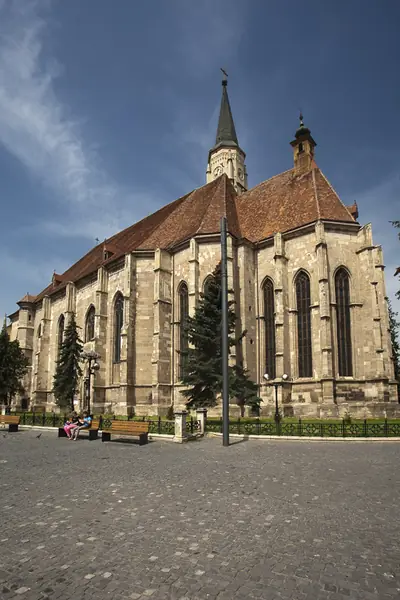
Union Square is the natural starting point for discovering Cluj-Napoca. Its most prominent landmark is St. Michael’s Church, one of the most important Gothic monuments in Transylvania.
Construction began in 1316, and the oldest part, the altar, was inaugurated in 1390. The main structure was completed by 1447. The present tower was built later in a Gothic Revival style and reaches 76 metres, or 80 metres including the cross. It is described as the tallest church tower in Transylvania.
The church’s western façade has a distinctive fifteenth-century double portal. Inside, look for the richly carved Renaissance frame around the sacristy door and the double spiral staircase known as the King’s Staircase.
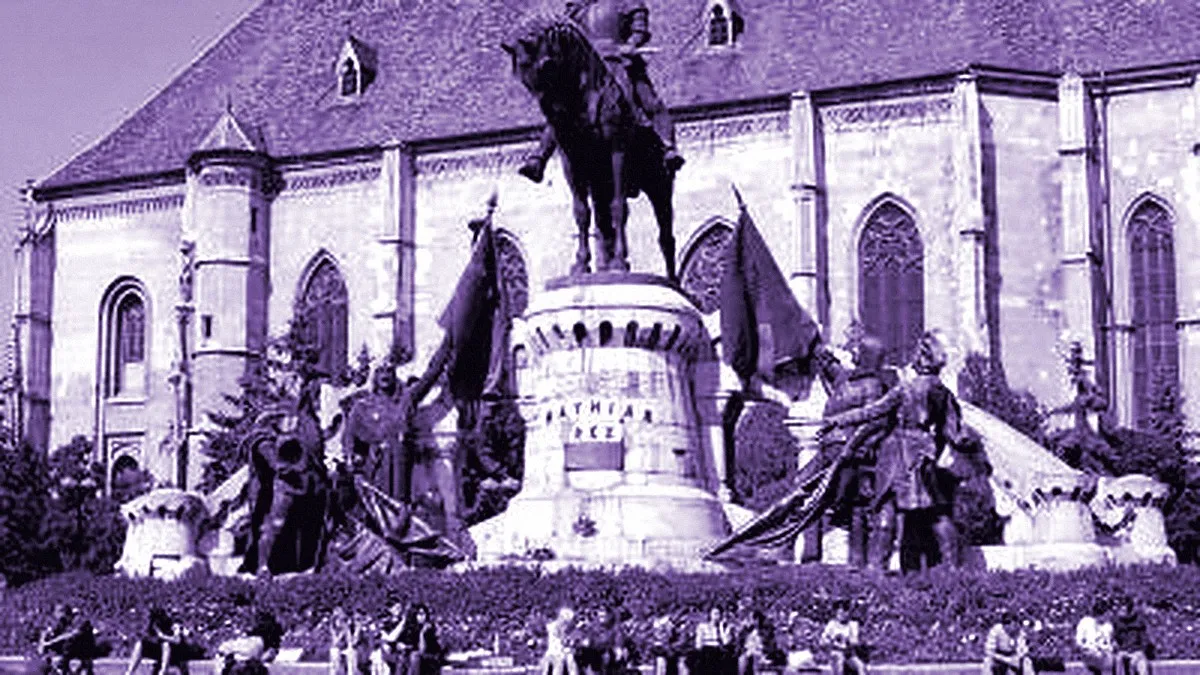
The Matthias Corvinus Monument
In Union Square, the Matthias Corvinus Monument depicts the king on horseback. It is one of the central landmarks of the square and appears alongside St. Michael’s Church in the city’s historic heart.
The square also gives access to the Art Museum of Cluj-Napoca, housed in Bánffy Palace, and to Hintz House, where the Pharmaceutical Museum preserves the history of pharmacy in Transylvania.
Hintz House and the Pharmaceutical Museum
Hintz House, also known as the Mauksch-Hintz House, combines Renaissance foundations with a classicist façade added in the 1820s. Its ground floor and basement date from the Renaissance era.
Cluj’s first pharmacy opened here in 1573. The pharmacy later passed through several owners before being inherited by the Hintz family in 1851, when it became known as Saint George’s Pharmacy, or La Sfântul Gheorghe. Since 1954, the lower part of the building has housed the Pharmaceutical Museum, whose displays occupy the historic rooms of the former shop.
Bánffy Palace and the Art Museum of Cluj-Napoca
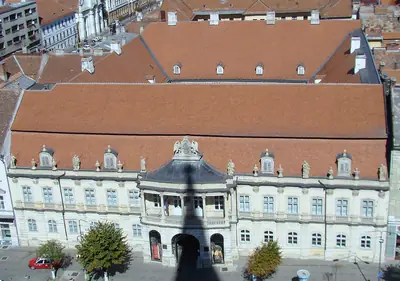
The Art Museum of Cluj-Napoca occupies one of the city’s most important Baroque buildings, Bánffy Palace. Founded in 1951, the museum presents Romanian and European painting, graphic art and decorative art from the fifteenth to the twentieth centuries.
Its collections have a strong focus on Transylvanian art. The National Gallery on the upper floor offers an overview of four centuries of Romanian art, including the sixteenth-century Jimbor Altarpiece, Biedermeier painting, twentieth-century art and the avant-garde. Works by artists including Nicolae Grigorescu, Ștefan Luchian, Dimitrie Paciurea, Theodor Pallady, Camil Ressu and Vasile Popescu are also represented.
The Franciscan Church and Piața Muzeului
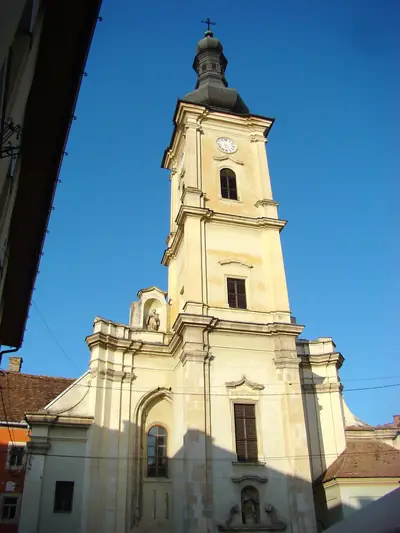
A short walk from Union Square, Cluj-Napoca Franciscan Church stands in Piața Muzeului, formerly Carolina Square. The first Franciscan monks arrived in Cluj in the thirteenth century, while the present Gothic church was completed in the late fifteenth century.
Later Baroque renovations created the contrast visible today: a relatively modest exterior and a richly decorated interior. The eighteenth-century altar, carved pulpit, vaulted ceilings, stained-glass windows and eighteenth-century organ add considerable detail to the church.
The National Museum of Transylvanian History
The National Museum of Transylvanian History traces the region’s past through archaeology, history and temporary exhibitions. Its collections reach from prehistoric times to the modern era and include more than 24,000 archaeological, numismatic and other objects.
The museum’s story began in 1859 with the Society of the Transylvanian Museum. Its holdings later passed through several institutions before the antiquities collection moved to the Institute of Classical Studies in 1929. Since 1963, the History Museum has operated as an independent institution, and since 1994 it has held national importance.
The Ethnographic Museum of Transylvania
For a different perspective on the region, visit the Ethnographic Museum of Transylvania. Founded on June 16, 1922, it is described as Romania’s oldest museum of its kind after a century of uninterrupted activity.
The museum explores rural traditions, occupations, clothing, household life, food and customs. Its central exhibition is housed in Reduta Palace at 21 Memorandumului Street. A second section, the open-air collection at Romulus Vuia Park in Hoia Forest, presents traditional houses, barns and other elements of rural heritage.
Firemen’s Tower
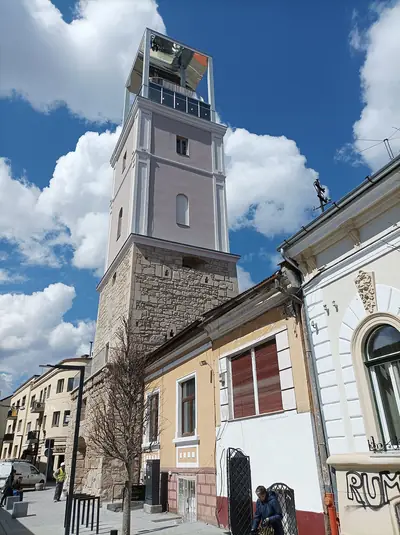
On Tipografiei Street, the Firemen’s Tower is a surviving reminder of Cluj-Napoca’s old city walls. It was once known as Turnul Lăcătușilor and remains listed in Romania’s register of historic monuments.
Avram Iancu Square and the Orthodox Cathedral
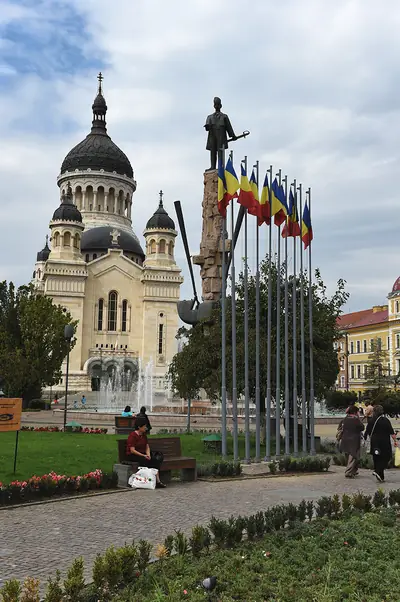
Avram Iancu Square offers a different architectural setting from Union Square. Its principal landmark is the Dormition of the Theotokos Cathedral, also known as the Orthodox Cathedral of Cluj-Napoca.
Built in the Romanian Brâncovenesc style, the cathedral combines Renaissance and Byzantine elements. Construction began on September 10, 1923, and was completed in 1933. The building stands alongside the Cluj-Napoca National Theatre and the Avram Iancu Statue.
The Transfiguration Cathedral
On Bulevardul Eroilor, the Transfiguration Cathedral, also known as the Minorites’ Church, is a Baroque landmark and an important place for the city’s Greek Catholic community.
Built between 1775 and 1779, it has a balanced façade crowned by two symmetrical towers. Inside, frescoes, marble altars and carefully arranged light create a richly decorated interior. In 1924, the church was donated by the Holy See to the Romanian Greek Catholic Church, and it later became the cathedral of the Cluj-Gherla Eparchy.
Saint George and the Dragon
The Statue of Saint George and the Dragon presents Saint George on horseback attacking the dragon. The bronze monument is a copy of a famous fourteenth-century work created in 1373 by Martin and Georg, whose original is preserved in Prague.
The Cluj replica was commissioned in the early twentieth century by the Cluj City Council together with Emperor Francis Joseph. Its Gothic-inspired setting and animated composition make it one of the city’s most striking medieval-themed monuments.
The Zoological Museum
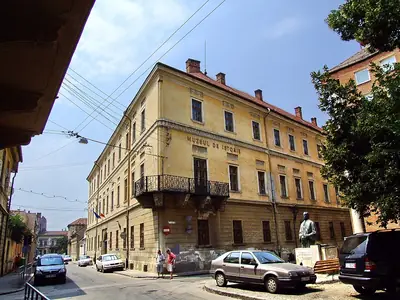
The Zoological Museum of Babeș-Bolyai University, also known as Muzeul Szervatiuzs, brings together specimens from Transylvanian fauna and from around the world. Its collections include insects, birds, mammals, reptiles, marine life, skeletons and taxidermy specimens.
More than 300,000 specimens are held here, with entomological collections described as among the richest in Romania. The museum was established in the mid-nineteenth century, and its collections have continued to grow through expeditions and academic research.
Saint Mary the Protector
Near the Holy Trinity Church, the Saint Mary the Protector monument, also called the Marian Column or Plague Statue, is a Baroque work created in Cluj in 1744 by Anton Schuchbauer.
The monument was removed in 1959 and later relocated behind the Church of Saints Peter and Paul. It was dismantled in 2022 and returned to its original location in November 2023. A copy of the Virgin Mary now stands on the pedestal while the original is restored and preserved in the city museum.
Explore Cluj-Napoca with Neywo
Neywo turns sightseeing into a self-guided experience. The app includes three walking tours, one bus route and one bike route in Cluj-Napoca:
- Union Square: Where King Matthias Was Born — 1.41 km, 82 minutes and 11 narrated stops
- Cathedrals, Bastions and a Roman Wolf — 1.99 km, 84 minutes and 12 narrated stops
- Belle Époque on the Someș — 0.96 km, 47 minutes and 7 narrated stops
- Line 24 Across Cluj: From St Peter’s to Mănăștur — a 3.7 km bus route lasting 16 minutes, with 6 stops
- Cluj Old Town Cultural Loop by Bike — 3.9 km, 20 minutes and 8 stops
Each story plays as you reach the place, at your own pace, with no group and no schedule. Download Neywo and explore Cluj-Napoca through its churches, museums, monuments and historic streets. When you continue travelling through Romania, you can also discover Brașov, Sibiu and Sighișoara.
Places with an audio guide in Cluj-Napoca
8 places in Cluj-Napoca with a Neywo audio guide. Each one starts telling its story as you reach it.
Self-guided tours in Cluj-Napoca
5 tours in Cluj-Napoca, free in the Neywo app. Each stop tells its story as you reach it.
- Bike ride
Cluj Old Town Cultural Loop by Bike
A short ride along the cycle lanes of Cluj's old centre, from the Hungarian Theatre past the Art Nouveau university library to the Marian column and the bronze St George, then back through the heart of the old town to the Ethnographic Museum, the pharmacy museum, the House with Legs and the Roman wolf.
Hungarian Theatre of Cluj · Lucian Blaga Central University Library of Cluj-Napoca · Saint Mary the Protector monument in Cluj-Napoca · Statue of Saint George and the Dragon in Cluj-Napoca · Ethnographic Museum of Transylvania · MNIT Muzeul Farmaciei …
Open this tour: Cluj Old Town Cultural Loop by Bike - Bus ride
Line 24 Across Cluj: From St Peter's to Mănăștur
CTP's line 24 crosses Cluj from the east along the 21 Decembrie 1989 Boulevard, through the old town and out to Mănăștur. Ride it past St Peter's Church, the Secession prefecture, the Unitarian church, the pharmacy museum and the Ethnographic Museum, and finish at the Jesuit residence on Mănăștur Street.
Saint Peter's church in Cluj-Napoca · Cluj County Prefecture · Cluj-Napoca Unitarian Church · MNIT Muzeul Farmaciei · Ethnographic Museum of Transylvania · Jesuit monastery in Cluj-Napoca
Open this tour: Line 24 Across Cluj: From St Peter's to Mănăștur - Walk
Union Square: Where King Matthias Was Born
Cluj's old centre is built around one square and one king. Stand under the 80-metre tower of St Michael's Church, look the bronze Matthias Corvinus in the eye, then see the Banffy Baroque palace, the old pharmacy museum, the house where the king was born, the Franciscan church, the Carolina Obelisk and the museums of Museum Square.
Unirii Square · Matthias Corvinus Monument · St. Michael's Church · Jósika Palace · Art Museum of Cluj-Napoca · MNIT Muzeul Farmaciei …
Open this tour: Union Square: Where King Matthias Was Born - Walk
Cathedrals, Bastions and a Roman Wolf
A walk through the eastern old town, where Romanian, Hungarian and Greek Catholic communities each built their landmarks. It runs from the Orthodox cathedral and the Neo-Baroque National Theatre to the last tower of the medieval walls, a Gothic Reformed church, a wolf from Rome and the Baroque churches along Eroilor Avenue.
Regional Railway Carrier of Romania Palace, Cluj-Napoca · Avram Iancu Square, Cluj-Napoca · Dormition of the Theotokos Cathedral, Cluj-Napoca · Finance Palace in Cluj-Napoca · Cluj-Napoca National Theatre · Cluj-Napoca Tailors' Bastion …
Open this tour: Cathedrals, Bastions and a Roman Wolf - Walk
Belle Epoque on the Someș
Around 1900 Cluj rebuilt the riverfront with Neo-Gothic, Secession and eclectic palaces. This short walk follows the bridge over the Someș and Horea Street: the apothecary's Szeky Palace, the Babos and Elian palaces, the Viennese-style Urania cinema palace and the Moorish-style Neolog synagogue.
Hungarian Theatre of Cluj · Poale Țedek Synagogue · Szeky Palace · Babos Palace, Cluj-Napoca · Elian Palace, Cluj-Napoca · Urania Palace in Cluj-Napoca …
Open this tour: Belle Epoque on the Someș
Walk Cluj-Napoca with Neywo
Neywo turns Cluj-Napoca into a self-guided audio tour. Stories arrive as you reach the place they belong to, and the route reshapes when you wander off it.

