Visiting Timișoara, Romania: Top Sights on Foot
Things to do in Timișoara: what to see in Romania’s historic city
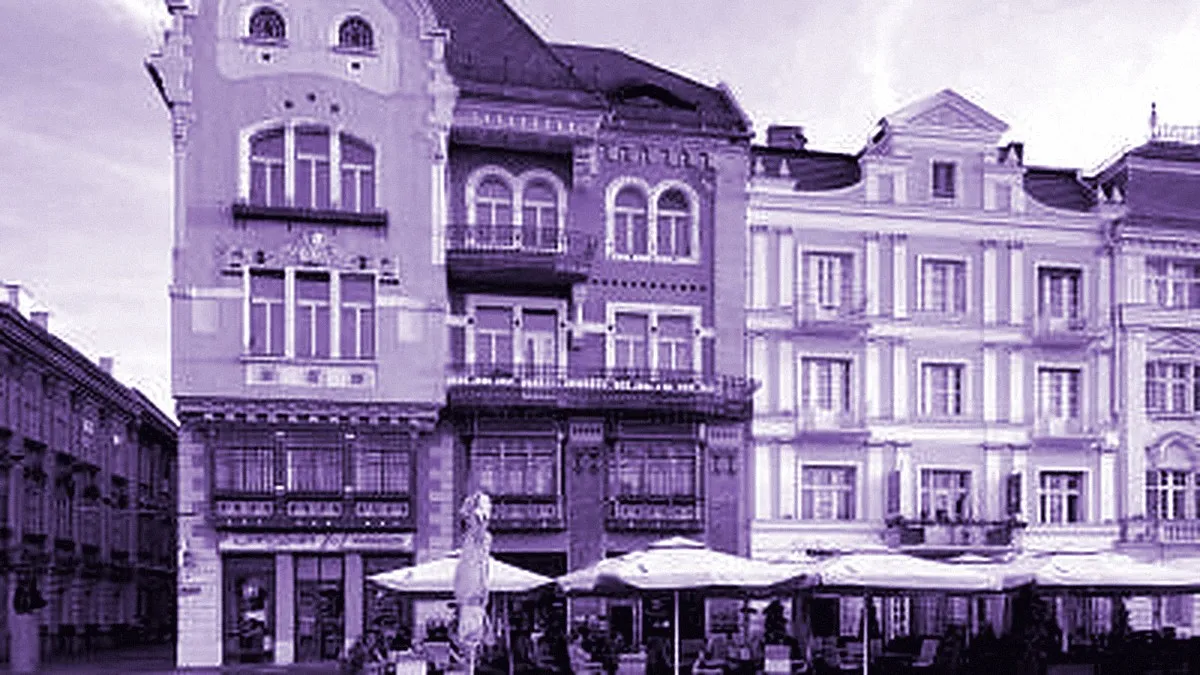
The best things to do in Timișoara include exploring Baroque squares, historic churches, museums, synagogues and the districts shaped by the Bega Canal. The city combines Central European architecture with a multicultural history and an important role in the 1989 Romanian Revolution. Neywo offers a free audio guide for Timișoara with 97 narrated places.
What to see in Timișoara
Huniade Castle and the National Museum of Banat
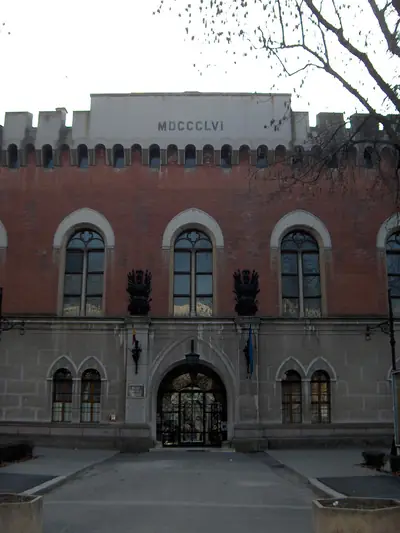
Huniade Castle is the oldest monument in Timișoara. Built between 1443 and 1447 by John Hunyadi and Paolo Santini de Duccio over an older royal castle, it has served as a fortress, noble residence and administrative centre.
The building has been shaped by several periods, including Ottoman rebuilding, eighteenth-century work associated with Prince Eugene of Savoy and reconstruction after severe damage during the siege of Timișoara in 1849. Romanesque, Gothic, Renaissance and Baroque elements are visible in its tower and fired-brick façade. Today, it houses the National Museum of Banat, whose collections cover History, Archaeology and Natural Sciences.
Timișoara Orthodox Cathedral
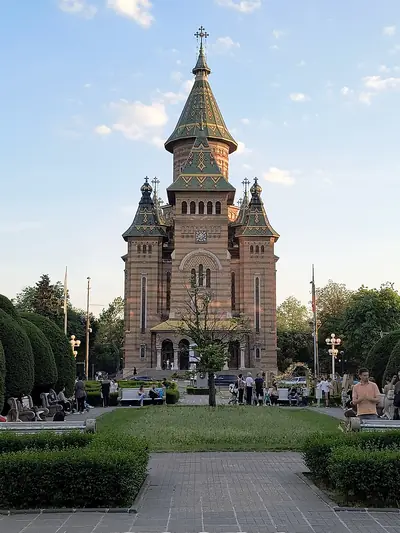
The Orthodox Cathedral, or Catedrala Mitropolitană, is one of the city’s most recognizable landmarks and the largest religious building in Timișoara. Built between 1936 and 1941, it was conceived as a symbol of Romania’s unity after Banat became part of the country following the First World War.
Its architecture combines Neo-Moldavian and Byzantine elements, including patterned brickwork, glazed ceramic tiles and arched porticoes. Eleven towers shape the silhouette, while the central tower rises to 90.5 metres. Inside, frescoes depicting biblical scenes and Romanian saints cover the walls beneath the central dome.
Victory Square and the Palace of Culture
Victory Square is framed by the Palace of Culture, also known as the Opera or National Theatre. The building contains the Romanian National Opera, Mihai Eminescu National Theatre, Csiky Gergely Hungarian State Theatre and German State Theatre. Together, these ensembles perform in Romanian, German and Hungarian.
The Palace of Culture is closely connected with Timișoara’s modern history. In 1918, a gathering in the Kronprinz Rudolf restaurant heard Aurel Cosma support the union of Banat with Romania. On 20 December 1989, the Democratic Romanian Front was founded here, and Timișoara was declared free from communism from the balcony facing the square.
Union Square and St. George’s Cathedral
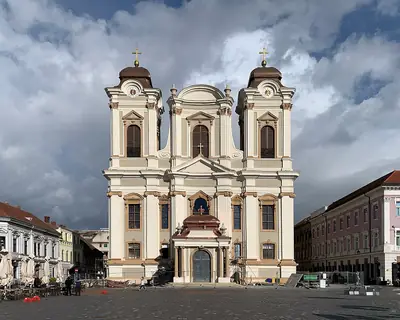
Union Square brings together some of Timișoara’s most important Baroque buildings. St. George’s Cathedral, also known as the Roman Catholic Dome, stands out with its harmonious façade and twin towers. Built between 1736 and 1774, it is dedicated to Saint George and has been the seat of the Roman Catholic Diocese of Timișoara since 1930.
The cathedral is the second-largest Baroque religious building in Southeastern Europe, after the Cathedral Basilica of Oradea. Its interior features a light-filled nave, decorated altars, gilded stucco and paintings by Austrian and Italian masters of the eighteenth century. The high altar depicts Saint George defeating the dragon.
The Art Museum of Timișoara
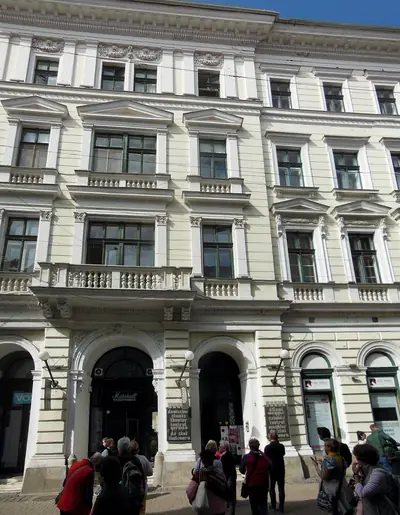
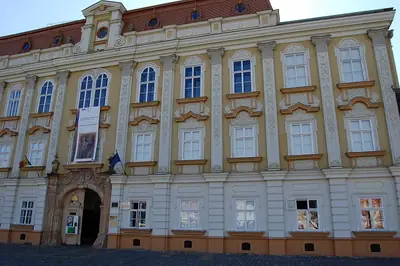
The Art Museum occupies the Baroque Palace in Union Square, creating a setting where the city’s architecture and artistic heritage meet. Its collections include Romanian, Banat, European, decorative, religious and contemporary art.
A particular highlight is the collection dedicated to painter Corneliu Baba, with ninety works and personal objects. The ground floor hosts temporary exhibitions, while restored details, high ceilings, elegant halls, stucco decoration and vaulted spaces add to the experience of visiting the museum.
Serbian Orthodox Cathedral
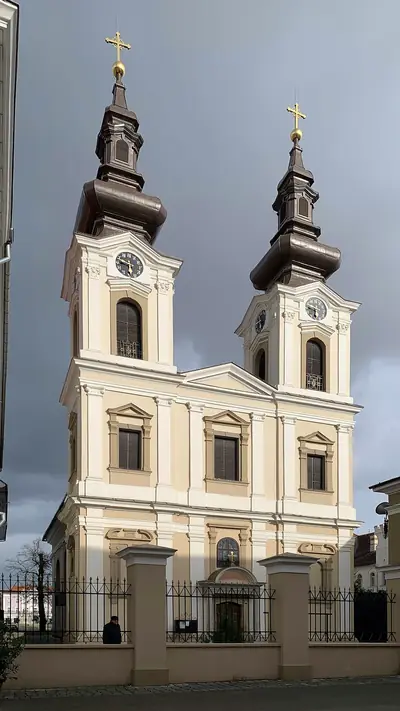
The Serbian Orthodox Cathedral, also called the Cathedral of the Ascension of the Lord, stands beside the Serbian Orthodox Bishop’s Palace and the House of the Serb Community in Union Square. The present church was built between 1744 and 1748 after an earlier Orthodox church was destroyed by fire in 1728.
Its two towers were added in 1791, and the interior preserves religious art and furnishings from the eighteenth and nineteenth centuries. Pay particular attention to the iconostasis, made by woodcarver Mihailo Janic, with icons by the Timișoara painter Constantin Daniel.
The Holy Trinity Monument and Liberty Square
In the centre of Union Square, the Holy Trinity Monument—also known as the Plague Column—was placed in 1740 after the city survived the plague that affected the region in 1738 and 1739. Its late Baroque design includes the Holy Trinity among clouds and angels, along with saints associated with protection from plague and hardship.
Nearby, Liberty Square is the city’s second-oldest square. It began as a crossroads for three medieval trade routes and later became a planned rectangular space during the Habsburg reconstruction of the eighteenth century. The Garrison Command, former Chancellery of War, Old City Hall and Military Casino are among the historic buildings around it. The square was also the city’s central market until commercial activity moved to Union Square in 1903.
Cetate Synagogue
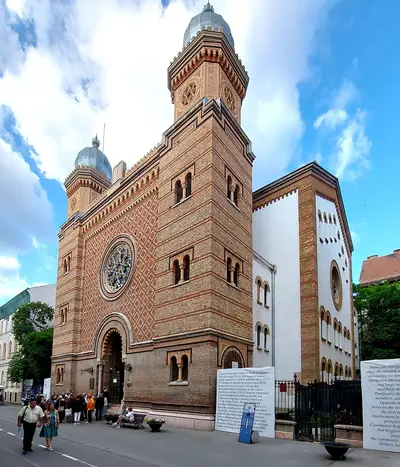
On Mărășești Street, the Cetate Synagogue reflects Timișoara’s Jewish heritage and multicultural character. Built between 1863 and 1865 for the Neolog Jewish congregation, it combines Moorish and Romanesque Revival influences with Jewish decorative traditions.
Its brick façade features glazed ceramic tiles arranged in geometric patterns, while the rose window contains a Star of David. Inside, a central dome rises above the cruciform plan, surrounded by stained glass and detailed ornament. The synagogue had space for about 3,000 people and remained a centre of Jewish communal life for more than a century.
Fabric Synagogue
The Fabric Synagogue was completed in 1899 in Timișoara’s Fabric district. Designed by Lipót Baumhorn, it combines Moorish, Gothic and Renaissance Revival elements, with decorative arches, stained-glass windows and a prominent dome.
The building is a protected historic monument and a reminder of the Jewish community that once flourished in the district. Services ended in the 1980s, and the synagogue later fell into disrepair. As of August 2024, Timișoara City Hall was carrying out restoration work, with plans to use the building as a cultural centre.
Iosefin Water Tower and Metal Bridge
The Iosefin district offers a different side of Timișoara’s heritage. The Water Tower in Iosefin is an industrial monument connected with the city’s early twentieth-century water system and is protected as a national heritage site.
Nearby, the Metal Bridge—also called the Iron Bridge—is a historic steel pedestrian crossing over the Bega Canal between Ady Endre Street and Andrei Mureșanu Street. It is protected as a historic monument and appears on Romania’s heritage list.
Banat Village Museum
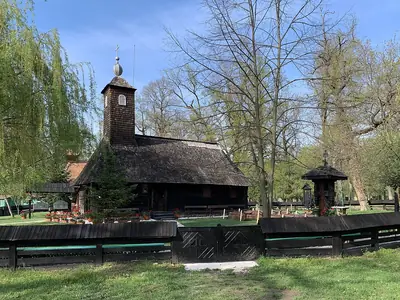
At the edge of the Green Forest in northeastern Timișoara, the Banat Village Museum recreates a traditional Banat village across seventeen hectares. Its civic centre includes a town hall, church, school, cultural house and inn, representing the social heart of village life.
The museum also presents living traditions. During the summer season, an outdoor stage beside the National House is used for folk performances, followed each Sunday by the village dance known as the hora satului.
Jecza Gallery
The Jecza Gallery is one of Romania’s respected art galleries outside Bucharest. Established in 2011 by Sorina Ianovici-Jecza and Andrei Jecza, it presents contemporary art from the 1960s to the present, with a particular connection to the work and legacy of sculptor Péter Jecza.
Explore Timișoara with a self-guided audio tour
A Timișoara self-guided walking tour is a flexible way to connect the city’s squares, palaces, churches and historic neighbourhoods. Neywo has six walking tours, one bus route and one bike route in Timișoara.
The walking tours range from 1.15 to 3.11 km and from 47 to 103 minutes, with between 5 and 12 narrated stops. They cover Victory Square, Liberty and Union Squares, the former fortress area, Iosefin, Fabric and Elisabetin. The bus route is 2.9 km long, takes 12 minutes and has 5 stops. The bike route along the Bega Canal is 4.4 km long, takes 22 minutes and has 7 stops.
The app tells the story of each place as you reach it, at your own pace, with no group and no schedule. Narration is available in 11 languages, making it an easy way to explore independently.
Download Neywo and discover Timișoara
Download Neywo to explore Timișoara with six walking tours, one bus route and one bike route, covering routes from 1.15 to 4.4 km, lasting 12 to 103 minutes and including 5 to 12 narrated stops. Follow the city’s Baroque centre, discover the heritage of Iosefin and Fabric, or trace the Bega Canal by bike while the app narrates each place when you arrive.
You can also continue exploring Romania, from Oradea and Sibiu to Sighișoara and Bucharest.
Places with an audio guide in Timișoara
8 places in Timișoara with a Neywo audio guide. Each one starts telling its story as you reach it.
Self-guided tours in Timișoara
8 tours in Timișoara, free in the Neywo app. Each stop tells its story as you reach it.
- Bike ride
Along the Bega Canal: Water Tower to the Green Bridge
Ride the tree-lined cycle path beside the Bega, Romania's first navigable canal, from the Iosefin water tower past the Iron Bridge, the Anchor Palace and Michael the Brave Bridge to the steel Decebalus (Green) Bridge.
Water Tower in Iosefin · Gemeinhardt Palace, Timișoara · Metal Bridge, Timișoara · Anchor Palace · Typopassage · Roses Park, Timișoara …
Open this tour: Along the Bega Canal: Water Tower to the Green Bridge - Bus ride
Line 5C: Through Cetate to the Fabric District
Ride Timișoara's regular line 5C from the fortress district across the Bega: the Cetate synagogue, the site of Saint George church, the Deschan palace and the steel Decebalus Bridge to the church of the Nativity in Fabric.
Cetate Synagogue · Saint George Church of Timisoara · Deschan Palace in Timișoara · Decebalus Bridge, Timișoara · Church of the Nativity of Virgin Mary in Fabric
Open this tour: Line 5C: Through Cetate to the Fabric District - Walk
Victory Square: Where Romania Broke Free
Timișoara declared itself free of communism from a balcony here on 20 December 1989. Walk from the towering Orthodox cathedral up the Corso, past Secession palaces, the Fish Fountain and the medieval Huniade Castle, to the Palace of Culture and the Moorish-style Cetate Synagogue. The walk also passes the Victory Square palaces of Merbl, Neuhausz and Löffler and the Romanian National Opera.
Piarist Church, Timișoara · Timișoara Orthodox Cathedral · Helios · Dauerbach Palace, Timișoara · Merbl Palace · Neuhausz Palace, Timișoara …
Open this tour: Victory Square: Where Romania Broke Free - Walk
Plague Columns and Baroque Palaces: Liberty and Union Squares
Two of the oldest squares of Timișoara, rebuilt by the Habsburgs after 1716. Meet twelve giants holding up a merchant's house, a plague column of thanks, a pair of lions guarding a haberdashery and the cathedrals of two faiths, finishing at the Roman Catholic dome. Continue past one of the city's oldest houses, the Secession Brück House and Ormós House to the Baroque Palace and St George's Cathedral.
House with Atlantes, Timișoara · Timișoara Military Museum · St. Mary and St. John of Nepomuk Monument, Timişoara · Nedelkovich House in Timișoara · Stojanovch House in Timișoara · Serbian Orthodox Cathedral in Timișoara …
Open this tour: Plague Columns and Baroque Palaces: Liberty and Union Squares - Walk
Fortress Timișoara: Courts, Counts and a Bastion
Follow the Habsburg fortress town: the palace of a French-born nobleman with the city's first bazaar and casino, the governor's house, the courts, a neoclassical Lutheran church, an iron axle with a legend and the last bastion of the walls, now full of cafés. The walk begins at Mărăști Square, where the short-lived Banat Republic was proclaimed in 1918.
Mărăști Square · Banat Republic · Lutheran Church, Timișoara · House with Iron Axis · Dicasterial Palace, Timișoara · Deschan Palace in Timișoara …
Open this tour: Fortress Timișoara: Courts, Counts and a Bastion - Walk
Iosefin and the Spark of 1989
Cross the Bega to Iosefin, the district where the 1989 revolution began at a small Reformed church. Continue to a marble Virgin under a Romanesque canopy, a triangular square, Baroque and neo-Gothic churches, a Moorish synagogue and the palace with the anchor on its tower. The walk starts at the Iosefin water tower and crosses the Bega on the Metal Bridge.
Water Tower in Iosefin · Iosefin Synagogue · Gemeinhardt Palace, Timișoara · Anchor Palace · Church of the Nativity of Virgin Mary in Iosefin · Notre Dame Church, Timișoara …
Open this tour: Iosefin and the Spark of 1989 - Walk
Fabric: Brewery, Bricks and Synagogues
Cross the Bega to Fabric, the old factory district. See a Secession bath, the Moorish-style New Synagogue by Lipót Baumhorn, the red-brick Millennium Church built from almost four million bricks and Traian Square with its 1774 cross obelisk. Finish at the Greek Catholic church of the Nativity and the Timișoreana brewery, founded in 1718.
"Carmen Sylva" Pedagogical High School, Timișoara · Decebalus Bridge, Timișoara · Neptun public bath · Fabric Synagogue · Millennium Church · Traian Square …
Open this tour: Fabric: Brewery, Bricks and Synagogues - Walk
Elisabetin: Typopassage, Squares and the Turkish House
A quieter southern stroll through Elisabetin: the Typopassage printing-museum courtyard, the church of Mary Queen of Peace, Nicolae Bălcescu Square, the Roman Catholic church and the Turkish House.
Typopassage · Biserica Sfânta Maria Regina Păcii · Nicolae Bălcescu Square, Timișoara · Roman Catholic Church in Elisabetin · Turkish House in Timisoara
Open this tour: Elisabetin: Typopassage, Squares and the Turkish House
Walk Timișoara with Neywo
Neywo turns Timișoara into a self-guided audio tour. Stories arrive as you reach the place they belong to, and the route reshapes when you wander off it.

