What to See in Sighișoara, Romania: Free Audio Guide
Things to do in Sighișoara: a guide to the medieval citadel
The best things to do in Sighișoara are concentrated in and around its remarkably well-preserved medieval citadel, a living historic centre still inhabited today. Built by Transylvanian Saxon settlers in the twelfth century, the old town combines fortified towers, historic churches, distinctive houses and views across the city. Its importance is recognised by its inclusion on the UNESCO World Heritage List in 1999. Neywo has a free audio guide for Sighișoara with 19 narrated places, available in 11 languages.
Sighișoara lies in the historic region of Transylvania, in Mureș County, beside the Târnava Mare River. For more places to explore in the country, see our guide to Romania.
What to see in Sighișoara
The historic centre, also known as the Sighișoara Citadel, is the natural starting point. Known in Latin as Castrum Sex, it preserves much of the character of the medieval town built by Saxon settlers. Its landmarks include the Clock Tower, the Covered Stairway, the Church on the Hill, Citadel Square and the Monastery Church.
Clock Tower
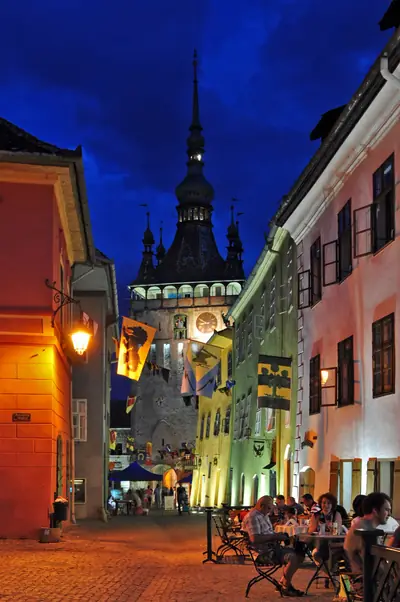
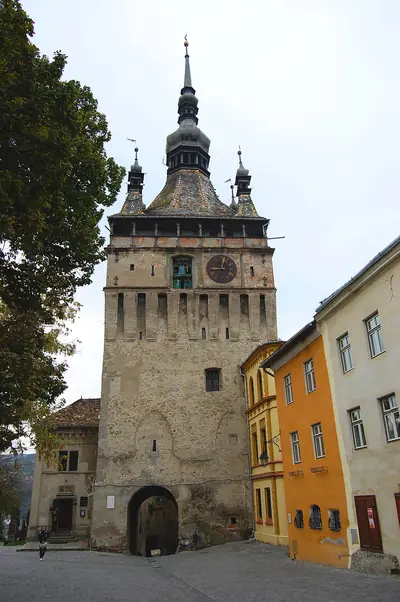
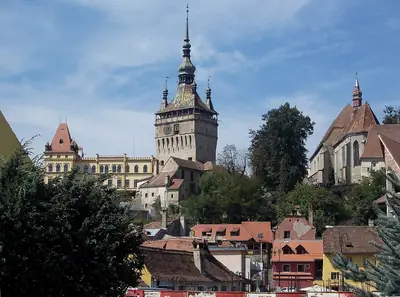
The Clock Tower, or Turnul cu Ceas, marks the main entrance to the walled upper city. Rising 64 metres, it can be seen from almost every part of Sighișoara and is one of Transylvania’s important clock towers.
The tower was built to defend the main gate and served as the town hall until 1556. Its five levels include a fourteenth-century ground floor made with river stone, with walls about 2.30 metres thick. The upper level is crowned by an open wooden gallery.
The clock received its quarter-hour mechanism in 1648. Its figures represent the days of the week as ancient gods, together with figures representing Peace, Justice, Day and Night, as well as two drummers and an executioner. Restored between 1999 and 2001, the clock remains one of the citadel’s most recognisable details. The tower also houses the Sighișoara History Museum.
Monastery Church
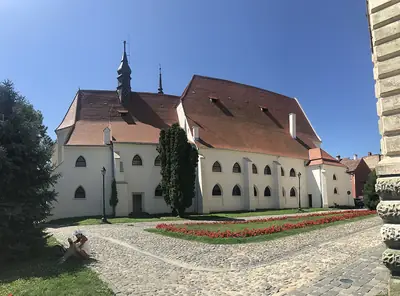
Immediately beside the Clock Tower stands the Monastery Church, also called the Church of the Dominican Monastery. The Gothic building belonged to a medieval Dominican monastery established in 1289. The present church was constructed between 1492 and 1515 on the site of an earlier Dominican church from the thirteenth century.
Although the monastery was demolished in 1888, the church survives as a Lutheran parish church and historic architectural monument. Its position beside the Clock Tower makes it one of the most accessible religious landmarks in the citadel.
Vlad Dracul House
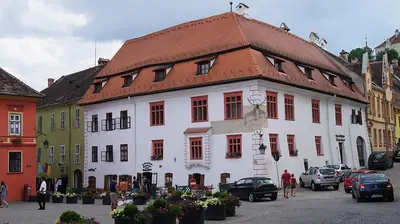
Vlad Dracul House stands on Tin Street between Citadel Square and the Clock Tower. It is traditionally identified as the birthplace of Vlad the Impaler, the historical figure who inspired Bram Stoker’s Dracula, in 1431.
According to the tradition connected with the house, Vlad the Impaler’s father, Vlad Dracul, and his pregnant wife stayed there between 1431 and 1435 while Wallachia faced a Turkish invasion. The lower level contains a cylindrical river-stone vault that may be the oldest stone structure in the city. Today, the ground floor houses a medieval-style restaurant and the first floor contains a small weapons museum.
Stag House
Casa cu Cerb, or the Stag House, is one of Sighișoara’s most distinctive historic houses. Built in the seventeenth century, it is described as the best-preserved house in the city.
Its name comes from the stag’s head fixed to the corner of the building. Look up as you walk through the citadel: this unusual feature makes the house particularly easy to recognise.
The citadel’s defensive towers
Sighișoara’s towers show how the medieval settlement was defended and organised. The Butchers’ Tower, or Turnul Măcelarilor, formed part of the western defences together with a small bastion. Built in the late fifteenth century, it was later rebuilt on a hexagonal plan and raised to give defenders a wider view. It has three floors and five loopholes, and survived the great fire of 1676.
The Furriers’ Tower, also known as the Coat Makers’ Tower or Turnul Cojocarilor, is smaller but forms a distinctive group with the Butchers’ Tower, Törle Gate and the house beneath it. Its square structure has four small levels, while the upper section widens slightly and contains machicolations. Documents record rebuilding and repairs in the sixteenth and seventeenth centuries, when the tower was still equipped for defence.
The Sighișoara walking routes also include the Shoemakers’ Tower, the Tailors’ Tower and the Ropemakers’ Tower, allowing visitors to follow more of the citadel’s fortified perimeter.
Church on the Hill
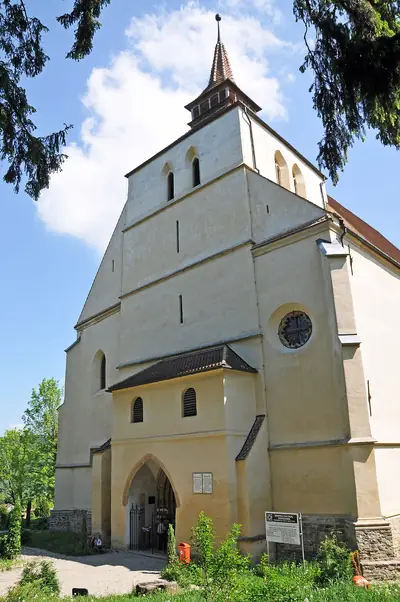
At the top of School Hill, the Church on the Hill, or Biserica din Deal, rises above Sighișoara. This Evangelical church is dedicated to Saint Nicholas and is one of the city’s most important religious monuments.
Construction took place in several stages between 1345 and 1525. At an altitude of 429 metres, the church dominates the city and can be seen from a considerable distance. The slightly misaligned bell tower and choir suggest that the building developed gradually over several centuries rather than according to one original plan.
The Covered Stairway leads towards the church and the Saxon cemetery. It is one of the defining features of the route up School Hill and an essential part of the citadel’s historic setting.
Churches and landmarks beyond the citadel
Sighișoara’s history extends beyond the upper town. These landmarks reflect the city’s different religious communities and its development beside the Târnava Mare River.
Holy Spirit Church
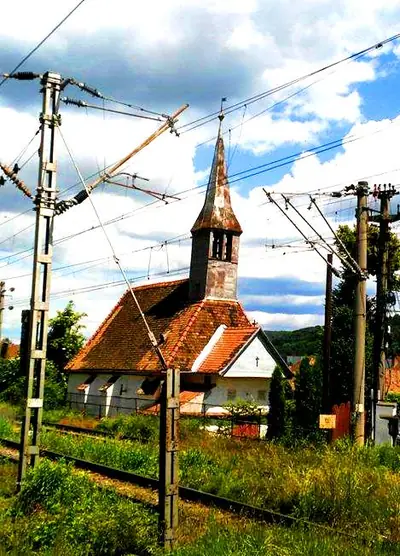
At the northwestern edge of the old Siechhof neighbourhood stands the Holy Spirit Church, also known as the Lepers’ Church. It stands beside the Târnava River and is associated with a shelter for people with leprosy that began operating nearby in 1507.
Because patients were not allowed to enter the church, a pulpit was built near the western entrance so the priest could preach to people gathered in the churchyard. The church is believed to date from the fifteenth century. Its surroundings changed considerably in the late nineteenth century when a railway was built only a few metres away.
Holy Trinity Church
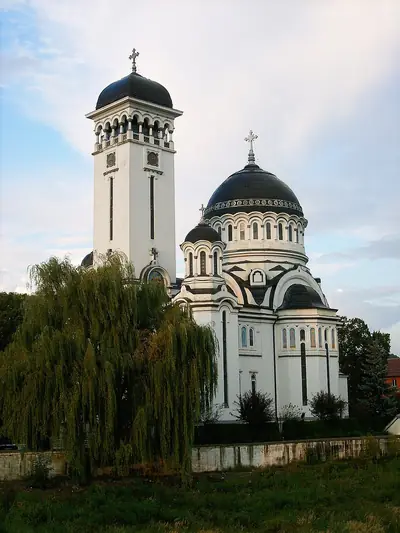
On the northern bank of the Târnava Mare River, Holy Trinity Church, or Biserica Sfânta Treime, represents Sighișoara’s Romanian Orthodox heritage. Although it is often called a cathedral, it is technically a church because it is the seat of an archpriest rather than a bishop.
Built between 1934 and 1937, it follows a neo-Byzantine design by architect Dumitru Petrescu Gopeș. Its interior includes paintings by A. Demian and an iconostasis made by specialists from Rupea. The exterior was renovated between 1980 and 1984.
Entry of the Theotokos into the Temple Church
The Entry of the Theotokos into the Temple Church is a Romanian Orthodox church on Ecaterina Varga Street. Its history reflects the long effort of Sighișoara’s Romanian community to establish its own place of worship.
The stone church was begun in 1780, with the main structure completed in 1788. The altar followed in 1789, the spire in 1797 and an inscription above the entrance in 1805. Bishop Vasile Moga dedicated the church in 1822. Inside, the iconostasis was carved and painted in 1818 by an artist from Brașov, while the present murals date from 1974.
St. Joseph’s Roman Catholic Church
Near the enclosure wall on the northeastern side of the citadel, St. Joseph’s Roman Catholic Church is recognisable by its tall belfry. Built between 1894 and 1896 after the demolition of a Franciscan nuns’ monastery, it was built by Hungarians, unlike the city’s two other largest churches, which were built by Transylvanian Saxons.
The church combines Gothic and Neo-Roman elements in an eclectic design. It extends for 30 metres and has a particularly tall belfry on its northern side. After a fire in 1983, the interior was altered; the church was later restored and renovated between 2005 and 2007.
The city’s religious landmarks also include the Sighișoara Synagogue and the Lutheran church in Hetiur, a historic monument in the village belonging to the municipality of Sighișoara.
Explore Sighișoara with a self-guided audio tour
Neywo offers two walking tours in Sighișoara, with no group and no schedule. The app tells the story of each place as you reach it, at your own pace, so you can explore independently while keeping your attention on the city around you.
- Inside the Walls of Dracula’s Birthplace: 1.1 km, 86 minutes and 12 narrated stops, including the History Museum, Monastery Church, Vlad Dracul House, Stag House, defensive towers, St. Joseph’s Roman Catholic Church and Biserica din Deal.
- Churches Beyond the Citadel: 3.13 km, 70 minutes and 5 narrated stops, including the Sighișoara Synagogue, the Entry of the Theotokos into the Temple Church, Holy Spirit Church and Holy Trinity Church.
Download Neywo and explore Sighișoara with its stories playing at the places where they happened. If you are continuing through Romania, you can also discover Sibiu, Brașov, Cluj-Napoca or Sinaia.
Places with an audio guide in Sighișoara
8 places in Sighișoara with a Neywo audio guide. Each one starts telling its story as you reach it.
Self-guided tours in Sighișoara
2 tours in Sighișoara, free in the Neywo app. Each stop tells its story as you reach it.
- Walk
Inside the Walls of Dracula's Birthplace
Sighisoara is one of Europe's last inhabited medieval citadels, founded by Transylvanian Saxons and listed by UNESCO. Climb through the Clock Tower gate, find the house where Vlad the Impaler is said to have been born, then circle the guild towers each built and defended by a different craft, and finish at the Church on the Hill.
Sighisoara History Museum · Monastery Church in Sighișoara · Vlad Dracul House · Stag House · Historic Centre of Sighișoara · St. Joseph's Roman Catholic Church …
Open this tour: Inside the Walls of Dracula's Birthplace - Walk
Churches Beyond the Citadel
Sighisoara's Romanian, Jewish and leprosy-patient communities worshipped outside the Saxon walls. Walk from the synagogue to the 18th-century Orthodox church built once Romanians were allowed a church of their own, then to the Lepers' Church by the Tarnava river and the neo-Byzantine Holy Trinity.
Sinagoga Sighișoara · Sighișoara · Entry of the Theotokos into the Temple Church, Sighișoara · Biserica Sfântul Spirit · Holy Trinity Church
Open this tour: Churches Beyond the Citadel
Walk Sighișoara with Neywo
Neywo turns Sighișoara into a self-guided audio tour. Stories arrive as you reach the place they belong to, and the route reshapes when you wander off it.

