What to See in Sibiu, Romania: Free Audio Guide
Things to Do in Sibiu: Museums, Churches and Medieval Fortifications
Sibiu is a historic city in Transylvania known for its Saxon heritage, medieval fortifications, museums and distinctive roof windows—the feature behind its nickname, the “City with Eyes.” The old centre brings together grand squares, churches, guild towers and compact streets, making it an excellent city to explore on foot. Neywo offers a free audio guide for Sibiu with 45 narrated places.
What to See in Sibiu’s Historic Centre
Brukenthal National Museum
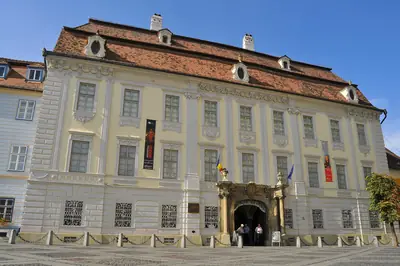
The Brukenthal National Museum began as the private collection of Baron Samuel von Brukenthal, governor of the Grand Principality of Transylvania. He assembled the collection in his city palace around 1790, and it opened to the public in 1817, making it the oldest institution of its kind on the territory of modern-day Romania.
The palace galleries contain around 1,200 works representing European schools of painting from the fifteenth to the eighteenth century, including Flemish-Dutch, German, Austrian, Italian, Spanish and French traditions. The wider museum complex also includes collections of engravings, books, coins, minerals and other objects. Today, the Brukenthal National Museum comprises six museums in different parts of Sibiu.
Piața Mare and the Jesuit Church
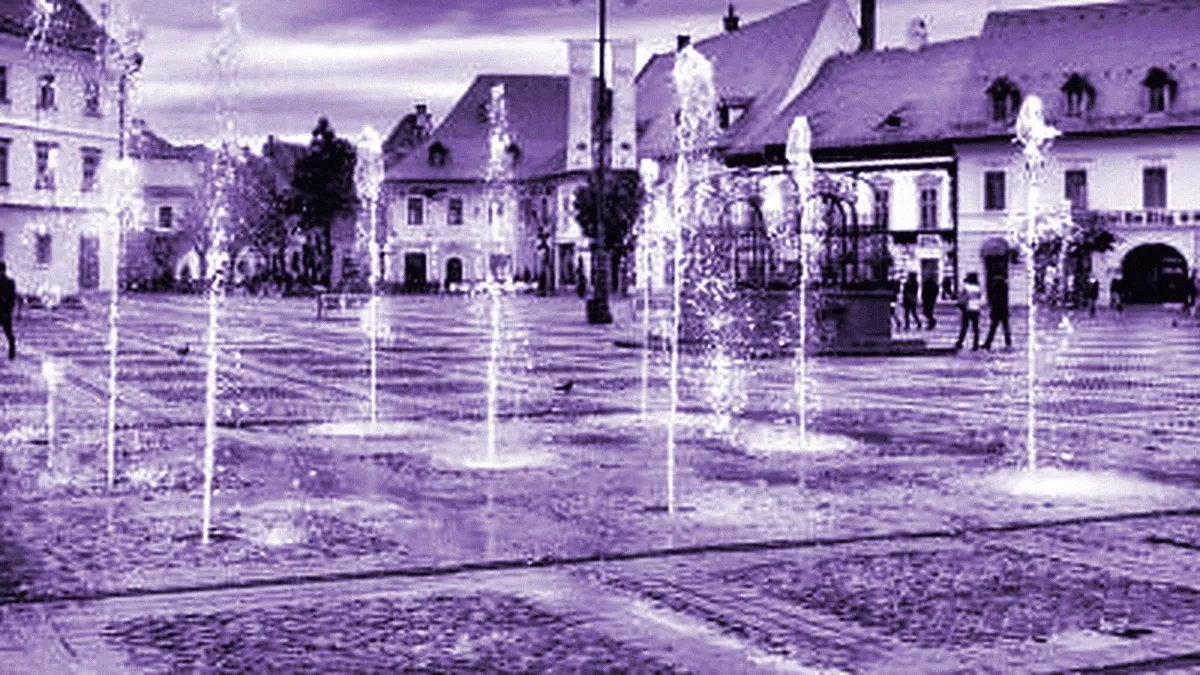
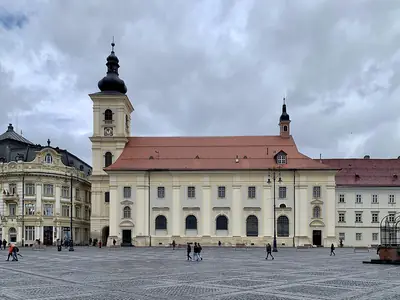
Piața Mare is Sibiu’s principal civic square, framed by historic buildings and the Brukenthal Palace. Beside the palace stands the Jesuit Church, also known as the Church of the Holy Trinity. Built between 1726 and 1733, it is one of the city’s notable Baroque landmarks.
The exterior is restrained, while the interior is richly decorated with Baroque details, including bells, triglyphs, volutes and shells. Its main shrine contains a fresco of the Virgin and Child, and the stained-glass windows were made in Budapest in 1901.
Altemberger House History Museum
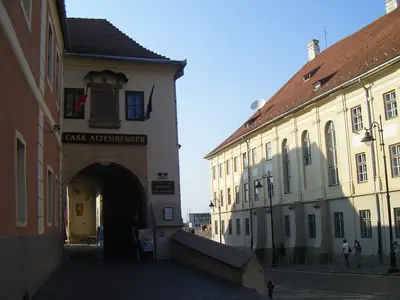
The History Museum occupies Altemberger House, one of Transylvania’s most important civic Gothic buildings, with Renaissance elements. The complex began with a dwelling tower built in the late thirteenth century and later expanded into ten architectural units, including a defensive tower.
The city magistrate acquired the building in the sixteenth century, and it served as Sibiu’s town hall until 1948. The permanent exhibition traces local history from the Palaeolithic period through the development of settlements in southern Transylvania.
Piața Mică, the Bridge of Lies and the Arts House
Piața Mică offers a more intimate counterpart to the Grand Square. The famous Bridge of Lies connects it with Huet Square and is one of Sibiu’s best-known pedestrian landmarks. Known locally as Podul Minciunilor and in German as Lügenbrücke, the bridge was made in 1859 at a foundry in Hesse.
In Huet Square, the Arts House contains the Emil Sigerus Museum of Saxon Ethnography and Folk Art. Its collections preserve the material and living heritage of the Transylvanian Saxon community. More than 8,900 objects are held in three main collections covering ceramics, clothing and textiles, and painted furniture. Its collection of tiles is described as the most complete and valuable in Romania.
Nearby, the Franz Binder World Ethnography Museum occupies a neo-Gothic building at 11 Piața Mică. The museum opened in 1993 and presents cultures, arts and everyday life from outside Europe through approximately 3,000 objects, including items from Africa, China, Japan, Indonesia, Ecuador and Argentina.
Sibiu Lutheran Cathedral
The Lutheran Cathedral of Saint Mary is one of the historic churches associated with Sibiu’s Saxon heritage. It appears among the central stops exploring the city’s squares, museums and architectural landmarks, and its position in the old centre makes it easy to include in a walk through the historic quarter.
Holy Trinity Cathedral
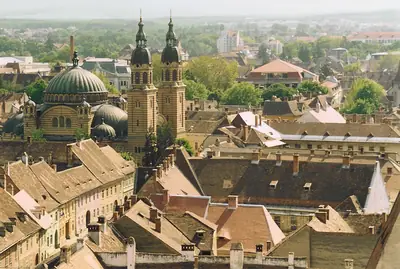
Holy Trinity Cathedral is the seat of the Romanian Orthodox Archbishop of Sibiu and the Metropolitan Church of Transylvania. Built between 1902 and 1906, it replaced a smaller Greek church that had served as the episcopal cathedral.
The building combines the character of a Byzantine basilica with a broad central dome and distinctive towers. Its design is a smaller-scale interpretation of Hagia Sophia in Constantinople, giving the cathedral a powerful presence among Sibiu’s historic buildings.
Sibiu’s Towers, Walls and Cultural Landmarks
Carpenters’ Tower and the city fortifications
The Carpenters’ Tower, or Turnul Dulgherilor, was built in the fourteenth century by Sibiu’s Saxon carpenters’ guild. It formed part of the city’s third fortification ring, built between 1357 and 1366.
The tower has a circular base and an octagonal upper section. Its defensive details include projecting supports and keyhole-shaped openings designed for arquebuses. It stands on Cetății Street with two other historic towers, close to the Cetății Park and Promenade, which follows the exterior defensive wall.
Sala Thalia and the Thick Tower
Sala Thalia is home to the State Philharmonic of Sibiu and has been used as a theatre and concert venue since October 7, 2004. The building’s history reaches back to 1788, when Martin Hochmeister established Sibiu’s first theatre on the site.
The hall was built onto the Thick Tower, or Turnul Gros, a medieval fortification constructed around 1540. After fires in 1826 and 1949, the building was reconstructed, and between 1990 and 2004 it was adapted for the State Philharmonic.
Natural History Museum
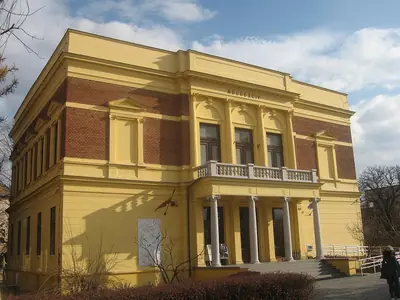
The Natural History Museum has roots reaching back to 1849. Its present building was constructed between 1894 and 1895 in the former Theatre park, at 1 Cetății Street. It is now a section of the Brukenthal National Museum.
Steam Locomotives Museum
Opposite Sibiu’s main railway station, the Steam Locomotives Museum occupies the former depot of the narrow-gauge railway that linked Sibiu with Agnita and formerly with Sighișoara.
The collection includes more than thirty locomotives, along with snowploughs and steam cranes. The exhibits were built between 1885 and 1959, and the collection includes both standard-gauge and narrow-gauge engines. The depot still contains a roundhouse and turntable, while some locomotives remain functional and are occasionally used for special trains and enthusiast groups.
Further Places to Visit in Sibiu
ASTRA Museum of Traditional Folk Civilization
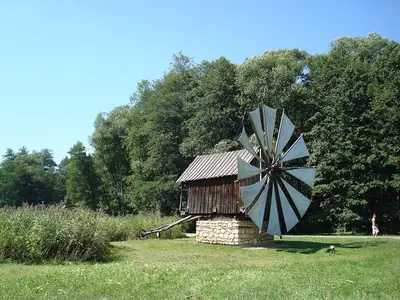
South of Sibiu, in the Dumbrava Sibiului nature reserve, the ASTRA Museum of Traditional Folk Civilization spreads across 96 hectares. This open-air museum brings together more than 400 relocated buildings, including houses, workshops, barns, mills and wooden churches arranged around a lake.
The paths lead through preserved interiors and rural settings that illustrate traditional skills and everyday life in pre-industrial Romanian communities. ASTRA began as a museum of peasant and agricultural techniques and is now one of the largest open-air museums in Europe.
August von Spiess Hunting Museum
The August von Spiess Museum of Hunting Weapons and Trophies occupies a former residence connected with Colonel August von Spiess, once master of hunting to the Royal Court of Romania. The museum reopened on February 25, 2007, after restoration and restructuring.
Its collection includes around 1,600 objects, including animal trophies, firearms, hunting instruments and accessories gathered through acquisitions and donations.
Saint Elisabeth Church
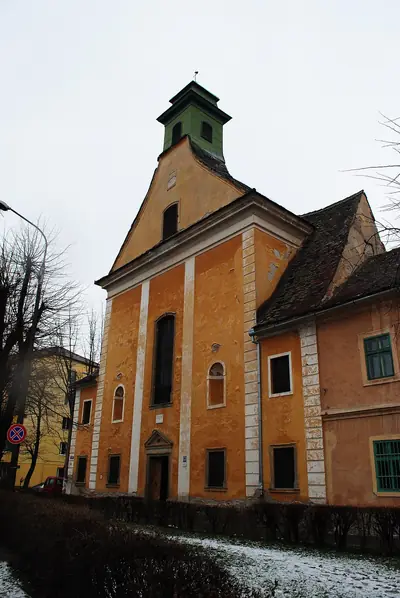
Saint Elisabeth Church, or Biserica Sf. Elisabeta, is a Roman Catholic historic monument in Sibiu’s Terezian district. It originally formed part of the Theresian Orphanage and is dedicated to the Visitation of the Virgin Mary.
Other notable religious landmarks include the Church of Asylum, whose name appears in the form “Biserica Azilului” from 1292, and the fortified evangelical church of Gușterița in Sibiu County.
Explore Sibiu with Neywo
Neywo has four walking tours and one bus route in Sibiu, covering 45 narrated places in total:
- Piața Mare and the Brukenthal Quarter: 1.1 km, 93 minutes and 11 stops
- Guild Towers and the Upper Town: 2.11 km, 76 minutes and 8 stops
- Faiths and Rails: Eastern Sibiu: 2.02 km, 57 minutes and 5 stops
- Churches of the Northern Quarter: 2.13 km, 56 minutes and 4 stops
- Line 2 across Sibiu: 5.3 km, 23 minutes and 5 stops
Download Neywo and explore Sibiu at your own pace. The app tells the story of each place as you reach it, with no group and no schedule. Narration is available in 11 languages, so you can turn a visit to Romania’s historic cities into a self-guided experience—from Sibiu to Sighișoara, Brașov or Cluj-Napoca.
Places with an audio guide in Sibiu
8 places in Sibiu with a Neywo audio guide. Each one starts telling its story as you reach it.
Self-guided tours in Sibiu
5 tours in Sibiu, free in the Neywo app. Each stop tells its story as you reach it.
- Bus ride
Line 2 across Sibiu: from the Orthodox west to the railway quarter
Tursib's public bus 2 crosses town from Piața Cibin to the eastern suburbs. Ride it past the Orthodox church of Saint Luke, the Carpenters' Tower, the Natural History Museum, the synagogue and the Holy Cross chapel without walking the old town.
Biserica Ortodoxă "Sfântul Luca" · Capela Romano-Catolică "Sfânta Cruce" · Synagogue of Sibiu · Muzeul de Istorie Naturală · Turnul Dulgherilor
Open this tour: Line 2 across Sibiu: from the Orthodox west to the railway quarter - Walk
Piața Mare and the Brukenthal Quarter
Start where Sibiu's Saxon merchants traded grain and tried criminals, under the roof windows locals call the city's eyes. You will pass the Council Tower, a pharmacy museum with a 1597 mortar, the steeple of the Lutheran cathedral, the oldest German-language school in Romania and the palace that became the country's first museum.
Grand Square · Haller house in Sibiu · Council tower of sibiu · History of Pharmacy Museum · Arts House, Sibiu · Franz Binder museum in Sibiu …
Open this tour: Piața Mare and the Brukenthal Quarter - Walk
Guild Towers and the Upper Town
Follow the third ring of Sibiu's medieval defences, where carpenters, potters and arquebusiers each held their own tower, then climb into the Habsburg-era streets of the upper town. The walk ends at the Orthodox cathedral modelled on Hagia Sophia and the 'church in the ditch'.
Filarmonica de Stat Sibiu, Sala Thalia · Potters Tower · Turnul Dulgherilor · Turnul Archebuzierilor din Sibiu · Reformed Church in Sibiu · Holy Trinity Cathedral …
Open this tour: Guild Towers and the Upper Town - Walk
Faiths and Rails: Eastern Sibiu
Leave the old squares for the east side of town, where a Dominican church became an Ursuline convent, Sibiu's only synagogue went up in 1898 and a chapel shelters a stone crucifix carved in 1417. Finish among the steam locomotives opposite the railway station.
Muzeul de Istorie Naturală · Former ursuline convent in Sibiu · Synagogue of Sibiu · Capela Romano-Catolică "Sfânta Cruce" · Sibiu Steam Locomotives Museum
Open this tour: Faiths and Rails: Eastern Sibiu - Walk
Churches of the Northern Quarter
Leave the squares for the quieter streets north of the old town. See the church of the asylum first mentioned in 1292, a Baroque Greek Catholic church with a massive onion dome and a cemetery of national figures, the Orthodox church of Saint Luke and the former orphanage church of Saint Elisabeth in the Theresian district.
Church of Asylum · The Greek Catholic Church Saints Peter and Paul, Sibiu · Biserica Ortodoxă "Sfântul Luca" · Biserica Sf. Elisabeta
Open this tour: Churches of the Northern Quarter
Walk Sibiu with Neywo
Neywo turns Sibiu into a self-guided audio tour. Stories arrive as you reach the place they belong to, and the route reshapes when you wander off it.

