Things to Do in Oradea, Romania: Walking Guide
Things to do in Oradea: an Art Nouveau city in Romania
The best things to do in Oradea include exploring its Secession and Art Nouveau palaces, Baroque churches, historic cathedrals, museums, and fortress. Set on both banks of the Crișul Repede River near the Hungarian border, Oradea brings together a rich religious and cultural heritage with an architectural landscape that rewards slow exploration. Neywo offers a free audio guide for Oradea with 27 narrated places.
What to see in Oradea
Oradea’s historic center is especially rewarding on foot. Its landmarks reflect the city’s Jewish, Greek Catholic, Roman Catholic, Orthodox, and literary heritage, while the following places reveal the variety of its architecture.
Black Eagle Palace
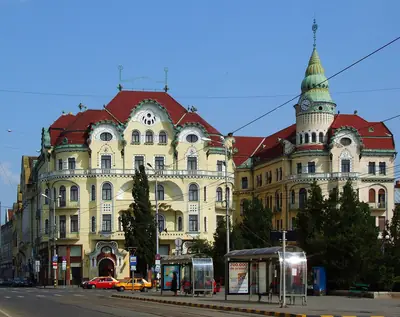
Palatul Vulturul Negru, or the Black Eagle Palace, is one of Oradea’s most representative buildings. Created between 1907 and 1908 by Marcell Komor and Dezső Jakab, it occupies a corner site beside Unirii Square.
Its most recognizable feature is the glass-covered passage connecting the building’s two main bodies. The passage opens towards Independenței Street, Unirii Square, and Vasile Alecsandri Street. Above the main façade, a stained-glass black eagle made in 1909 became the emblem of the entire complex.
Ullmann Palace
Palatul Ullmann is a notable example of Viennese Secession architecture. Completed in 1913, it has a symmetrical façade with stucco medallions, brick studs, metalwork, stained glass, and a ceramic bas relief made in the Zsolnay workshop.
The most distinctive detail is a ceramic menorah protected by two lions. Its bronze-colored metallic glaze gives the building a particularly memorable feature.
Füchsl Palace
Dating from 1902, Füchsl Palace is known for the contrast between its rectangular structure and its flowing façade. A sinuous cornice made from pressed sheet metal gives the exterior a wave-like movement.
The rounded corner rises into a tower, while trapezoidal panels, kidney-shaped attic windows, vegetal motifs, and balcony ironwork add to its distinctive appearance.
Stern Palace
Stern Palace was built in 1909 to designs by Marcell Komor and Dezso Jakab. Its relatively restrained façades are enlivened by four bay windows and a large circular tower at the corner.
Look up at the deeply projecting roof eaves, supported by carved wooden braces. Although the ground-floor decoration has been destroyed, the two entrance gates remain intact.
Moskovits Palace and Apollo Palace
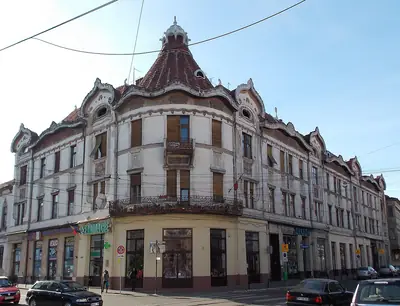
Moskovits Palace, also known as Moskovits Miksa Palace, was designed in 1905 by Kálmán Rimanóczy Junior. Its rounded corner is topped by an elliptical roof with shaped metalwork, flowing lines, volutes, and plant motifs. A balcony with ornate floral wrought iron sits beneath a striking decorative motif: a woman’s head emerging from leaves, flowers, and branches.
Nearby, at the intersection of Republicii Street and Mihai Eminescu Street, Apollo Palace forms another highlight of Oradea’s architectural heritage.
Orthodox Episcopal Palace
Built in 1905 as a family residence, the Orthodox Episcopal Palace later became an important Orthodox center. Its design combines Venetian inspiration, early Gothic elements, and Secession details.
The façade includes alternating brick and plaster, three arched upper-floor windows, bay windows, and stone statuettes on the balustrade. After the Romanian Orthodox Church purchased the building in 1921, a chapel was installed on the first floor. During the interwar period, the palace also briefly housed the Orthodox Theological Academy.
Greek-Catholic Episcopal Palace
The Greek-Catholic Episcopal Palace is a protected heritage monument designed by Kálmán Rimanóczy. Built between 1903 and 1905 on the site of the former Greek-Catholic diocesan palace, it was inaugurated by Bishop Demetriu Radu on June 11, 1905.
Its eclectic design brings together varied forms and details rather than following one strict architectural style.
Baroque Palace and the Cathedral Basilica of St. Mary
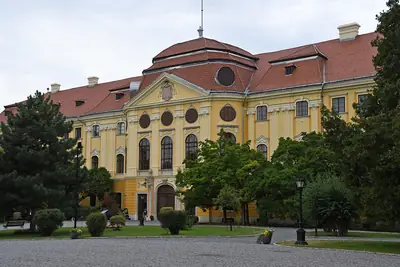
The Baroque Palace, also known as the Roman Catholic Episcopal Palace, forms part of Oradea’s outstanding Baroque ensemble with Saint Mary’s Basilica and the Canonical Row. Built in the second half of the eighteenth century, it is considered one of the most valuable Baroque buildings in Romania. From 1971 to 2006, it housed the Museum of the Criș Land.
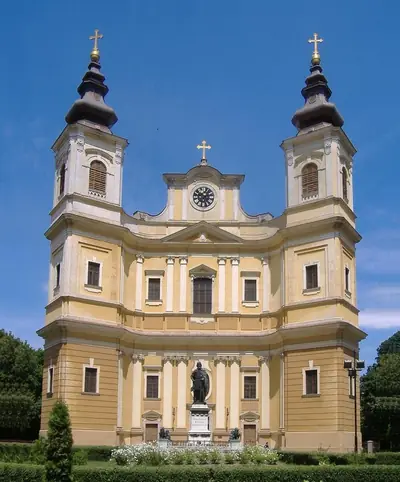
The Cathedral Basilica of St. Mary was built between 1752 and 1780. Giovanni Battista Ricca began the project, and Franz Anton Hillebrandt completed it after Ricca’s death. The church is described as the largest Baroque church in Romania, with a central nave about 70 metres long and between 30 and 40 metres wide.
Inside, Vaskó and Carrara marble cover the walls. The church received the rank of minor basilica from Pope John Paul II in 1991. In front of it stands a statue of Saint Ladislaus, moved there from the main square in 1921.
St. Nicholas Cathedral
Known in Romanian as Catedrala Sfântul Nicolae, St. Nicholas Cathedral is a Greek Catholic cathedral and the seat of the Eparchy of Oradea Mare. It is also recognized as a nineteenth-century historical and architectural monument in Bihor County.
The cathedral is both a place of worship and an important part of Oradea’s architectural heritage.
Episcopal Cathedral of Oradea
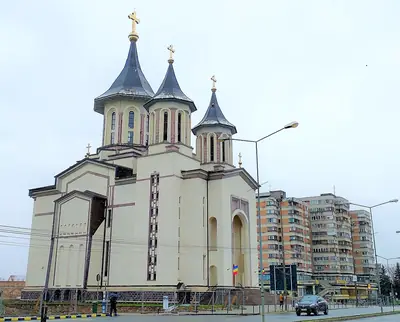
At Piața Emanuil Gojdu, the Episcopal Cathedral of Oradea—also known as the Cathedral of the Resurrection—is the principal place of worship of the Romanian Orthodox Diocese of Oradea. It is one of the largest Orthodox cathedrals in western Romania.
Capuchin Monastery
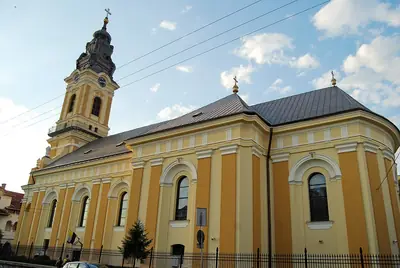
The Capuchin Monastery is an eighteenth-century historic monument. Its church is dedicated to the Visitation of the Virgin Mary, with its feast celebrated on July 2 according to the calendar traditions observed by Capuchins in Central Europe and German-speaking Roman Catholic regions.
Oradea Citadel
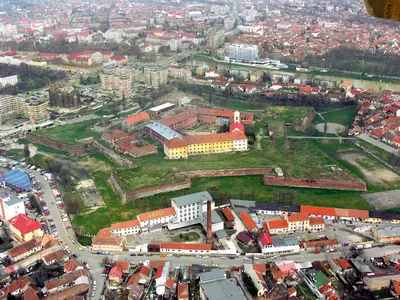
Oradea Citadel, or Oradea Fortress, is an architectural monument in Bihor County and one of the few fortresses still in use today. Its origins go back to the eleventh century, when it served as an episcopal residence and religious center.
The fortress underwent renovation before becoming home to the Oradea City Museum from 2020. Its long history is also connected with the story of underground networks linking it with the outside. According to the tradition, conduits from the Peța River could supply the fortress’s water-filled moat with thermal water during a siege.
Ady Endre Museum
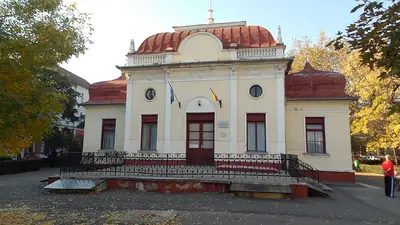
In Traian Park, the Ady Endre Museum preserves literary materials and memorabilia connected with the poet Ady Endre. It opened in 1955 and occupies the summer pavilion of Müllerei, also known as Mülleráj, a confectionery where the poet often spent time.
Explore Oradea with a self-guided walking tour
An Oradea self-guided walking tour with Neywo lets you discover the city’s architecture and history without joining a group or following a fixed timetable. The app tells the story of each place as you reach it, at your own pace.
Neywo has three walking tours in Oradea:
- Secession Showcase: Black Eagle to Holy Trinity — 1.9 km, 84 minutes, and 10 narrated stops.
- Faiths and Fortress: Synagogues, Cathedrals and the Citadel — 2.65 km, 76 minutes, and 7 narrated stops.
- Baroque Oradea: Bishops, Basilica and Union Square — 3.23 km, 94 minutes, and 9 narrated stops.
The free audio guide includes 27 narrated places, with narration available in 11 languages. Download Neywo to explore Oradea with the story of each landmark playing when you arrive—at your own pace, with no group and no schedule.
For a wider journey through Romania, continue to Cluj-Napoca, Sighișoara, Sibiu, or Timișoara, or browse the full Romania destination guide.
Places with an audio guide in Oradea
8 places in Oradea with a Neywo audio guide. Each one starts telling its story as you reach it.
Self-guided tours in Oradea
3 tours in Oradea, free in the Neywo app. Each stop tells its story as you reach it.
- Walk
Oradea's Secession Showcase: Black Eagle to Holy Trinity
In the early 1900s a handful of architects, Komor, Jakab and Rimanoczy among them, turned Oradea into a capital of Art Nouveau. Walk from the Zsolnay menorah of the Ullmann Palace to the glass-roofed Black Eagle and the wavy cornices of the Fuchsl and Stern palaces, and end at a ship-shaped church that predates them all.
Palatul Ullmann · Füchsl Palace, Oradea · Neologue synagogue · Palatul Vulturul Negru · Oradea State Theatre · Orthodox Episcopal Palace, Oradea …
Open this tour: Oradea's Secession Showcase: Black Eagle to Holy Trinity - Walk
Faiths and Fortress: Synagogues, Cathedrals and the Citadel
Oradea has long been a meeting point of Orthodox, Catholic, Greek-Catholic and Jewish communities. Follow their buildings from a Capuchin monastery and a hidden-away synagogue to the Orthodox Cathedral of the Sun, then cross to the old star-shaped citadel that once guarded the town.
Capuchin monastery in Oradea · Orthodox synagogue · Episcopal Cathedral of Oradea · Oradea Citadel · Church in Oradea fortress · Biserica Seminarului Greco-Catolic din Oradea …
Open this tour: Faiths and Fortress: Synagogues, Cathedrals and the Citadel - Walk
Baroque Oradea: Bishops, Basilica and Union Square
The largest Baroque ensemble in Romania was built by the bishops of Oradea in the 1700s. Start at the great basilica and its palace, walk south to the heart of the old New Town, and finish among the churches and palaces around Union Square.
Cathedral Basilica of St. Mary · Baroque Palace in Oradea · Biserica mănăstirii premonstratense Maica Îndurerată · Union Square · Biserica Sf. Ladislau · Greek-Catholic episcopal palace (Oradea) …
Open this tour: Baroque Oradea: Bishops, Basilica and Union Square
Walk Oradea with Neywo
Neywo turns Oradea into a self-guided audio tour. Stories arrive as you reach the place they belong to, and the route reshapes when you wander off it.

