Visiting Bucharest, Romania: Top Sights on Foot
Things to Do in Bucharest: What to See in Romania’s Capital
The best things to do in Bucharest reveal a city built in layers: royal architecture, grand concert halls, historic churches, museums, open-air collections and monumental reminders of the communist era. It is a capital where elegant boulevards stand alongside quiet religious landmarks and buildings moved or reshaped by the city’s turbulent history. Neywo offers a free audio guide for Bucharest with 154 narrated places, so you can explore its history as you walk.
Bucharest is the capital of Romania, and its sights are spread across several distinct areas. The centre is ideal for discovering palaces, museums and churches on foot, while the northern districts bring together house museums, natural-history collections and the city’s large open-air village museum.
What to see in Bucharest
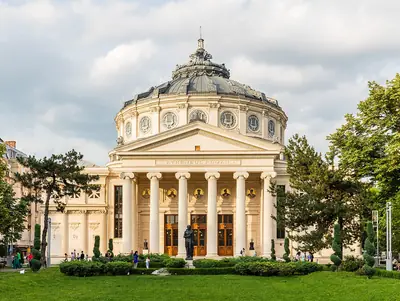
Romanian Athenaeum
The Romanian Athenaeum is one of Bucharest’s great cultural landmarks and a prestigious concert hall associated with Romanian classical music. Built between 1886 and 1888 to plans by the French architect Albert Galleron, the circular building combines neoclassical architecture with eclectic details.
Its grand façade, Doric columns, ornate foyer and rotunda create an imposing entrance. Inside, the concert hall is known for its acoustics and its sweeping 75-metre fresco, which presents important moments in Romanian history from ancient Dacia to the unification of Greater Romania in 1919. The building is home to the “George Enescu” Philharmonic and is closely linked with the George Enescu Festival.
Royal Palace and the National Museum of Art of Romania
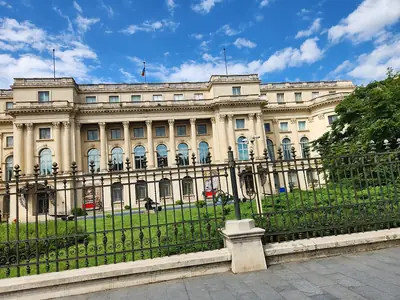
The Royal Palace stands on Calea Victoriei, beside Revolution Square. It was the principal royal residence in Bucharest until it was bombarded on 24 August 1944. After King Michael I’s forced abdication on 30 December 1947, the building became the National Museum of Art of Romania. Between 1948 and 1990, it was known as the Palace of the Republic.
The former palace now houses three major collections. Medieval Romanian Art includes religious icons, frescoes and woodwork from the 14th to the 18th centuries. The European Art collection covers the Renaissance through the 19th century, with works by El Greco, Rembrandt and Rubens, as well as Romanian artists. Modern Romanian Art traces changing styles and ideas of national identity through artists including Nicolae Grigorescu, Ion Andreescu and Theodor Pallady.
Theodor Aman Museum
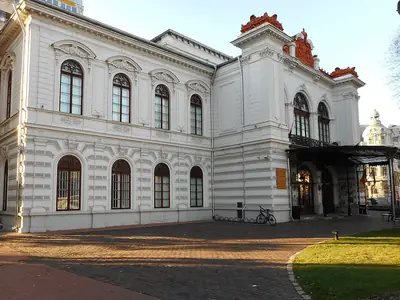
On C. A. Rosetti Street, the Theodor Aman Museum offers a more intimate artistic experience. It is a memorial collection devoted to the painter and graphic artist Theodor Aman, who lived from 1831 to 1891.
The museum brings together paintings, graphic art and sculpture, along with Aman’s working tools and other objects connected with his life and work. It provides a focused counterpoint to the larger collection in the former Royal Palace.
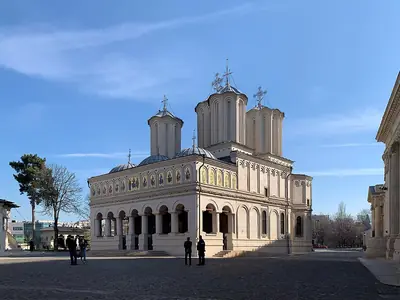
Romanian Patriarchal Cathedral
The Romanian Patriarchal Cathedral stands on Metropolitan Hill and is also known as the Metropolitan Church or the Cathedral of the Saints Constantine and Elena. It was built between 1654 and 1658 at the commission of Wallachian ruler Constantin Șerban and his wife Bălașa.
The church became the metropolitan cathedral when the seat of the Metropolis of Ungrovlahia moved from Târgoviște to Bucharest in 1668. In 1925, it became the patriarchal cathedral. Its white exterior combines Byzantine influences with the Brancovenesc style, which incorporates Renaissance and Ottoman decorative elements. Inside are ancient relics, including those of Saint Dimitrie Basarabov in a silver casket, as well as restored frescoes by Dimitrie Belizarie.
Suțu Palace
Suțu Palace, now home to the Bucharest Municipal Museum, was built between 1833 and 1835 in the neogothic style. The Viennese architects Conrad Schwink and Johann Veit designed the building for Costache Gr. Suțu.
Its interior was substantially modernized around 1862 by the sculptor Karl Storck. Among the additions were a monumental double staircase and a large mirror brought from Murano. The museum’s purpose is to document Bucharest’s history and life across the centuries, making the palace an important stop for anyone interested in the city itself.
Mihai Vodă Monastery
Mihai Vodă Monastery is one of Bucharest’s oldest surviving buildings. Founded by Mihai Viteazul in 1591, it was originally enclosed by stone walls and had the character of a fortress. The complex later served as a residence for the country’s leaders, a military hospital, a medical school and the site of the National Archives of Romania.
The monastery also stood above an archaeological site with remains from the Dacian period, including an ancient hearth and pottery vessels. During the communist regime, in 1985, the church was moved about 285 metres east on rails and concealed in its present location near Sapienței Street, Splaiul Independenței Street and Izvor Park. The medieval cloisters and other supporting buildings were demolished.
Palace of the Parliament
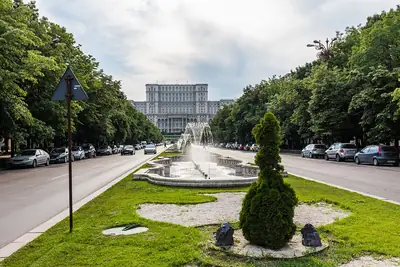
The Palace of the Parliament is Bucharest’s most monumental political landmark. Designed during the communist period as the People’s House, it now accommodates the Parliament of Romania, including the Senate, the Chamber of Deputies and the Constitutional Court.
The building reaches 84 metres above ground and extends 92 metres underground. It has nine levels above ground and nine below, with a floor area of about 365,000 square metres. Its modernist Neoclassical forms and socialist-realist character express the enormous scale of the urban transformation carried out during the communist era.
Romanian Peasant Museum
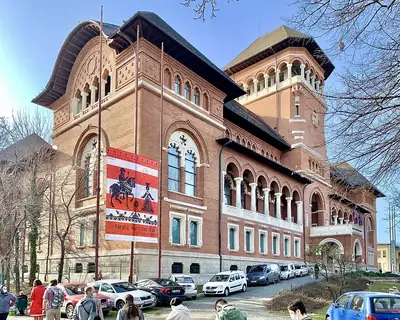
The Romanian Peasant Museum explores rural life and traditional culture across Romania. Its building was constructed between 1912 and 1941 according to plans by the architect N. Ghica-Budești. After housing the Lenin-Stalin Museum and later the Museum of the Party, it was reinstated as the Museum of the Romanian Peasant on 5 February 1990.
The collection contains more than 100,000 items, including embroidered costumes, icons, ceramics, wooden tools, religious objects and decorative masks. Pottery comes from nearly 200 centres. One of the museum’s distinctive displays is a “house-in-a-house” exhibit: a peasant cottage presented in situ, with sections opened to show objects as they would have been used in daily life.
“Grigore Antipa” National Museum of Natural History
The “Grigore Antipa” National Museum of Natural History houses more than two million specimens covering zoology, paleontology, minerals, rocks and ethnography. It began as the National Museum of Natural History on 3 November 1834 and was renamed after Grigore Antipa, who directed it for 51 years.
The current building was designed by Grigore Cerchez and inaugurated by Carol I of Romania in 1908. After a major renovation, the museum reopened in 2011. Its broad collections make it one of Bucharest’s most substantial museums, whether your interests lie in animals, fossils, geology or human cultures.
Dimitrie Gusti National Village Museum
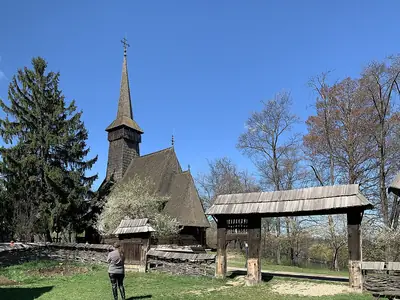
In King Michael I Park, the Dimitrie Gusti National Village Museum presents traditional Romanian village life in the open air. It covers more than 100,000 square metres and opened to the public in May 1936.
The houses were dismantled in different parts of Romania, transported to Bucharest by train, cart or boat, and reassembled beside the lake in what was then Herăstrău Park. Some buildings date from the 17th century, while others belong to the 20th century. The museum represents regions including Banat, Transylvania, Moldavia, Maramureș, Oltenia, Dobrogea and Muntenia, showing how local geography shaped house design.
Bucharest Botanical Garden
The “Dimitrie Brândză” Botanical Garden in the Cotroceni neighbourhood is a university garden with about 18.2 hectares dedicated to plant diversity. It contains more than 10,000 plant species, outdoor sectors, greenhouses and a museum.
The garden was founded in 1860 near the medical faculty by Carol Davila. Prince Alexandru Ioan Cuza signed the decree establishing it on 5 November that year. Today, the outdoor exhibition is divided into 12 sectors, complemented by two greenhouse buildings and the museum.
Museum of Popular Art “Nicolae Minovici”
The Museum of Popular Art “Nicolae Minovici” occupies a Romanian Revival-style house designed by Cristofi Cerchez. Originally built as a retreat on the outskirts of Bucharest for Nicolae Minovici, it later became the city’s first folk-art museum.
Its collection includes icons, ceramics, textiles, wooden objects and traditional musical instruments from across Romania. The museum also contains documentary material connected with the activity of Dr. Nicolae Minovici.
Grand Hotel Continental
The Grand Hotel Continental is a historic monument on Calea Victoriei, built on the foundation of the former Grand Hotel Broft. Its 53 rooms face Calea Victoriei, while six apartments are decorated in styles including Renaissance, Baroque, Imperio and Ludovic XV.
The hotel officially reopened on 27 January 2010 after two years of modernization. Its presence adds another layer to Calea Victoriei, the historic avenue that connects several of Bucharest’s most important palaces, museums and concert halls.
Explore Bucharest with Neywo
Neywo turns Bucharest into a self-guided walking tour through the city’s streets. The app has 8 walking tours, 1 bus route and 1 bike route, covering journeys from 0.56 to 3.76 km, with routes lasting between 14 and 222 minutes. Together, they include the city’s 154 narrated places.
Walks explore Calea Victoriei, the Athenaeum and the royal palace; University Square, Lipscani and the old inns; Curtea Veche and Manuc’s Inn; Piața Unirii and the Choral Temple; Mihai Vodă and the historic centre; and Şoseaua Kiseleff with its house museums. The bus route follows the route from the Arch of Triumph down Calea Victoriei to Piața Unirii, while the bike route connects palaces, concert halls and old Bucharest.
Each story plays as you reach the place, at your own pace, with no group and no schedule. Download the free Neywo audio guide and discover Bucharest in 11 languages, whether you choose a Cluj-Napoca side trip, continue to Brașov, or explore more of Romania.
Places with an audio guide in Bucharest
8 places in Bucharest with a Neywo audio guide. Each one starts telling its story as you reach it.
Self-guided tours in Bucharest
11 tours in Bucharest, free in the Neywo app. Each stop tells its story as you reach it.
- Bike ride
Calea Victoriei by Bike: Palaces, Concert Halls and Old Bucharest
Pedal the cycle lanes of central Bucharest from the Enescu Museum down to the Old Town. Pass the Athenaeum, the Royal Palace on Revolution Square and the Post Palace, ending at the walled Mihai Voda Monastery.
George Enescu Museum · Museum of Art Collections · White Church · Romanian Athenaeum · Royal Palace of Bucharest · Grand Hotel Continental …
Open this tour: Calea Victoriei by Bike: Palaces, Concert Halls and Old Bucharest - Bike ride
Cișmigiu Gardens by bike
5 narrated places along the way: Avântul Țării, St. Elijah–Gorgani Church, Gheorghe Panu, Monument to French soldiers, Crețulescu Palace.
Avântul Țării · St. Elijah–Gorgani Church · Gheorghe Panu · Monument to French soldiers · Crețulescu Palace
Open this tour: Cișmigiu Gardens by bike - Bus ride
Bus 361: from the Arch of Triumph down Calea Victoriei to Piata Unirii
A regular city bus that runs from the north of Bucharest through Kiseleff park and down the length of Calea Victoriei. Ride it past the Arch of Triumph, the Peasant Museum, the Enescu Museum, Revolution Square and the old Post Palace for the cost of one ticket.
Museum of Popular Art "Nicolae Minovici" · Anti-Communist Monument, Mihai Buculei, Bucharest · Arcul de Triumf Bucharest · Romanian Peasant Museum · George Enescu Museum · Museum of Art Collections …
Open this tour: Bus 361: from the Arch of Triumph down Calea Victoriei to Piata Unirii - Bus ride
Line 381 · Piața Romană to the old centre
Board at Piața Romană, alight at Bulevardul Mărășești. 8 narrated places along the way: Admiral Vasile Urseanu House, Bucharest, CICLOP Building, Bucharest, Italian Church, Suțu Palace, Church of Colta, Bucharest Bărăția Church, Saint Spyridon the New Church, Slobozia Church.
Admiral Vasile Urseanu House, Bucharest · CICLOP Building, Bucharest · Italian Church · Suțu Palace · Church of Colta · Bucharest Bărăția Church …
Open this tour: Line 381 · Piața Romană to the old centre - Walk
Calea Victoriei: the Athenaeum and the royal palace
Bucharest's grand street. The Athenaeum concert hall, the royal palace that now holds the National Art Museum, the Revolution square where Ceaușescu's last speech went wrong, and the memorial to it.
Sala Palatului · Royal Palace of Bucharest · National Museum of Art of Romania · Memorial of Rebirth · Central University Library of Bucharest · Theodor Aman Museum …
Open this tour: Calea Victoriei: the Athenaeum and the royal palace - Walk
Stavropoleos, the history museum and the bank palaces
The western old town: the tiny Stavropoleos monastery with its carved stone screen, the national history museum in the post office palace, and the interwar bank buildings that gave the quarter its 'little Paris' reputation.
Mihai Vodă Monastery Church · Mihai Vodă Monastery · Biserica „Adormirea Maicii Domnului” - Sapienței · Biserica Sfinții Apostoli · Blocul Adriatica-Trieste · National Museum of Romanian History …
Open this tour: Stavropoleos, the history museum and the bank palaces - Walk
University Square, Lipscani and the old inns
The heart of the old commercial town — Suțu Palace and the city museum, the Colțea church and hospital, and the surviving merchants' inns, Hanul cu Tei and Gabroveni, off the Lipscani lanes.
University of Bucharest · University Square · Suțu Palace · Colțea Church, Bucharest · Creditul Rural · Palatul Societății Creditul Rural …
Open this tour: University Square, Lipscani and the old inns - Walk
Curtea Veche and Manuc's Inn
Where Bucharest began: the ruins of the princely court of Vlad the Impaler's line, the church beside it, and Manuc's Inn, an 1808 caravanserai still working as one, with the CEC Palace dome at the end of the street.
Grand Hotel Continental · Odeon Theatre · Church of the Entry of the Most Holy Theotokos into the Temple · National Military Club · Alhambra Summer Theatre · Muzeul Memorial "Gh. M. Tattarescu" …
Open this tour: Curtea Veche and Manuc's Inn - Walk
Piaţa Unirii, Curtea Veche and the Choral Temple
The southern edge of the old town: the princely court where Bucharest began, Manuc's Inn — an 1808 caravanserai still working as one — the Domniţa Bălaşa church, and the Moorish-revival Choral Temple.
Domnița Bălașa church · Parcul Unirii · Piața Unirii · Manuc's Inn · "Curtea Veche" - Palatul Voievodal · Curtea Veche Church …
Open this tour: Piaţa Unirii, Curtea Veche and the Choral Temple - Walk
Elefterie: two churches and the sanitary heroes
A short walk on the western bank around the old and new Elefterie churches and the monument to the doctors and nurses of the First World War.
Muzeul Memorial "Dimitrie și Aurelia Ghiata" · Old St. Eleftherios Church · St. Elefterie Church · Monument to the Sanitary Heroes, Bucharest
Open this tour: Elefterie: two churches and the sanitary heroes - Walk
Şoseaua Kiseleff and the house museums
North from the Peasant Museum and the natural history museum through the villa quarter, where half a dozen collectors' houses are now small museums — Enescu's, Severeanu's, and the sea captain's house built to look like a ship.
National Geological Museum · Romanian Peasant Museum · “Grigore Antipa” National Museum of Natural History · George Enescu Museum · Casa cu cariatide · Admiral Vasile Urseanu House, Bucharest …
Open this tour: Şoseaua Kiseleff and the house museums
Walk Bucharest with Neywo
Neywo turns Bucharest into a self-guided audio tour. Stories arrive as you reach the place they belong to, and the route reshapes when you wander off it.

