Visiting Avilés, Spain: Top Sights on Foot
Things to do in Avilés: what to see in Asturias’ historic town
The best things to do in Avilés include exploring its medieval old town, historic palaces, Romanesque churches and the striking Oscar Niemeyer International Cultural Centre. Avilés combines centuries of history with a lively cultural landscape, making it a rewarding stop in Asturias. Neywo has a free audio guide for Avilés with 14 narrated places, available in 11 languages.
What to see in Avilés
Iglesia de Santo Tomás de Cantorbery
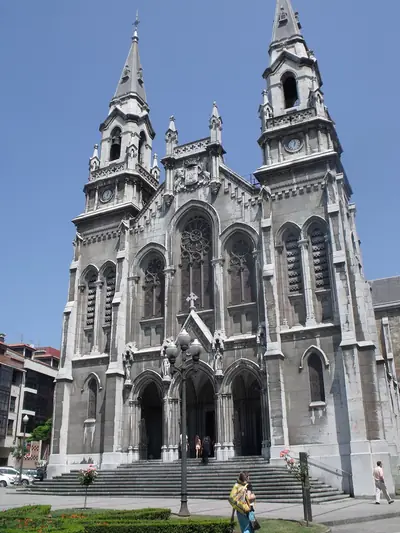
Also known as the Iglesia de Sabugo, this Romanesque church stands in what was once the fishing village of Sabugo. Construction probably began in the early thirteenth century, although the exact dates remain debated. Its stonework and long history make it one of the essential historic sights in Avilés.
Plaza de los Hermanos Orbón
The Plaza de los Hermanos Orbón is an open square in Avilés’ historic centre and is recognised as a site of cultural interest. It is one of the places included on a walk through the town’s old streets and architectural heritage.
Camposagrado Palace
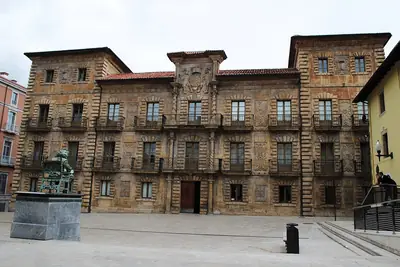
Camposagrado Palace is one of Avilés’ most distinctive Baroque landmarks. Built on the site of an earlier medieval building, it was home to the Marquises of Camposagrado before becoming a military barracks and later accommodating commercial uses. The City Council eventually acquired and restored it, and it now houses the School of Art for the Principality of Asturias.
The palace is especially notable for its two contrasting façades. The side facing what is now Muelle park once looked directly onto the estuary and was incorporated into the defensive wall. Its fortified character can be seen in the closed ground floor and small arrow slits, while the upper level opens into broad galleries.
Museum of Avilés Urban History
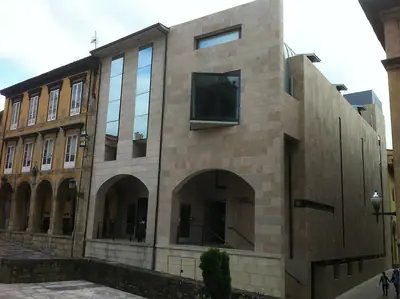
The Museum of Avilés Urban History is the first public space dedicated entirely to the town’s history. Located in the historic-artistic district, it presents Avilés chronologically, from the charter granted by King Alfonso VI in 1085 to the present day.
The estuary is central to the exhibition, linking the town’s development to the waterway that has shaped its history. The museum occupies around 1,000 square metres across three floors.
Iglesia de San Nicolás de Bari
The Iglesia de San Nicolás de Bari was once a Franciscan convent and is also known as the Iglesia de San Francisco. It offers a quieter glimpse of Avilés’ medieval religious heritage in the old town.
Palacio de Valdecarzana
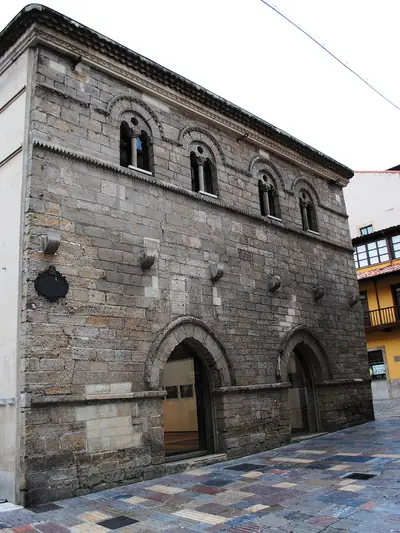
Also known as the Casa de las Baragañas, the Palacio de Valdecarzana is the oldest surviving civil building in Avilés. It was built between the fifteenth and sixteenth centuries as the residence of a wealthy local merchant.
The palace is a fine example of Gothic architecture. After a complete restoration in the early twentieth century, it became the city’s historical archive.
Los Alas Chapel and the Church of San Antonio de Padua
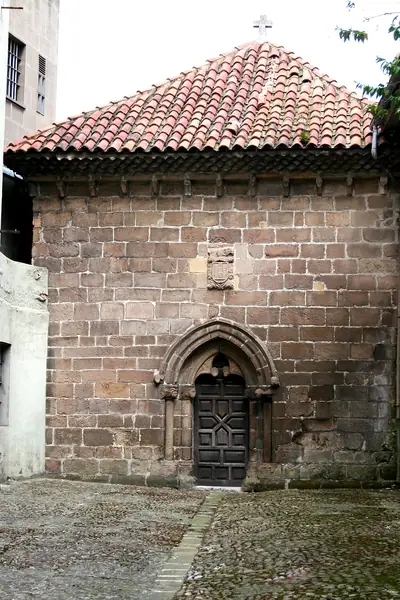
The Church of San Antonio de Padua, also called the Church of the Franciscan Fathers, is the oldest preserved building in Avilés. It was originally built in the twelfth century as the parish church of San Nicolás de Bari. Its Romanesque design includes richly decorated capitals, moldings and corbels; one capital depicts the scene of original sin.
The church contains the tomb of Pedro Menéndez de Avilés, who founded St. Augustine, Florida. Attached to its northern side is the Chapel of Santa María de los Alas, a fourteenth-century Gothic funerary chapel belonging to the de las Alas family, founders of the original temple.
Llano Ponte Palace
At the corner of Calle Rivero and Plaza de España stands Llano Ponte Palace, also known as the Casa-Palacio de García-Pumarino. This Baroque residence was built between 1700 and 1706 for Rodrigo García Pumarino, an Indiano who had made his fortune in Peru.
After his death, the house passed to the Llano Ponte family in 1774. Its original courtyard and chapel no longer survive. During the twentieth century, the building was transformed into a cinema named Marta y María, referring to the novel by Armando Palacio Valdés. The writer lived opposite the palace and drew inspiration from it for his work.
Maqua Palace
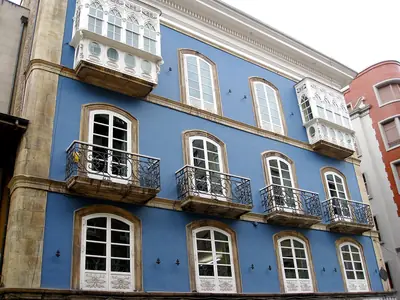
Maqua Palace reflects the history of a prominent local family and Avilés’ own growth during the nineteenth and twentieth centuries. Built for the Maqua family, the three-storey residence is particularly recognisable for the balconies on its top floor.
The palace was restored in 1983 and 1997, declared a monument of cultural interest in 1991, and had its façade renovated in 2006 so that it could be used as municipal offices.
Balsera Palace
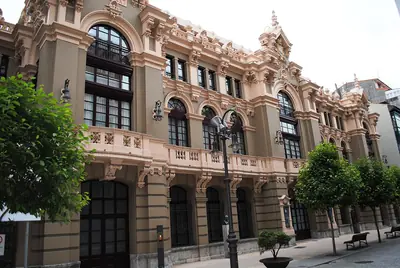
Balsera Palace, also known as Sendón, is one of Avilés’ most elegant early twentieth-century residences. It was commissioned by the local merchant Victoriano Fernández Balsera and designed by the Pontevedran architect Antonio Palacios.
The building combines Art Nouveau and eclectic influences. Its design rises from a curved corner to a slender tower, creating a striking sequence of ascending volumes. Inside, the preserved decoration includes a V-shaped staircase opening towards the first floor. The palace now houses the Julián Orbón Municipal Conservatory of Music.
Palacio Valdés Theatre
The Palacio Valdés Theatre is one of Avilés’ major cultural landmarks. Designed by Manuel del Busto in a Neobaroque style, it has a longitudinal layout running parallel to the front façade.
The first stone was laid on 5 August 1900, but financial difficulties repeatedly interrupted construction. The theatre opened in 1920 and was named after the writer Armando Palacio Valdés, who attended the opening performance. It hosted performances and operated as a cinema until 1972, then remained abandoned until its restoration and reopening in 1992.
Oscar Niemeyer International Cultural Centre
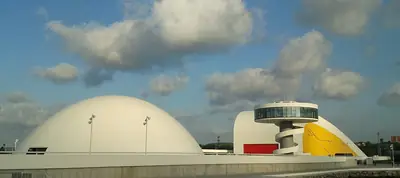
On the banks of the Avilés estuary, the Oscar Niemeyer International Cultural Centre introduces a dramatic modern contrast to the historic town. Its white, curved forms stand out against the industrial landscape around the water.
Construction began in 2008, and the centre opened on 26 March 2011. It was conceived as an open plaza dedicated to education, culture and peace. The complex includes an auditorium, observation tower, exhibition hall, cinema and restaurant, and hosts exhibitions, music, theatre, dance, film and gastronomy.
San Lorenzo de Cortina
In the Llaranes neighbourhood, the chapel of San Lorenzo de Cortina stands on the site of an earlier pre-Romanesque temple. The only surviving element of that earlier building is a small double-arched window above the west entrance, dating from the tenth century.
The present chapel was built in the eighteenth century and served the local community until a new parish church was constructed in 1957. It was seriously damaged during the Civil War and has since undergone significant changes. Inside are a postwar neo-Gothic altarpiece, devotional images and a processional banner from the chapel’s period.
Alfercam Museum
The Alfercam Museum was a private museum created by brothers Alfredo and Fernando Campelo. Its collections brought together around 400 ethnic musical instruments and about 30 classic cars across more than 1,000 square metres.
The museum opened in 2006 but has been closed to the public for some time. It first announced a temporary closure in 2008 and another in 2012, after which it did not reopen.
Explore Avilés with a free audio guide
Neywo’s Avilés self-guided walking tour covers 1.84 kilometres in around 90 minutes, with 11 narrated stops. It is the walk “Merchant Palaces, a Navigator’s Tomb and Niemeyer’s White Plaza”, taking in the town’s churches, squares, palaces, theatre, Museum of Avilés Urban History and Oscar Niemeyer International Cultural Centre.
Download Neywo and explore Avilés at your own pace. The app tells the story of each place as you reach it, with no group and no schedule. After Avilés, continue discovering Asturias with Gijón or Covadonga, or explore more of Spain.
Places with an audio guide in Avilés
8 places in Avilés with a Neywo audio guide. Each one starts telling its story as you reach it.
Self-guided tours in Avilés
1 tour in Avilés, free in the Neywo app. Each stop tells its story as you reach it.
- Walk
Avilés: Merchant Palaces, a Navigator's Tomb and Niemeyer's White Plaza
Walk Asturias' best-kept old town from the Romanesque church of the old fishing quarter through the stone palaces of its merchant families. Find the tomb of the conquistador who founded St. Augustine, Florida, then end at Oscar Niemeyer's only building in Spain, glowing white on the estuary.
Iglesia de Santo Tomás de Cantorbery · Plaza de los Hermanos Orbón, Avilés · Camposagrado Palace · Museum of Avilés Urban History · Iglesia de San Nicolás · Palacio de Valdecarzana, Avilés …
Open this tour: Avilés: Merchant Palaces, a Navigator's Tomb and Niemeyer's White Plaza
Walk Avilés with Neywo
Neywo turns Avilés into a self-guided audio tour. Stories arrive as you reach the place they belong to, and the route reshapes when you wander off it.

