Things to Do in Oviedo, Spain: Walking Guide
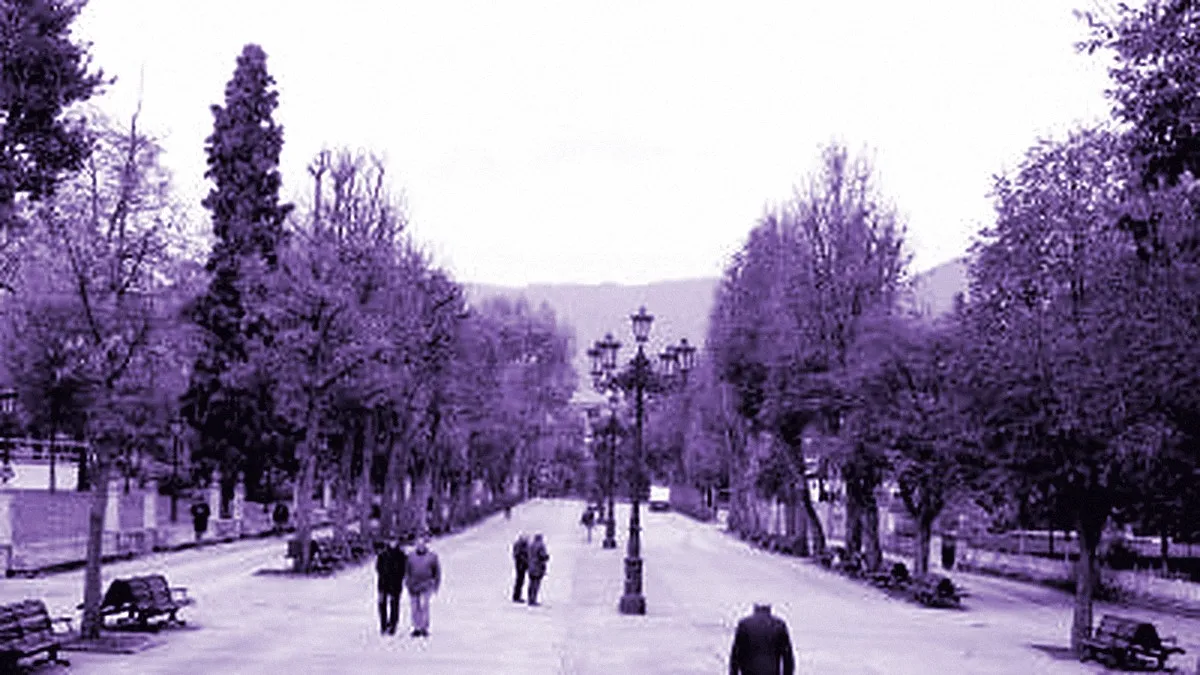
Things to Do in Oviedo: What to See in Asturias’ Historic Capital
Looking for things to do in Oviedo? The capital of Asturias brings together early medieval monuments, a Gothic cathedral, museums, historic streets, public sculpture and distinctive local traditions. It is a city where royal chapels and ninth-century architecture stand alongside lively squares and contemporary artworks. Neywo’s free audio guide to Oviedo narrates 117 places as you explore.
What to See in Oviedo
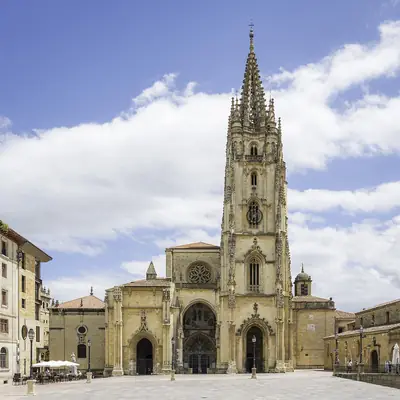
Metropolitan Cathedral Basilica of the Holy Saviour
Oviedo Cathedral, also known as the Sancta Ovetensis, is mainly Gothic but preserves elements from the Pre-Romanesque, Romanesque, Renaissance and Baroque periods. Its construction began in the late thirteenth century with the chapter house and cloister, while the tower was completed in the middle of the sixteenth century.
Inside, three naves, side chapels, a transept and a Renaissance ambulatory reveal the cathedral’s long architectural evolution. Plant motifs decorate the tall columns, and the Flemish Gothic altarpiece presents scenes from the life of Christ. The Chapel of King Casto contains a pantheon for Asturian royalty.
Cámara Santa
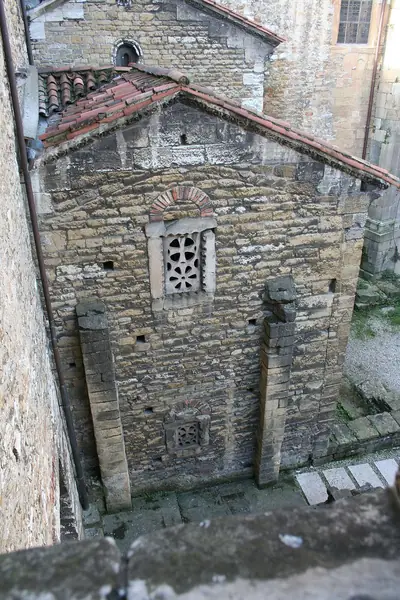
The Cámara Santa, or Holy Chamber, is one of the oldest surviving parts of the cathedral complex. Built in the ninth century during the reign of Alfonso II of Asturias, it served as a royal chapel and a secure place for the cathedral’s relics and treasures.
The chamber has two chapels arranged one above the other. The lower level is the crypt of Santa Leocadia, while the upper chapel of San Miguel contains Romanesque sculptures of the Apostles on the columns supporting the vault. Its treasures include the Cross of Victory, the Cross of the Angels, the Box of the Agates and the Holy Ark.
La Foncalada
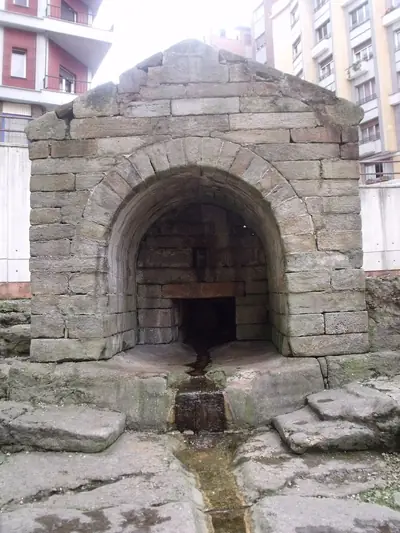
La Foncalada is a rare surviving example of an early medieval public utility. Commissioned by Alfonso the Third of Asturias in the ninth century, it was built over a natural spring outside the city walls and beside an ancient Roman road.
The compact pavilion is roughly four metres wide and has a pitched roof, a semicircular entrance arch and a Victory Cross above the doorway. It is considered the oldest civil monument in Spain to remain in continuous use and the only surviving Asturian pre-Romanesque public fountain.
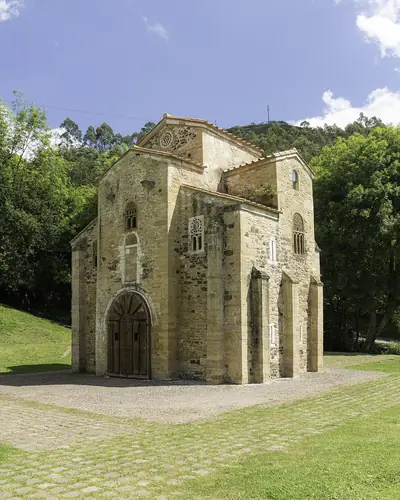
San Julián de los Prados
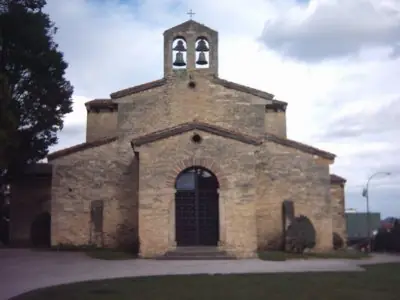
Also known as Santullano, San Julián de los Prados was built in Oviedo around the year 830 by Tioda, the court architect of Alfonso II of Asturias. Dedicated to the martyred saints Julian and Basilissa, it is one of the defining monuments of Asturian pre-Romanesque art.
Its basilican plan has three naves, a broad transept and three straight-ended chapels. Inside, thick piers and stone walls give the church a solid, calm character. Large areas of ninth-century frescoes remain on the walls, with geometric bands, painted arcades, draperies and architectural patterns inspired by Roman and late-antique models.
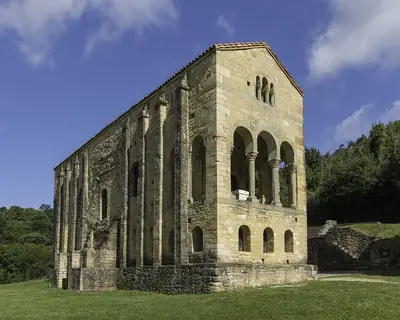
Santa María del Naranco
On the southern slope of Mount Naranco, Santa María del Naranco is one of the most important examples of Asturian pre-Romanesque architecture. The building began as a royal palace for King Ramiro I and was completed in 842, before being consecrated in 848. Its original function remains debated: it may have been a royal hall, hunting pavilion, residence or mausoleum.
The two-storey structure has elevated open galleries and an upper hall covered by a long barrel vault. Exterior buttresses support the walls, while the galleries open towards Oviedo and the surrounding hills. The building’s raised arches and vertical decoration are often seen as early steps towards the Romanesque style.
San Miguel de Lillo
A short distance from Santa María del Naranco, San Miguel de Lillo is another remarkable pre-Romanesque monument associated with the reign of Ramiro I. Built around the year 842, it was probably part of a royal retreat and may originally have been dedicated to both Saint Mary and Saint Michael.
The surviving church is only part of a structure that once had three aisles, vaulted ceilings and side chapels arranged in a Latin-cross plan. Its narrow, lofty form is marked by exterior buttresses. Inside, carved human figures decorate the vestibule jambs, while the windows contain latticework cut from single slabs of stone. Traces of the original wall paintings are still visible.
Archaeological Museum of Asturias
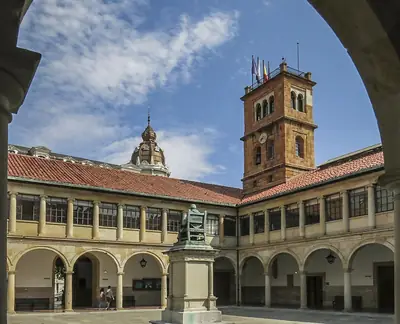
The Archaeological Museum of Asturias occupies the cloister of the former Monastery of San Vicente. Its permanent exhibition follows the cultural history of Asturias from the Paleolithic and Neanderthal discoveries through the Neolithic, Metal Ages, fortified settlements known as castros, the Roman period and medieval Asturias.
The collection includes everyday objects as well as works of artistic importance. Highlights include the Vega del Cielo mosaic, medieval altar stones from San Miguel de Lillo and Santa María del Naranco, and a twelfth-century sarcophagus associated with Gontrodo Pérez.
Monastery of San Pelayo
Near Oviedo Cathedral, the Monastery of San Pelayo—also called Las Pelayas—is an active Benedictine convent for women. Alfonso II of Asturias founded the monastery, originally dedicated to Saint John the Baptist. Its name changed in 994 after the relics of Saint Pelayo arrived in Oviedo.
Much of the present building belongs to later rebuilding. The church was reconstructed in 1590 by Leonardo de la Cajiga, and the towers were added in 1650 by Melchor Velasco. The monastery remains an important part of the historic setting around the cathedral.
University of Oviedo
The University of Oviedo has been active in the city since 1608. Its origins go back to the end of the sixteenth century, when the Catholic archbishop Fernando Valdés Salas set out the project in his will. A papal bull issued by Pope Gregory the Thirteenth in 1574 supported its foundation, later confirmed by a royal decree signed by Philip the Third in 1605.
The public university’s presence now extends beyond Oviedo to campuses and research centres in Gijón and Mieres.
Iglesia de San Martín
Iglesia de San Martín de Pereda reflects the long architectural history of the area. The parish church was established in the twelfth century, although documents record an earlier foundation created in 857 by Ordoño the First of Asturias.
Its Romanesque character led to its inclusion in the Inventory of the Cultural Heritage of Asturias in 2019.
Casona de Regla
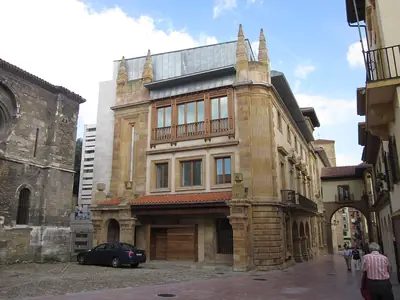
Beyond Oviedo’s old medieval walls, Casona de Regla is an eighteenth-century semirural house once built outside the city. Known also as Casona La Regla, Cortixu and Casa de les tres perrines, it combined a home with work and production spaces.
Attributed to Manuel Reguera González, the building has three levels, a mansard attic, a gently sloping tiled roof and a double exterior staircase. Its design combines refined architectural details with popular regional forms. Today, it is protected as an Asset of Cultural Interest.
Oviedo’s public sculpture
Oviedo’s streets and squares form an open-air collection of more than a hundred sculptures. Among the city’s works are the Bust of Isabella II on Ramón y Cajal Street and Alegorías al Trabajo y las Artes on the façade of the Junta General del Principado.
Created by Víctor Hevia between 1915 and 1920, the latter pair represents industry and the arts. The bronze bust of Isabella II was created by Francisco Pérez del Valle and dated 1846; it was cast at the Foundry Workshop of the Trubia Arms Factory.
Asturian culture and language
Asturian, or asturianu, is the region’s own Romance language and belongs to the wider Asturleonese group. It has its own grammar, dictionary and spelling rules. Its use is regulated by the Academy of the Asturian Language, and although it is not an official language of Spain, it is protected by the Statute of Autonomy of Asturias and offered as an elective subject in schools.
Explore Oviedo with Neywo
Neywo offers an Oviedo self-guided walking tour experience with five walking tours, one bus route and one bike route. The walks range from 0.69 to 2.29 km and from 69 to 82 minutes, with between 10 and 12 narrated stops each. The bus route covers 5.5 km in 24 minutes and has 10 stops, while the bike route covers 0.4 km in 2 minutes and has two stops.
The tours include the cathedral and relics, Oviedo’s noble streets, the squares of the Fontán, the city’s open-air sculpture collection, and the modern city. The app tells the story of each place as you reach it, at your own pace, with no group and no schedule. Narration is available in 11 languages.
Download Neywo to explore Oviedo’s historic centre, pre-Romanesque monuments and public art while you walk, ride or travel by bus. You can also continue discovering northern Spain, nearby Gijón or Covadonga with the app.
Places with an audio guide in Oviedo
8 places in Oviedo with a Neywo audio guide. Each one starts telling its story as you reach it.
Self-guided tours in Oviedo
7 tours in Oviedo, free in the Neywo app. Each stop tells its story as you reach it.
- Bike ride
From Santullano to the Olympic Flame: a short ride on Oviedo's cycle lane
A short, easy ride on a dedicated cycle lane in the east of the city. It starts at San Julian de los Prados, the ninth-century church whose walls still carry painted Roman-style frescoes, and ends at the swirling bronze Olympic Flame in front of the Palace of Sports.
Llama Olímpica · San Julián de los Prados
Open this tour: From Santullano to the Olympic Flame: a short ride on Oviedo's cycle lane - Bus ride
Line E2: Olympic Flame to the old town by bus
A regular city line that crosses Oviedo from the east. It passes the Olympic Flame and A la Tona, stops by the ninth-century Foncalada fountain and Santa Clara convent, runs through Escandalera and Woody Allen's bronze to the modernist Casas del Cuitu, then on west to the steel pavilion and the oak tree of Al roble.
Llama Olímpica · A la Toná · Vida · La Foncalada · Convent of Santa Clara (Oviedo) · Plaza de la Escandalera …
Open this tour: Line E2: Olympic Flame to the old town by bus - Walk
Holy Oviedo: cathedral, relics and the first kings
Follow the pilgrims' saying that whoever visits Santiago but not the Saviour visits the servant and leaves the master. This loop around the cathedral takes in the Holy Chamber with its ninth-century treasury, the bishop's courtyard, the old walls and the monasteries that grew up in the shadow of the first Asturian court.
Palacio de Velarde · Church of San Tirso, Oviedo · Metropolitan Cathedral Basilica of the Holy Saviour, Oviedo · Cámara Santa · Palacio Episcopal de Oviedo · Corrada del Obispo …
Open this tour: Holy Oviedo: cathedral, relics and the first kings - Walk
From a ninth-century fountain to the university: Oviedo's noble streets
Start at La Foncalada, the oldest civil monument in Spain still in use, then climb into the old town of baroque palaces. Coats of arms, courtyards and the 1608 university show how the city's nobility lived once the court had left for Leon.
La Foncalada · Guisandera · Casa de los Campomanes · Valdecarzana-Heredia Palace, Oviedo · Camposagrado Palace · Capilla de la Balesquida …
Open this tour: From a ninth-century fountain to the university: Oviedo's noble streets - Walk
Cider, markets and bronze Lola: the squares of the Fontan
The lower old town is where Oviedo eats, drinks and gossips. Wander from the medieval Trascorrales square past the town hall plaza to the arcades of the Fontan, where a longing bronze woman sits beside the market and the cider houses.
Iglesia de Santo Domingo · Casona de Regla · Plaza de Trascorrales, Oviedo · La lechera · Plaza de la Constitución · Iglesia de San Isidoro …
Open this tour: Cider, markets and bronze Lola: the squares of the Fontan - Walk
Woody Allen, Mafalda and a very round Botero: Oviedo's open-air museum
Oviedo has more than a hundred sculptures on its streets and this walk meets the best of them: three bronze horses, Botero's mother, a bullfighter's torso, Woody Allen out for a stroll, Mafalda on her bench and the writer of La Regenta. It ends in the Campo de San Francisco park.
Asturcones · Plaza de la Escandalera · La Pensadora · Culis monumentalibus · El diestro · Memorial to Woody Allen …
Open this tour: Woody Allen, Mafalda and a very round Botero: Oviedo's open-air museum - Walk
Uría, the railway and a Dalí dolphin: the modern city and its aqueduct
Leave the old town for the Ensanche, the extension laid out along Calle Uria. From the remains of a thirteenth-century convent and a neo-Gothic church, this walk passes a pink basilica, a lacy modernist facade, Dali's bronze man on a dolphin, a surviving Renaissance aqueduct and a steel mining pavilion.
Vida · Convent of Santa Clara (Oviedo) · Church of the Sagrado Corazón de Jesús, Oviedo · Basilica of St. John the Baptist · Casas del Cuitu · Asturias …
Open this tour: Uría, the railway and a Dalí dolphin: the modern city and its aqueduct
Walk Oviedo with Neywo
Neywo turns Oviedo into a self-guided audio tour. Stories arrive as you reach the place they belong to, and the route reshapes when you wander off it.

