What to See in Gijón, Spain: Free Audio Guide
Things to Do in Gijón: Museums, History and Asturian Culture
Gijón is a coastal city in Asturias where Roman remains, railway heritage, museums and local traditions come together. The city is worth visiting for its wide range of places to see, from the historic Cimadevilla district and Campo Valdés to the Aquarium of Gijón, the Museum of the Asturian People and the former Roman villa at Veranes. Neywo has a free audio guide for Gijón with 43 narrated places.
Gijón is part of Asturias, in northern Spain. Its attractions are spread between the historic centre, the waterfront, residential districts and the surrounding countryside, making the city especially rewarding to explore on foot.
What to See in Gijón
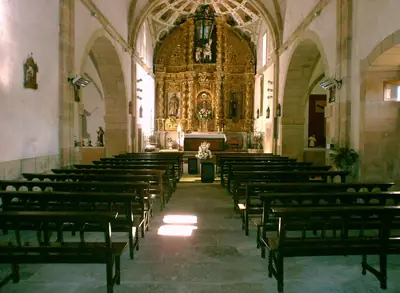
Santuario de Nuestra Señora de Contrueces
South of Gijón’s urban area, in the Contrueces neighbourhood, the Sanctuary of Our Lady of Contrueces is an important religious site in the city’s history. The earliest surviving documentary references date from the early tenth century, including a document signed on 28 August 905 in Cortuloces, then described as a suburb of Gijón.
For many years, the Virgin venerated here was regarded by much of Gijón’s population as the city’s patroness. Because the sanctuary stood away from the centre, the chapel of the Virgin of Begoña also became important to local worship. Even today, many people from Gijón come to Contrueces on the Sunday after the feast of the Virgin of Begoña.
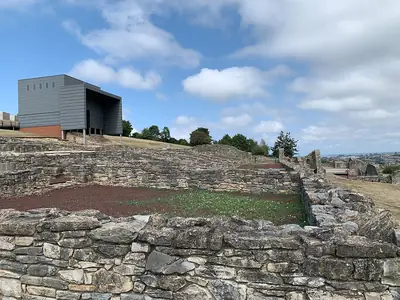
Villa Romana de Veranes
The Villa Romana de Veranes is an archaeological site where the remains of a Roman villa can be seen alongside an interpretation centre. The villa was in use from the beginning of the Common Era until the fifth century. It was initially identified as the remains of a Visigothic church, but later research showed that the church had been built over the older Roman structure.
A substantial part of the villa survives, including fragments of a mosaic from one of its halls. Early Medieval tombs add another layer to the site’s history. The interpretation centre includes a permanent exhibition and an audiovisual room, providing context for the ruins officially known as Torrexón de Veranes, an Asset of Cultural Interest.
Aquarium of Gijón
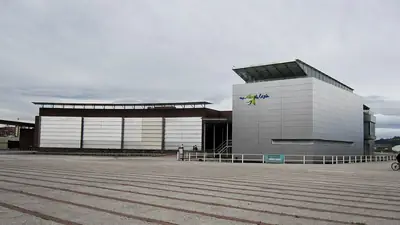
On the Poniente Beach promenade, the Aquarium of Gijón occupies the docks of the former Astilleros del Cantábrico shipyards. Its exhibition space covers 2,000 square metres and contains 60 aquariums with around 250 animal species.
The collection includes fish, invertebrates, mammals, reptiles, amphibians and birds. Around 5,000 individual animals live in the tanks, including eight sharks measuring between one and a half and three metres long. The aquarium also has an auditorium, an educational classroom and a recovery area for marine mammals and reptiles.
Asturias Railway Museum
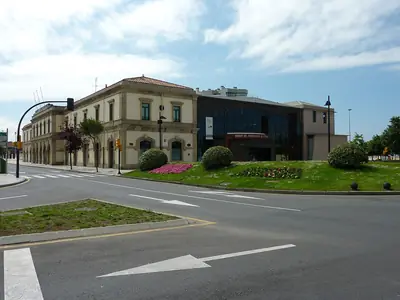
Beside Poniente Beach in the Natahoyo district, the Asturias Railway Museum explores the railway history of the region through locomotives, carriages, tracks and railway equipment. The museum occupies more than 14,000 square metres, including the former North Station of Gijón, two newer buildings and railway tracks.
The original station dates from 1874, while the museum opened in 1998. Its collection includes steam locomotives, diesel tractors, passenger coaches, wagons, trams, mine railway equipment and smaller track vehicles. Many of the exhibits belonged to railways serving Asturias’s mines, factories and industries. The museum also shows how varied the regional network once was, with lines associated with Langreo, Norte, Vasco Asturiano, Carreño, RENFE and FEVE.
Espacio Etnográfico Ciudadela de Celestino Solar
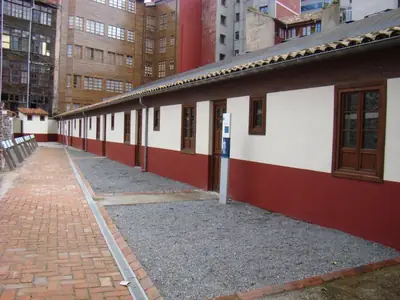
Hidden inside the block known as the Martillo de Capua, the Espacio Etnográfico Ciudadela de Celestino Solar preserves a workers’ settlement. The ciudadela was built in 1877 by Celestino González Solar in an area then known as La Garita.
It originally contained 23 houses and belonged to a type of workers’ housing that was once common in Gijón. Around 200 settlements of this kind existed in the city, making this preserved example a useful way to understand the living conditions and urban history of working communities.
Evaristo Valle Museum
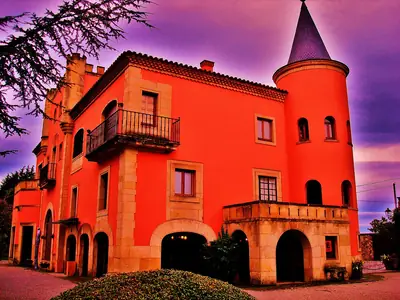
The Evaristo Valle Museum is set within the La Redonda estate, surrounded by 16,000 square metres of gardens. It is devoted to the life and work of the Gijón painter Evaristo Valle.
The collection is displayed in two buildings: one constructed specifically for the museum and another occupying a former palace from the late nineteenth century. Alongside Valle’s paintings, personal objects and documents help explain his life. One particularly personal detail is the collection of shells that belonged to the painter’s father. The museum began as a cultural foundation in 1981 and opened to the public in 1983.
San Pedro Church
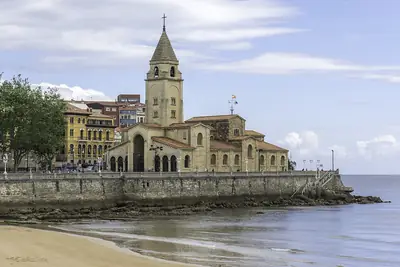
At the edge of San Lorenzo Beach, where the Cimadevilla neighbourhood begins, San Pedro Church stands in Campo Valdés. The present building was constructed between 1945 and 1955 after the earlier fifteenth-century church was destroyed during the Spanish Civil War.
Architects Francisco and Federico Somolinos designed the reconstruction. Although the former church was Gothic, the present building has a historicist character influenced by Romanesque architecture and Asturias’s pre-Romanesque tradition.
International Bagpipe Museum
Inside the Museum of the Asturian People, the International Bagpipe Museum brings together instruments from Spain, Europe, Africa and Asia. Its collection shows how widely the bagpipe appears across different musical traditions.
Founded in 1965, the museum first occupied the Antiguo Instituto Jovellanos before moving in 1975 to the González Vega family house, where it remains part of the Museum of the Asturian People. Comparing the instruments from different regions makes this a distinctive stop for anyone interested in music and ethnography.
Jove Huergo Palace and the Juan Barjola Museum of Painting
The Juan Barjola Museum of Painting occupies a historic complex connected with the Jove Huergo Palace. The museum opened in 1988 after the artist donated 104 works created between 1950 and 1988.
The palace itself dates from the seventeenth century. Its two rectangular buildings have three floors and a symmetrical arrangement of openings. A coat of arms belonging to the Hevia, Miranda and Lavandera families is the central decorative feature of the façade. Attached to it, the Chapel of the Trinity has a Baroque entrance, a belfry, a ribbed vault and a dome decorated with figures of the four Evangelists.
Museo Jovellanos
In Cimadevilla, the Museo Jovellanos, also known as the Casa Natal de Jovellanos, occupies a palatial home. The building is an important part of the visit, linking the museum with the historic neighbourhood and with Gijón’s cultural heritage.
Roman Baths in Campo Valdés
Beneath Campo Valdés in Cimadevilla, the Roman Baths Museum preserves the remains of public baths built near the end of the first century. The thermae remained in use until the fourth century, after which the site became a necropolis and was eventually covered by a plaza.
The baths were rediscovered in 1903 during work on a sewer system. Excavations followed, and the site opened as a museum in March 1995. It offers a glimpse of a place that was built nearly two thousand years ago.
Nicanor Piñole Museum
The Nicanor Piñole Museum is devoted to the work and life of the Asturian painter Nicanor Piñole. It provides a focused introduction to an important regional artist and to the world in which he lived.
Museum of the Asturian People
The Museum of the Asturian People is a 35,000-square-metre open-air museum dedicated to the memory and culture of Asturias. Its grounds combine traditional buildings, popular art and large ethnographic objects.
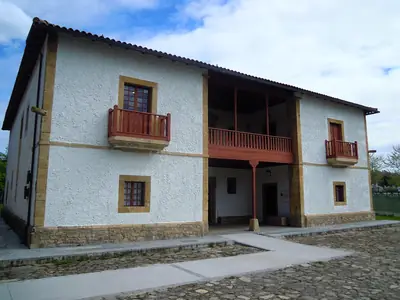
Among the buildings are hórreos and paneras—traditional storage structures dating from the seventeenth to the nineteenth centuries—along with the seventeenth-century Casa de los Valdés and the Casa de los González de la Vega, built in Serín in 1757. The museum also includes a traditional farmhouse, an iron forge, a cider press and a bolera for the cuatreada style of bowling. The International Bagpipe Museum is one of its main stops.
Torre del Reloj
The Torre del Reloj in Cimadevilla reaches back to 1572, although the present tower was rebuilt in 1989. It was intended to serve as both a museum and a viewpoint, and it now houses the Municipal Archive of Gijón.
Over time, the tower has served several purposes, including use as a prison. Its museum role was connected with archaeological documentation from excavations in the city and material concerning Gijón’s history.
El Molinón-Enrique Castro Quini
El Molinón-Enrique Castro Quini is Gijón’s municipal football stadium and the home ground of Real Sporting de Gijón. It seats 29,371 spectators, making it one of Asturias’s major football venues.
The name comes from a large hydraulic mill that once stood nearby. The exact construction date is unknown, but a local newspaper mentioned a match at “the Molinón ground” on 20 May 1908, suggesting that the venue was already familiar to local people by then.
Explore Gijón with a Free Audio Guide
A Gijón self-guided walking tour lets you explore the city without joining a group or following a fixed timetable. Neywo offers four walking tours, one bus route and one bike route, with narration available in 11 languages.
The walks include:
- Cimadevilla: Roman Baths, Palaces and the Horizon — 2.67 km, 98 minutes and 12 narrated stops.
- Poniente Shipyards to Belle Epoque Gijon — 4.16 km, 119 minutes and 12 narrated stops.
- Football, Bulls and the Asturian Village — 2.91 km, 82 minutes and 8 narrated stops.
- Laboral and Somio: Art, Villas and a Cathedral of Learning — 2.34 km, 53 minutes and 4 narrated stops.
There is also an EMTUSA Line 4 bus route from the Railway Museum to the Belle Epoque Centre, covering 2.9 km in 12 minutes with 5 narrated stops, and a 1 km bike route from Poniente Beach to Cimadevilla with 2 stops.
Download Neywo and explore Gijón at your own pace. The app tells the story of each place as you reach it, so you can pause, look around and continue when you are ready—with no group and no schedule. When you have more time in the region, Oviedo and Covadonga offer two more places to discover in Asturias.
Places with an audio guide in Gijón
8 places in Gijón with a Neywo audio guide. Each one starts telling its story as you reach it.
Self-guided tours in Gijón
6 tours in Gijón, free in the Neywo app. Each stop tells its story as you reach it.
- Bike ride
Poniente Beach to Cimadevilla by Bike
A short ride on a mapped cycle lane from the Asturias Railway Museum beside Poniente beach to the Juan Barjola Museum at the foot of Cimadevilla.
Asturias Railway Museum · Juan Barjola Museum of Painting
Open this tour: Poniente Beach to Cimadevilla by Bike - Bus ride
EMTUSA Line 4: Railway Museum to the Belle Epoque Centre
City bus line 4 links the Asturias Railway Museum on Poniente beach with the Barjola museum, the Sacred Heart basilica and the old workers' ciudadela. A cheap way to see the western half of Gijon.
Asturias Railway Museum · Juan Barjola Museum of Painting · Shrine Basilica of the Sacred Heart · Espacio etnográfico Ciudadela de Celestino Solar · Plaza de Los Campos
Open this tour: EMTUSA Line 4: Railway Museum to the Belle Epoque Centre - Walk
Cimadevilla: Roman Baths, Palaces and the Horizon
Gijon began on the Cimadevilla headland. Walk from the monumental stairs of San Lorenzo beach through Roman baths, baroque palaces, the main square and the clock tower, then out to Chillida's concrete 'Eulogy of the Horizon' facing the Cantabrian Sea.
Shrine Basilica of the Sacred Heart · Espacio etnográfico Ciudadela de Celestino Solar · La Escalerona · San Pedro church, Gijón · Roman thermae in Campo Valdés · Palacio de los Valdés …
Open this tour: Cimadevilla: Roman Baths, Palaces and the Horizon - Walk
Poniente Shipyards to Belle Epoque Gijon
Start at the former shipyards on Poniente beach with a shark-filled aquarium and the railway museum, then cut through the 19th-century city: a workers' ciudadela, neo-Gothic and baroque churches, the Jovellanos theatre and the basilica known as La Iglesiona.
Aquarium of Gijón · Asturias Railway Museum · Nicanor Piñole Museum · Plaza del Humedal · Church of San José in Gijón · Shrine Basilica of the Sacred Heart …
Open this tour: Poniente Shipyards to Belle Epoque Gijon - Walk
Football, Bulls and the Asturian Village
A walk through the Bibio quarter and the eastern park: a bullring that opened in 1888, El Molinon stadium of Sporting de Gijon, the statue of coach Manolo Preciado, and the open-air Museum of the Asturian People with its International Bagpipe Museum.
Monumento a los caídos del cuartel del Simancas · Plaza de Los Campos · Church of San Antonio de Padua, Gijón · Plaza de toros de El Bibio · El Molinón-Enrique Castro Quini · Statue of Manolo Preciado …
Open this tour: Football, Bulls and the Asturian Village - Walk
Laboral and Somio: Art, Villas and a Cathedral of Learning
Head east to the Universidad Laboral, the vast 1950s complex built as a school for miners' orphans, with its church and theatre, then go on to the leafy parish of Somio, its pre-Romanesque-inspired church and the gardens of the Evaristo Valle Museum.
Iglesia de la Universidad Laboral · Teatro de la Laboral · Church of San Julián, Somió, Gijón · Evaristo Valle Museum
Open this tour: Laboral and Somio: Art, Villas and a Cathedral of Learning
Walk Gijón with Neywo
Neywo turns Gijón into a self-guided audio tour. Stories arrive as you reach the place they belong to, and the route reshapes when you wander off it.

