What to See in Koh Samui, Thailand: Free Audio Guide
Things to do in Koh Samui: temples, traditions and island culture
The best things to do in Koh Samui include much more than time on the beach. The island’s Buddhist temples reveal its artistic traditions, religious heritage and connection with local communities, from the colourful Wat Plai Laem to the quiet seaside setting of Wat Ratchathammaram. Neywo offers a free audio guide for Koh Samui with 8 narrated places, so you can explore while the stories play as you arrive.
What to see in Koh Samui
Wat Plai Laem
Wat Plai Laem, also known locally as Wat Laem Suwannaram, is a modern Buddhist temple between the Big Buddha and Chaweng Beach. Founded in 1880, it combines Chinese and Thai artistic traditions.
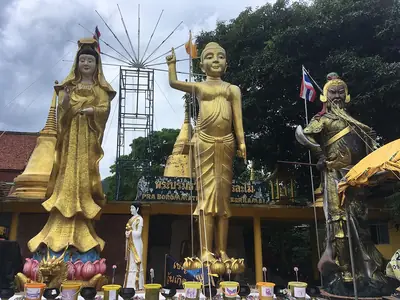
The temple’s most distinctive feature is its ordination hall, or ubosot, built on a lotus-shaped platform in the middle of a pond. A bridge leads across the water, while green naga serpents decorate the entrance stairs. On either side of the hall stand a 20-metre-high Guanyin statue with many arms and a jovial Budai figure.
Inside, a standing Buddha is positioned between the doors, and the principal golden Buddha sits in the mara vijaya pose. Bright mural paintings cover the interior. Visitors also come to admire the lotus-inspired architecture and feed the fish in the pond.
Wat Bo Phut and Wat Na Phra Lan
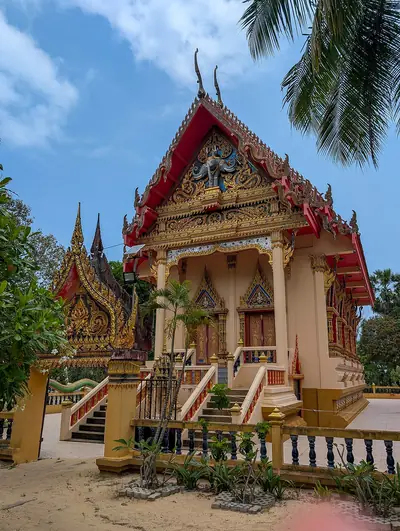
Wat Bo Phut and Wat Na Phra Lan are Buddhist temples in Surat Thani province. They add two more religious sites to Koh Samui’s cultural landscape and can be included when exploring the island beyond its coastline.
Wat Samret
Wat Samret, also known as Wat Maret, is a Buddhist temple in the Maret area. Its origins date back to Buddhist year 2340, and the temple received its official wisungkhamasima boundary in 2423 BE.
The complex contains more than fifty Buddha statues and a tranquil vihara with centuries-old stories. The ubosot houses a stone Buddha image brought from Burma, nearly a century old. The principal figure, originally from Mandalay, measures 36 inches across the lap and 52 inches high.
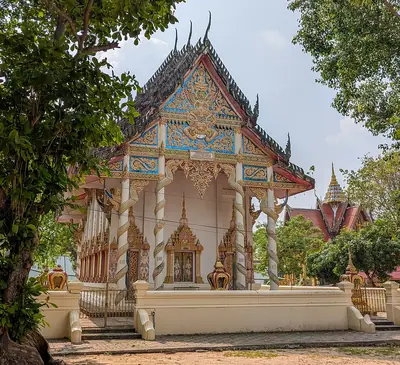
Nearby, a vihara shelters a coral-stone reclining Buddha and more than fifty original Buddha images. Its walls are said to bear the footprints of Luang Pho Phutthasorn. The building is now locked to prevent theft. The temple also has a two-storey wooden chanting hall built in 2469 BE in a Thai-Chinese hip-roof style.
Wat Lamai
Wat Lamai stands in the old part of Ban Lamai, commonly known as Lamai Beach. It is one of Koh Samui’s three oldest temples and serves not only as a place of worship, but also as the home of a folk museum and a cultural hall for community events.
The small Phra Borommathat Chedi Sri Lamai contains a relic brought from Sri Lanka in the early 1980s. A nearby two-storey wooden museum, built in 1986, preserves traditional Samui objects.
Its collection includes a bronze drum more than three hundred years old, a Dong Son metal artifact from northern Vietnam discovered in 2000, ancient lamps, glazed jars, dragon-decorated pots and tools used in coconut farming. The Dong Son artifact was once used in rituals to dispel spirits and invoke rain.
Wat Ratchathammaram
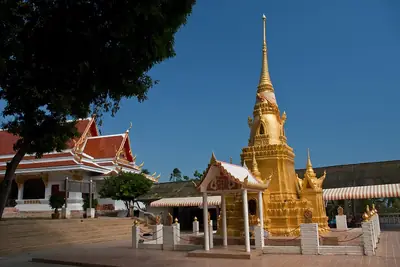
Wat Ratchathammaram, also known as Wat Sila Ngu, is a tranquil Buddhist temple beside the sea. It was founded in Buddhist year 2415 and has served the Mahanikaya monastic community ever since.
The local names refer to the beach stones, which resemble snake scales. At high tide, they are said to look like a giant snake resting in the water. The temple’s golden stupa houses a revered Buddha relic, enshrined there on June 12, 2498 BE, during a ceremony led by a senior monk from Wat Chai Ton in Ayutthaya province.
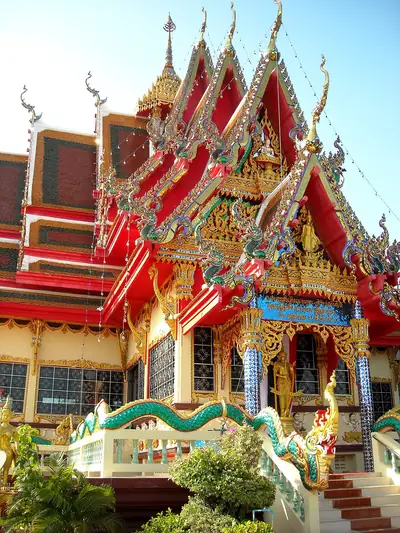
The red ordination hall is especially distinctive. Its colour comes from finely ground salty limestone mixed with local lime and red pigment. Its design brings together Srivijaya and Bayon influences, creating an unusual expression of the region’s artistic heritage.
Wat Khunaram and Luang Pho Daeng
Wat Khunaram is associated with Luang Pho Daeng, a respected monk whose preserved body remains seated in meditation. Born in 1894, he entered monastic life later than many monks, joining the monkhood in his seventies. He died during meditation in 1973.
The temple offers a quiet setting for reflecting on Buddhist traditions and the relationship between spirituality and everyday life in Koh Samui’s inland communities.
Samui Airport and Khao Duang Nok
Samui International Airport is the island’s main point of arrival and its only airport. Construction began in 1982 by Bangkok Airways, and the airport opened in April 1989. It handles domestic and international flights, including services to nearby islands such as Koh Phangan.
About 1.5 kilometres from the airport, Khao Duang Nok rises 180 metres above sea level. The hill offers a natural viewpoint over the surrounding plains.
Wat Hin Lat
Wat Hin Lat is a Buddhist temple in Surat Thani province. It is another religious site connected with Koh Samui’s wider cultural and spiritual landscape.
Explore Koh Samui with Neywo
There are no scheduled tours or group walks to join. Neywo’s free Koh Samui audio guide includes 8 narrated places, and each story plays as you reach the place, at your own pace. The narration is available in 11 languages, allowing you to explore independently without a group or a schedule.
Download Neywo and discover Koh Samui’s temples, museums and coastal landmarks through stories that accompany you as you walk. For more ideas elsewhere in Thailand, you can also explore destinations such as Phuket, Krabi and Koh Lipe.
Places with an audio guide in Koh Samui
6 places in Koh Samui with a Neywo audio guide. Each one starts telling its story as you reach it.
Walk Koh Samui with Neywo
Neywo turns Koh Samui into a self-guided audio tour. Stories arrive as you reach the place they belong to, and the route reshapes when you wander off it.

