Visiting Bangkok, Thailand: Top Sights on Foot
Things to Do in Bangkok: What to See in Thailand’s Capital
Bangkok is Thailand’s capital, a city where royal compounds, Buddhist temples, riverside communities, markets, and modern creative spaces come together. The best things to do in Bangkok include exploring the historic Rattanakosin area, crossing the Chao Phraya River to Wat Arun, discovering Chinatown and Bang Rak, and seeing how different faiths and traditions have shaped the city. Neywo offers a free audio guide for Bangkok with 505 narrated places.
What to See in Bangkok
Bangkok’s most important sights are concentrated in and around the historic centre, but the city’s story continues through its riverside districts, royal neighbourhoods, and diverse communities.
The Grand Palace and Wat Pho
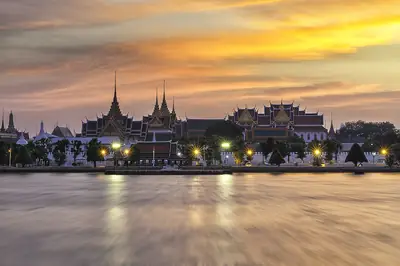
The Grand Palace has stood at the centre of Thailand’s royal and national life since 1782. King Rama I began construction after moving the capital from Thonburi to Bangkok and establishing the Chakri dynasty. The complex includes palaces, halls, pavilions, gardens, courtyards, and the Temple of the Emerald Buddha. Its buildings were added and rebuilt by successive kings, so the palace combines several architectural styles rather than following one uniform design.
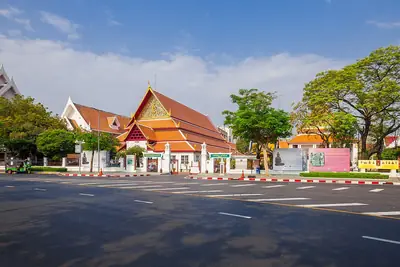
Directly south of the Grand Palace, Wat Pho is one of Bangkok’s essential sights. The royal Buddhist temple is famous for its 46-metre-long Reclining Buddha, but the complex contains much more to explore: Thailand’s largest collection of Buddha images and around 99 chedis, including four great stupas associated with Rama I, Rama II, Rama III, and Rama IV. Wat Pho is also closely connected with traditional medicine and education in Thailand.
Wat Arun on the Chao Phraya
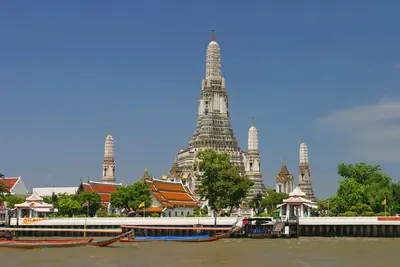
On the western bank of the Chao Phraya River, Wat Arun is one of Bangkok’s most recognisable landmarks. Known as the Temple of Dawn, it is built around a central prang rising 67 metres above the temple grounds, surrounded by four smaller prangs.
The towers are covered with glazed tiles and colourful benjarong porcelain bowls. Their symbolism reflects the Buddhist idea of the three realms, with the central tower representing Mount Meru, the sacred cosmic mountain. The temple existed by at least the seventeenth century, when it was known as Wat Bang Makok, and its present identity developed through the history of Thonburi and the early Bangkok period.
Sao Chingcha and Bangkok’s old town
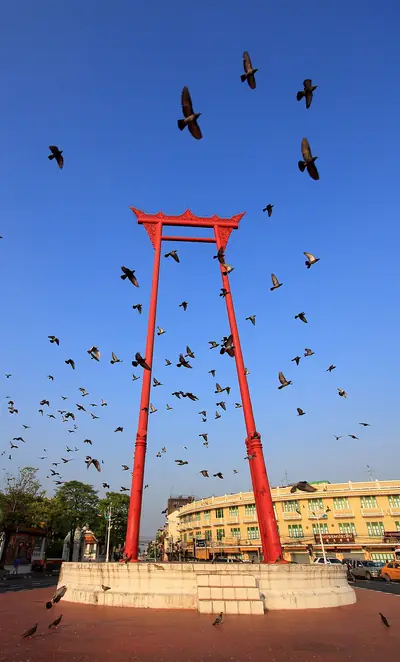
Sao Chingcha, or the Giant Swing, stands in front of Wat Suthat and the Devasathan, the Royal Brahmin Office of the Thai royal court. The vivid vermilion structure rises 21.15 metres and was created for the Triyamphawai, or Tripavai, ceremony, a sacred Brahmin ritual involving Tamil devotional hymns.
Although the swing ceremony was discontinued during the reign of King Prajadhipok, the structure remains an important Bangkok landmark. Its teak posts, carved beams, decorative brackets, elephant-ear motifs, and lion details sit on a stone platform with a circular base about 10.5 metres across. The tradition began here in 1784, and the present structure recalls that long history.
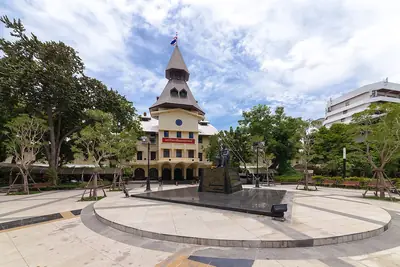
Nearby, Thammasat University’s Tha Phra Chan campus marks an important chapter in Thailand’s educational and political development. Founded by Pridi Banomyong on 27 June 1934 as the University of Moral and Political Sciences, it began as an open university focused on law and politics. Its first year brought 7,094 students, and the university later expanded into a broad institution covering subjects from the humanities and social sciences to health sciences, natural sciences, and engineering.
Bangkok National Museum
Facing Sanam Luang, the Bangkok National Museum occupies the former palace of the vice king, or Wang Na. Its history began in 1874, when King Chulalongkorn opened a museum to display the royal collections of his father, King Mongkut.
The complex includes former throne halls and palace buildings such as Siwamokhaphiman Hall, the Buddhaisawan Chapel, Issares Rachanusorn Hall, the Vimarn buildings, the Prasat Museum building, and the Maha Surasinghanat building. Inside, the collections cover Thai history, art, archaeology, fine crafts, and ethnology, with material reaching from Neolithic times through later periods.
Assumption Cathedral and Bang Rak
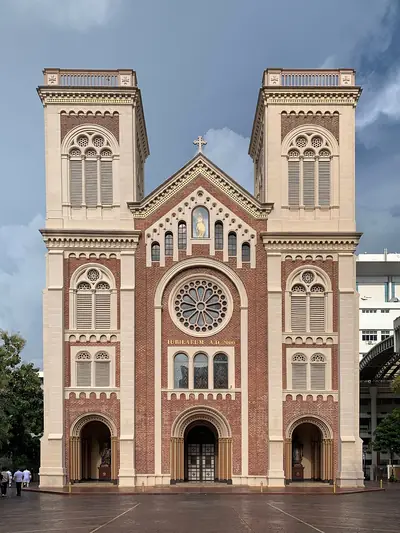
Assumption Cathedral stands on Oriental Avenue in Bang Rak District and is the principal Roman Catholic church of Thailand, as well as the main church of the Archdiocese of Bangkok. The present building was constructed in 1909 as Bangkok’s Catholic community grew.
Its Renaissance-inspired Italian architecture includes marble and stained glass brought from France, Singapore, and Italy. The bell tower rises 32 metres, while frescoes and stucco sculptures decorate the interior with scenes connected to Christian belief.
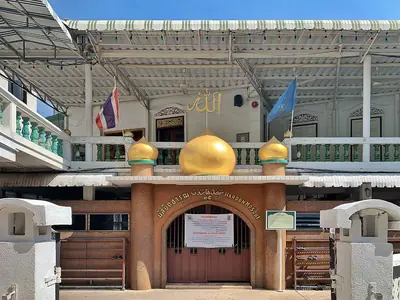
Bang Rak also reveals Bangkok’s religious diversity through Haroon Mosque. Established in the nineteenth century for the Ton Samrong community beside the Chao Phraya River, it was originally a wooden mosque on the riverbank. The present two-storey masonry building dates from 1934 and combines European townhouse influences with neoclassical floral motifs, Romanesque pillars, and wooden shutters.
Charoen Krung’s historic landmarks
Phitthaya Sathian Bridge carries Charoen Krung Road over Khlong Phadung Krung Kasem. It began as a steel bridge that could open to allow boats to pass, and was rebuilt between 1899 and 1900. The present reinforced-concrete structure is distinguished by Venetian Gothic details, decorated balustrades, eight lamp posts, and lion-head sculptures at its ends.
Further along the Chao Phraya, Holy Rosary Church, also known as Kalawar Church, reflects the history of Bangkok’s Portuguese Catholic community. The church’s story began in 1769, and the present Gothic Revival building was constructed in 1891. It preserves a statue of Our Lady of the Rosary and a statue of the body of Jesus, both said to date from the second fall of Ayutthaya.
TCDC and Bangkok’s creative side
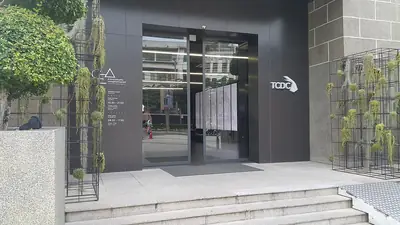
The Thailand Creative and Design Center, usually called TCDC, occupies the Central Post Office building on Charoen Krung Road. Founded in September 2003, it was created to make knowledge more accessible and encourage new creative thinking.
TCDC functions as a showroom and resource centre where design, ideas, and creative inspiration meet. Its focus is not simply on displaying design, but on giving visitors ways to gather ideas from the work and experiences of thinkers and designers from around the world.
Dusit Palace and Vimanmek Mansion
Dusit Palace is a spacious compound of royal residences set among gardens and lawns. Created during the reign of King Chulalongkorn, it eventually became a permanent royal residence and now brings together thirteen residences across more than 64,000 square metres. Amphorn Sathan Palace, Abhisek Dusit Throne Hall, Ananta Samakhom Throne Hall, and Vimanmek Palace are among the buildings associated with the compound.
Vimanmek Mansion is not currently open to visitors: it was dismantled for foundation repairs and is intended to be rebuilt when the work is complete. The former royal villa was built largely from golden teak and combines Western and Thai influences in a Victorian style. Originally constructed at Chudhadhuj Palace on Ko Sichang Island, it was moved to Dusit Palace in 1900 and became the first permanent royal residence there.
Amphorn Sathan Residential Hall remains a royal residence within Dusit Palace. Known in Thai as Phra Thinang Amphon Sathan, it is the residence of King Vajiralongkorn and Queen Suthida. It was also the principal home of former King Bhumibol Adulyadej and Queen Sirikit, and the birthplace of King Vajiralongkorn.
Explore Bangkok with a free audio guide
Neywo’s Bangkok audio guide includes 7 walking tours and 1 bus route, with 505 narrated places across the city. The walks range from 1.85 to 4.94 km and from 61 to 118 minutes, while the bus route covers 15.8 km in 68 minutes.
Choose a route according to the part of Bangkok you want to discover:
- Rattanakosin: Where Bangkok Was Born — 4.35 km, 118 minutes, 10 stops
- Giant Swing to Golden Mount: Old Town Icons — 3 km, 99 minutes, 10 stops
- Dragon Road: Chinatown on Foot — 4.08 km, 101 minutes, 8 stops
- Dusit: The Royal Garden Quarter — 4.44 km, 114 minutes, 9 stops
- Bang Rak: Cathedrals, Mosques and Temples on Charoen Krung — 4.94 km, 113 minutes, 7 stops
- Siam and Pathum Wan: Silk, Shrines and Palaces — 3.99 km, 95 minutes, 7 stops
- Kudi Chin and Thonburi: A River Bank of Many Faiths — 1.85 km, 61 minutes, 7 stops
- Bus 53: The Old Town Circle — 15.8 km, 68 minutes, 12 stops
The app tells the story of each place as you reach it, at your own pace, with no group and no schedule. Narration is available in 11 languages. Download Neywo and explore Bangkok as a self-guided walking tour—or combine a walk with the old town bus route to discover more of the capital’s history, architecture, and everyday districts.
Places with an audio guide in Bangkok
8 places in Bangkok with a Neywo audio guide. Each one starts telling its story as you reach it.
Self-guided tours in Bangkok
8 tours in Bangkok, free in the Neywo app. Each stop tells its story as you reach it.
- Bus ride
Bus 53: The Old Town Circle
A cheap city-bus loop around Rattanakosin Island, riding the anticlockwise direction. It starts at the medicine museum on the edge of Chinatown and passes the Museum of Siam, the river palace of Tha Phra, Thammasat, Wat Mahathat, the National Gallery and Theatre and the riverside park at Santichaiprakarn. It then crosses a canal bridge and returns to the old town at Sala Chalermkrung, the poet's museum and the Democracy Monument.
Berlin Pharmaceutical Museum · The Museum of Siam · Tha Phra Palace · Thammasat University · Wat Mahathat Yuwaratrangsarit · National Art Gallery …
Open this tour: Bus 53: The Old Town Circle - Walk
Rattanakosin: Where Bangkok Was Born
Follow the royal heart of Bangkok from the museum that explains Thai identity to the temple of the Reclining Buddha, then cross the river's edge to Wat Arun by ferry and return to the Emerald Buddha. Pass an art museum and a summer palace, cross the ceremonial field of Sanam Luang and finish at the national museum and the national gallery.
The Museum of Siam · Wat Pho · Wat Arun · Wat Phra Kaew · Silpa Bhirasri National Museum · Saranrom Palace …
Open this tour: Rattanakosin: Where Bangkok Was Born - Walk
Giant Swing to Golden Mount: Old Town Icons
A walk through old Phra Nakhon, from the 1933 theatre that was the first in Asia with air conditioning to the artificial hill crowned by a golden stupa. Pass a vermilion swing where Brahmin priests once rode into the air, a Chinese tiger shrine, the monument of 1932, a poet's museum and a castle of metal.
Sala Chalermkrung Royal Theatre · Sao Chingcha · San Chaopho Suea (Sao Chingcha) · Wat Mahannapharam · Democracy Monument · Sunthorn Phu Museum …
Open this tour: Giant Swing to Golden Mount: Old Town Icons - Walk
Dragon Road: Chinatown on Foot
Start with the world's largest pure-gold Buddha, then follow Yaowarat, the Dragon Road, through the Chinese heart of Bangkok. Visit a Teochew shrine in the old Talat Kao market, a small museum of Western medicine, and the city's largest Chinese Buddhist temple. Finish at two temples tucked behind the old city's temple school.
Wat Traimit · Yaowarat Road · Leng Buai Ia Shrine · Wat Mangkon Kamalawat · Berlin Pharmaceutical Museum · Wat Thewi Worayat …
Open this tour: Dragon Road: Chinatown on Foot - Walk
Dusit: The Royal Garden Quarter
Leave the crowded old town for the tree-lined avenues King Chulalongkorn laid out in the 1900s. See the great plaza with its equestrian statue, the Dusit compound, royal residences and palaces built for the king's sons.
Vimanmek Mansion · Royal Elephant National Museum · Dusit Palace · Amphorn Sathan Residential Hall · Wang Suan Sunandra · Royal Plaza …
Open this tour: Dusit: The Royal Garden Quarter - Walk
Bang Rak: Cathedrals, Mosques and Temples on Charoen Krung
Bangkok's oldest riverside quarter holds seven faiths within a few blocks. Visit a Javanese mosque and a French-founded church, the cathedral of the Archdiocese of Bangkok, the first mosque in Thailand's Charoen Krung quarter and a Hindu temple, then end at a preserved mansion among the Sathorn towers.
Jawa Mosque · St. Louis Church (Bangkok) · Assumption Cathedral · Ban Oou Mosque · Haroon Mosque · Sri Maha Mariamman Temple, Bangkok …
Open this tour: Bang Rak: Cathedrals, Mosques and Temples on Charoen Krung - Walk
Siam and Pathum Wan: Silk, Shrines and Palaces
A walk through the modern heart of Bangkok. Visit Jim Thompson's house of silk, the contemporary art centre, a royal residence and the temple standing between two malls. Pass the Erawan Shrine and the Baiyoke tower, and end at the palace known as the Cabbage Patch.
Jim Thompson House · Bangkok Art and Culture Centre · Sa Pathum palace · Wat Pathum Wanaram · Erawan Shrine · Baiyoke Tower II …
Open this tour: Siam and Pathum Wan: Silk, Shrines and Palaces - Walk
Kudi Chin and Thonburi: A River Bank of Many Faiths
Cross to the Thonburi side of the Chao Phraya for the neighbourhood where Chinese, Portuguese and Muslim families settled. Walk past canal-side mosques, King Taksin's palace, a riverside temple and the pink Santa Cruz church.
Kudi Charoenphat · Bang Luang Mosque · Ton Son Mosque · Phra Racha Wang Derm · Wat Kalayanamitr · Baan Kudichin Museum …
Open this tour: Kudi Chin and Thonburi: A River Bank of Many Faiths
Walk Bangkok with Neywo
Neywo turns Bangkok into a self-guided audio tour. Stories arrive as you reach the place they belong to, and the route reshapes when you wander off it.

