Visiting Chiang Rai, Thailand: Top Sights on Foot
Things to Do in Chiang Rai: Temples, Art and Northern Thai Culture
Chiang Rai is a city in northern Thailand where long history, Buddhist tradition and contemporary art come together. The best things to do in Chiang Rai include visiting distinctive temples, discovering artistic spaces and exploring landmarks connected with the region’s diverse cultural communities. Neywo has a free audio guide for Chiang Rai with 14 narrated places.
The city is the capital of Thailand’s northernmost province. Its history is linked to Hiran Nakhon Ngoen Yang, Ngoen Yang, Chiang Saen and the Lanna Kingdom, while its modern identity is shaped by religious landmarks and contemporary creative spaces. If you are comparing Chiang Rai with nearby Chiang Mai, its attractions offer a different perspective on northern Thailand.
What to see in Chiang Rai
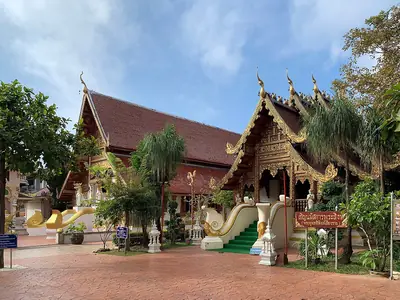
Wat Phra Sing
Wat Phra Sing is a Buddhist temple on Tha Luang Road in the Wiang area and a royal temple of the third class. Its elaborate wall paintings are among its most notable artistic features.
The temple is also associated with two Buddha images: Phra Sing Luang and the smaller Phra Sing Noi. Both are connected with the famous statue at Wat Phra Singh in Chiang Mai, placing Wat Phra Sing within the wider story of the Phra Sing images.
Wat Phra Kaeo and the Emerald Buddha
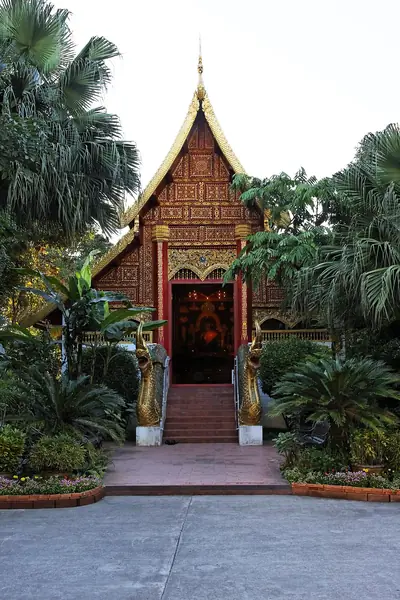
Wat Phra Kaeo is one of Chiang Rai’s most important Buddhist temples because it is remembered as the original home of the Emerald Buddha. According to the temple’s history, lightning struck an old chedi in 1434, revealing the translucent green Buddha image inside. The statue is now worshipped at the Emerald Buddha Temple in Bangkok’s Grand Palace.
A replica known as Phra Yok Chiangrai is also found at the temple. Made from jade brought from Canada for the Princess Mother’s ninetieth birthday in 1990, it presides over Hor Phra Yok, which opened on November 26, 1998.
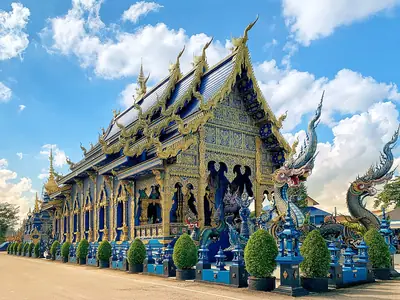
Wat Rong Suea Ten, the Blue Temple
Wat Rong Suea Ten is better known as the Blue Temple. This Buddhist temple stands out for its striking modern artistic design, making it one of the most distinctive places to see in Chiang Rai.
Its vivid visual identity provides a memorable example of the city’s connection between religious architecture and contemporary art.
Wat Si Sai Mun
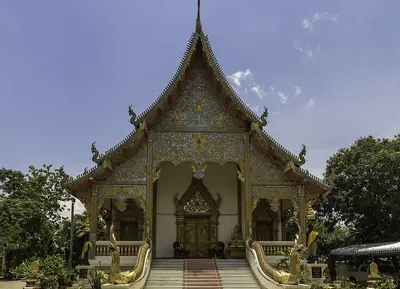
Wat Si Sai Mun brings modern construction together with the decorative language of Lanna art. Built in 1886, the temple received royal permission for its consecrated boundary in 1946.
The ordination hall shows this combination particularly clearly. It is a tall reinforced-concrete structure associated with central Thai architecture, but its decoration is distinctly Lanna. Look for the three-tiered roof covered with glazed terracotta tiles, Lanna patterns, curved roof-edge ornaments and naga forms at the ends of the roof.
The temple’s contemporary chedi is ten metres high. It combines a Lanna single-spired palace form with covered niches on all four sides. Five niches on each side of the base hold a total of twenty Buddha images.
Wat Chet Yot, the Temple of the Seven Spires
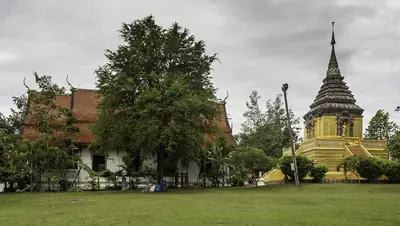
Wat Chet Yot has a history reaching back to the Lanna Kingdom and possibly to the period before King Mangrai founded Chiang Rai. The temple was later abandoned after an invasion from Burma, and its damaged buildings and sacred stupa were eventually restored.
The name means Temple of the Seven Spires. One tradition says that restorers found the foundations of seven stupas arranged together. Another says that seven abandoned temples once stood in the area and were combined into one temple. The site became a royal monastery on May 31, Buddhist Era 2521.
Darunaman Mosque
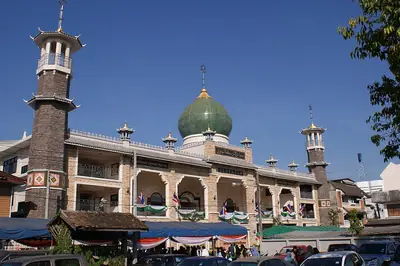
Darunaman Mosque, also known as Darun Aman Mosque or Ban Haw Mosque, is the largest Sunni mosque in Chiang Rai province. It is an important landmark for the local Muslim community.
The mosque was built by Hui people, known in Thailand as Chin Haw. Its presence reflects the history of Hui communities and the mosques they established in northern Thailand.
Wat Doi Phrabat
Wat Doi Phrabat is known for a replica of the Buddha’s footprint and the stupa built near it. Local tradition says that the Buddha once came to the hill and left his footprint, giving the hill its name, Buddha’s Footprint Hill.
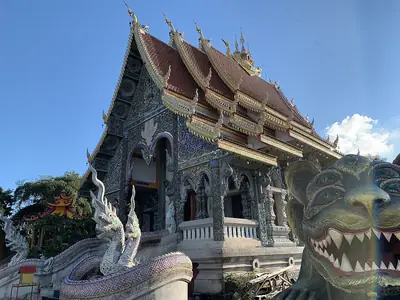
The present stupa was built over an earlier one after the original fell into ruin. Its structure rises from a tall, two-tiered lotus base, with naga stairways leading up from all four sides. Stucco figures with joined hands decorate the base, while the upper terrace has a balcony-like railing.
The temple was officially established on January 21, 1974, and received its consecrated boundary on January 16, 1975. Its hilltop setting also offers views across Chiang Rai by day and by night.
Wat Phra That Doi Khao Khwai Kaeo
Set on a hill along the route to Dong Mada, Wat Phra That Doi Khao Khwai Kaeo is an ancient Buddhist temple believed to be more than a thousand years old. Its position provides views across Chiang Rai.
The temple’s chedi is said to enshrine a sacred relic associated with the Buddha, together with the horn of Kaew Khao Saeng, a mythical white crystal-horn buffalo. The sanctuary is also connected with the legend of Mang Si Hu Ha Ta, a mythical creature described as having four ears and five eyes.
Wat Nam Lat Wang Sang
Wat Nam Lat Wang Sang, also known as Wat Namlat Wang Sang, has a history connected with the Kok River. Its most important sacred site is Phra That Wang Sang, a chedi that gives the temple particular significance.
The temple began as a monastic residence called Wat King Kaew. Its principal Buddha image has an unusual origin: in 1980, fishermen caught the head of a Buddha image in their net in the Kok River. A ceremony was held to invite the sacred image from the river, and the recovered head was identified as Lanna art in the Chiang Saen One style, shown in the Subduing Mara posture. A much larger Buddha image was later built to support it.
Art Bridge Chiang Rai
Art Bridge Chiang Rai is an art gallery and one of the city’s creative spaces. It offers another way to experience Chiang Rai’s contemporary artistic identity beyond its temples.
Rai Mae Fa Luang Art and Cultural Park
Rai Mae Fa Luang Art and Cultural Park is a museum dedicated to art and culture. It provides a place to pause and explore another side of Chiang Rai’s heritage and creative life.
The Nativity of Our Lady Church
The Nativity of Our Lady Church, also known as Wat Mae Phra Bang Koet, is a church in Chiang Rai. Its presence adds a Christian landmark to the city’s varied religious landscape.
Explore Chiang Rai with a self-guided walking tour
A Chiang Rai self-guided walking tour is a practical way to connect several of the city’s religious landmarks without joining a group. Neywo’s walking tour, Temples of the Seven Spires and the Emerald Buddha, covers 6.11 km in around 120 minutes and includes six narrated stops:
- Wat Si Sai Mun
- Wat Chet Yot
- Darunaman Mosque
- Wat Phra Kaeo
- Wat Phra Sing
- Wat Rong Suea Ten
The app tells the story of each place as you reach it, at your own pace, with no group and no schedule. Neywo offers one walking tour in Chiang Rai, with narration available in 11 languages.
Download the Chiang Rai audio guide
Download Neywo to explore Chiang Rai with a free audio guide that brings the city’s temples, mosque, church and cultural landmarks to life as you walk. The guide includes 14 narrated places, and each story plays when you reach the corresponding location. You choose your pace and route, without a group or a fixed schedule.
Chiang Rai is one stop in a wider journey through Thailand, with Bangkok, Ayutthaya and other destinations offering different views of the country’s history and culture.
Places with an audio guide in Chiang Rai
8 places in Chiang Rai with a Neywo audio guide. Each one starts telling its story as you reach it.
Self-guided tours in Chiang Rai
1 tour in Chiang Rai, free in the Neywo app. Each stop tells its story as you reach it.
- Walk
Temples of the Seven Spires and the Emerald Buddha
Chiang Rai was founded in the 13th century, and its temples keep its stories: a hall with a three-tier Lanna roof, the Temple of the Seven Spires, a mosque built by Chin Haw traders, the shrine where the Emerald Buddha was found inside a lightning-struck chedi, Wat Phra Sing with its Lanna wall paintings, and the Blue Temple beside the Kok River.
Wat Si Sai Mun · Wat Chet Yot · Darunaman Mosque · Wat Phra Kaeo · Wat Phra Sing · Wat Rong Suea Ten
Open this tour: Temples of the Seven Spires and the Emerald Buddha
Walk Chiang Rai with Neywo
Neywo turns Chiang Rai into a self-guided audio tour. Stories arrive as you reach the place they belong to, and the route reshapes when you wander off it.

