What to See in Ayutthaya, Thailand: Free Audio Guide
Things to Do in Ayutthaya: Ancient Temples and the Lost Capital of Siam
Looking for things to do in Ayutthaya? The former capital of the Ayutthaya Kingdom is a vast historic landscape of temples, fortifications, museums and rivers, preserved within the Ayutthaya Historical Park. Its ruins tell the story of a city that remained the capital of Siam for more than four centuries, until its destruction in 1767. Neywo offers a free audio guide for Ayutthaya with 33 narrated places, so you can explore while the story unfolds around you.
What to See in Ayutthaya
Ayutthaya Historical Park
Ayutthaya Historical Park occupies the island where the ancient capital once stood, surrounded by the Chao Phraya, Pa Sak and Lopburi rivers. The area covers more than four thousand eight hundred rai and has been protected by Thailand’s Fine Arts Department since 1976.
The city was founded in 1351 by King Ramathibodi I, also known as King U Thong, although the area had earlier connections with Mon Dvaravati and Khmer settlements. Its long history reflects a blend of Khmer, Mon and Thai influences.
Wat Mahathat
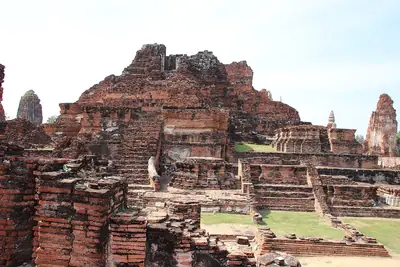
Wat Mahathat was one of the most important religious centres of the ancient capital. It housed the Buddha relics of Ayutthaya and served as the residence of the Supreme Patriarch, the highest Buddhist authority in the kingdom.
The temple was burned and looted during the Burmese sack of 1767. Among its collapsed prangs and chedis, the best-known surviving image is a sandstone Buddha head embraced by the roots of a banyan tree—a striking meeting of nature and ruins.
Wat Ratchaburana
Wat Ratchaburana stands a short distance north of Wat Mahathat and is known for its tall central prang, built in a Khmer style. King Borommarachathirat II founded the temple in 1424 on the cremation site of his two elder brothers, who had died fighting for the throne.
A hidden crypt beneath the prang contained gold regalia, votive tablets and royal insignia. Looters entered it in 1957, after which the Fine Arts Department excavated the chamber and recovered objects that had been left behind or dropped.
Chao Sam Phraya National Museum
The Chao Sam Phraya National Museum displays archaeological finds from the crypts of Wat Ratchaburana and Wat Mahathat. Its collection includes Buddhist relics, gold jewellery, votive tablets and sculpture from different periods of Ayutthaya’s history.
Founded in 1961, it was Thailand’s first national museum to adopt a modern exhibition approach, using carefully arranged displays, lighting and space. A later Ayutthaya Gold exhibition building presents more than two thousand two hundred gold objects.
Phet Fort
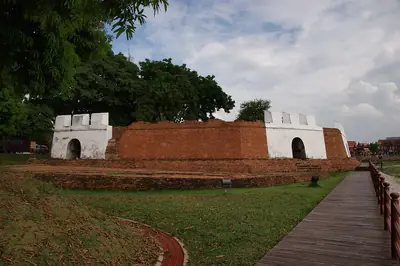
Phet Fort, or the Diamond Fort, was one of the strongest defensive positions in Ayutthaya. It is one of only two surviving forts from the twenty-nine that once guarded the island city.
Built during the reign of King Maha Chakkraphat after the Burmese-Siamese War of 1547–1549, the fort replaced earlier wooden defences with brick and laterite. Its walls are fourteen metres thick at the base, and its hexagonal form projects towards the river like the prow of a ship.
Wat Phanan Choeng
On the eastern bank of the Chao Phraya, where it meets the Pa Sak River, Wat Phanan Choeng has been a place of worship since the fourteenth century. It is one of the oldest continuously operating monasteries in the ancient capital and holds the status of a second-class royal temple.
Its principal Buddha image, Phra Phuttha Trairattananayok—also known as Luang Pho Tho—is the largest Buddha image in Ayutthaya. The massive bronze figure dominates the main hall.
Wat Suwan Dararam
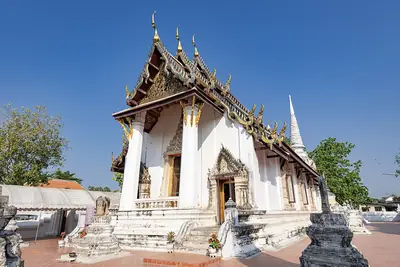
Wat Suwan Dararam is a first-class royal temple on the edge of the old Phet Fort. It began as Wat Thong, a temple founded during the late Ayutthaya period by the man who later became Rama I, founder of the Chakri dynasty.
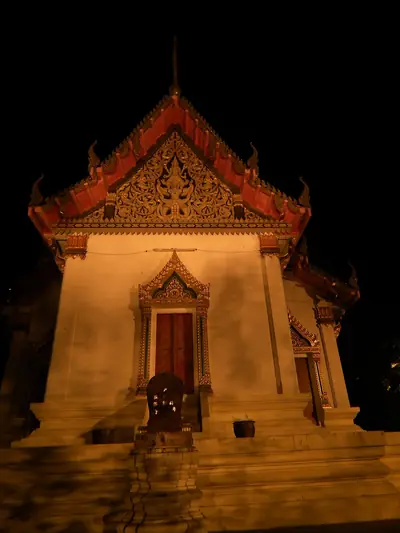
The temple’s ordination hall has a curved base shaped like the hull of a traditional Chinese junk. This form represents Buddhist teachings as a vessel carrying people across the sea of suffering, and is a distinctive feature of Ayutthaya-period architecture.
Wat Senasanaram Ratworawihan
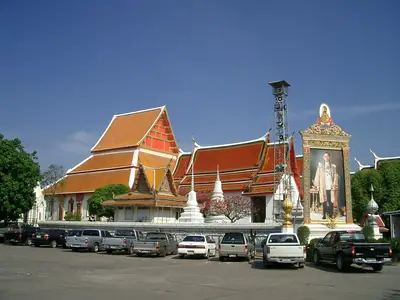
Wat Senasanaram Ratworawihan is a first-class royal temple in the Hua Ro area, close to the old city island. Although the monastery has Ayutthaya-period roots, much of the present complex comes from a restoration ordered by King Rama IV and completed in 1863.
The ordination hall retains an Ayutthaya-period structure. Its carved wooden gables are covered with gold leaf and coloured glass, including an image of the celestial elephant Erawan.
Wat Sala Pun Worawihan
Wat Sala Pun Worawihan is a second-class royal temple and one of the few temples outside the old city walls to hold that status. It was associated for centuries with Somdet Phra Phuthachan, a highly revered monk who received a royal appointment in the outer capital district.
Inside the viharn is Luang Pho Khen Lai, an ancient Buddha image with a broad face measuring twenty-nine inches across. Its style predates the Ayutthaya period, making it an important example of earlier Thai Buddhist art.
Wat Phanom Yong
Wat Phanom Yong stands beside Khlong Mueang, the old city canal that once served as Ayutthaya’s main artery. Its origins are connected with Yong, the royal wet nurse of King Narai the Great. After her death, a nobleman built a temple on her former garden to commemorate her kindness.
The temple was abandoned after the destruction of Ayutthaya in 1767 and restored in the late nineteenth century on the orders of King Chulalongkorn. The family of the original patron has continued to care for it. Its ordination hall has a roof shaped like the hull of a Chinese junk, known in Thai as a samphao form.
Wat Mondop
Across from the old Chandrakasem Palace, Wat Mondop appears in the registry of Ayutthaya’s royal monasteries. Its name first appears in the chronicles during the reign of King Phetracha.
The temple became the scene of a rebellion led by Tham Thian, who made his stand on an elephant. A cannon fired from the palace grounds struck the animal and ended the uprising. In 1767, Burmese troops later used the temple as an encampment. The monastery was eventually restored after its abandonment.
Wat Sam Wihan
Wat Sam Wihan dates from around 1377, during the reign of King Borommaracha I. Its original name, Wat Sam Phihan, referred to three separate halls containing a reclining Buddha, a seated Buddha and a standing Buddha.
The hall of the standing Buddha disappeared over time, leaving the reclining and seated vihara. The temple’s present name preserves the memory of its original three-hall layout.
Other historic temples
Several quieter sites add depth to an exploration of Ayutthaya. Wat Rat Praditthan is an active civilian temple mentioned several times in the royal chronicles, although its founder and exact date of construction are unknown. Wat Mae Nang Pluem is a royal Buddhist temple in the Hua Ro area belonging to the Mahanikaya sect.
Wat Chaiyaphum, also known as Wat Saphan Than, survives as foundations and scattered remains in the Pratu Chai area. Wat Suwan Dararam, Wat Phanom Yong and the other temples show how the historic city extends beyond its most photographed ruins.
Explore Ayutthaya at Your Own Pace
An Ayutthaya self-guided walking tour is a practical way to connect the temples, museums and fortifications. Neywo has four walking tours, covering between 3.72 and 4.22 kilometres, with routes lasting from 89 to 114 minutes and including between 6 and 9 narrated stops.
There is also one 4.2-kilometre bike route lasting 21 minutes, with 10 narrated stops. The routes include the historic park, Wat Mahathat, Wat Ratchaburana, Phet Fort, Wat Phanan Choeng, the Chao Sam Phraya National Museum and several quieter temples.
If you are continuing through the country, Ayutthaya can also be combined with time in Bangkok, while the Thailand destination page provides an overview of other places to visit.
Download Neywo for Ayutthaya
Download Neywo and choose from 4 walking tours and 1 bike route in Ayutthaya. The walks cover 3.72–4.22 km and take 89–114 minutes, while the bike route covers 4.2 km in 21 minutes. Together, the tours include narrated stops at the city’s major temples, museums, fortifications and riverside sites.
Neywo is available in 11 languages. Each story plays as you reach the place, at your own pace, with no group and no schedule—an easy way to turn a visit to Ayutthaya into a self-guided audio tour.
Places with an audio guide in Ayutthaya
8 places in Ayutthaya with a Neywo audio guide. Each one starts telling its story as you reach it.
Self-guided tours in Ayutthaya
5 tours in Ayutthaya, free in the Neywo app. Each stop tells its story as you reach it.
- Bike ride
Cycling the Ruins of the Old Capital
Ayutthaya's historical park is famously explored by bicycle. Pedal from the canal-side temples in the west past Wat Na Phra Men, the temple the Burmese spared, through the royal core to Wat Ratchaburana and Wat Mahathat, with the Chao Sam Phraya museum and the lion chedi of Wat Thammikarat on the way.
Wat Sala Pun Worawihan · Wat Phanom Yong · Wat Na Phra Men · Wat Chi Chiang · Wat Thammikarat · Ayutthaya Historical Park …
Open this tour: Cycling the Ruins of the Old Capital - Walk
Prangs, Palaces and the Fall of 1767
Start at the lion-ringed chedi of Wat Thammikarat, then head to the ruined prangs of Wat Ratchaburana and Wat Mahathat, where a Buddha head sits in banyan roots. Continue past the gilded Erawan gable of Wat Senasanaram to Chandra Kasem Palace, where Naresuan planned his defence against Burma, and finish at Wat Mondop and the temple of the three viharas.
Wat Thammikarat · Wat Yannasen · Wat Ratchaburana · Wat Mahathat · Wat Rat Praditthan · Wat Senasanaram Ratworawihan …
Open this tour: Prangs, Palaces and the Fall of 1767 - Walk
The Royal Core: Glazed Tiles, Lions and a Temple Spared
Walk the heart of the old capital, from the temple that once shone with yellow glazed roofs to the museum holding the crypt gold of Ayutthaya. Pass the lion-ringed chedi of Wat Thammikarat and end beside the Lopburi river at Wat Na Phra Men, the one temple the Burmese left untouched in 1767.
Wat Borom Phuttharam · Chao Sam Phraya National Museum · Ayutthaya Historical Park · Wat Thammikarat · Wat Chi Chiang · Wat Worapho …
Open this tour: The Royal Core: Glazed Tiles, Lions and a Temple Spared - Walk
Where Three Rivers Meet: Diamond Fort to the Pa Sak
A river-edge walk on the south-east side of the island. Start across the Pa Sak at Wat Phanan Choeng, home of the largest Buddha image in Ayutthaya, then cross to Phet Fort, the Diamond Fort whose walls guarded three rivers. Visit the temple Rama I founded as a prince, the ground from which King Taksin broke out in 1766 and finish by the Pa Sak river.
Wat Phanan Choeng · Phet Fort · Wat Suwan Dararam · Wat Phichai Songkhram · Wat Thammaniyom · Pa Sak River
Open this tour: Where Three Rivers Meet: Diamond Fort to the Pa Sak - Walk
Quiet Temples of the Western Canals
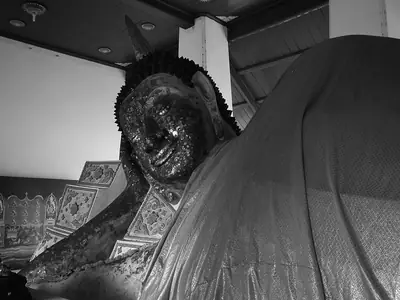
A slower walk away from the crowds: from the octagonal chedi of Wat Wang Chai, once a royal palace, to canal-side temples such as Wat Phanom Yong, named for a royal wet nurse and home to an open-sided reclining Buddha. Finish on the Lopburi river at Wat Choeng Tha and Wat Na Phra Men, the one temple the Burmese left untouched in 1767.
Wat Wang Chai · Wat Phrom Niwat Worawihan · Wat Sala Pun Worawihan · Wat Phanom Yong · Wat Choeng Tha · Wat Na Phra Men
Open this tour: Quiet Temples of the Western Canals
Walk Ayutthaya with Neywo
Neywo turns Ayutthaya into a self-guided audio tour. Stories arrive as you reach the place they belong to, and the route reshapes when you wander off it.

