Kanchanaburi, Thailand: Self-Guided Walking Tour
Things to Do in Kanchanaburi: What to See in Thailand’s Historic Riverside City
The best things to do in Kanchanaburi combine powerful Second World War history with Buddhist temples, archaeological discoveries, and distinctive bridges. The provincial capital in western central Thailand sits among waterways, hills, and farmland, making it a place to explore at a reflective pace. Neywo has a free audio guide for Kanchanaburi with 17 narrated places, available in 11 languages.
What to See in Kanchanaburi
The River Kwai Bridge
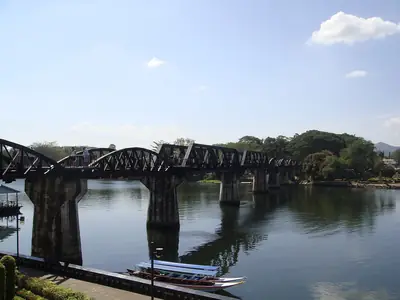
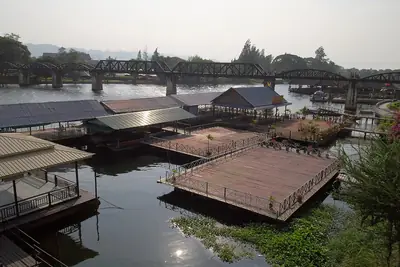
The River Kwai Bridge is one of Kanchanaburi’s most important symbols. The railway bridge crosses the Kwai Yai River and remains in use on the Thon Buri–Nam Tok line, once known as the Death Railway.
The bridge is 322.90 metres long, with curved steel sections and alternating truss sections supported by reinforced-concrete piers. It was built in one year by Allied prisoners of war under the control of the Japanese army. Allied aircraft bombed it during the war, collapsing its middle section. After the war, the Thai government bought the railway from Britain and restored the bridge in 1946.
The bridge’s story later inspired The Bridge on the River Kwai, released in 1957, and The Railway Man, released in 2013. Today, it is also honoured as a symbol of peace.
The Thailand–Burma Railway Centre
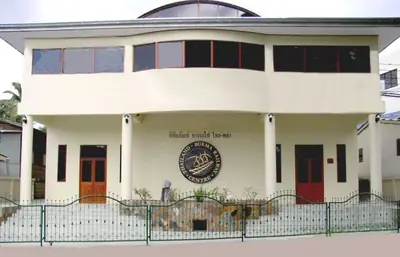
The Thailand–Burma Railway Centre is a museum and research centre dedicated to the history of the Thailand–Burma Railway, also known as the Death Railway. It stands west of Kanchanaburi War Cemetery in a former Imperial Japanese Army headquarters.
The building itself forms part of the story: prisoners of war and Asian forced labourers constructed it during the war. The centre provides an important introduction to the railway and the people forced to build it.
Wat Chaichumphon Chana Songkhram and Wat Tai
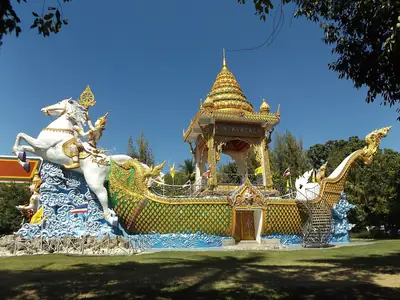
On the bank of the Mae Klong River, Wat Chaichumphon Chana Songkhram is a Buddhist temple also known as Wat Tai, meaning the temple south of the city wall. It is sometimes associated with the JEATH War Museum, although the temple itself is the focus of this historic site.
The temple is said to have been established in 1785, while local tradition attributes its foundation to a man known as Phraya Ta Daeng. Near the old ordination hall stands one of the temple’s oldest features, a chedi registered as an archaeological monument in 1935. Local tradition connects it with Thai armies that gathered here before battle.
The old ordination hall, built around 1830, contains murals that reward a close look. Wat Tai is one of the stops on Neywo’s walking route through Kanchanaburi.
Kanchanaburi War Cemetery and Beata Mundi Regina
Beata Mundi Regina is a Roman Catholic church near Kanchanaburi War Cemetery. Built in 1955, it honours Dutch soldiers who died during the construction of the Death Railway. Its name honours Mary as Queen of the World, and the church was consecrated on 7 August 1955. It was renovated in 2006.
Together with the nearby cemetery and railway museums, the church forms part of Kanchanaburi’s memorial landscape. It is also included in Neywo’s Death Railway walking tour.
Hellfire Pass
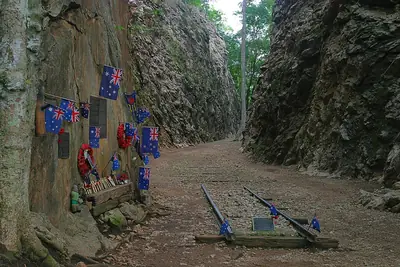
Hellfire Pass is one of Thailand’s most powerful war memorial sites. The dramatic railway cutting formed part of the former Thai–Burma Railway, where hills, cliffs, rocky rises, and ravines had to be cut through to create the route.
More than 250,000 Southeast Asian civilians and 12,000 Allied soldiers worked on the railway under forced labour conditions. The name Hellfire Pass refers to the sight of emaciated prisoners working by torchlight, a scene witnesses compared with hell. The pass is also known locally as Chong Khao Kard, or Torn Valley Pass, and in Japanese as Konyu Cutting.
The Burma Railway and Death Curve
The Burma Railway once linked Ban Pong in Thailand with Thanbyuzayat in Burma, now Myanmar. Built during the Second World War as a strategic route, it was constructed by captured Allied soldiers and Southeast Asian civilians under brutal conditions.
The original line stretched about 415 kilometres and included 37 stations. At least 250,000 Southeast Asian civilians were subjected to forced labour, and more than 90,000 civilians died, along with around 12,000 Allied soldiers.
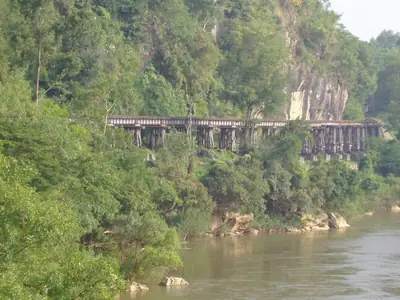
Trains still run on the surviving section in Thailand, reaching Nam Tok. Another memorable section is the Death Curve, where the railway follows the cliffs and the Khwae Noi River along a bridge section about 400 metres long.
Ban Kao National Museum
Beside the Khwae Noi River, Ban Kao National Museum presents archaeological discoveries from one of the region’s important prehistoric sites. The finds show evidence of human settlement more than four thousand years ago.
Excavations carried out between 1960 and 1962 uncovered Neolithic human skeletons, stone tools, everyday implements, ornaments, bowls, axes, and objects placed in graves. The discoveries were made near Ban Kao during railway construction in the Second World War by a Dutch prisoner. The museum now preserves and presents many of these objects.
Wat Tham Khao Noi
Wat Tham Khao Noi is known for its Chinese-style artistic and architectural details and its Mahayana Buddhist tradition, associated here with Vietnamese worshippers. Its most striking feature is the Kiri Borommathat Pagoda, also called the Pagoda of Ten Thousand Buddhas.
Founded in 1883 by Luang Pho Haeng, also known as Kak Ngeang, the temple has been cared for and restored across generations. Its elevated setting also provides views of rice fields.
Wat Tham Khao Pun
Wat Tham Khao Pun, or Khao Pun Cave Temple, is a Buddhist temple complex in Kanchanaburi Province. The site adds a religious and geological dimension to the area’s many historic and cultural attractions.
Wat Phra Thaen Dong Rang
Inside Wat Phra Thaen Dong Rang is a large, flat stone shaped somewhat like a bed. Known as Phra Thaen Dong Rang, it forms the centre of the temple’s religious story. It was once believed to be the place where the Buddha attained final nirvana, before the accepted location was identified as the Sala Grove in India.
The temple also includes Khao Thawai Phra Phloeng, a recreation of the place where the Buddha’s body was cremated, on a hill rising 55 metres. The temple is thought to date from around the Ayutthaya period, although its exact foundation date and founder are unknown.
Wat Sa Long Ruea
Wat Sa Long Ruea, also written Wat Sa Long Rua, is believed to have origins in the Ayutthaya period. Its ruins include a chedi, two prangs, a vihara, and an ubosot. Inside the ubosot, a Buddha image sits in the Subduing Mara posture.
A large bodhi tree spreads over the building, while a small pond lies in front of it towards the northeast.
Wat Wang Wiwekaram and Uttamanusorn Bridge
In Sangkhlaburi District near the Thai–Burma border, Wat Wang Wiwekaram is closely connected with Karen and Mon communities. The temple began in 1953, when Luang Pho Uttama built it with local Karen and Mon immigrants. After the construction of Khao Laem Dam threatened the original district with flooding, the temple moved to a hill in 1984 and the present complex was completed in 1985.
Its architecture combines Mon and Thai styles, and Luang Pho Uttama’s body is kept there in a glass coffin.
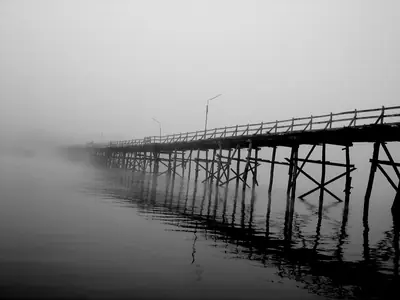
Nearby, Uttamanusorn Bridge, also called Mon Bridge, crosses the Songaria River between the Mon village of Wang Kha and the Thai town of Sangkhla Buri. At 445 metres, it is Thailand’s longest wooden bridge. Luang Pho Uttama initiated its construction in 1986, and local Mon workers completed it in 1987.
Wat Pha Luangta Maha Bua
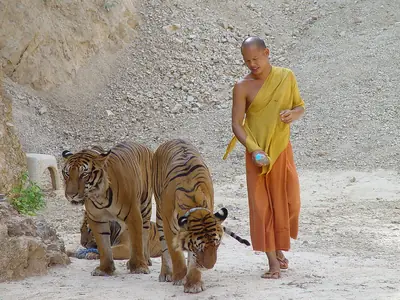
Wat Pha Luangta Maha Bua, better known as the Tiger Temple, is a Theravada Buddhist forest temple in western Thailand. It has been closed to the public since 2016.
The temple became internationally known for keeping tigers on its grounds. Established in 1994, its origins are linked to a tiger cub brought there after its mother was killed by a hunter. The temple presented its care of injured wild animals and orphaned animals as a Buddhist form of coexistence. Later, its reputation became the subject of serious investigation, making the site part of wider discussions about wildlife, controversy, and animal care.
Explore Kanchanaburi with Neywo
Neywo’s Death Railway Trail: From Wat Tai to the Bridge on the River Kwai is a self-guided walking tour covering 5.82 km in 108 minutes, with five narrated stops: Wat Chaichumphon Chana Songkhram, Mae Klong, Beata Mundi Regina, the Thailand–Burma Railway Centre, and the River Kwai Bridge.
Download Neywo to explore Kanchanaburi with its free audio guide. The app tells the story of each place as you reach it, at your own pace, with no group and no schedule. If you are planning a wider journey through Thailand, Kanchanaburi offers a particularly memorable chapter in the country’s history.
Places with an audio guide in Kanchanaburi
8 places in Kanchanaburi with a Neywo audio guide. Each one starts telling its story as you reach it.
Walk Kanchanaburi with Neywo
Neywo turns Kanchanaburi into a self-guided audio tour. Stories arrive as you reach the place they belong to, and the route reshapes when you wander off it.

