Things to Do in Pai, Thailand: Walking Guide
Things to Do in Pai: Visit Its Tai Yai Temples
Pai is a small town in northern Thailand, in Mae Hong Son Province, known for its relaxed atmosphere and mountain setting. Among the things to do in Pai, exploring its historic Buddhist temples offers a closer look at the area’s Tai Yai heritage, especially at Wat Luang and Wat Klang. Neywo has a free audio guide for Pai with two narrated places, available in 11 languages.
What to See in Pai
The most distinctive places described in Pai’s centre are two Buddhist temples in Wiang Tai. Their large chedis, historic layers and religious details reflect the area’s Tai Yai artistic tradition.
Wat Luang
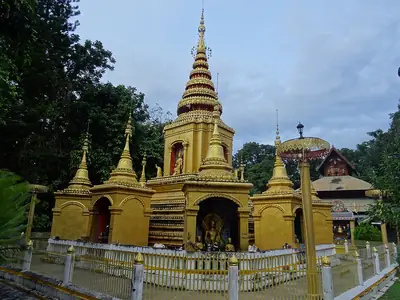
Wat Luang is a Buddhist temple in Wiang Tai Subdistrict, in Pai District. Its Tai Yai-style chedi is regarded as one of Pai’s symbols and is the temple’s central feature.
The temple was established in Buddhist Era 2346 on the site of an earlier abandoned temple. Its history is closely connected to the local community. In Buddhist Era 2442, after the death of Phraya Damrong, his son Phraya Rach led residents in constructing the chedi over a large brick-and-mortar Buddha image that had fallen into disrepair. The work lasted three years, and Phraya Rach placed the finial on the chedi in Buddhist Era 2444.
The chedi is not the only part of Wat Luang’s religious heritage worth noticing. Two old Buddha images, known as Phra Chao Phet and Phra Pharala-ong, are also among the temple’s distinctive features. Together, they help make the site an important stop for anyone interested in what to see in Pai beyond its natural scenery.
Wat Luang belongs to the Mahanikaya school of the Thai Buddhist monastic order. It received royal permission for its consecrated boundary on the third of February in Buddhist Era 2494.
Wat Klang
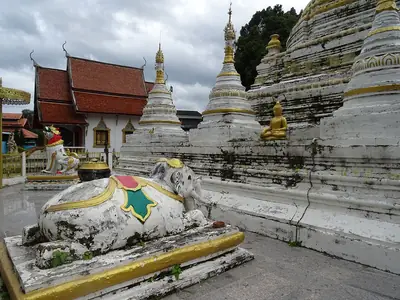
Wat Klang is another Buddhist temple in Wiang Tai, Mae Hong Son Province. Its most prominent feature is a large Tai Yai-style chedi standing at the centre of the temple grounds.
The temple has a layered and sometimes conflicting history. One account dates its construction to Buddhist Era 2335, while the temple history gives Buddhist Era 2394. The site was later abandoned. According to the temple’s story, a wandering monk named Sunanta arrived from Muang Pu, recognised signs that a temple had once stood there, and repaired enough of the buildings to live on the site and spend the rainy season.
Another account describes several Tai Yai reconstructions, with the most recent taking place around Buddhist Era 2469. These different accounts are part of what makes Wat Klang interesting: the present temple reflects successive periods of rebuilding rather than a single moment of foundation.
The central chedi is surrounded by smaller Mon-style chedis. Niches beneath the main structure contain Buddha images associated with the days of the week. Above the base of the chedi is a pavilion crowned by a decorative crown-shaped finial.
Wat Klang received its royal boundary designation on March 10 in Buddhist Era 2515. The designated area measures 30 metres wide by 40 metres long.
Pai’s Tai Yai Heritage
Wat Luang and Wat Klang provide two different perspectives on Pai’s religious and architectural history. Both temples centre on Tai Yai-style chedis, but each has its own details: Wat Luang is associated with Phra Chao Phet and Phra Pharala-ong, while Wat Klang combines its main chedi with smaller Mon-style structures and Buddha images linked to the days of the week.
Visiting both sites is a simple way to explore Pai’s cultural heritage while walking through Wiang Tai. For a more immersive visit, a Pai self-guided walking tour can help connect the places you see with their stories. Neywo’s Pai audio guide is designed for that kind of independent exploration: the narration plays as you reach each place, at your own pace, with no group and no schedule.
Explore Pai with Neywo
Download Neywo to explore Pai with a free audio guide covering two narrated places. Each story starts as you reach the place, so you can walk at your own pace without joining a group or following a schedule. Narration is available in 11 languages.
Neywo is also available in other destinations across Thailand, including Phuket, Krabi and Koh Samui.
Places with an audio guide in Pai
2 places in Pai with a Neywo audio guide. Each one starts telling its story as you reach it.
Walk Pai with Neywo
Neywo turns Pai into a self-guided audio tour. Stories arrive as you reach the place they belong to, and the route reshapes when you wander off it.

