Visiting Derby, United Kingdom: Top Sights on Foot
Things to Do in Derby: Historic Houses, Mills and the Derwent Valley
Looking for things to do in Derby? The city is a gateway to some of Derbyshire’s most important historic places, from medieval manor houses and ruined castles to the mills that helped create Britain’s modern factory system. A free Neywo audio guide for Derby brings 435 narrated places to life as you explore.
Derby sits at the heart of a landscape shaped by the River Derwent, industry, country estates and long human history. The city itself offers a starting point, while the surrounding area is filled with distinctive places to see.
What to See in Derby and the Surrounding Area
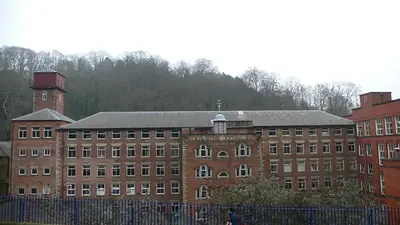
Derwent Valley Mills
The Derwent Valley Mills World Heritage Site follows the River Derwent through Derbyshire. It was designated in December 2001 and preserves the mills and workers’ settlements associated with the beginnings of Britain’s modern factory system.
The story began in the eighteenth century, when water-powered technology made continuous cotton spinning possible. Richard Arkwright developed the water frame and used water power for cotton production in the 1770s. His first mill was built at Cromford, and the system soon influenced industrial development far beyond the valley. By 1788, more than 200 Arkwright-type mills had been built in Britain.
The industrial landscape remains unusually complete. Mills and associated buildings have been preserved and reused, with many listed buildings and Scheduled Monuments. The site includes 848 buildings recognised for their architectural or historical interest and nine Scheduled Monuments.
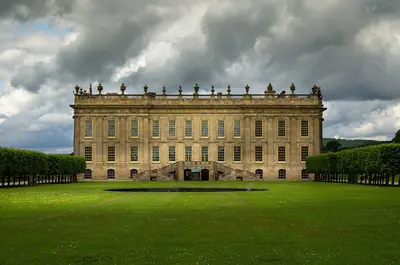
Chatsworth House
Set beside the River Derwent, Chatsworth House is surrounded by parkland, wooded hills and heather moorland. It has been the home of the Cavendish family since 1549 and remains the seat of the Duke of Devonshire.
Bess of Hardwick began building a new Chatsworth in 1553. The house was completed in the 1560s, and she lived there with her fourth husband, George Talbot, the sixth Earl of Shrewsbury. The house is also associated with Mary, Queen of Scots, who stayed there several times during her captivity from 1570 onwards. Her rooms are now known as the Queen of Scots rooms.
Much of the present building reflects later transformations. William Cavendish, the fourth Earl of Devonshire, began rebuilding it in 1687, starting with the south wing and its State Apartments. Further changes followed in the eighteenth century.
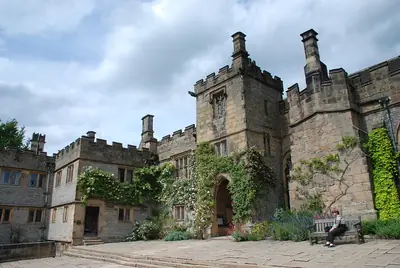
Haddon Hall
Near Bakewell, beside the River Wye, Haddon Hall is a carefully preserved medieval manor house with origins reaching back to the eleventh century. Additions were made between the thirteenth and seventeenth centuries, including later Tudor work, but the building retains the form of a medieval manor.
Haddon became associated with the Vernon family through the twelfth-century marriage of Sir Richard de Vernon and Alice Avenell. In 1563, Dorothy Vernon, daughter and heiress of Sir George Vernon, married John Manners, the second son of the first Earl of Rutland. Through this marriage, Haddon passed into the Manners family and became connected with the future Dukes of Rutland.
A nineteenth-century legend claims that Dorothy Vernon and John Manners eloped. Whether or not the story is true, it inspired novels, dramatisations and other works of fiction.
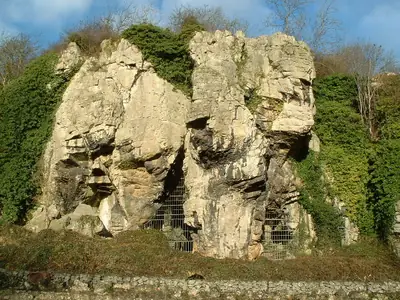
Creswell Crags
Creswell Crags is an enclosed limestone gorge on the border between Derbyshire and Nottinghamshire, near Creswell and Whitwell. Its cliffs contain caves occupied by Neanderthals and modern humans during the Last Glacial Period, from around 60,000 to 10,000 years ago.
The occupation layers preserve evidence of flint tools made by Neanderthals and by later modern human communities. The caves provide a direct connection with some of the earliest human activity in this part of Britain.
Peveril Castle
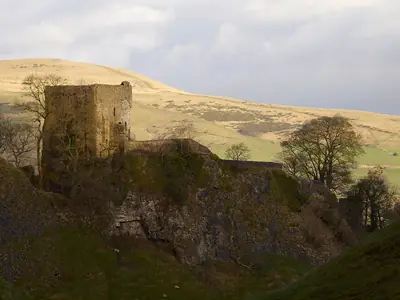
The ruins of Peveril Castle overlook Castleton, with views across the Hope Valley and Cave Dale. The fortress was founded sometime between the Norman Conquest in 1066 and its first recorded mention in the Domesday Survey of 1086.
It became the main settlement of William Peverel’s feudal barony, the Honour of Peverel, while Castleton developed as the barony’s economic centre. King Henry II confiscated William Peveril the Younger’s estates in 1155 and visited the castle in 1157, 1158 and 1164. During his first visit, he hosted Malcolm IV, King of Scotland.
The castle came closest to battle in 1216, when a castellan refused to surrender control after King John granted Peveril to William de Ferrers. Although Ferrers was authorised to use force, the castellan eventually capitulated and there is no evidence that the castle was attacked.
Hardwick Hall
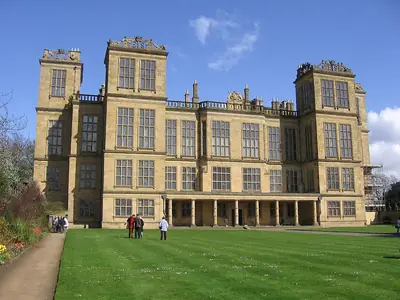
Hardwick Hall is one of Derbyshire’s most distinctive Elizabethan country houses. Built for Bess of Hardwick between 1590 and 1597, it was designed by the architect Robert Smythson and is a leading example of the Elizabethan prodigy house.
The building reflects a Renaissance style influenced by ideas that had spread from Florence. Unlike earlier fortified homes, it was constructed at a time when domestic buildings no longer needed to be defensive. Its strong vertical lines, simple geometry and unusually large areas of glass create the famous impression of a “glass cage”.
Inside, the arrangement reflects changing ideas about domestic life. The hall was no longer used for dining: a large dining room occupied the first floor, alongside impressive apartments for the owner.
Bolsover Castle
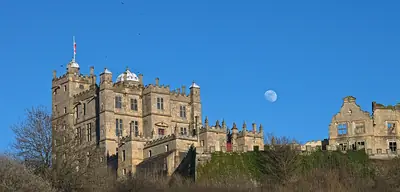
Bolsover Castle combines a seventeenth-century residence with the earthworks and ruins of a much older medieval castle. The present castle was built in the early seventeenth century, when Sir Charles Cavendish began a new structure between 1612 and 1617 on the site of the twelfth-century fortress.
This layering of medieval remains and later construction gives Bolsover Castle its distinctive character above the surrounding landscape.
Eyam Hall
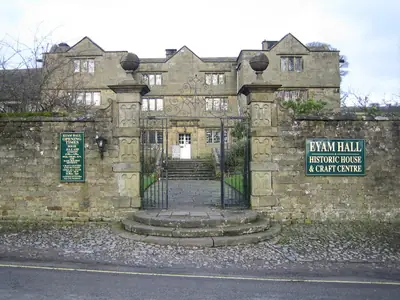
In the Derbyshire village of Eyam, Eyam Hall is a historic country house west of St Lawrence’s Church. It is recognised as a Grade II* listed building on the National Heritage List for England. From 2013 until 2018, it was leased to the National Trust.
Eyam is also one of the places covered by a Neywo walk, making the village’s historic setting easy to explore at your own pace.
Historic churches and village landmarks
Derbyshire’s smaller villages add further places to see. All Saints Church in Ballidon is a peaceful Grade II listed building cared for by the Friends of Friendless Churches. It is a redundant Anglican church and is no longer used for regular worship.
Other historic churches include the Grade II* listed Church of St Mary in Ilkeston, also known as Saint Mary the Virgin or the Mollis Chapel; the Grade I listed St Mary the Virgin’s Church in Denby; and St Mary’s in Crich, a Grade I listed Church of England parish church. The Church of St Mary in Coton in the Elms, the Church of St Mary in Mapleton and the Church of St Matthew in Overseal are also part of the region’s historic setting.
Explore Derby with a Free Audio Guide
Neywo makes a Derby self-guided walking tour easy to follow. The app includes eight walking tours, one bus route and one bike route in the area, with narration available in 11 languages.
The walks range from 1.33 to 5.08 kilometres and from 45 to 108 minutes. They include:
- Arkwright’s Valley: From the Canal to the Heights — 5.08 km, 108 minutes, 7 narrated stops
- Matlock Bath: Little Switzerland of Derbyshire — 4.26 km, 101 minutes, 8 stops
- Eyam: The Plague Village — 4.35 km, 95 minutes, 6 stops
- Chatsworth Park: Palace of the Peak — 4.79 km, 100 minutes, 5 stops
- Bakewell and Haddon Hall: Pudding Town to Medieval Manor — 4.52 km, 97 minutes, 5 stops
- Ashford in the Water: Bridges of the Wye — 1.33 km, 45 minutes, 4 stops
- Belper: A Mill Town on the Derwent — 1.77 km, 61 minutes, 6 stops
- Buxton: England’s Highest Spa Town — 4.24 km, 91 minutes, 6 stops
There is also a 6.4-kilometre, 27-minute bus route with 4 stops and a 3.1-kilometre, 16-minute bike route with 2 stops. The app tells the story of each place as you reach it, at your own pace, with no group and no schedule.
Download Neywo and explore Derby, the Derwent Valley and the surrounding historic villages with a free audio guide. You can also continue discovering England and the wider United Kingdom through Neywo’s destination guides.
Places with an audio guide in Derby
8 places in Derby with a Neywo audio guide. Each one starts telling its story as you reach it.
Self-guided tours in Derby
10 tours in Derby, free in the Neywo app. Each stop tells its story as you reach it.
- Bike ride
High Peak Trail to Cromford Canal
A traffic-free ride on the High Peak Trail, a former railway line, from the National Stone Centre down to High Peak Junction on the Cromford Canal, gateway to the Derwent Valley Mills World Heritage Site.
National Stone Centre · High Peak Junction
Open this tour: High Peak Trail to Cromford Canal - Bus ride
Bus 158: Matlock to Cromford and Bonsall
A short country bus from Matlock through Starkholmes to Cromford, the mill village of Arkwright, and on up to the Peak District village of Bonsall with its market cross.
Church of St Giles · St Mary's Church, Cromford · Cromford Mill · Market Cross
Open this tour: Bus 158: Matlock to Cromford and Bonsall - Walk
Arkwright's Valley: From the Canal to the Heights
Follow the Derwent Valley from its industrial beginnings to its Victorian spa. Start at a Victorian pump house on the Cromford Canal and walk to High Peak Junction, then Richard Arkwright's world-first water-powered mill and his castle-like home. Finish in Matlock Bath at the Edwardian pavilion, the lead mining museum and the cable car to the Heights of Abraham.
Leawood Pump House · High Peak Junction · Cromford Mill · Willersley Castle · Grand Pavilion, Matlock Bath · Peak District Mining Museum …
Open this tour: Arkwright's Valley: From the Canal to the Heights - Walk
Matlock Bath: Little Switzerland of Derbyshire
A stroll along the Derwent gorge in Matlock Bath, the Victorian spa village. Visit the church, the Edwardian pavilion and its lead mining museum, ride up to the Heights of Abraham, then follow the hill to a friendless chapel, Matlock's parish church and the ruined towers of Riber Castle.
Church of Holy Trinity · Grand Pavilion, Matlock Bath · Peak District Mining Museum · Royal Museum · Heights of Abraham · St John the Baptist's Chapel, Matlock Bath …
Open this tour: Matlock Bath: Little Switzerland of Derbyshire - Walk
Eyam: The Plague Village
In 1665 the villagers of Eyam shut themselves in to stop the plague spreading. Follow their story from a well where supplies were left, through the museum, the hall and the church, to a natural cave where the rector held open-air services.
Mompesson's Well · Eyam Museum · Eyam Hall · St Lawrence's Church, Eyam · Cucklet Church · Church of St Martin
Open this tour: Eyam: The Plague Village - Walk
Chatsworth Park: Palace of the Peak
Wander through Edensor estate village and the parkland of Chatsworth, home of the Dukes of Devonshire. See the church where the dukes are buried, the great house of Bess of Hardwick, a Greek column in the gardens and the graceful One Arch Bridge over the Derwent.
Church of St Anne · One Arch Bridge · Column of the Temple of Poseidon at Chatsworth · Chatsworth House · Church of St Peter, Edensor
Open this tour: Chatsworth Park: Palace of the Peak - Walk
Bakewell and Haddon Hall: Pudding Town to Medieval Manor
Cross the medieval packhorse bridge over the Wye, visit the Old House Museum and the Saxon-rooted parish church of Bakewell, then walk out to Haddon Hall, one of the best-preserved fortified manor houses in England, and its tiny chapel.
Bakewell Bridge · Bakewell Old House Museum · All Saints Church, Bakewell · Haddon Hall · Chapel of St Nicholas, Haddon Hall
Open this tour: Bakewell and Haddon Hall: Pudding Town to Medieval Manor - Walk
Ashford in the Water: Bridges of the Wye
A short stroll round one of the prettiest villages in the Peak District. Cross the packhorse Sheepwash Bridge, the old mill bridge and Lees Bridge, then end at the parish church.
Sheepwash Bridge · Ashford Bridge · Lees Bridge · Church of Holy Trinity
Open this tour: Ashford in the Water: Bridges of the Wye - Walk
Belper: A Mill Town on the Derwent
Walk through the World Heritage mill town the Strutts built. See their North Mill and the Derwent Valley Mills, the Congregational and parish churches and the town that grew around the cotton industry.
Derwent Valley Mills · Strutt's North Mill · Christ Church · Congregational Church · Parish Church of St Peter · Belper
Open this tour: Belper: A Mill Town on the Derwent - Walk
Buxton: England's Highest Spa Town
Climb to Solomon's Temple on Grin Low, visit Poole's Cavern, then walk into the Georgian spa town for the Pavilion Gardens, the churches and the story of Buxton's waters.
Solomon's Temple, Buxton · Poole's Cavern · Pavilion Arts Centre · Church of St John the Baptist · Church of St Anne · Buxton
Open this tour: Buxton: England's Highest Spa Town
Walk Derby with Neywo
Neywo turns Derby into a self-guided audio tour. Stories arrive as you reach the place they belong to, and the route reshapes when you wander off it.

