Maidstone, United Kingdom: Self-Guided Walking Tour
Things to Do in Maidstone: Castles, Museums and Medieval Heritage
Looking for things to do in Maidstone? The county town of Kent brings together medieval castles, museums, churches and historic buildings beside the River Medway. It is also a useful base for exploring the surrounding countryside, including Leeds Castle, former monasteries and traditional rural properties. Neywo offers a free audio guide for Maidstone with 73 narrated places.
Maidstone’s heritage is spread across the town and its surroundings, so a self-guided visit can move from an archbishop’s former residence to a carriage museum, a ruined castle or a half-timbered house. The town’s museums add local, artistic and unusual collections to the experience.
What to see in Maidstone
Archbishop’s Palace
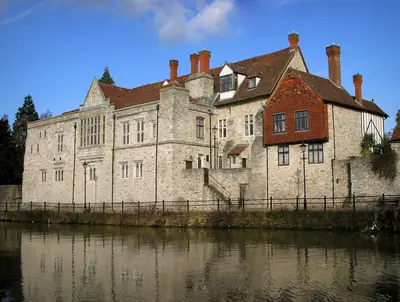
Beside the River Medway, the Archbishop’s Palace reflects Maidstone’s long connection with the Archbishops of Canterbury. The building dates back to the fourteenth century, with additions from the sixteenth century. It was originally used as a residence for archbishops when they were travelling, and is most recently known as a venue for wedding services.
Maidstone Museum and Bentlif Art Gallery
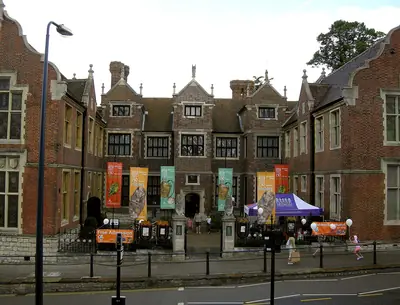
Maidstone Museum and Bentlif Art Gallery is a Grade II star listed building with collections covering fine art, natural history and human history. Its displays extend well beyond the town itself, including internationally important works of fine art and objects connected with the natural and human history of the area.
The building also contains the Queen’s Own Royal West Kent Regiment Museum, an independent regimental museum devoted to the regiment and its history.
The Museum of Carriages
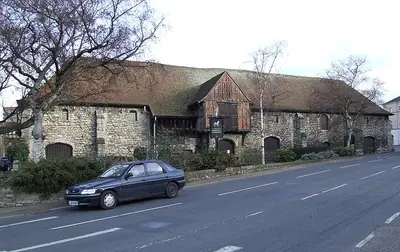
The Tyrwhitt-Drake Museum of Carriages occupies the Tithe Barn on the east side of Mill Street. The building is an attraction in its own right: constructed in the fourteenth century as a tithe barn for the nearby Archbishop’s Palace, it later served as the palace’s stables.
The Tithe Barn is Grade I listed and a scheduled monument. Its construction is attributed to Archbishop Courtenay, who died in 1396. Inside, the carriage collection combines transport history with the atmosphere of a medieval building.
Stone Pavilion in Mote Park
Mote Park provides a green setting within Maidstone, and the Stone Pavilion—also known as the Volunteers Pavilion—is one of the places to notice while exploring it. The pavilion adds a historic structure to the park’s open surroundings and is included on one of Neywo’s Maidstone walks.
Leeds Castle
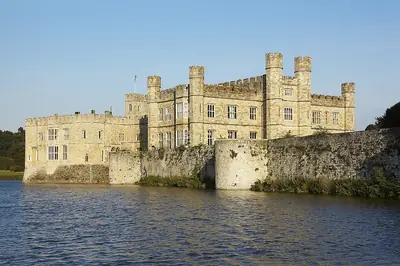
Southeast of Maidstone, Leeds Castle rises from islands in a lake formed by the River Len. Water and green grounds surround the estate, giving it a distinctive setting. A castle has stood here since 857, and the site later became a royal residence. In the thirteenth century, it passed to King Edward the First, who made it one of his favourite homes.
The medieval castle is known as the Gloriette. Its defences include a barbican divided into three sections, each with its own entrance, drawbridge, gate and doors. Much of the castle visible today dates from the early nineteenth century, with further alterations in the 1930s. The last private owner was Olive, Lady Baillie, who left the castle in trust so it could open to the public.
Allington Castle
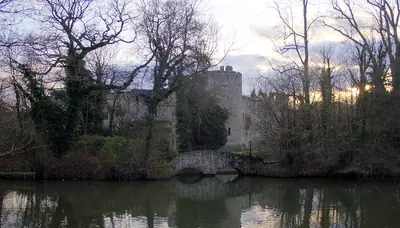
Just north of Maidstone, Allington Castle is a stone-built castle surrounded by a moat. Its history began with an unauthorised fortification built during the Anarchy, between 1135 and 1153. After that structure was demolished, a manor house was built and later fortified with royal permission in the thirteenth century.
Successive owners expanded the property into a fortified compound with six irregularly placed towers and domestic buildings, including one of the first long galleries built in England. The Crown seized the castle in 1554 after the failed rebellion of Sir Thomas Wyatt the Younger against Queen Mary. Fires, neglect and vandalism later left it largely ruined, before Sir Martin Conway and his wife restored it during the first half of the twentieth century.
Boxley Abbey
At the foot of the North Downs, Boxley Abbey preserves the remains of a former Cistercian monastery. It was founded around 1146 in the parish of Boxley, near Sandling, and continued until 1538, when it was dissolved during the closure of the monasteries under Henry the Eighth.
Leeds Priory
Leeds Priory, also known as Leeds Abbey, was founded in 1119 and remained in use for more than four centuries, until its dissolution in 1539. The site is now a scheduled monument. A mansion was built there after the priory was dissolved, but that later building was demolished in the late eighteenth century, leaving the former priory site as the principal reminder of its history.
Stoneacre
In Otham, Stoneacre is a small National Trust property with a garden, orchard and meadows. At its centre stands a fifteenth-century half-timbered yeoman farmer’s house, offering a glimpse of a rural Kent home. Stoneacre is a Grade II star listed building, and its house and surrounding landscape make it a compact historic site to explore near Maidstone.
Sutton Valence Castle
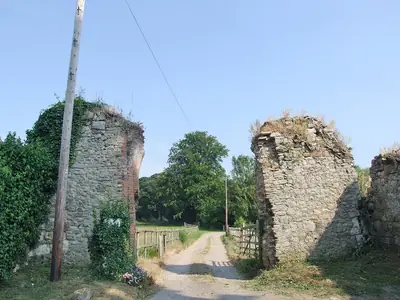
Sutton Valence Castle is a ruined medieval fortification overlooking a strategic route to the coast. Only the keep remains, but the surviving structure gives an impression of the stronghold’s former scale. The original castle probably included an inner and outer bailey, a barbican and a three-storey keep.
It was built in the second half of the twelfth century, probably by Baldwin of Bethune, the Count of Aumale. The castle later passed through the families of Marshal and de Montfort before Henry the Third gave it to his half-brother, William de Valence, in 1265. It was abandoned by the early fourteenth century and gradually fell into ruin.
St Peter’s and St Paul’s Church, Yalding
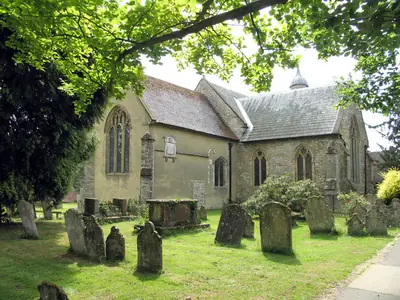
Also known as St Peter and St Paul, this parish church in Yalding is dedicated to Saints Peter and Paul. Construction began in the thirteenth century, and the church is recognised as a Grade I listed building.
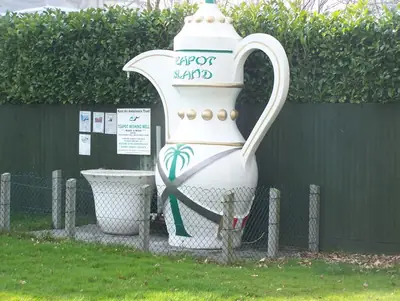
Teapot Island
Teapot Island offers one of Maidstone’s more unusual museum experiences: a collection devoted entirely to teapots. It grew from owner Sue Blazye’s personal collection, which began in 1983 when her grandmother gave her a teapot and encouraged family members and friends to do the same. That gift became the foundation of the museum.
Lashenden Air Warfare Museum
At Lashenden, also known as Headcorn, Airfield, the Lashenden Air Warfare Museum presents an aviation-focused attraction in Kent. It adds a twentieth-century subject to Maidstone’s broader mix of castles, churches and historic buildings.
Further historic places
Other places included in the Maidstone area’s heritage landscape are the Trinity Foyer, a church building in Maidstone, and Coldbridge Castle. The surrounding villages also add churches to a visit, including St Michael’s, St Mary’s in Sutton Valence and St Peter’s and St Paul’s in East Sutton.
For more destinations in the area, explore England or continue through the United Kingdom. If you are planning a wider trip, Margate is another English destination to consider.
Explore Maidstone with a free audio guide
Neywo has five walking tours in Maidstone, with stories in 11 languages. The app tells the story of each place as you reach it, at your own pace, with no group and no schedule.
The walks include:
- Maidstone on the Medway: Archbishops, Carriages and a Grand Perpendicular Church — 4.63 km, 116 minutes and 10 narrated stops.
- North of Maidstone: A Moated Castle and a Ruined Abbey — 5.4 km, 97 minutes and 4 narrated stops.
- Chart Sutton to Sutton Valence: Churches and a Ruined Keep — 3.22 km, 66 minutes and 4 narrated stops.
- Leeds Castle and the Len Valley — 5.89 km, 111 minutes and 4 narrated stops.
- Mote Park to Otham and Stoneacre — 4.38 km, 83 minutes and 4 narrated stops.
Download Neywo and explore Maidstone as you walk, from the Archbishop’s Palace and the Museum of Carriages to Leeds Castle, Boxley Abbey and Stoneacre.
Places with an audio guide in Maidstone
8 places in Maidstone with a Neywo audio guide. Each one starts telling its story as you reach it.
Self-guided tours in Maidstone
2 tours in Maidstone, free in the Neywo app. Each stop tells its story as you reach it.
- Walk
Maidstone on the Medway: Archbishops, Carriages and a Grand Perpendicular Church
Maidstone grew up as a river port and as a stopping place for the Archbishops of Canterbury. Follow the Medway from their medieval palace and tithe barn to the grandest Perpendicular church in Kent, then into the town for the Hazlitt Theatre, the museum with its Victoria Crosses and a ring of old churches, ending in Mote Park.
Archbishop's Palace · Museum of Carriages · All Saints Church, Maidstone · Hazlitt Theatre · St Faith's Maidstone · Maidstone Museum and Bentlif Art Gallery …
Open this tour: Maidstone on the Medway: Archbishops, Carriages and a Grand Perpendicular Church - Walk
Chart Sutton to Sutton Valence: Churches and a Ruined Keep
A country walk south of Maidstone along the greensand ridge. Start at the church of Chart Sutton, climb to Sutton Valence's village church and the ruined twelfth-century keep that looks over the Weald, then finish at the Grade I church of East Sutton.
Church of St Michael · Church of St Mary, Sutton Valence · Sutton Valence Castle · St Peter's and St Paul's Church, East Sutton
Open this tour: Chart Sutton to Sutton Valence: Churches and a Ruined Keep
Walk Maidstone with Neywo
Neywo turns Maidstone into a self-guided audio tour. Stories arrive as you reach the place they belong to, and the route reshapes when you wander off it.

