Visiting Dover, United Kingdom: Top Sights on Foot
Things to Do in Dover: Historic Forts, Roman Ruins and the White Cliffs
The best things to do in Dover combine dramatic coastal scenery with centuries of military, Roman and religious history. Visit Dover Castle and the White Cliffs, explore historic forts, and discover the remains of Roman and medieval Dover. Neywo has a free audio guide for Dover with 114 narrated places, available in 11 languages.
Dover stands on the English Channel at the shortest sea route between Britain and the continent. Its strategic position shaped the town’s history, from the Roman port of Dubris to the medieval fortress known as “the Key to England” and the coastal defenses built during later conflicts.
What to see in Dover
Dover Castle and the Roman Pharos
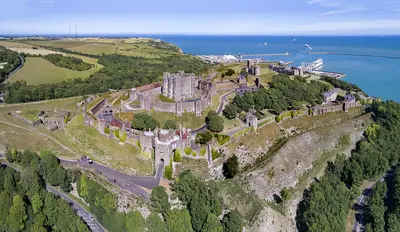
Dover Castle rises above the town and port in a position that guarded the shortest sea route between Britain and the continent. Founded in the eleventh century, the medieval fortress was built in stone after an earlier earth-and-timber castle and altered several times as defensive needs changed.
The castle grounds also contain the Roman Pharos, or Dubris Pharos, beside St Mary in Castro. Built around 46–50 AD during the reign of Emperor Claudius, the lighthouse helped guide ships across the English Channel to the Roman port and fort of Dubris. It was originally an octagonal tower about 24 metres high, with a fire beacon at the summit.
White Cliffs of Dover
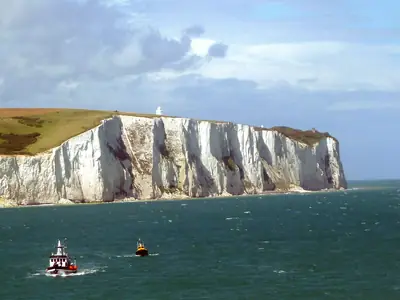
The White Cliffs of Dover are among Britain’s most recognisable natural landmarks. Their chalk face, marked by streaks of black flint, rises to about 350 feet, or 110 metres, at its highest point and extends on both sides of the town.
The cliffs form part of the North Downs and face the Strait of Dover and France. Julius Caesar remarked on them during his invasion of Britain in 55 BC. They later became a natural defensive barrier and, during the Second World War, a symbol of Britain’s determined defence and a welcome sight for evacuees returning from Dunkirk.
St Mary’s Church, Dover
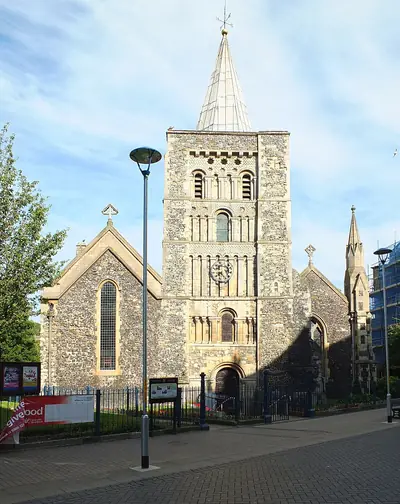
St Mary’s Church stands on Cannon Street in central Dover, on a site used for worship since Saxon times. Although its origins are ancient, the church was largely rebuilt in the nineteenth century. It is an Anglican church and a Grade II* listed building.
The church is also one of the stops on Neywo’s walk through Dover’s historic centre, alongside Dover Museum and other places connected with the town’s civic and religious history.
St James’ Church
The remains of St James’ Church offer a direct link to Saxon and medieval Dover. The original church was mentioned in the Domesday Book, while the surviving structure dates mainly from the twelfth century and was built in the Norman style. Its remaining arch still shows a distinctive chevron pattern.
The church was damaged in both world wars. German artillery fire caused severe damage during the Second World War, and the tower collapsed in 1950. The ruins were preserved as a memorial to the suffering caused by the conflict. St James’ Church is now a Grade II listed building.
Western Heights and the Drop Redoubt
Western Heights forms one of Dover’s major defensive landscapes. The Drop Redoubt, one of two forts on the heights, was constructed between 1804 and 1808 during the Napoleonic Wars. Further strengthening followed an invasion scare in 1859.
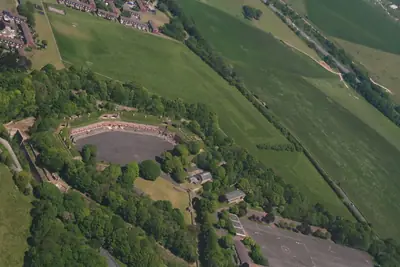
A deep pentagonal ditch surrounds the fort. Inside are remains of soldiers’ barracks, gun rooms, a guardhouse, a jail cell and officers’ quarters with fireplaces. The site also contains the foundations of a second-century Roman Pharos, known locally as Bredenstone, beneath the Victorian officers’ quarters.
Fort Burgoyne
Fort Burgoyne, also known as Fort Burgoyne Western Redoubt, occupies high ground northeast of Dover. Built in the 1860s, it was originally called Castle Hill Fort and formed part of the Palmerston forts constructed around Dover. Its role was to protect the high ground north of Dover Castle.
The fort followed a polygonal design with detached eastern and western redoubts. After the First World War, it became a military depot and store for Connaught Barracks. In 2014, Fort Burgoyne and 42 hectares of surrounding land were acquired by the Land Trust. The West Wing Battery was stabilised and transformed from derelict buildings in woodland into an informal recreation space opened to the community in 2023.
Admiralty Pier Turret
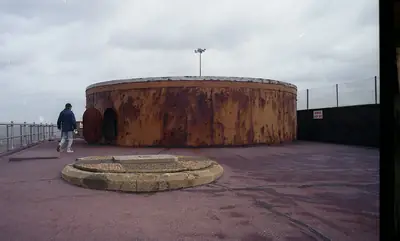
The Admiralty Pier Turret, also known as Dover Turret, stands on the western breakwater of Dover Harbour. Built in 1882, this enclosed armoured structure housed two Fraser rifled muzzle-loading guns. Each gun weighed 80 tons, and together they were the biggest guns installed in the United Kingdom.
The turret was declared obsolete in 1902. It cannot be entered because it is part of the port, but both guns remain in place.
Roman history near Dover
Dover’s Roman story centres on Portus Dubris, the settlement that developed around the Roman port and fort. The surviving Pharos at Dover Castle is one of its most visible remains, while the wider region contains further evidence of Roman Kent.
Richborough Roman Fort, also known as Richborough Castle, was part of the settlement of Rutupiae, or Portus Ritupis. Founded after the Roman conquest of Britain in AD 43, it grew around a fort and port near the Wantsum Channel and the mouth of the Stour. Although the coastline later changed and the site is now about two and a half miles inland, its substantial Roman walls still rise several metres.
The later stone fort was built around 277 as part of the military command known as the Saxon Shore. Richborough also marked the beginning of the Roman road now known as Watling Street, which led towards Canterbury, London, St Albans and Wroxeter.
Deal, Walmer and Sandown Castles
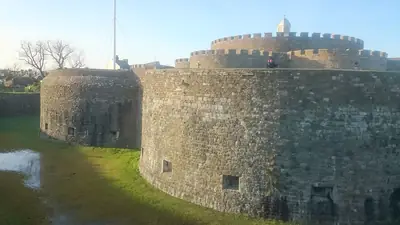
The coast east of Dover contains a remarkable group of Tudor artillery forts. Deal Castle and Walmer Castle were built for Henry VIII between 1539 and 1540 as part of the King’s Device programme. Together with Sandown Castle, now largely ruined, they guarded the strategically important Downs anchorage and helped protect the coast from invasion by France and the Holy Roman Empire.
Deal Castle has a rounded stone form centred on a keep with six inner and outer bastions. Its compact site contained 66 artillery firing positions. During the Second English Civil War, pro-Royalist insurgents seized the castle in 1648, and Parliamentary forces retook it only after several months of fighting.
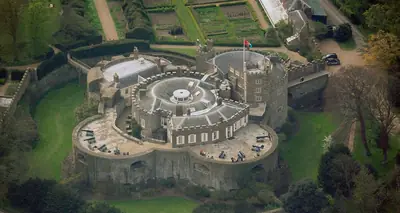
Walmer Castle has a central keep, four circular bastions and a moat. It later became a residence for prominent political figures, adding a civic and domestic chapter to its military history.
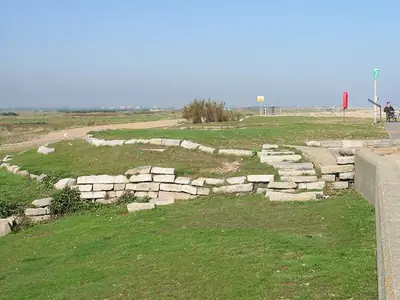
Sandown Castle originally had a central keep, four circular bastions, a moat, 39 artillery firing positions and 31 basement gunloops for handguns. Coastal erosion damaged the fort, and the War Office demolished its upper levels with explosives in the nineteenth century. The remains now form part of the coastal defenses.
The nearby town of Deal adds further context to this coastline. Once a limb port of the Cinque Ports, Deal grew around the Downs anchorage and preserves historic streets, buildings and monuments. Middle Street became Kent’s first conservation area in 1968.
St Radegund’s Abbey, Poulton
St Radegund’s Abbey stands in Hougham Without, in Kent. This historic religious site provides another perspective on the area around Dover, beyond its castles and military works.
Explore Dover with Neywo
Download Neywo to explore Dover with a free audio guide that narrates 114 places as you reach them. The app includes two walking tours:
- Pilgrims, Priory and the Market Square: 2.29 km, 72 minutes and 8 narrated stops
- Key to England: From the Seafront to the Castle: 4.73 km, 110 minutes and 8 narrated stops
The walks include places such as Dover Castle, Dover Museum and Bronze Age Boat Gallery, St Mary’s Church, the Admiralty Pier Turret and St James’ Church. Each story plays as you reach the place, at your own pace, with no group and no schedule. It is a self-guided way to discover Dover’s history while walking through the town.
Dover is part of England in the United Kingdom, and its coastal setting makes it a natural companion to nearby destinations such as Eastbourne.
Places with an audio guide in Dover
8 places in Dover with a Neywo audio guide. Each one starts telling its story as you reach it.
Self-guided tours in Dover
2 tours in Dover, free in the Neywo app. Each stop tells its story as you reach it.
- Walk
Pilgrims, Priory and the Market Square
Dover has welcomed travellers for two thousand years. Start at Charlton Church, still scarred by a 1944 shell, then pass a school built among the ruins of a medieval priory, a pilgrims' hospital that is now the town hall and a tiny 13th-century wayside chapel. Finish around the Market Square at St Mary's, the old King's Hall cinema and a 3,500-year-old Bronze Age boat.
Church of St Peter and St Paul · Dover College · St Edmund's Chapel · Dover Town Hall · St Paul's Church, Dover · Gaumont Dover …
Open this tour: Pilgrims, Priory and the Market Square - Walk
Key to England: From the Seafront to the Castle
Walk from the Western Heights, where the Knights Templar left a round church and Henry VIII a fort, along the harbour with its giant Victorian gun turret and memorials to Dover's sailors and soldiers, through the oldest pub in town and a ruined Norman church, up to the great medieval fortress the English called the Key to England, with a Roman lighthouse still standing in its grounds.
Knights Templar Church, Dover · Archcliffe Fort · Admiralty Pier Turret · Dover Frontline Britain Memorial · Dover and District Merchant Navy Memorial · White Horse Inn …
Open this tour: Key to England: From the Seafront to the Castle
Walk Dover with Neywo
Neywo turns Dover into a self-guided audio tour. Stories arrive as you reach the place they belong to, and the route reshapes when you wander off it.

