Visiting Manchester, United Kingdom: Top Sights on Foot
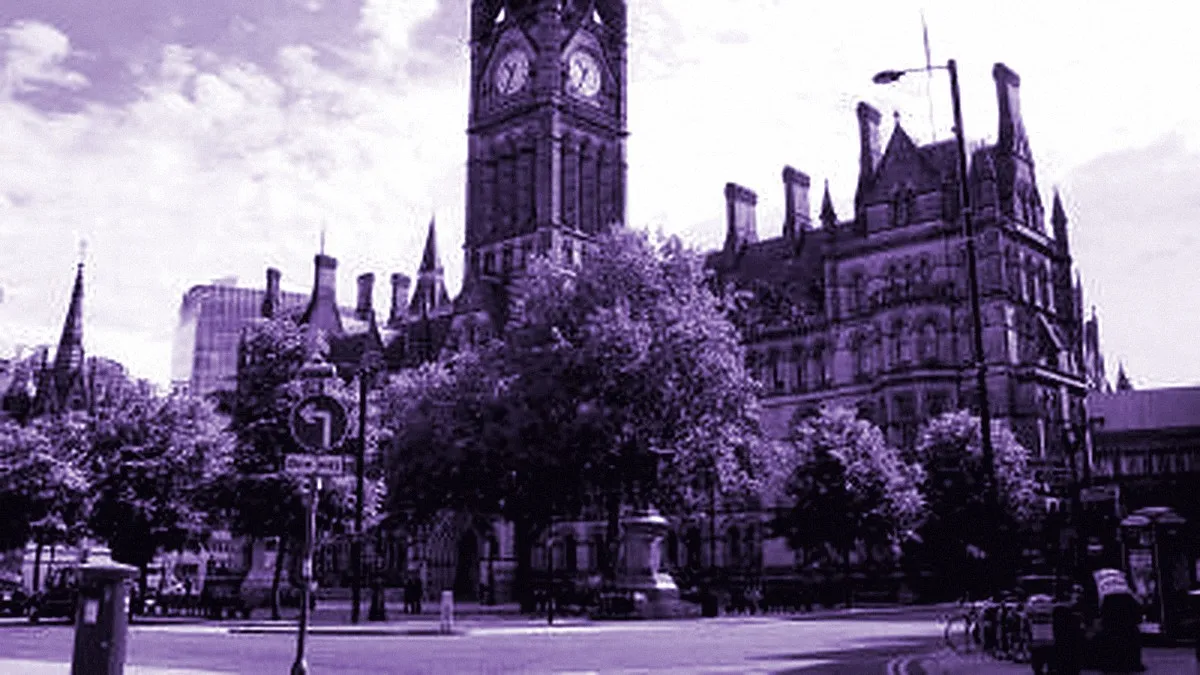
Things to Do in Manchester: What to See in the City Centre
The best things to do in Manchester include exploring its cathedral, museums, football landmarks, historic buildings and reminders of the city’s industrial and social history. From the medieval centre to Castlefield and Oxford Road, Manchester combines Victorian architecture, cultural institutions and a strong modern identity. Neywo has a free audio guide for Manchester with 168 narrated places.
Manchester’s past is especially visible in its buildings and public spaces. The city’s history includes the Industrial Revolution, the first scheduled passenger railway to use only steam locomotives, campaigns for political reform and women’s rights, and a major role in football and music. Its present-day cultural life occupies many of the same historic districts.
What to See in Manchester
Manchester Cathedral
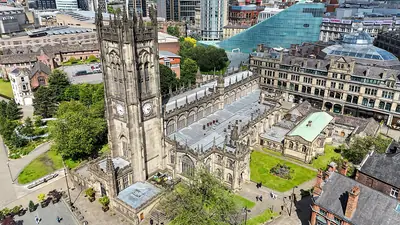
Manchester Cathedral stands on Victoria Street and is formally known as the Cathedral and Collegiate Church of St Mary, St Denys and St George. It is the mother church of the Anglican Diocese of Manchester and the seat of the Bishop of Manchester.
The Grade I listed building was rebuilt in the Perpendicular Gothic style after the foundation of its collegiate body in 1421. Its late-medieval interior includes wooden choir stalls, a pulpitum and a nave roof supported by angels carrying gilded instruments. The cathedral became the cathedral of the newly created Diocese of Manchester in 1847 and was later restored after bomb damage during the Second World War.
Nearby, The Old Wellington Inn is a half-timbered, Grade II listed pub and part of Shambles Square, created in 1999.
Manchester’s central churches, monuments and squares
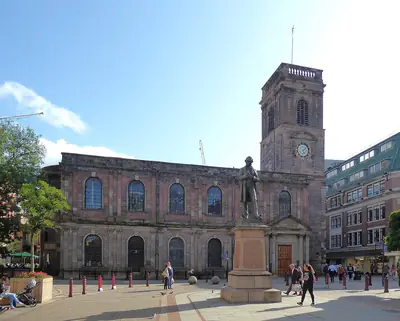
St Ann’s Church is a neoclassical Church of England parish church and a Grade I listed building. Although named for St Anne, it also honours its patron, Ann, Lady Bland.
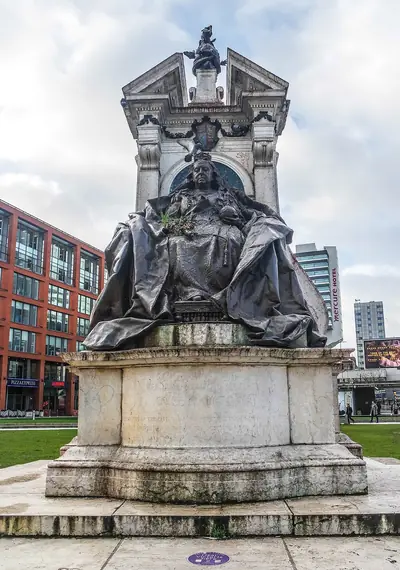
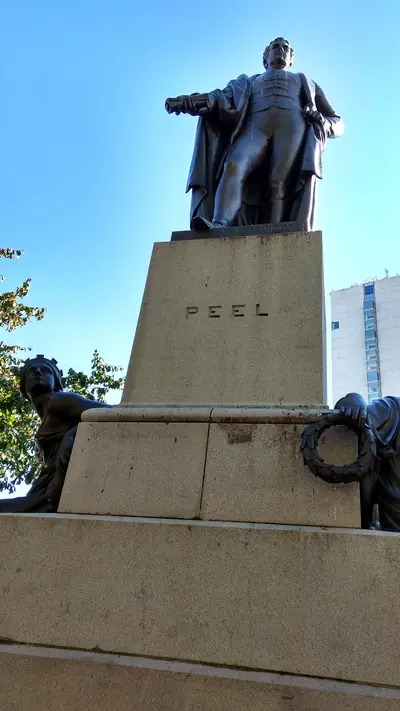
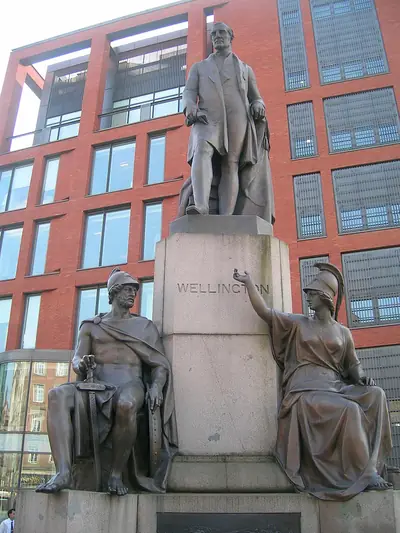
Several monuments add to the city centre’s historic streetscape. The Queen Victoria Monument stands alongside a statue of James Watt, while the Peel Statue and Wellington Statue commemorate two further figures associated with Britain’s public and political history.
Manchester Arena and its memorial
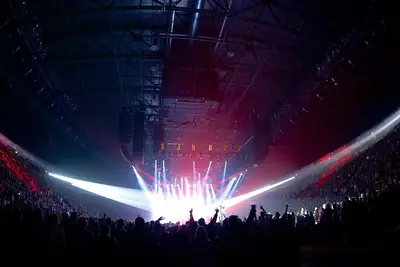
North of the city centre, Manchester Arena—currently known as the AO Arena under its sponsorship name—was built in part above Manchester Victoria railway station. It is one of the world’s busiest indoor arenas and hosts music, boxing and swimming events. The building also played a role in Manchester’s bids to host the Olympic Games in 1996 and 2000, and was later used for the 2002 Commonwealth Games.
A memorial marks the site of the terrorist attack of 22 May 2017, when a suicide bomber detonated a device in the arena foyer as an Ariana Grande concert was ending. Twenty-two people were killed. The attack remains one of the heaviest memories in Manchester’s recent history.
Manchester Art Gallery
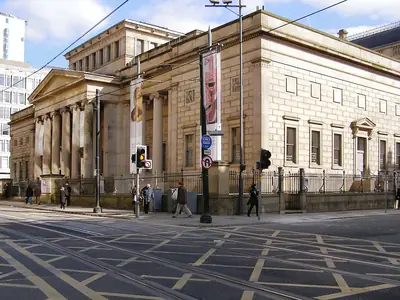
On Mosley Street, Manchester Art Gallery occupies three connected buildings. Its original premises were built for a learned society in the 1820s. Two of the buildings were designed by Sir Charles Barry, while the connecting structure was designed by Hopkins Architects and opened in 2002 after a major renovation and expansion.
Manchester Museum
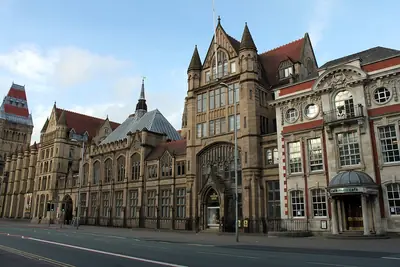
Manchester Museum stands on Oxford Road at the heart of the University of Manchester’s neo-Gothic campus. Its collections cover archaeology, anthropology and natural history from every continent. Owned by the university, it is the largest university museum in the United Kingdom.
Etihad Stadium
The Etihad Stadium is home to Premier League club Manchester City. With a capacity of around 61,000, it is one of the largest football stadiums in the country.
The stadium was originally built for the 2002 Commonwealth Games and converted into a football ground afterwards. Manchester City moved there in 2003 from Maine Road. Its cable-stayed roof is supported by twelve external masts and cables, a design that received awards from the Institution of Structural Engineers and the Royal Institute of British Architects.
Over the years, the stadium has hosted the 2008 UEFA Cup final, England football internationals, rugby league matches, a boxing world title fight and a pool match during the 2015 Rugby World Cup.
National Football Museum
Inside the Urbis building in the city centre, the National Football Museum preserves and displays important collections of football memorabilia. It is England’s national museum of football. The museum was originally based in Deepdale, Preston, before moving to Manchester in 2012.
Corn Exchange
The Corn Exchange in Exchange Square has changed both its name and purpose several times. Originally used for trading corn, it later became the Corn & Produce Exchange, The Triangle and a shopping centre. Following the 1996 IRA bomb attack on central Manchester, the Grade II listed building was renovated. Since 2014, it has been redeveloped as a collection of food outlets.
Castlefield and the River Irwell Railway Bridge
Castlefield is one of the most important places to explore Manchester’s industrial and transport history. Near Water Street, the River Irwell Railway Bridge was built in 1830 for the Liverpool & Manchester Railway. That railway was the world’s first passenger railway to run a scheduled service using only steam locomotives.
George Stephenson designed the stone bridge as part of Liverpool Road railway station. The line and bridge opened on 15 September 1830, although construction had been marked by the deaths of eleven workers who drowned in April of that year. The bridge was restored in 2016 during the project to build the Ordsall Chord and remains in use today.
Castlefield is also home to Castlefield Gallery, a contemporary visual arts space founded in 1984 by the Manchester Artists Studio Association. The gallery supports contemporary visual artists and is located on Hewitt Street in Knott Mill.
Manchester’s history and cultural identity
Manchester’s story extends beyond industry. The city became associated with workers’ rights, parliamentary reform and women’s political activism. The Peterloo Massacre of 1819 remains a defining event in the history of democratic representation, while the city’s connections with Alan Turing and its influential music scene add other dimensions to its identity.
The city’s historic architecture and cultural institutions make it possible to explore these stories on foot. The central area brings together medieval buildings, Victorian civic confidence, railway heritage, museums, theatres and spaces connected with Manchester’s radical past.
Explore Manchester with Neywo
Neywo offers a free Manchester audio guide with 168 narrated places. Its tours include four walks, one bus route and one bike route:
- Medieval Manchester: Cathedral, Pubs and the Exchange — 1.51 km, 90 minutes and 11 narrated stops.
- Peterloo, Suffragettes and Turing: Manchester’s Radical Heart — 2.88 km, 106 minutes and 11 narrated stops.
- Castlefield: Romans, Canals and the First Railway — 2.6 km, 90 minutes and 10 narrated stops.
- Oxford Road: Universities, Suffragettes and Mrs Gaskell — 4.19 km, 118 minutes and 11 narrated stops.
- Bus 197: Along Oxford Road to Elizabeth Gaskell’s House — 3.4 km, 15 minutes and 6 narrated stops.
- City Centre Cycle Lane: Castlefield to the Cathedral — 1.5 km, 8 minutes and 5 narrated stops.
The app tells the story of each place as you reach it, at your own pace, with no group and no schedule. Narration is available in 11 languages. Download Neywo and explore Manchester through its cathedral, railway heritage, museums, football landmarks and historic streets.
Places with an audio guide in Manchester
8 places in Manchester with a Neywo audio guide. Each one starts telling its story as you reach it.
Self-guided tours in Manchester
6 tours in Manchester, free in the Neywo app. Each stop tells its story as you reach it.
- Bike ride
City Centre Cycle Lane: Castlefield to the Cathedral
A short ride on the cycle lane that runs from Castlefield up Deansgate to the old cathedral quarter. Stop at the art gallery in the canal basin, the neo-Gothic John Rylands Library, St Ann's Church and the Cathedral.
HOME · Castlefield Gallery · John Rylands Library · St Ann's Church, Manchester · Manchester Cathedral
Open this tour: City Centre Cycle Lane: Castlefield to the Cathedral - Bus ride
Bus 197: Along Oxford Road to Elizabeth Gaskell's House
A regular city bus that leaves the centre past the Art Gallery and runs the length of Oxford Road, the university corridor. Ride it for Manchester Museum, the Jesuit church on Oxford Road and Elizabeth Gaskell's villa on Plymouth Grove.
Manchester Art Gallery · Palace Theatre · Dancehouse Theatre · Manchester Museum · Church of the Holy Name of Jesus, Manchester · Elizabeth Gaskell's House
Open this tour: Bus 197: Along Oxford Road to Elizabeth Gaskell's House - Walk
Medieval Manchester: Cathedral, Pubs and the Exchange
Manchester's oldest corner: the site of the medieval castle, a cathedral, a Tudor-era pub that survived the 1996 bomb, the cotton-trading Royal Exchange and the square that rose from the rubble. Add the football museum, the Corn Exchange and a Georgian church and a hidden Catholic shrine for good measure.
Sadler's Yard · Manchester Castle · National Football Museum · Corn Exchange · Manchester Cathedral · The Old Wellington Inn …
Open this tour: Medieval Manchester: Cathedral, Pubs and the Exchange - Walk
Peterloo, Suffragettes and Turing: Manchester's Radical Heart
Manchester's streets were battlefields for votes, rights and ideas. Start among the Victorian monuments of Piccadilly Gardens and Alan Turing's bench, pass the suffragette statue, the war memorial and the square where cavalry charged a peaceful crowd in 1819, then the Town Hall and a neo-Gothic library.
Queen Victoria Monument · Alan Turing Memorial · Manchester Art Gallery · Manchester Cenotaph · Statue of Emmeline Pankhurst · St Peter's Square …
Open this tour: Peterloo, Suffragettes and Turing: Manchester's Radical Heart - Walk
Castlefield: Romans, Canals and the First Railway
Where Manchester started: a reconstructed Roman fort, a canal basin ringed by railway viaducts, the world's first passenger railway station, the street that Coronation Street made famous, and the modern arts venues of Aviva Studios and HOME. Industrial history in one compact loop.
People's History Museum · Manchester Opera House · Coronation Street · The Factory · River Irwell Railway Bridge · Science and Industry Museum …
Open this tour: Castlefield: Romans, Canals and the First Railway - Walk
Oxford Road: Universities, Suffragettes and Mrs Gaskell
Manchester's learning mile: from the Palace Theatre along Oxford Road, past Barry's Gothic Revival chapel, the Victorian museum and art gallery of the university, the house where the Pankhursts founded the suffragettes, and the novelist Elizabeth Gaskell's villa, where Dickens and Bronte were guests.
Palace Theatre · Dancehouse Theatre · Upper Brook Street Chapel, Manchester · Manchester Museum · Stephen Joseph Studio · Church of the Holy Name of Jesus, Manchester …
Open this tour: Oxford Road: Universities, Suffragettes and Mrs Gaskell
Walk Manchester with Neywo
Neywo turns Manchester into a self-guided audio tour. Stories arrive as you reach the place they belong to, and the route reshapes when you wander off it.

