Visiting Girona, Spain: Top Sights on Foot
Things to Do in Girona: A Walk Through Medieval Streets, Museums and Riverside Views
Girona is a Catalan city shaped by Romanesque, Gothic and Baroque architecture, medieval Jewish heritage, historic fortifications and the colorful houses along the Onyar River. The compact old town brings many of the city’s most important sights close together, making Girona especially rewarding to explore on foot. Neywo has a free audio guide for Girona with 80 narrated places.
Part of Catalonia in northeastern Spain, Girona is a city to discover one layer at a time: from cathedral steps and ancient cloisters to museums, bridges and hilltop castles.
What to See in Girona
Girona Cathedral
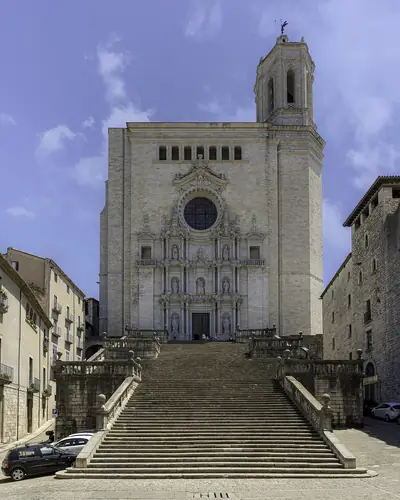
Girona Cathedral stands at one of the highest points in the city, reached by a broad Baroque staircase. Construction began in the eleventh century and continued through the eighteenth, leaving a building that combines Romanesque, Gothic and Baroque elements.
Its most striking feature is the single Gothic nave. At 22.98 metres wide, it is considered the widest Gothic nave in the world, and the widest nave of any style except that of Saint Peter’s Basilica in the Vatican. The Romanesque cloister and bell tower are among the oldest surviving parts, while the interior also contains stained glass, side chapels and a silver and gem-encrusted altarpiece.
The Jewish Quarter of Girona
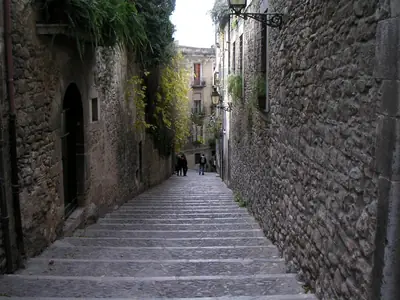
Known in Catalan as the Call, Girona’s Jewish Quarter preserves narrow lanes and stone stairways around Carrer de la Força. Jewish families are documented in Girona as early as 888, while the quarter became established in the twelfth century.
The community flourished from the twelfth to the fifteenth century, when merchants, craftsmen and scholars lived among the closely packed streets. At its height, the quarter was home to as many as eight hundred people. The expulsion of Spain’s Jewish population in 1492 brought this chapter to an abrupt end, but the medieval layout remains visible today.
The Museum of Jewish History occupies the Centre Bonastruc ça Porta, on the site where Girona’s synagogue and adjoining buildings stood in the fifteenth century. Its eleven rooms explore the life and traditions of Girona’s Jewish community.
Girona Museum of Art
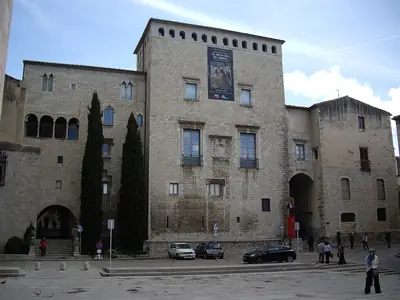
Beside the cathedral, the Girona Museum of Art occupies the former Episcopal Palace. Founded in 1976, it brought together collections from the Provincial Museum of Fine Arts and the Diocesan Museum of Girona.
The displays trace local art chronologically, from Romanesque and Gothic works through the Renaissance, Baroque, Realist, Modernist and Noucentista periods. The medieval collection includes the portable altar from Sant Pere de Rodes, altarpieces, carved wooden sculptures, panel paintings, Gothic silverwork and religious textiles. The palace itself adds another historical layer, with Romanesque foundations and Gothic and Baroque alterations.
Basilica of Sant Feliu
The Basilica of Sant Feliu is another prominent part of Girona’s historic skyline. Its inclusion among the city’s main historic sights makes it a natural stop while exploring the cathedral area and the old town.
Arab Baths of Girona
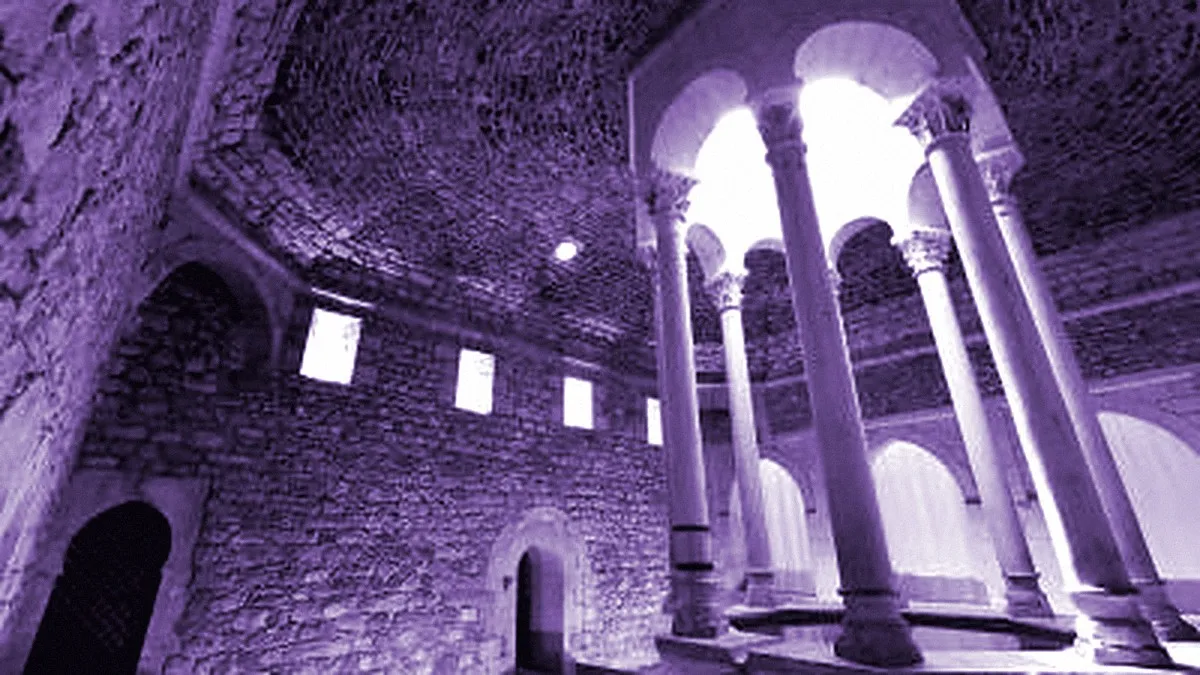
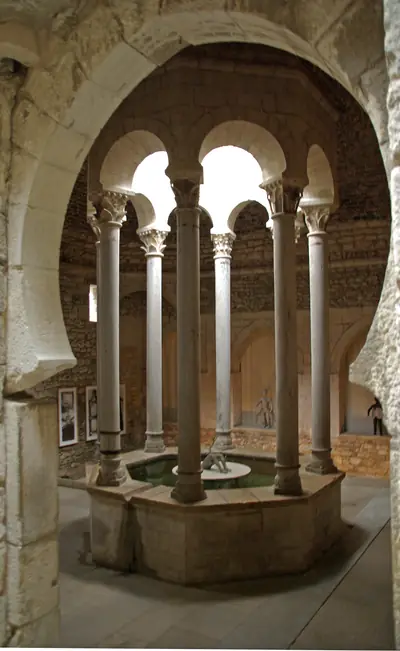
Despite their name, the Arab Baths of Girona are a Christian complex built in 1194 in the late Romanesque style. Their design combines Roman engineering with ideas borrowed from Islamic architecture.
The complex begins with the apodyterium, or dressing room, beneath an octagonal pool supported by slender columns. The rooms then move through different temperatures: the cold frigidarium, the tepidarium and the steam-filled caldarium. The hottest room was warmed by a hypocaust, an underfloor system that circulated heat beneath the stone.
The baths remained in use until the fifteenth century. They later became part of a Capuchin convent, where they served as a pantry and laundry. That practical reuse helped preserve the building.
Sant Pere de Galligants and the Archaeology Museum
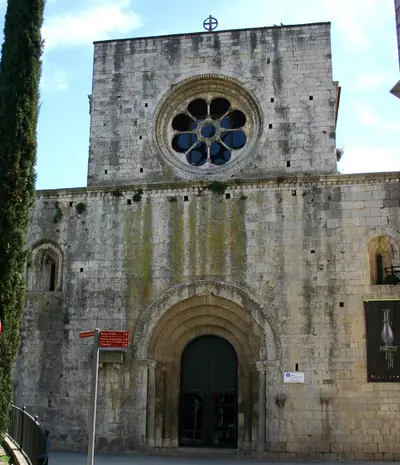
Sant Pere de Galligants is a former Benedictine abbey that now houses Girona’s Archaeology Museum of Catalonia. The monastery was first established in 992 outside Girona’s walls, and its Romanesque church was completed in 1130 with support from Ramon Berenguer the Great, Count of Barcelona.
Only the church and cloister remain. The church is distinguished by its octagonal bell tower and rose window, while the small cloister offers an intimate view of the monastery’s carved Romanesque stonework. The northern gallery dates from 1154, with the other galleries built in stages.
The museum’s archaeological collections focus on prehistory and ancient history in Catalonia, placing the former monastery in a broader regional context.
Cinema Museum in Girona
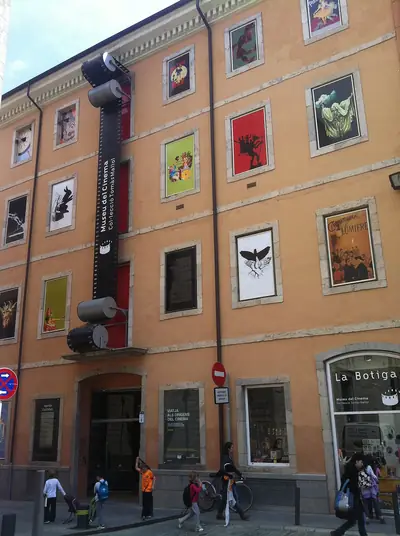
The Cinema Museum, or Museu del Cinema, is based on the Tomàs Mallol Collection. Girona City Council acquired the collection of pre-cinema and cinema objects in 1994, and the museum opened on April 8, 1998, as the first museum of its kind in Spain.
Its permanent exhibition follows 400 years of moving-image history, from early visual experiments to the development of cinematography in the late nineteenth century. Optical devices, shadow puppets, magic lanterns, early cameras, film reels, posters and other memorabilia show how images were projected and brought to life. Interactive exhibits explain the mechanics behind these inventions.
The Onyar River and Pont d’en Gómez
The colorful houses along the Onyar River form one of Girona’s most recognizable views. Several bridges offer different perspectives, including Pont d’en Gómez, a slender pedestrian crossing built in 1915.
The bridge is a single reinforced-concrete arch connecting the Sant Feliu side with Sant Agusti Square. It replaced an earlier wooden bridge and is also known as the Princess Bridge or the White Cross Bridge. Its best-known name comes from a homeowner who gave up part of their residence to make construction possible.
Pont d’en Gómez is part of the Architectural Heritage Inventory of Catalonia. It also has a slight bounce at its midpoint, an unusual detail that visitors can notice when they cross it.
Farinera Teixidor
On Santa Eugènia Street, Farinera Teixidor is one of Girona’s representative Modernist buildings. The architect Rafael Masó i Valentí designed it in 1910 as a combined industrial flour mill and residence for its owner.
The building is included in the Architectural Heritage Inventory of Catalonia, reflecting its importance within Girona’s architectural heritage.
Castell de Montjuïc
At 219 metres above sea level, Castell de Montjuïc occupies the highest point of Montjuïc and looks over Girona. Philip the Fourth ordered the seventeenth-century fortress in 1653 to protect the northern approaches to the plain of Girona. It was completed in 1675.
The defensive system also included four additional towers: Sant Joan, Sant Daniel, Sant Narcís and Sant Lluís. The site later acquired a different social history, as informal settlements linked to immigrant communities grew around the castle during the 1950s and 1960s. Today, the building is abandoned and has no specific function.
Castell de Sant Miquel
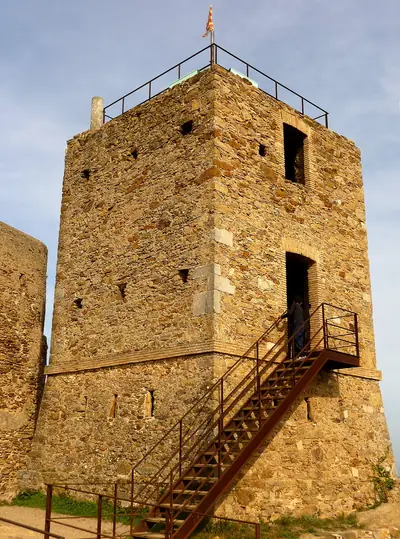
Castell de Sant Miquel stands at 385 metres above sea level on Sant Miquel mountain, on the boundary between Girona and Celrà. Its elevated position allowed the site to control wide stretches of the surrounding territory.
The complex includes a moat, the hermitage of Sant Miquel Arcàngel and a square-based tower. It has been adapted repeatedly during the medieval, modern and contemporary periods, as its needs changed over time.
CaixaForum Girona
CaixaForum Girona occupies La Fontana d’Or, a thirteenth-century palace in the historic quarter. Its preserved features include a ground-floor portico, an inner courtyard and distinctive triforium windows.
The site was built over the remains of a mill recorded as early as 1078. It later belonged to the Sitjar family, became an inn in the eighteenth century and eventually hosted civic and cultural institutions. After restoration, it reopened as a cultural venue in 1973. Today’s CaixaForum Girona officially opened in spring 2011.
Explore Girona with Neywo
A Girona self-guided walking tour lets you follow the city’s history without joining a group or following a fixed schedule. Neywo’s free audio guide includes four walks, one bus route and one bike route, with narration available in 11 languages.
The available routes are:
- Ninety-One Steps to the Widest Gothic Nave — 1.22 km, 64 minutes and 9 narrated stops.
- Roman Walls, Romanesque Cloisters and a Medieval Bath — 0.82 km, 51 minutes and 8 narrated stops.
- The Colourful Houses on the Onyar — 1.87 km, 78 minutes and 11 narrated stops.
- Walls, Hills and a Monastery of Nuns — 3.09 km, 68 minutes and 5 narrated stops.
- Bus L11: Museums, the Onyar Bridges and Sant Daniel Monastery — 12.3 km, 53 minutes and 10 narrated stops.
- Devesa Park by Bike: Plane Trees, Modernist Mill and the Onyar — 1.1 km, 6 minutes and 4 narrated stops.
Download Neywo and explore Girona at your own pace. The app tells the story of each place as you reach it, with no group and no schedule, so you can pause, look around and continue whenever you are ready.
Places with an audio guide in Girona
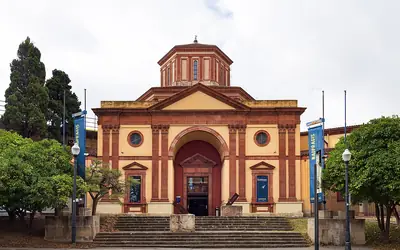
8 places in Girona with a Neywo audio guide. Each one starts telling its story as you reach it.
Self-guided tours in Girona
6 tours in Girona, free in the Neywo app. Each stop tells its story as you reach it.
- Bike ride
Devesa Park by Bike: Plane Trees, Modernist Mill and the Onyar
A relaxed ride through Girona's largest park, between the Ter, the Onyar and the Guell rivers. Start at Rafael Maso's modernist flour mill, cross the park under more than 2,500 plane trees and finish at the minimalist footbridge that links the park to the old town.
Farinera Teixidor · Escultura per a Europa · Parc de la Devesa · Sant Feliu Pedestrian Bridge
Open this tour: Devesa Park by Bike: Plane Trees, Modernist Mill and the Onyar - Bus ride
Bus L11: Museums, the Onyar Bridges and Sant Daniel Monastery
Girona's city line L11 runs from the red Eiffel bridge across the old town edge and out to the Benedictine monastery of Sant Daniel. Ride it past the Cinema Museum, the Jewish History Museum and the Romanesque abbey of Sant Pere de Galligants, then get off in the valley where nuns have lived since 1015.
Pont Palanques Vermelles · Cinema Museum in Girona · Museu d'Art de Girona - Farmàcia de L'Hospital Santa Caterina · Sagrat Cor de Girona · Església del Carme i edifici de la Diputació · Museo de Historia de los Judíos …
Open this tour: Bus L11: Museums, the Onyar Bridges and Sant Daniel Monastery - Walk
Ninety-One Steps to the Widest Gothic Nave
Climb the Baroque staircase that stood in for the Great Sept of Baelor, then stand under the widest Gothic nave in the world. Along the way you meet the lioness whose rear you are supposed to kiss, a basilica older than the cathedral, the bishop's palace turned art museum, the medieval Jewish quarter and a Dominican convent still used by the university.
Cul de la Lleona · Basilica of St. Felix (Girona) · Plaça de la Catedral de Girona · Girona Cathedral · Plaça dels Apòstols (Girona) · Girona Museum of Art …
Open this tour: Ninety-One Steps to the Widest Gothic Nave - Walk
Roman Walls, Romanesque Cloisters and a Medieval Bath
Girona's oldest layers sit within a few minutes of each other. Visit a Benedictine abbey with lions and sirens carved on its cloister, a tiny Romanesque chapel, the Christian baths from 1194 that were later named Arab, the museum of the city's history and the Roman tower at the top of the old walls.
Museu d'Història de la Ciutat · Arab Baths of Girona · Casa de l'Abat · Sant Nicolau de Girona · Plaça de Sant Pere · Sant Pere de Galligants …
Open this tour: Roman Walls, Romanesque Cloisters and a Medieval Bath - Walk
The Colourful Houses on the Onyar
Walk from the plane-tree avenues of Devesa Park to the river that gives Girona its postcard view. Cross the bouncing Pont d'en Gomez and Eiffel's red iron bridge, step into Rafael Maso's birthplace, find the smallest square in Europe, rest under the arcades of Placa de la Independencia and finish in the squares by the old mills.
Parc de la Devesa · Sant Feliu Pedestrian Bridge · Pont d'en Gómez · Casa Masó · Plaça de la Independència (Girona) · Plaça dels Raïms …
Open this tour: The Colourful Houses on the Onyar - Walk
Walls, Hills and a Monastery of Nuns
Climb from the ruined Roman tower of Gironella to the seventeenth-century fortress on Montjuic, then drop into the valley of Sant Daniel, where Benedictine nuns have lived since 1015. A short, green walk away from the crowds, with views over the whole old town.
Torre Gironella · Castell de Montjuïc · Monastery of Sant Daniel · Plaça de les Sardanes · Capella del Calvari
Open this tour: Walls, Hills and a Monastery of Nuns
Walk Girona with Neywo
Neywo turns Girona into a self-guided audio tour. Stories arrive as you reach the place they belong to, and the route reshapes when you wander off it.

