What to See in Toledo, Spain: Free Audio Guide
Things to Do in Toledo, Spain: What to See in the City of Three Cultures
The best things to do in Toledo are concentrated in a remarkable historic center shaped by Christian, Islamic and Jewish heritage. Gothic cathedrals, Mudéjar monuments, former synagogues, medieval fortifications and El Greco’s legacy all appear within Toledo’s hilltop streets. Neywo has a free audio guide for Toledo with 44 narrated places.
What to See in Toledo
Toledo Cathedral
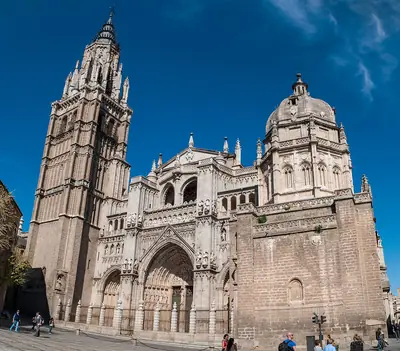
Toledo Cathedral, also known as the Cathedral of Santa María, is one of Spain’s great Gothic landmarks and remains an important center of religious life. Construction began in 1226 under Ferdinand III, while the final Gothic contributions were added in the 15th century; the vaults of the central nave were completed in 1493.
The cathedral is built from white limestone from the quarries of Olihuelas, near Toledo. Its five-nave plan was designed to cover the sacred space of the former city mosque and its sahn. Mudéjar details in the cloister and multifoiled arches in the triforium add to the building’s mixture of styles.
Alcázar of Toledo
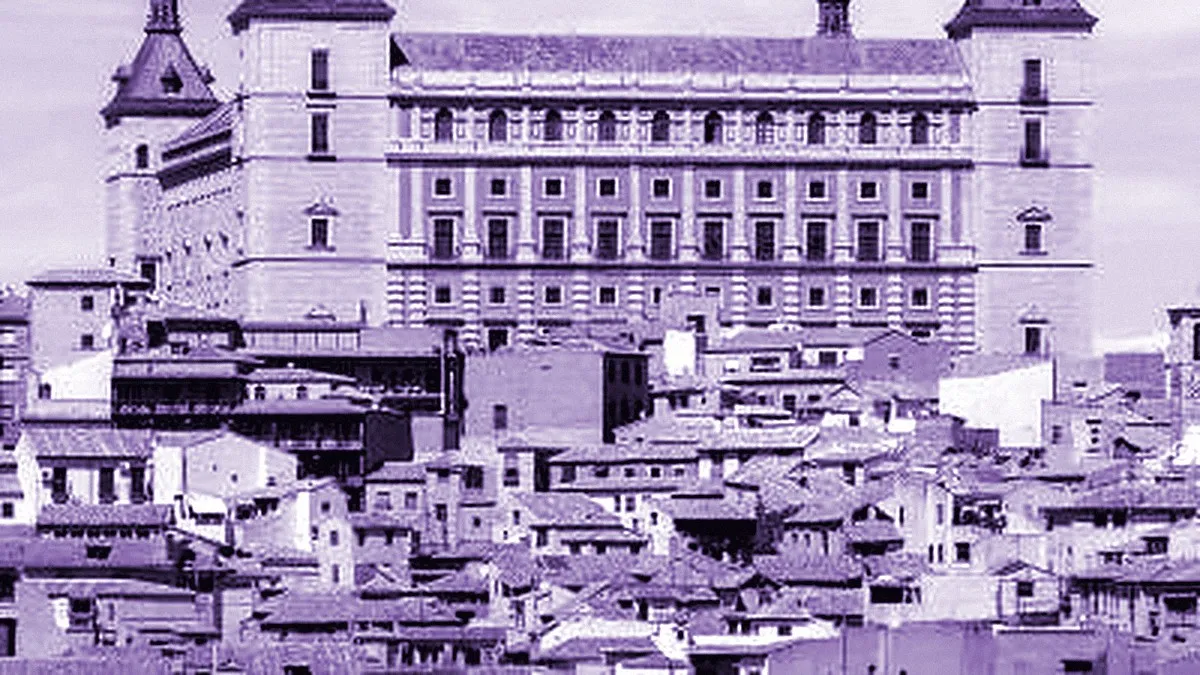
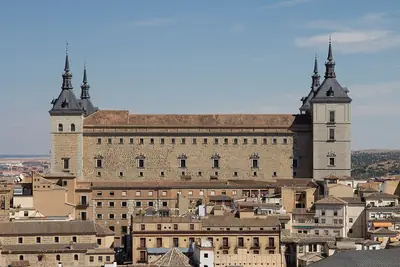
High above the city, the Alcázar of Toledo is a large quadrangular fortress measuring 60 metres on each side, with four towers that rise 60 metres and end in slate spires. Its name comes from the Arabic Al Qasar, meaning “fortress”.
The site was used as a Roman palace in the 3rd century and was restored in the 1540s under Carlos I and Felipe II. Hernán Cortés was received here by Carlos I in July 1528 after the conquest of the Aztec Empire. Much of the present building was rebuilt or restored between 1939 and 1957 after the siege of the Alcázar. It now houses the Army Museum and the Library of Castilla-La Mancha.
Castillo de San Servando
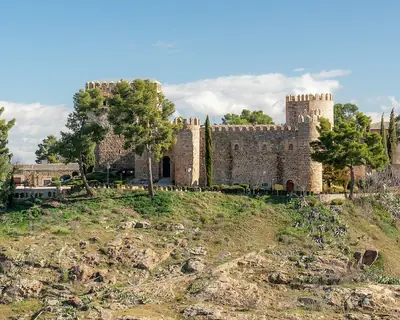
Castillo de San Servando began as a monastery before later becoming a fortress and being occupied by the Knights Templar. Its history may reach back to an even older monastery attached to a basilica possibly founded in the 7th century.
After Alfonso VI of Castile conquered Toledo in 1085, he and Constance of Burgundy became benefactors of the basilica and rebuilt the monastery. The castle was named a national monument in 1874, and it also appears in El Greco’s View of Toledo.
Mosque of Cristo de la Luz
The Mosque of Cristo de la Luz is a small but exceptionally layered monument. Built in 999, during the height of the Caliphate of Córdoba, it served as a place of worship beside the city gate of Bab al-Mardum. Its entrance façade includes an inscription band referring to that period.
After the Christian reconquest, an apse was added in the 12th century. Alfonso VI ceded the building to the Knights of the Order of San Juan, who established a chapel there. This Christian expansion is considered the oldest documented example of Mudéjar art.
Puerta del Sol
Puerta del Sol is a medieval fortified gate built in the late 13th or early 14th century by the Knights Hospitaller. It is a notable example of Mudéjar military architecture, combining Romanesque and Islamic elements.
Above the arch, a medallion depicts the ordination of Ildephonsus of Toledo, receiving his cassock beneath the sun and moon. The gate’s name also relates to its eastern orientation, facing the rising sun. Horseshoe arches, blind multifoil arches and decorative brick patterns give the façade its distinctive appearance.
Puerta de Alcántara
On the eastern side of Toledo’s walls, Puerta de Alcántara provides access to the historic center. The gate has Arab-period origins and dates from around the 10th century, although it was later modified during the Christian era.
Its passage bends between two square towers and includes a horseshoe arch. Crenellations and arrow slits on the towers and sides reveal the defensive role it played during the Middle Ages, when it was the main entry point for people and goods.
Synagogue of Santa María la Blanca
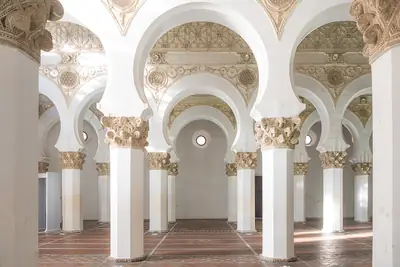
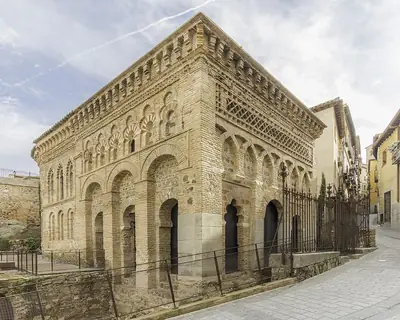
Originally constructed as a Jewish synagogue in 1180, Santa María la Blanca functioned as a synagogue for 211 years before being expropriated and transformed into a Christian church after the pogrom of 1391. It is now preserved as a public museum.
The building is an important example of Mudéjar architecture created by Jews under the Christian Kingdom of Castile. Horseshoe arches, geometric stuccowork and brick patterns give the interior the character of an Islamic sanctuary. Rows of whitewashed octagonal columns carry capitals that combine Islamic, Corinthian and Byzantine motifs, while the prayer hall is divided into nine bays around a central eight-pointed star vault.
Monasterio de San Juan de los Reyes
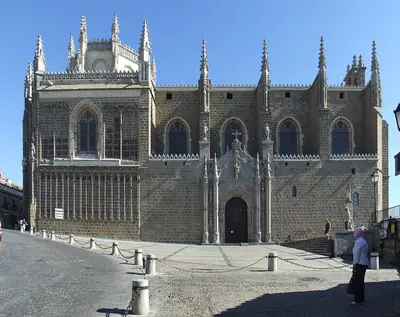
The Monasterio de San Juan de los Reyes is an Isabelline-style Franciscan monastery commissioned under the patronage of Queen Isabel I of Castile. It was planned as a royal mausoleum commemorating the Battle of Toro and the birth of Prince Juan.
The Gothic church has a Latin-cross plan, three naves, side chapels and a polygonal chancel. Star-shaped ribbed vaults cover the interior, while the cloisters combine Gothic verticality with carvings of saints, plants and mythical beasts. Later additions include a Renaissance altarpiece by Felipe Bigarny and paintings of the Passion and Resurrection.
Museo Sefardí
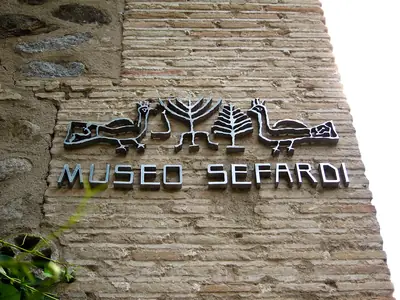
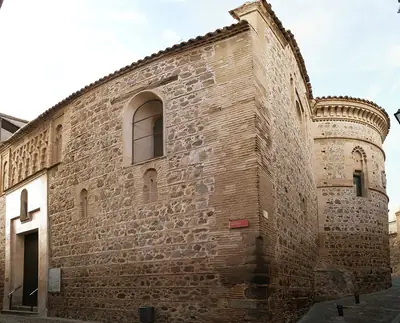
The Sephardic Museum, or Museo Sefardí, focuses on Jewish cultural heritage in Spain and the history of the Sephardim, the descendants of Jews who lived on the Iberian Peninsula until 1492. It occupies the former convent of the Knights of Calatrava and is annexed to the Synagogue of El Tránsito.
In 1964, the synagogue of El Tránsito, also known as the Synagogue of Samuel ha-Levi, was selected as the site of the museum.
El Greco Museum
The El Greco Museum brings together the painter’s work and objects connected with the world in which he lived. It was inaugurated in the early 20th century as a house-museum, but El Greco never actually lived in the building.
The Marquis of Vega-Inclán purchased several houses in Toledo’s former Jewish quarter and, with architect Eladio Laredo, transformed them into a reconstruction of a 16th- and 17th-century residence. The museum contains more than 3,000 objects, including Talavera de la Reina ceramics, antique furnishings and decorated Moorish-style wooden ceilings.
Among its most important works is a series of thirteen portraits of Christ and the Apostles, painted between 1610 and 1614. Visitors can also see The Tears of Saint Peter and View and Plan of Toledo.
Church of Santo Tomé
The Church of Santo Tomé was built on the site of an older mosque, which was consecrated as a Christian church after Alfonso VI reconquered Toledo. By the beginning of the 14th century, the building was in poor condition and was completely rebuilt under Gonzalo Ruiz de Toledo, Lord of Orgaz.
The former minaret became a Mudéjar bell tower, with brick patterns and horseshoe arches that preserve the site’s Islamic architectural memory. Inside, the church follows a Latin-cross plan with three naves, a barrel vault and a polygonal apse. Its side chapels contain ornate Baroque altarpieces.
Church of El Salvador
The Church of El Salvador, also known as the Mezquita-Iglesia de El Salvador, was completed in 1159 on a site with four successive religious constructions. These include a 9th-century Visigothic building, an 11th-century Taifa mosque and the 12th-century Christian church.
The building still faces southeast, towards Mecca, reflecting its former function as a mosque. A Visigothic pilaster from the end of the 6th or beginning of the 7th century is one of its most important surviving elements.
Convent of Santa Úrsula
The Convent of Santa Úrsula began in 1259 as a beaterio under the rule of San Agustín. Donations gradually expanded the complex, whose dependencies are arranged around two patios.
Its church is believed to have replaced an earlier building in 1360. The medieval Mudéjar apse is particularly notable for its taped masonry and three windows, each formed by a pointed horseshoe arch sheltered by a lobed arch.
Palacio de Fuensalida
The Palacio de Fuensalida is an example of Toledan Mudéjar, combining Gothic, Plateresque and Mudéjar elements. Pedro López de Ayala, the first lord of Fuensalida, commissioned it in 1440.
The palace forms part of the block around the Plaza del Conde, together with the Taller del Moro and the Church of Santo Tomé. Charles V lived here while the Alcázar was being completed, and Philip II spent part of his childhood in the palace with his mother, the Empress. A sculpture by Pompeo Leoni depicting Isabel of Portugal presides over the courtyard.
Explore Toledo with a Self-Guided Audio Tour
Neywo offers four walking tours and one bus route in Toledo, with 44 narrated places in total:
- Cathedral and the Jewish quarter: 1.11 km, 95 minutes and 12 stops.
- Alcázar, Zocodover and the Mosque of Cristo de la Luz: 1.79 km, 90 minutes and 12 stops.
- The Tagus gorge, bridges, synagogues and San Juan de los Reyes: 1.85 km, 62 minutes and 7 stops.
- The ultimate Toledo, covering the three faiths in one afternoon: 2.72 km, 123 minutes and 10 stops.
- Bus line 12, the old-town loop from Plaza del Conde to the Cornisa: 4.4 km, 19 minutes and 7 stops.
Download Neywo and explore Toledo at your own pace. The app tells the story of each place as you reach it, with no group and no schedule. Narration is available in 11 languages, making it a practical way to discover the city’s cathedral, fortresses, mosques, synagogues and museums independently.
To continue exploring Spain, browse the Spain destination page or plan time in Madrid.
Places with an audio guide in Toledo
8 places in Toledo with a Neywo audio guide. Each one starts telling its story as you reach it.
Self-guided tours in Toledo
5 tours in Toledo, free in the Neywo app. Each stop tells its story as you reach it.
- Bus ride
Line 12: the old town loop from Plaza del Conde to the Cornisa
Toledo's small local bus threads the narrow streets of the old town on a ride of about six kilometres. It starts beside the El Greco Museum and the synagogue of Santa Maria la Blanca, passes the Cambron gate, the mosque of Cristo de la Luz and the Santa Cruz museum, and climbs to the Alcazar. A cheap way to see the three cultures of Toledo without climbing every hill.
El Greco Museum · Synagogue of Santa María la Blanca · Puerta del Cambrón · Church of St James, Toledo · Mosque of Cristo de la Luz · Museum of Santa Cruz …
Open this tour: Line 12: the old town loop from Plaza del Conde to the Cornisa - Walk
Toledo's cathedral and the Jewish quarter
The dense upper town: a cathedral that took 250 years, the mansions and convents packed around it, and the descent west into the Juderia, where the synagogue museum and El Greco's house sit a few doors apart.
Toledo Cathedral · Monstrance of the Cathedral of Toledo · City Hall of Toledo · Convent of Santa Úrsula · Church of El Salvador · Palacio de Fuensalida …
Open this tour: Toledo's cathedral and the Jewish quarter - Walk
Alcazar, Zocodover and the mosque of Cristo de la Luz
Toledo's eastern half, from the fortress that crowns the hill down to the market square, then out through the Moorish gate to a tenth-century mosque that survived because it became a church.
Convento de San Pedro Mártir · Church of San Ildefonso, Toledo · Cueva de Hércules · Mezquita de las Tornerías · Alcázar of Toledo · Plaza de Zocodover, Toledo …
Open this tour: Alcazar, Zocodover and the mosque of Cristo de la Luz - Walk
The Tagus gorge: bridges, synagogues and San Juan de los Reyes
The long way round the west side. Cross the San Martin bridge for the view painters keep coming back for, then work uphill past Santa Maria la Blanca and the Catholic Monarchs' own monastery to the Bisagra gate.
Monastery of Saint Dominic of Silos · Jewish quarter of Toledo · Real Fundación de Toledo - Museo Victorio Macho · San Martín bridge · Monasterio de San Juan de los Reyes · Puerta del Cambrón …
Open this tour: The Tagus gorge: bridges, synagogues and San Juan de los Reyes - Walk
The Ultimate Toledo: three faiths in one afternoon
A single walk through the city's Jewish, Muslim and Christian monuments — synagogue, mosque, cathedral, royal monastery and fortress — which is the whole point of Toledo and takes barely three kilometres.
Monasterio de San Juan de los Reyes · Synagogue of Santa María la Blanca · Museo Sefardí · El Greco Museum · Palacio de Fuensalida · Convent of Santa Úrsula …
Open this tour: The Ultimate Toledo: three faiths in one afternoon
Walk Toledo with Neywo
Neywo turns Toledo into a self-guided audio tour. Stories arrive as you reach the place they belong to, and the route reshapes when you wander off it.

