Leipzig, Germany: Self-Guided Walking Tour
Things to Do in Leipzig: What to See in the Saxon City
The best things to do in Leipzig include exploring its historic market square, following Johann Sebastian Bach’s legacy, and discovering churches, merchants’ houses, museums, and former trade-fair buildings. The city combines a richly layered past with distinctive architecture, from Romanesque and Baroque landmarks to Gothic Revival and historicist churches. Neywo offers a free audio guide for Leipzig with 146 narrated places.
Leipzig is the largest city in Saxony, in eastern Germany, and its sights are easy to approach as part of a self-guided visit. The city’s history appears in its churches, commercial buildings, cultural institutions, and neighborhoods beyond the central Old Town.
What to see in Leipzig
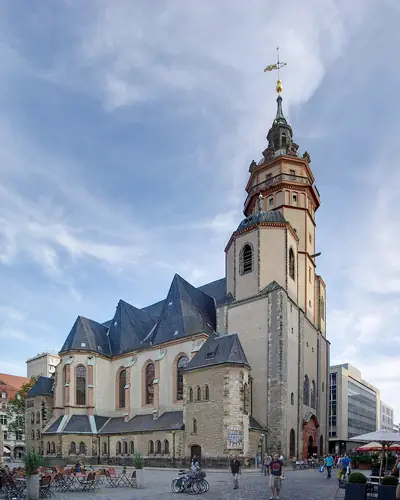
St. Nicholas Church
St. Nicholas Church, or Nikolaikirche, is one of central Leipzig’s most important churches. Construction began in 1165 in the Romanesque style, while the building later became a Gothic hall church. Baroque additions followed in the 18th century, including the tower, and the interior was redesigned in the Neoclassical style in the late 18th century.
Inside, a semicircular apse and barrel vault are framed by slender Egyptian-style columns with palm-shaped capitals. The pale green and dusty rose color scheme gives the interior a distinctive appearance. The church is also closely associated with Bach: several of his works premiered here, including four performances of his Passion of Saint John in 1724, 1728, 1732, and 1749.
St. Nicholas Church is also an important place in Leipzig’s modern history. Monday demonstrations held here in 1989 helped challenge the East German regime.
Königshaus
On the south side of Leipzig Market stands the Königshaus, a culturally significant town house originally built around 1560. It was extensively rebuilt in the Baroque style in 1706 and 1707 while retaining parts of the older structure.
The building was initially known as Apelsches Haus or Apels Haus after its owner, the merchant Andreas Dietrich Apel. Its current name dates from its conversion into a commercial building in 1904. It recalls August the Strong, Elector of Saxony and King of Poland, who stayed at the house during his visits to Leipzig.
Old Stock Exchange
The Old Stock Exchange, known in German as the Alte Handelsbörse, is Leipzig’s oldest assembly building for the merchant community and the city’s oldest Baroque structure. Built in 1678, it provided a neutral place where merchants could conduct business.
The upper floor contained the Börsensaal, used for auctions, balls, and other events, while merchant offices occupied the ground floor. The building burned down completely in 1943 during the Second World War. Its exterior was later restored between 1955 and 1962.
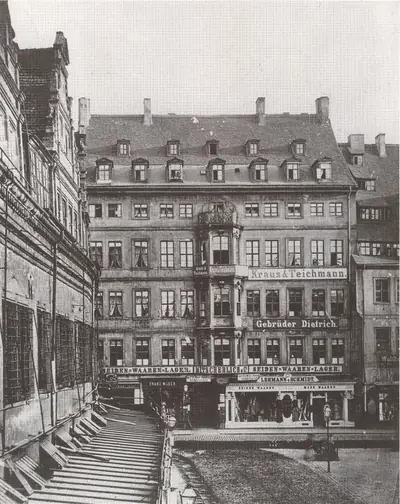
Fregehaus
Fregehaus is a Baroque merchant’s house on Katharinenstraße and a protected historic monument. Although its origins date to around 1535, the building took its current Baroque form between 1706 and 1707.
Its symmetrical façade includes a decorative bay window, while the steep roof has 16 dormer windows arranged in four rows. Christian Gottlob Frege II bought the house in 1782 and established his trading and banking business there. The Frege family’s banking business continued at the building until 1945.
Handelshof Leipzig
Handelshof Leipzig, or the Trading Court, is a former trade-fair house in the city center. The building occupies a complete block between Naschmarkt, Grimmaische Straße, Reichsstraße, and Salzgäßchen. It is now used mostly as a hotel, but its scale reflects Leipzig’s long history as a trade-fair city.
Bach-Museum Leipzig
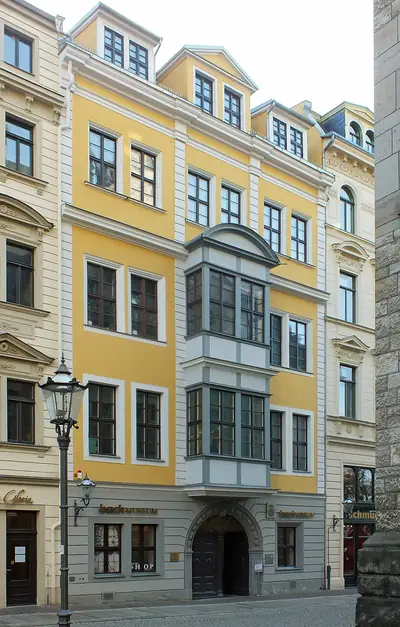
The Bach-Museum Leipzig occupies the historic Bosehaus at Thomaskirchhof, beside St. Thomas Church. The Bosehaus was built in 1710 and 1711 as the Baroque residence of the Bose family, affluent merchants and close friends of the Bachs. Johann Sebastian Bach knew the house, making it a fitting location for a museum devoted to his life and work.
The museum forms part of the Bach Archive and presents a permanent interactive multimedia exhibition. The Bosehaus was restored between 2008 and 2010 and reopened on 20 March 2010. Its location connects the museum directly with the places associated with Bach in Leipzig.
St. Peter
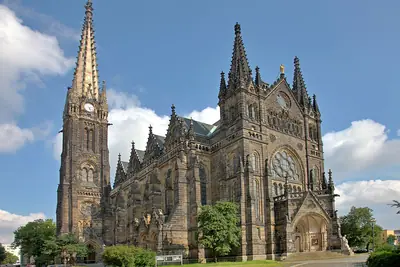
St. Peter’s Church is both a place of worship and a concert and event venue in the city center. Its 87-metre tower is the tallest church tower in Leipzig.
The present building was constructed from 1882 onward in the Gothic Revival style, based on plans by August Hartel and Constantin Lipsius. It was consecrated on 27 December 1885. The richly decorated exterior includes stained-glass windows and a large western portal.
Reformierte Kirche
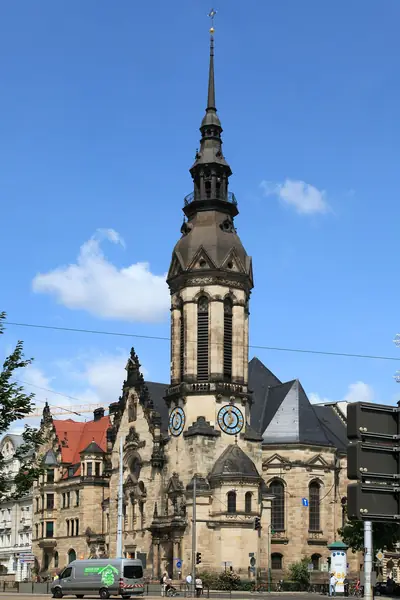
The Reformierte Kirche on Tröndlingring is notable for combining a church and rectory in one building. Designed by Gerhard Weidenbach and Richard Tschammer in a neo-Renaissance style, the complex was built between 1896 and 1899.
This unified design was considered pioneering at the time, since churches were traditionally built as standalone structures. The project won first prize at the Paris World Exhibition in 1899. Its 67-metre tower and façade of bay windows, canopies, balustrades, and balconies make it a distinctive landmark north of the historic center.
Michaeliskirche
Michaeliskirche was built between 1901 and 1904 to serve Leipzig’s rapidly growing northern suburb. The Protestant church was designed by Heinrich Rust and Alfred Müller and consecrated on 12 June 1904.
Its cross-shaped nave is surrounded by chapels on the choir side, while the 70-metre tower is one of the tallest in Leipzig. The sandstone façade combines Renaissance, neo-Gothic, neo-Baroque, and Art Nouveau elements. The church survived the destruction of the Second World War with minimal damage, losing only some windows and its bronze bells.
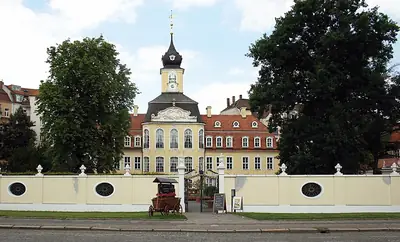
Gohliser Schlösschen
Gohliser Schlösschen is a well-preserved Rococo country house in the Gohlis borough. Built as a representative bourgeois country house, it is also regarded as an excellent example of Saxon Baroque architecture.
The palace stands in the garden setting of Musenhof am Rosental, with a fountain and statues. Since the late 18th century, it has hosted cultural events including theatre, opera, and cinema. Its interior includes paintings by the Leipzig painter and sculptor Friedrich Oeser, particularly in the ballroom. The city of Leipzig has owned the palace since 1906.
Taborkirche
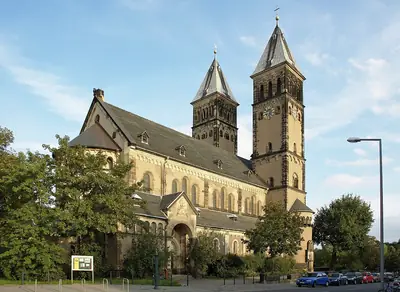
Taborkirche in Kleinzschocher has a feature found nowhere else in Leipzig: a double-tower façade. The church was built between 1902 and 1904 as a replacement for the former village church.
Designed in the neo-Romanesque style, the building has two south-facing towers, each rising to 52 metres. The main entrance is set in the south gable and framed by two smaller side portals. The nave roof was renewed in the 1990s, and the towers have been illuminated at night since 2008.
Natural History Museum Leipzig
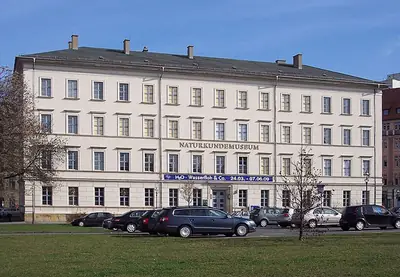
The Natural History Museum Leipzig, known locally as “Das Haus mit der Spinne,” brings together collections covering geology and paleontology, botany, zoology, and archaeology. It is especially known for its collection of animal specimens and models prepared by Herman H. ter Meer.
The museum also preserves photographic documents recording the development of Saxony’s natural life and landscapes since the late 19th century. In 2014 and again in 2020, Leipzig’s city council decided that the museum would be established in the former Bowling Club.
Dominikanerkloster St. Albert
Dominikanerkloster St. Albert is a Dominican convent with an important wartime history. Between 1942 and 1945, its Superior, Aurelius Arkenau, hid deserters, Jews, communists, and forced laborers in the convent and rectory. He also arranged medical assistance and false passports.
On 5 August 1999, Israel’s ambassador at the time, Avi Primor, posthumously awarded Aurelius Arkenau the title “Righteous Among the Nations.”
Explore Leipzig with a self-guided audio guide
Neywo’s Leipzig audio guide includes 8 walking tours, 1 bus route, and 1 bike route, with 146 narrated places in total. The walks range from 0.62 to 4.5 km and from 71 to 142 minutes, with 8 to 15 narrated stops per route.
The routes cover the city’s central landmarks and neighborhoods:
- St Nicholas, the Old City Hall and the trade-fair arcades: 0.62 km, 110 minutes, 12 stops.
- Bach’s Leipzig: St Thomas and the Bose House: 0.74 km, 111 minutes, 12 stops.
- The Round Corner and the Museum of Fine Arts: 1.78 km, 114 minutes, 12 stops.
- The Ring: the Gewandhaus and the Moritzbastei: 1.23 km, 104 minutes, 12 stops.
- Gohlis: the Schlösschen and the northern villas: 4.5 km, 132 minutes, 8 stops.
- Mädlerpassage, Auerbach’s Keller and the university: 1.1 km, 98 minutes, 12 stops.
- Augustusplatz, the Opera and the Hauptbahnhof: 1.29 km, 71 minutes, 8 stops.
- A second St Nicholas, the Old City Hall and the trade-fair arcades walk: 0.96 km, 142 minutes, 15 stops.
- Bus 89: From Connewitz Through the Old Town to the Hauptbahnhof: 5.9 km, 25 minutes, 9 stops.
- Leipzig Cycle Lanes: Monument of the Battle of the Nations to the Opera House and Station: 7.7 km, 38 minutes, 5 stops.
Download Neywo and explore Leipzig at your own pace. The app tells the story of each place as you reach it, with no group and no schedule. Narration is available in 11 languages.
Places with an audio guide in Leipzig
8 places in Leipzig with a Neywo audio guide. Each one starts telling its story as you reach it.
Self-guided tours in Leipzig
11 tours in Leipzig, free in the Neywo app. Each stop tells its story as you reach it.
- Bike ride
Leipzig Cycle Lanes: Monument of the Battle of the Nations to the Opera House and Station
Ride Leipzig's cycle lanes from the Monument to the Battle of the Nations in the south, past the Museum of Musical Instruments and the Opera House on Augustusplatz, to the Hauptbahnhof and on to Eutritzsch in the north.
Völkerschlachtdenkmal · Museum of Musical Instruments of the University of Leipzig · Leipzig Opera House · Hauptbahnhof · Christuskirche (Eutritzsch)
Open this tour: Leipzig Cycle Lanes: Monument of the Battle of the Nations to the Opera House and Station - Bike ride
Karl-Heine canal · Zentrum to Plagwitz by bike
5 narrated places along the way: Luisenbrücke, Kunstkraftwerk, Gleisbrücke P I, St. Philip's Church, King John's bridge.
Luisenbrücke · Kunstkraftwerk · Gleisbrücke P I · St. Philip's Church · King John's bridge
Open this tour: Karl-Heine canal · Zentrum to Plagwitz by bike - Bus ride
Bus 89: From Connewitz Through the Old Town to the Hauptbahnhof
A short city bus ride from Connewitz north along Leipzig's inner ring and through the old town to the main station. It passes the New Town Hall, St Thomas Church, the Königshaus and Specks Hof around the Markt, the Museum of City History and the railway monument beside the Hauptbahnhof.
Südbrause · University of Music and Theatre Leipzig · Neues Rathaus · St. Thomas Church · Königshaus · Specks Hof …
Open this tour: Bus 89: From Connewitz Through the Old Town to the Hauptbahnhof - Bus ride
Bus 89 · Hauptbahnhof through the old centre
Board at Hauptbahnhof, Goethestraße, alight at Wächterstraße. 7 narrated places along the way: Eisenbahndenkmal, Specks Hof, Königshaus, St. Thomas Church, Old Bach-monument Leipzig, Neues Rathaus, Galerie für Zeitgenössische Kunst.
Eisenbahndenkmal · Specks Hof · Königshaus · St. Thomas Church · Old Bach-monument Leipzig · Neues Rathaus …
Open this tour: Bus 89 · Hauptbahnhof through the old centre - Walk
Bach's Leipzig: St Thomas and the Bose House
Seven hundred metres around the church where Bach was cantor for 27 years and is now buried, with the Bach Museum in the Bose family house opposite and the Coffe Baum, serving since 1711, on the way.
Plato-Dolz-Denkmal · Old Bach-monument Leipzig · Bosehaus · Burgstraße 4 · New Bach monument · St. Thomas Church …
Open this tour: Bach's Leipzig: St Thomas and the Bose House - Walk
The Round Corner and the Museum of Fine Arts
North-west of the centre: the Stasi district headquarters kept as a museum with its files and letter-steaming machines intact, the natural history museum, and the glass cube of the fine arts museum.
Mendelssohn-Denkmal · Thomaskirche · Schauspiel Leipzig · Gedenkstätte Museum in der "Runden Ecke" · Richard-Wagner-Denkmal · Hahnemann-Denkmal …
Open this tour: The Round Corner and the Museum of Fine Arts - Walk
The Ring: the Gewandhaus and the Moritzbastei
Round the boulevard that replaced the walls, past the composers' monuments, to the Gewandhaus concert hall and the Moritzbastei — the last surviving bastion, dug out by student volunteers and now a music venue.
Rathausbrunnen · Merkurhaus · Klingerhaus · Schiller-Denkmal · Krystallpalast Varieté Leipzig · Gellert memorial …
Open this tour: The Ring: the Gewandhaus and the Moritzbastei - Walk
Gohlis: the Schlösschen and the northern villas
Four and a half kilometres out through the villa quarter to the Gohliser Schlösschen, a 1756 rococo summer house where Schiller wrote part of the Ode to Joy nearby.
Käthe-Kollwitz-Straße 115 (Leipzig) · Julburg · Haus Pommer · German Central Library for the Blind · Gustav Adolf bridge · Michaeliskirche …
Open this tour: Gohlis: the Schlösschen and the northern villas - Walk
Mädlerpassage, Auerbachs Keller and the university
A kilometre of the merchant city: the finest of the trade-fair arcades, the cellar tavern Goethe set a scene of Faust in, the city history museum in the old weigh house, and the university's new Paulinum.
Alte Waage Leipzig · Museum of City History Leipzig · Junges Paar · Löwenbrunnen · Mädlerpassage · Auerbachs Keller …
Open this tour: Mädlerpassage, Auerbachs Keller and the university - Walk
Augustusplatz, the Opera and the Hauptbahnhof
From the opera house across the square to Europe's largest railway terminus by floor area, with the 1920s Kroch high-rise and the railway monument on the way.
Brühl · Hauptbahnhof · Eisenbahndenkmal · Busto de Richard Wagner · Leipzig Opera House · Fürstenkollegium …
Open this tour: Augustusplatz, the Opera and the Hauptbahnhof - Walk
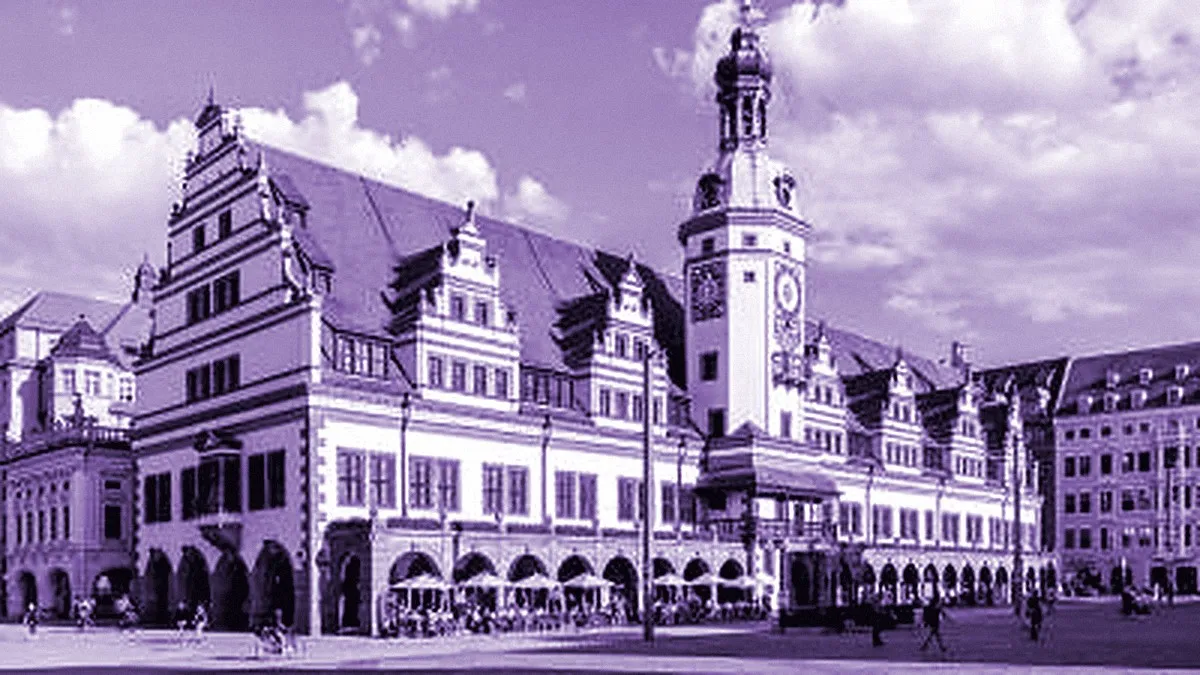
St Nicholas, the Old City Hall and the trade-fair arcades
Six hundred metres and eleven buildings. The church where the Monday demonstrations of 1989 began, the Renaissance town hall, the old stock exchange, and the glass-roofed Specks Hof and Handelshof arcades of the trade-fair city.
Junges Paar · Old Stock Exchange · Goethe-Denkmal · Old City Hall · Löwenbrunnen · Königshaus …
Open this tour: St Nicholas, the Old City Hall and the trade-fair arcades
Walk Leipzig with Neywo
Neywo turns Leipzig into a self-guided audio tour. Stories arrive as you reach the place they belong to, and the route reshapes when you wander off it.

