What to See in Ancona, Italy: Free Audio Guide
Things to do in Ancona: what to see in the Adriatic city
Ancona is a historic port city in Italy’s Marche region, built between the Adriatic Sea and a series of hills. The best things to do in Ancona include exploring ancient Roman monuments, hilltop churches, noble palaces, archaeological museums and panoramic viewpoints above the coast. Neywo offers a free audio guide for Ancona with 83 narrated places, so you can discover the city while walking at your own pace.
What to see in Ancona
Ancona’s sights stretch from the old port to the hills above the city. Together, they reveal the city’s Greek, Roman, medieval, Renaissance and modern history.
The Arch of Trajan
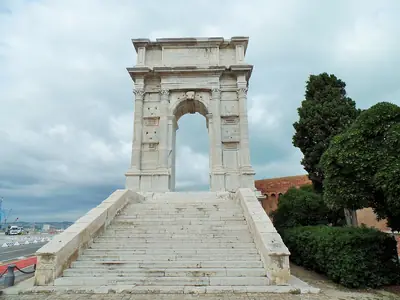
The Arch of Trajan stands on the harbor mole, directly beside the water. The Roman Senate commissioned it in the early second century AD to honor Emperor Trajan, who funded a major expansion of Ancona’s harbor and made its approach safer for ships and commerce.
Its single vaulted passage is framed by pairs of fluted Corinthian columns. The slender proportions give the arch an elegant vertical appearance, while the dedicatory inscription on the attic remains clearly legible.
Palazzo Benincasa
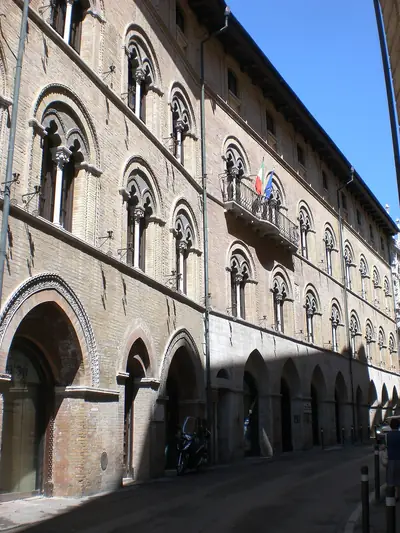
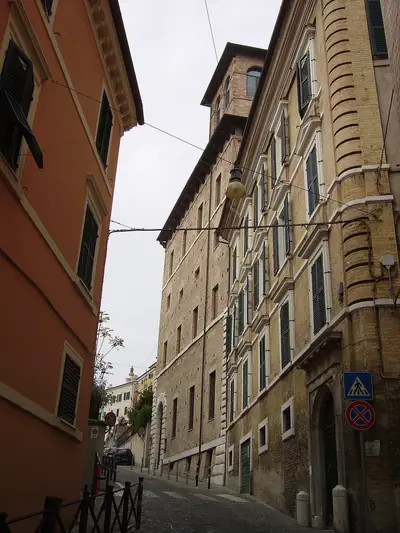
On Via della Loggia, Palazzo Benincasa is one of Ancona’s most important noble residences. Architect Giorgio Orsini da Sebenico built it in the fifteenth century. The palace was expanded and restored several times, and it remains the largest privately owned civil building in the historic centre.
Piazza del Plebiscito and Palazzo del Governo
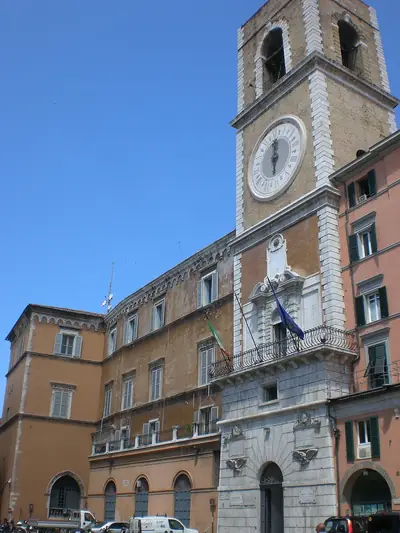
Palazzo del Governo stands in Piazza del Plebiscito, one of the city’s historic civic spaces. Formerly known as Palazzo dei Governatori, it was once the seat of Ancona’s governors. Today, it houses the Prefettura and continues to serve as a centre of provincial government.
San Francesco alle Scale
The Church of San Francesco alle Scale occupies a historic position on Via Pizzecolli, formerly known as Via del Comune. It is part of the sequence of churches, palaces and public buildings that gives Ancona’s old centre its distinctive character.
The Church of the Santissimo Sacramento
The Church of the Santissimo Sacramento stands opposite the Teatro delle Muse, close to the port. It served for many years as Ancona’s co-cathedral, a role it retained until 1986, when the Archdiocese of Ancona merged with the Diocese of Osimo.
The former church of Sant’Agostino
The former Church of Sant’Agostino now houses the Sala museale Contrammiraglio Guglielmo Marconi. The building began as a fourteenth-century church and was transformed in the seventeenth century by architect Luigi Vanvitelli. After Italian unification, it became a military barracks.
Its most notable surviving feature is the main portal, a richly carved fifteenth-century work by Giorgio da Sebenico. Its details bring together Gothic and Renaissance styles associated with the Adriatic Renaissance.
The Cathedral Basilica of St. Cyriacus
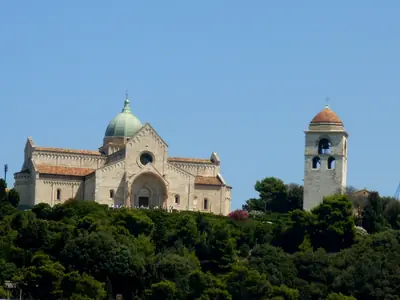
The Cathedral Basilica of St. Cyriacus crowns Guasco Hill, with views across Ancona and its gulf. Dedicated to the city’s patron saint, it is the metropolitan cathedral of the Archdiocese of Ancona-Osimo. Pope Pius XI raised it to the rank of a basilica in 1926, and it has been a national monument since 1940.
The hill was once the acropolis of the Greek-Doric city that founded Ancona, giving the cathedral a setting with more than two millennia of history. The building combines Romanesque and Byzantine elements, most visibly in its Greek-cross plan, whose four arms meet beneath a central dome.
The church developed over several centuries. An early Christian basilica stood here in the sixth century, and by the eleventh century the building had become the city’s cathedral. It was expanded into its Greek-cross form in the twelfth century.
The Diocesan Museum of Ancona
Beside the cathedral, the Diocesan Museum occupies the former archiepiscopal palace. The museum has been located here since 1952, while its collections began to take shape nearly a century earlier.
The building preserves medieval porticoes from its cloister. In the fifteenth century, Pope Pius II stayed here before intending to sail from Ancona on a crusade against the Ottoman Turks. Already ill, he died shortly after arriving, and the expedition never took place.
The collection began with works discovered during restorations of the cathedral, including sarcophagi, tombstones and inscribed slabs. After churches were damaged or closed following the bombings of the Second World War, additional artworks were transferred here. The museum now includes a painting collection spanning the fourteenth to the nineteenth century, as well as Roman and medieval coins and medals.
The National Archaeological Museum of the Marches
Inside the sixteenth-century Palazzo Ferretti, the National Archaeological Museum of the Marches presents the history of the region from prehistory through the Roman era. The palace’s stone façade and courtyard provide a historic setting for the galleries.
Its most important collection focuses on the Picenes, who flourished in the region from the ninth to the fourth century BC. The museum also presents evidence of the Greek colony of Ankón, the Gallic Senones and the later Roman presence.
Unlike many national archaeological museums in Italy, its holdings were not primarily formed from aristocratic collections. They come from more than 150 years of systematic archaeological excavation across the Marche region.
The Pinacoteca Civica Francesco Podesti
Palazzo Bosdari, a noble palace on Via Pizzecolli, has housed the Pinacoteca Civica Francesco Podesti since 1973. Founded in 1884, the collection is named after the Ancona-born painter Francesco Podesti, whose dedication helped establish it.
The museum follows the development of painting in the Marche from the fourteenth to the nineteenth century. Its collection includes two paintings by Titian, Lorenzo Lotto’s Pala dell’Alabarda, a Madonna and Child by Carlo Crivelli, two works by Guercino and an altarpiece by Carlo Maratta.
The Museo Tattile Statale Omero
The Museo Tattile Statale Omero is Italy’s national tactile museum. It makes art accessible through touch and was created especially for people with visual impairments, while remaining open to everyone.
The museum offers a different way to experience sculpture and form. Its institutional basis is an agreement established in 2001 between the Municipality of Ancona and the Italian Ministry of Culture.
The war memorial at Passetto
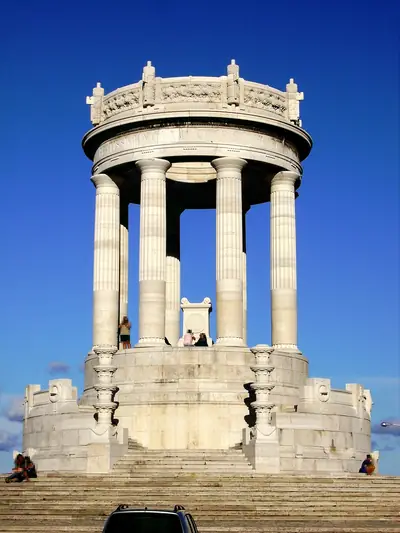
In Piazza IV Novembre, in the Passetto district, the Monument to the Fallen of the First World War marks the end of Ancona’s great “sea to sea” axis. The boulevard runs from the port docks through the city centre to this clifftop above the Adriatic.
Designed in the 1920s by architect Guido Cirilli, the memorial takes the form of a circular temple. A broad panoramic staircase descends from it towards Passetto beach, creating one of the city’s most scenic routes between the cliff and the shore.
Fort Garibaldi
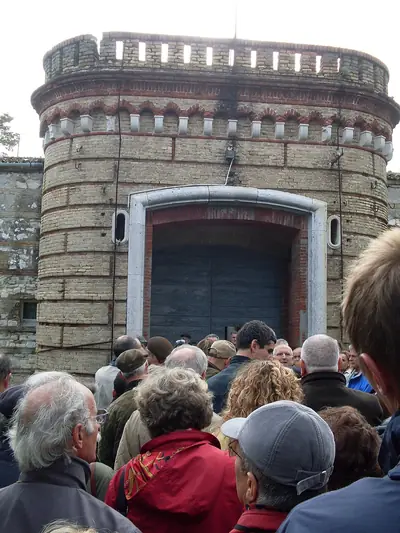
Fort Garibaldi stands on the heights of Monte Pelago above the Pietralacroce district. Built between 1861 and 1870 by military engineer Giuseppe Morando, it was originally called Forte Umberto.
The fort formed part of Ancona’s second defensive line, together with Fort Altavilla and Fort Scrima. Its elevated position offered views over the surrounding approaches, reflecting the strategic importance of Ancona after Italian unification.
Santa Maria di Portonovo
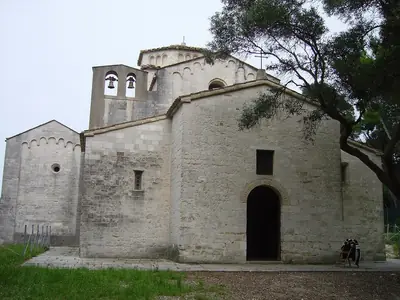
Outside the city centre, Santa Maria di Portonovo is one of the most striking places to visit along the Conero Riviera. The small Romanesque church stands between the mountain and the sea, with simple stone walls that harmonise closely with the landscape.
It is a memorable stop for anyone combining Ancona with the coast: ancient stone, mountain and Adriatic water come together in a single view.
Ancona self-guided walking tour with Neywo
Neywo’s free audio guide lets you explore Ancona without joining a group or following a fixed schedule. The app plays each story as you reach the place, at your own pace, and the narration is available in 11 languages.
The Ancona guide includes:
- Three walking tours
- Gates, Arches and Merchant Squares of the Old Port: 3.32 km, 105 minutes and 11 narrated stops.
- Guasco Hill: Greeks, Romans and the Cathedral of the Lions: 1.75 km, 73 minutes and 9 narrated stops.
- Ancona’s Hills, Gates and Fortress: 4.23 km, 103 minutes and 8 narrated stops.
- One bus route
- Line 11: Old Port, Cathedral Hill and Capodimonte: 6.6 km, 28 minutes and 10 narrated stops.
Download Neywo and explore Ancona with the city’s history unfolding as you arrive at each church, palace, museum, monument and viewpoint. Then continue discovering Italy through its other destinations, from Agnone to Matera.
Places with an audio guide in Ancona
8 places in Ancona with a Neywo audio guide. Each one starts telling its story as you reach it.
Self-guided tours in Ancona
4 tours in Ancona, free in the Neywo app. Each stop tells its story as you reach it.
- Bus ride
Line 11: Old Port, Cathedral Hill and Capodimonte
Conerobus line 11 is the one city bus that climbs to Guasco Hill. It runs from the port-side markets past the Roman amphitheatre and the cathedral on the summit, then down through the Capodimonte district to the churches of the old quarter. Ride it to reach the hill sights without the climb.
Chiesa dei Santi Cosma e Damiano · Mercato delle Erbe · Sant'Anna dei Greci · Roman Amphitheatre of Ancona · Cathedral Basilica of St. Cyriacus · National Archaeological Museum of the Marches …
Open this tour: Line 11: Old Port, Cathedral Hill and Capodimonte - Walk
Gates, Arches and Merchant Squares of the Old Port
Ancona was founded by Greeks and made rich by Adriatic trade, and the lower town still shows both. Start under Vanvitelli's papal gate and Trajan's arch on the harbour mole, then climb through the merchants' loggia, a Romanesque church built over a fourth-century one, the opera house and the old civic squares to a covered market in Art Nouveau iron.
Arco Clementino · Arch of Trajan · Loggia dei Mercanti · Palazzo Benincasa · Santa Maria della Piazza · Sala museale Contrammiraglio Guglielmo Marconi …
Open this tour: Gates, Arches and Merchant Squares of the Old Port - Walk
Guasco Hill: Greeks, Romans and the Cathedral of the Lions
Climb from the pope's square to the acropolis of the Greek colony of Ankon. On the way you pass the museum that holds the most complete Picene collection in existence, a Roman amphitheatre half dug out of the hillside, and a cathedral on the summit guarded by two stone lions. End at the old and new lighthouses with the whole gulf below you.
Piazza del Plebiscito · Pinacoteca civica "Francesco Podesti" · Palazzo del Senato · National Archaeological Museum of the Marches · Cathedral Basilica of St. Cyriacus · Diocesan Museum of Ancona "Mons. Cesare Recanatini" …
Open this tour: Guasco Hill: Greeks, Romans and the Cathedral of the Lions - Walk
Ancona's Hills, Gates and Fortress
A walk through the military and civic side of Ancona: a papal gate, the touch-only museum in the old quarantine station, Sangallo's star-shaped Cittadella and the hillside memorials to the Resistance and to the fallen of the First World War, finishing on the clifftop at the end of the city's sea-to-sea axis.
Museo Tattile Statale Omero · Porta Pia · Chiesa di San Giovanni Battista · Cittadella di Ancona · Monumento alla Resistenza · Lunetta di Santo Stefano …
Open this tour: Ancona's Hills, Gates and Fortress
Walk Ancona with Neywo
Neywo turns Ancona into a self-guided audio tour. Stories arrive as you reach the place they belong to, and the route reshapes when you wander off it.

