Visiting Ostuni, Italy: Top Sights on Foot
Things to do in Ostuni: what to see in Italy’s White City
Ostuni is a hilltop town in Apulia known as La Città Bianca, or the White City. Its historic center combines whitewashed lanes, Baroque and Rococo churches, medieval architecture, and views across the surrounding landscape. Neywo offers a free audio guide to Ostuni with 11 narrated places, so you can explore while hearing the story of each site.
What to see in Ostuni
The best way to discover Ostuni is to walk through its historic center, moving between major churches, small votive shrines, museums, and architectural details. These are the main places to include in your visit.
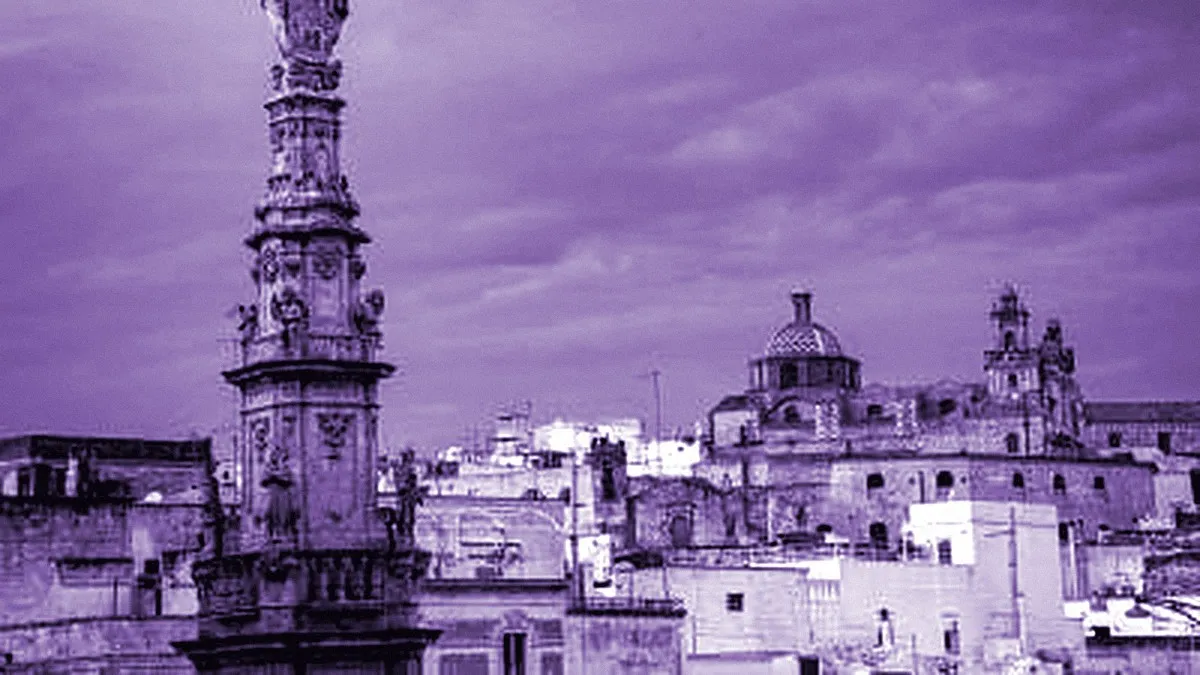
Guglia di Sant’Oronzo in Piazza della Libertà
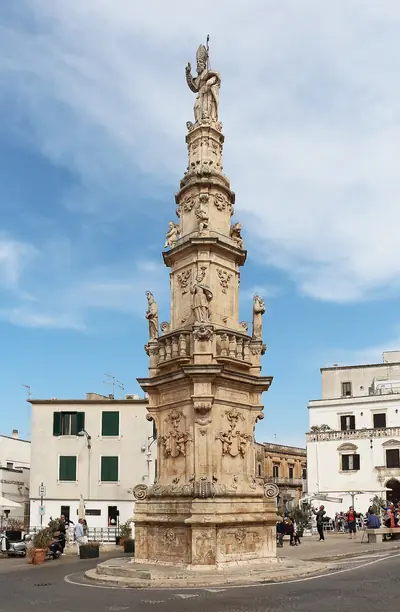
Piazza della Libertà is dominated by the Guglia di Sant’Oronzo, also called the Column or Spire of Saint Oronzo. The Baroque monument rises about twenty metres above the square and was created in 1771 by Giuseppe Greco, a sculptor from Ostuni.
Its four-level structure is covered with Latin inscriptions, angels, decorative frames, and statues. At the top stands Saint Oronzo, Ostuni’s patron saint. The column was built as an expression of gratitude to the saint, who was believed to have saved the city from a devastating plague. Look closely at the figures around the second level, including Saint Lucia, a bishop identified as Saint Augustine of Hippo, Saint Bernardino Realino, and Saint Irene.
Beside the column, the former Franciscan complex is now Palazzo Municipio, connecting the square’s religious and civic history.
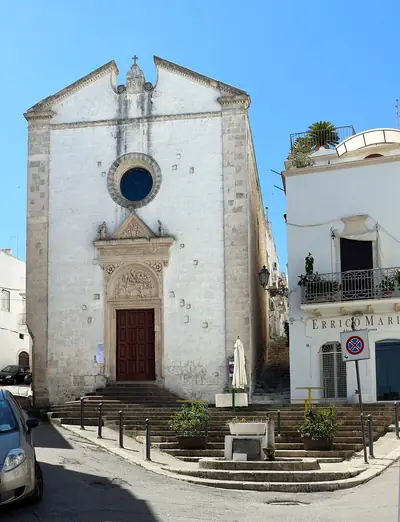
Santo Spirito
The Church of the Holy Spirit has a restrained exterior, but its history and doorway make it a worthwhile stop. The church was built between 1628 and 1637 on the orders of Bishop Andrea Perbenedetti of Venosa. Its façade includes a broken pediment and the stone coat of arms of Bishop Vincenzo Meligne, while the doorway dates from 1450.
Inside, the single nave has stone vaults and lunettes, with four altars along the sides. One altar, dating from 1670, is dedicated to Saint Oronzo. Another is dedicated to Saint Anna, while an altar on the right holds a seventeenth-century wooden statue of the Madonna del Buon Consiglio.
Church of San Vito Martire and the Museum of Preclassic Civilizations
The former Carmelite monastery of Santa Maria Maddalena dei Pazzi and the adjoining Church of San Vito Martire house the Museum of Preclassic Civilizations of Southern Murgia. The museum opened to the public in 1989, initially bringing together discoveries from the countryside around Ostuni before expanding to include finds from across the southern Murgia.
One of its most moving displays is the skeleton of a young woman who died during childbirth. Researchers estimate that she was about twenty years old and carrying a developing fetus. Her burial included shell bracelets, a headdress made from around six hundred Cyclope neritea shells dyed with red ocher, stone tools, and animal remains.
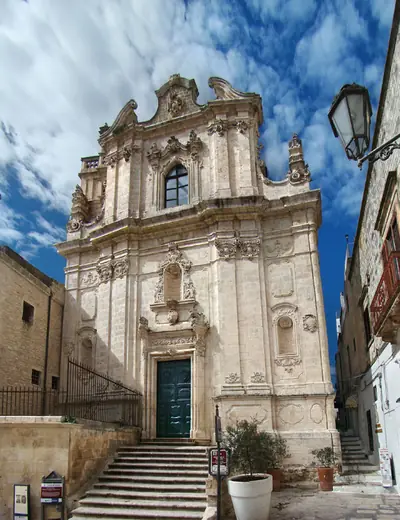
The nearby Church of San Vito Martire is closely associated with the Carmelite cloistered convent. Its gently curved façade and richly ornamented details make it a distinctive example of Rococo architecture in Ostuni.
Ostuni Cathedral
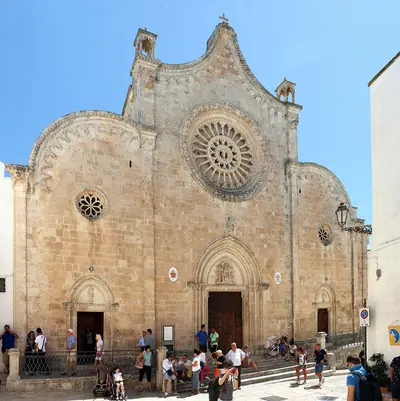
The Cathedral Basilica of Santa Maria Assunta is one of the historic center’s essential landmarks. Dedicated to the Assumption of the Virgin Mary, it combines Romanesque origins with later Gothic reconstruction and a rich collection of religious art.
The cathedral took on its Romanesque form between 1228 and 1229, under the patronage of Frederick II of Swabia, and was built mainly from local pietra gentile. After an earthquake in 1456, it was reconstructed between 1469 and 1495 in the Gothic style.
The façade is especially notable for its elegant fifteenth-century rose window and the portal dedicated to Saint Blaise, one of Ostuni’s patron saints. Inside, the altars and ceiling are decorated with numerous works. The altarpiece of the Assumption occupies the apse, while the Chapel of Santa Maria della Sanità contains a fresco of Saint Catherine of Alexandria. A fifteenth-century statue of Christ stands in a niche on the counter-façade.
Arco Scoppa
In Largo Trinchera, directly in front of the cathedral, Arco Scoppa creates one of Ostuni’s most distinctive architectural views. Also known as the Loggia, it connects the Bishop’s Palace with the Seminary.
The arch was originally made of wood and rebuilt in stone in 1750 under the direction of Cardinal Stoppa. Its upper section is richly decorated: a pediment shaped like a large cartouche contains a cherub, while volutes, shells, and torches fill out the design. The form was inspired by Venice’s Bridge of Sighs.
The nearby Episcopal Palace leads to the Museo Diocesano di Arte Sacra, or Diocesan Museum of Ostuni, housed on the palace’s ground floor beside the cathedral.
Chiesa San Francesco di Assisi
The Church of Saint Francis of Assisi stands beside Palazzo Municipio. Its present façade was completed in 1883 and combines sculpture, bronze work, and an unusual Romanesque-inspired window.
The church began in 1304 on land donated by the Prince of Taranto and was originally Gothic. It underwent extensive renovation in 1615, while the current façade was designed by Gaetano Jurleo. Two Carrara marble statues—Saint Francis of Assisi and Saint Anthony of Padua—stand beneath the central cornice, with a bronze door by Egidio Giaroli between them.
The interior largely reflects a redesign from 1777. Columns, pilasters, cornices, and Corinthian capitals lead towards the vaults and dome. The marble main altar was completed in 1780, and the church also contains an organ made by Tommaso Alvano in 1882.
Chiesa del Purgatorio and the Immacolata votive shrine
The Chiesa del Purgatorio, or Church of Purgatory, is one of the smaller religious landmarks in Ostuni’s historic town. Its name reflects the strong religious character of the old center.
Nearby, the Edicola votiva Immacolata is a quiet votive shrine dedicated to the Immaculate Conception. These modest places are part of the detailed religious landscape encountered between Ostuni’s larger churches.
Santuario Madonna della Grata
The Santuario Madonna della Grata is linked to the story of a miraculous healing. According to local tradition, a farmer suffering from severe spinal pain regularly prayed before a fresco of the Madonna in a small eighteenth-century church. After his pain disappeared, he proclaimed that a miracle had occurred, and the church became known as Madonna della Grata.
The present sanctuary was built in the twentieth century through contributions from the faithful, near the older church dating from 1747. The Madonna’s fresco was moved into the new building, though the transfer damaged parts of the image because it had been painted directly onto a tuff wall. On the main wall behind the high altar, visitors can distinguish original sections from restored areas. An intricate mosaic frame was added in the 1970s.
The white historic center
Between these landmarks, Ostuni’s narrow streets and whitewashed buildings are an attraction in their own right. The medieval center developed under Norman rule, while later periods brought fortifications and architectural influences associated with Spanish, Bourbon, and Renaissance traditions.
The white lime coating became especially important during plague outbreaks and eventually shaped the city’s defining appearance. Exploring the old town means following winding lanes, stairways, and arches rather than sticking to a rigid route. The historic center reveals its character through changing views, painted doors, small shrines, and the contrast between white walls and the surrounding landscape.
Ostuni is one of the highlights of Apulia, and it can also fit into a wider journey through Italy. Nearby destinations include Locorotondo, Monopoli, Polignano a Mare, and Lecce.
Explore Ostuni with a free audio guide
For an Ostuni self-guided walking tour, download Neywo and explore without joining a group or following a fixed schedule. The app offers one walking tour covering 0.47 km in 26 minutes, with four narrated stops: Guglia di Sant’Oronzo, Santo Spirito, the Museum of Preclassic Civilizations of Southern Murgia, and Ostuni Cathedral.
Neywo tells the story of each place as you reach it, at your own pace, with no group and no schedule. Its Ostuni audio guide includes 11 narrated places, and narration is available in 11 languages.
Places with an audio guide in Ostuni
5 places in Ostuni with a Neywo audio guide. Each one starts telling its story as you reach it.
Self-guided tours in Ostuni
1 tour in Ostuni, free in the Neywo app. Each stop tells its story as you reach it.
- Walk
The White City: Baroque, Rococo and a Cathedral on the Hill
A short climb through Ostuni's whitewashed old town, from the Baroque spire of Piazza della Libertà to the Gothic cathedral crowning the hill. Stop for a prehistoric mother and her shell headdress, and for the Rococo church next door.
Guglia di Sant'Oronzo · Santo Spirito · Museo di civiltà preclassiche della Murgia meridionale · Ostuni Cathedral
Open this tour: The White City: Baroque, Rococo and a Cathedral on the Hill
Walk Ostuni with Neywo
Neywo turns Ostuni into a self-guided audio tour. Stories arrive as you reach the place they belong to, and the route reshapes when you wander off it.

