Things to Do in Turin, Italy: Walking Guide
Things to Do in Turin: What to See in Italy’s Royal City
Turin is a northern Italian city shaped by Roman foundations, the power of the House of Savoy and a strong tradition of art, architecture and design. The former capital of unified Italy is worth visiting for its royal palaces, important museums, historic churches and distinctive neighbourhoods, all set out along elegant streets and spacious squares. Neywo has a free audio guide for Turin with 291 narrated places.
What to See in Turin
Royal Palace of Turin
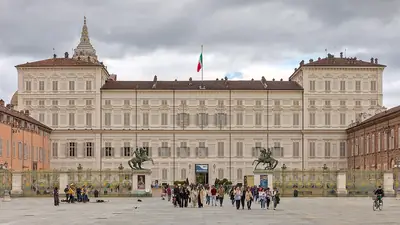
The Royal Palace of Turin, or Palazzo Reale, stands in Piazzetta Reale beside Piazza Castello. It was the first and most important Savoy residence in Piedmont and remained a setting for the political life of the Savoy states for at least three centuries.
The palace began in the sixteenth century and was transformed in the seventeenth century under Christine Marie of France. Filippo Juvarra contributed to its Baroque character. The complex is connected with Palazzo Chiablese and the Chapel of the Holy Shroud, built to house the Shroud of Turin.
Today, the palace forms part of the Musei Reali complex, together with the Galleria Sabauda, Royal Armoury, Royal Library and Palazzo Chiablese. It also belongs to the UNESCO World Heritage group of Savoy residences, listed in 1997.
Turin Cathedral and the Chapel of the Holy Shroud
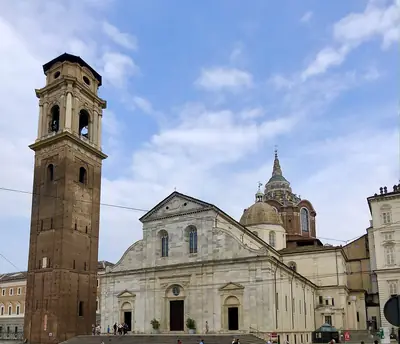
In Piazza San Giovanni, Turin Cathedral is the city’s principal Catholic church and the seat of the Archdiocese of Turin. Built between 1491 and 1498, it is considered the only Renaissance religious building in Turin. Its bell tower dates from 1470.
The cathedral complex includes the Chapel of the Holy Shroud, designed by Guarino Guarini and added between 1668 and 1694. The Holy Shroud has been associated with Turin Cathedral since 1578, giving the building an importance that extends well beyond the city.
Palazzo Carignano
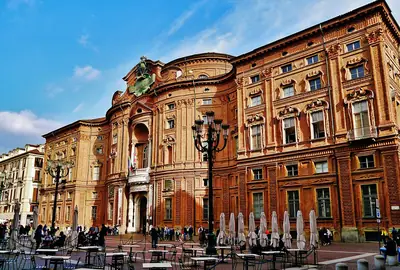
Palazzo Carignano is one of Turin’s most recognisable Baroque buildings. Its rounded façade, designed by Guarino Guarini, gives the palace an unusual appearance on Via Accademia delle Scienze.
Built as a private residence for the Princes of Carignano, the palace later became a major political centre. It housed the Subalpine Chamber of Deputies from 1848 to 1861 and the first Chamber of Deputies of the Kingdom of Italy from 1861 to 1865.
The piano nobile now houses the National Museum of the Italian Risorgimento, which reopened after restoration in 2011 as part of the celebrations for the 150th anniversary of Italian unification.
Museo Egizio
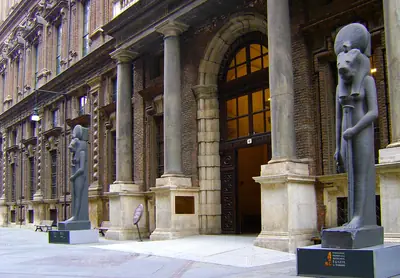
The Museo Egizio is one of the essential things to do in Turin for anyone interested in ancient history. Founded in 1824, it is the world’s oldest museum devoted entirely to ancient Egypt and holds more than 40,000 artefacts.
The collection began when King Charles Felix of Savoy acquired the Drovetti collection. It is housed in the Palazzo dell’Accademia delle Scienze, a Baroque building designed by Guarino Guarini in 1678 as a college for nobles.
The museum combines archaeological material with anthropological evidence, presenting ancient Egyptian culture through more than individual objects. Its location also places it close to San Filippo Neri, a monumental Catholic church that forms part of this historic area.
Mole Antonelliana and the National Cinema Museum
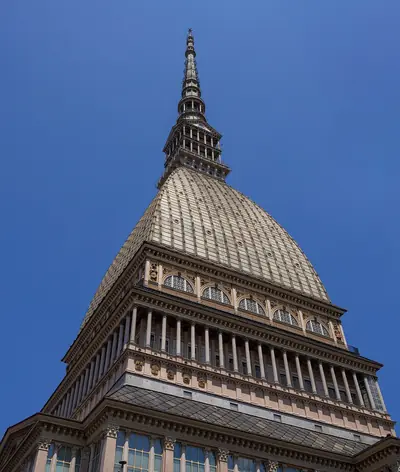
The Mole Antonelliana is Turin’s defining landmark. Rising 167.5 metres above the historic centre, the monumental tower was designed by Alessandro Antonelli. Construction began in 1863, shortly after Italian unification, and the building was completed in 1889.
The project was originally intended as a synagogue for Turin’s Jewish community. Since 2000, the Mole has been home to the National Museum of Cinema. Its atrium includes Catalan vaults, a construction technique associated with Spain and relatively rare in Italy.
The building remained the world’s tallest masonry structure until 1908. Its combination of distinctive architecture and film history makes it one of the best places to include in a Turin self-guided walking tour.
Palazzo Madama and the Museo Civico d’Arte Antica
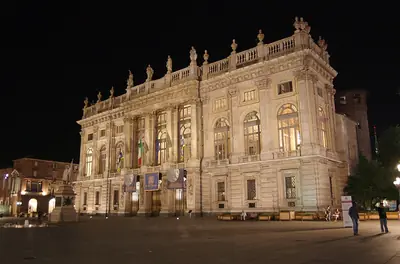
Palazzo Madama, in Piazza Castello, is part of the Palazzo Madama and Casaforte degli Acaja complex. It houses the Museo Civico d’Arte Antica, whose collection covers medieval, Renaissance and Baroque art.
The museum reopened in 2006 after restoration and also hosts temporary exhibitions and artistic displays. The palace is a useful stop for understanding how Turin’s historic buildings continue to serve as cultural spaces.
Galleria Sabauda
The Galleria Sabauda is one of Italy’s important picture galleries. Its collection contains more than 700 paintings dating from the thirteenth to the twentieth century, bringing together Italian and European art.
The gallery is particularly strong in Piedmontese painters, including Gaudenzio Ferrari, Defendente Ferrari, Macrino d’Alba, Tanzio da Varallo and Il Moncalvo. It also includes works by Fra Angelico, Duccio, Mantegna, Bronzino, Veronese, Tintoretto, Guido Reni and Giambattista Tiepolo.
Its Flemish collection includes paintings associated with Van Eyck, Memling, Rubens, Van Dyck, the Brueghels and Rembrandt. The gallery’s holdings have royal origins, drawing together collections connected with Eugene of Savoy, the Royal Palace of Turin, the Savoy-Carignano picture gallery and Palazzo Durazzo in Genoa.
Castello del Valentino and Parco del Valentino
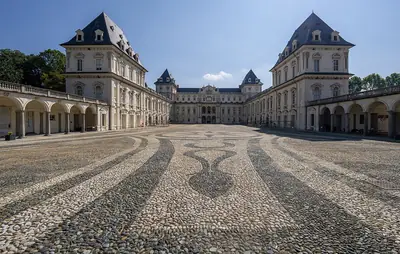
Along the Po River, Parco del Valentino provides a green setting for Castello del Valentino, one of Turin’s historic residences. The present castle was created in the seventeenth century under Christine of France and follows a horseshoe-shaped plan with four corner towers.
Its broad courtyard has a marble walkway, and construction continued until 1660. After a period of decline and abandonment, restoration began in 1860, when the castle was selected as the headquarters of Turin’s teaching body for technology.
The park is also home to the Orto Botanico dell’Università di Torino, the Borgo medievale and the Fontana dei 12 Mesi, making the area a rewarding part of a longer walk beside the river.
Basilica of Superga
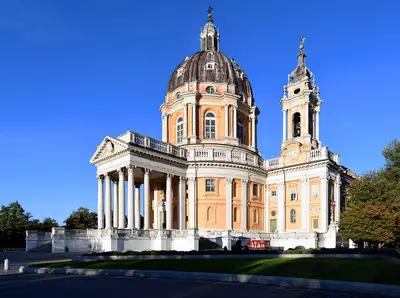
The Basilica of Superga stands on the summit of Superga Hill, 672 metres above sea level. It was built to fulfil a vow made by Vittorio Amedeo II of Savoy after the Piedmontese victory over Franco-Spanish forces during the siege of Turin in 1706.
Filippo Juvarra designed the basilica, whose construction began in 1717 and took fourteen years. It was inaugurated in 1731 in the presence of King Carlo Emanuele III of Savoy. Juvarra combined a classically inspired design with the Baroque style of his period, creating a prominent landmark above the city.
Villa della Regina
On Turin’s eastern hillside, Villa della Regina combines a former semi-rural royal residence with an elaborate garden landscape. Maurizio of Savoy commissioned the villa in the seventeenth century, when it was known as the Villa of the Cardinal Prince.
A broad elliptical terrace leads to an upper courtyard, while the hillside garden is arranged with terraces, belvederes, decorative fountains, grottoes, a chain fountain and the Teatro delle Acque. Villa della Regina has formed part of the UNESCO World Heritage listing of the Savoy residences since 1997.
Casa Scaccabarozzi
Casa Scaccabarozzi is one of Turin’s most unusual buildings. Known locally as Fetta di Polenta, or “slice of polenta”, it stands at the corner of Corso San Maurizio and Via Giulia di Barolo in the Vanchiglia neighbourhood.
Its ochre-yellow colour and extremely thin trapezoidal shape explain the nickname. At its narrowest, one side façade measures only 54 centimetres. The building was designed by Antonelli, who lived there with his wife for a few years before moving to an adjacent house also designed by him.
Turin’s historic churches
Turin’s streets contain several churches that reward a closer look. The Church of St. Francis of Paola, at the corner of Via Po and Via San Francesco da Paola, has a distinctive Baroque character. The Church of Santissima Annunziata adds another religious landmark along Via Po.
In Valdocco, the Basilica of Our Lady Help of Christians is closely connected with Saint John Bosco and the Salesian district. Built between 1864 and 1868, it was later enlarged between 1934 and 1942. Don Bosco’s remains rest in the sanctuary, which was raised to the status of a minor basilica in 1911.
Juventus Stadium
For a contemporary side of Turin, visit Juventus Stadium, also known as Allianz Stadium. It has been the home ground of Juventus since the 2011–2012 season and holds 41,689 spectators.
The stadium was designed as a modern football arena without architectural barriers and is described as the world’s first eco-compatible stadium. It was built on the site of the former Stadio delle Alpi, reusing part of its structures while creating a venue intended specifically as Juventus’s home.
Explore Turin with Neywo
Neywo offers six walking tours, one bus route and one bike route in Turin. The walks range from 1.11 to 3.89 km and last between 74 and 120 minutes, with between 9 and 12 narrated stops. The bus route covers 5.6 km in 24 minutes and has 12 stops, while the bike route covers 4.1 km in 20 minutes and has 4 stops.
Choose a route such as From Roman Gate to Royal Palace, Guarini’s Baroque: Palaces, Pharaohs and Twin Churches or Mole to Po: Polenta Slice and Gran Madre. Other walks explore Valentino Park, the Quadrilatero Romano and Via Roma, while the bus and bike routes offer different ways to connect Turin’s historic centre and riverside landmarks.
The app tells the story of each place as you reach it, at your own pace, with no group and no schedule. Download Neywo and explore Turin with a free audio guide available in 11 languages. Turin is also a starting point for discovering other destinations in Italy, including Courmayeur and Orta San Giulio.
Places with an audio guide in Turin
8 places in Turin with a Neywo audio guide. Each one starts telling its story as you reach it.
Self-guided tours in Turin
8 tours in Turin, free in the Neywo app. Each stop tells its story as you reach it.
- Bike ride
Along the Po: Valentino Castle to the Gran Madre
A riverside ride on the cycle paths of the Po, from the French-style Castello del Valentino past the d'Azeglio monument to the Gran Madre di Dio, then on along the river to the Madonna del Pilone. Flat, green and away from the traffic.
Castello del Valentino · Monument to Massimo d'Azeglio · Gran Madre di Dio · Chiesa della Madonna del Pilone
Open this tour: Along the Po: Valentino Castle to the Gran Madre - Bus ride
Star 2: Turin's Historic Centre Loop
A local GTT bus that links Porta Susa station with the Valentino by way of the Shroud Museum, Palazzo Barolo, the Egyptian Museum, Via Po and Piazza Vittorio Veneto. A cheap, easy ride across the old town.
Museo della Sindone · Palazzo Barolo · San Domenico, Turin · San Francesco d'Assisi, Turin · Santa Teresa, Turin · Museo Egizio …
Open this tour: Star 2: Turin's Historic Centre Loop - Walk
From Roman Gate to Royal Palace
Two thousand years of Turin in one short walk: the sixteen-sided Roman towers of the Palatine Gate, the Roman theatre, a Renaissance cathedral, Guarini's dome over the Holy Shroud and the palaces of the House of Savoy around Piazza Castello.
Palatine Towers · Roman Theatre of Turin · Piazza San Giovanni · Turin Cathedral · Sindone Chapel · Diocesan Museum of Turin …
Open this tour: From Roman Gate to Royal Palace - Walk
Guarini's Baroque: Palaces, Pharaohs and Twin Churches
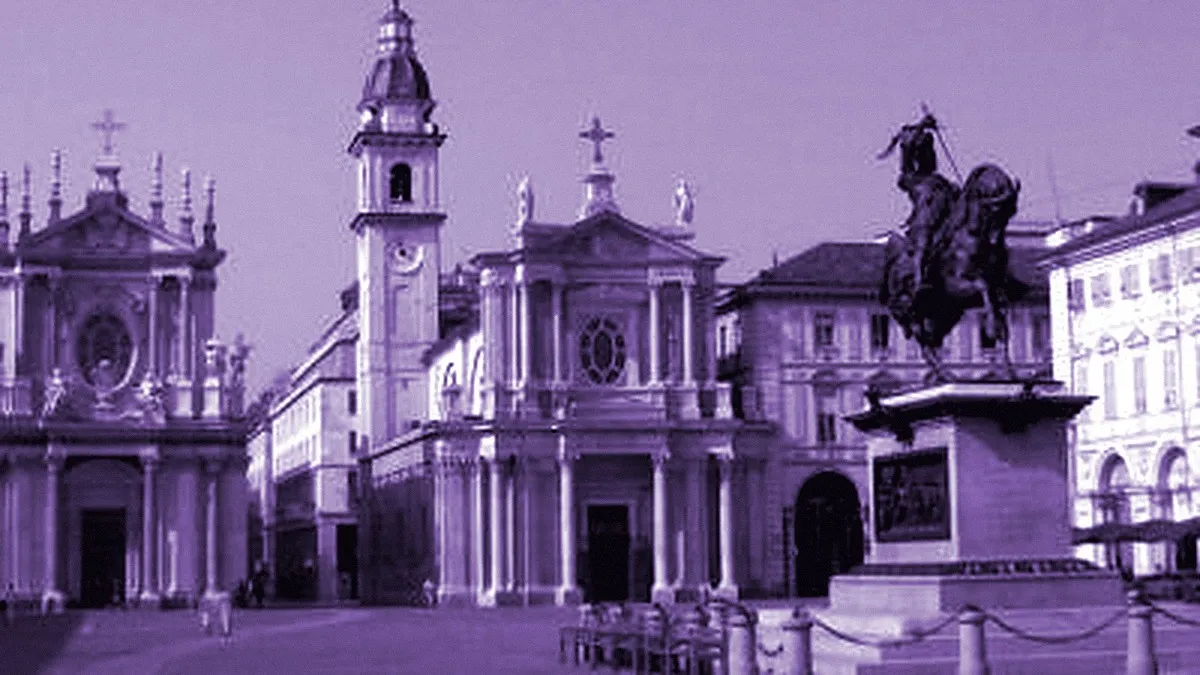
Follow the architect Guarino Guarini and the Savoy court south from Piazza Castello: the Royal Church of San Lorenzo, the curving facade of Palazzo Carignano, the Egyptian Museum in his old noble college and the bronze horse of Piazza San Carlo, Turin's drawing room, guarded by twin churches.
Church of San Lorenzo, Turin · Teatro Carignano · Piazza Carignano · Palazzo Carignano · National Museum of the italian Risorgimento · Museo Egizio …
Open this tour: Guarini's Baroque: Palaces, Pharaohs and Twin Churches - Walk
Mole to Po: Polenta Slice and Gran Madre
Start under the 167-metre spire of the Mole Antonelliana, home of the Cinema Museum, and find its architect's whimsical Fetta di Polenta, a house 54 cm wide at its narrowest. Then cross the arcaded Piazza Vittorio Veneto and the Po to the Pantheon-like Gran Madre and the hill of the Capuchins.
Mole Antonelliana · Santa Giulia, Turin · Casa Scaccabarozzi · Santissima Annunziata · Place Vittorio Veneto · Ponte Vittorio Emanuele I …
Open this tour: Mole to Po: Polenta Slice and Gran Madre - Walk
Valentino Park and San Salvario: Castles, Gardens and Synagogue
Begin in multicultural San Salvario with the Waldensian Church and the Moorish Revival synagogue, then enter Valentino Park on the banks of the Po: a French-style Savoy castle, a 1713 botanical garden, a medieval village built for the 1884 expo and Lombroso's museum of criminal anthropology.
Waldensian Church · Synagogue of Turin · National Electrotechnical Institute "Galileo Ferraris" · Castello del Valentino · Società Promotrice delle Belle Arti · Orto Botanico dell'Università di Torino …
Open this tour: Valentino Park and San Salvario: Castles, Gardens and Synagogue - Walk
Quadrilatero Romano: Shrine, Senate and Juvarra's Palaces
Turin's old Roman grid, north of the Duomo, packs a baroque shrine, a Savoy senate and palaces by Filippo Juvarra into a few streets. Start at the Consolata, Turin's principal Marian sanctuary, and finish at the museum that tells the story of the Holy Shroud.
Santuario della Consolata · Santa Chiara (Turin) · Sant'Agostino, Turin · Museum of Oriental Art · Palazzo del Senato Sabaudo · Palazzo Barolo …
Open this tour: Quadrilatero Romano: Shrine, Senate and Juvarra's Palaces - Walk
Via Roma and the Salotto: Palaces Behind Piazza San Carlo
From the railway station square up Via Roma into Turin's drawing room: the twin churches of Piazza San Carlo, the Gallerie d'Italia, seventeenth-century palaces by Castellamonte and the palace linked with Count Cavour, down to the doorway Turin calls the Devil's Door.
Piazza Carlo Felice · Palazzo Cavour · Palazzo Bricherasio · Piazza C.L.N. · Palazzo Perrone di San Martino · Palazzo Turinetti …
Open this tour: Via Roma and the Salotto: Palaces Behind Piazza San Carlo
Walk Turin with Neywo
Neywo turns Turin into a self-guided audio tour. Stories arrive as you reach the place they belong to, and the route reshapes when you wander off it.

