What to See in Alberobello, Italy: Free Audio Guide
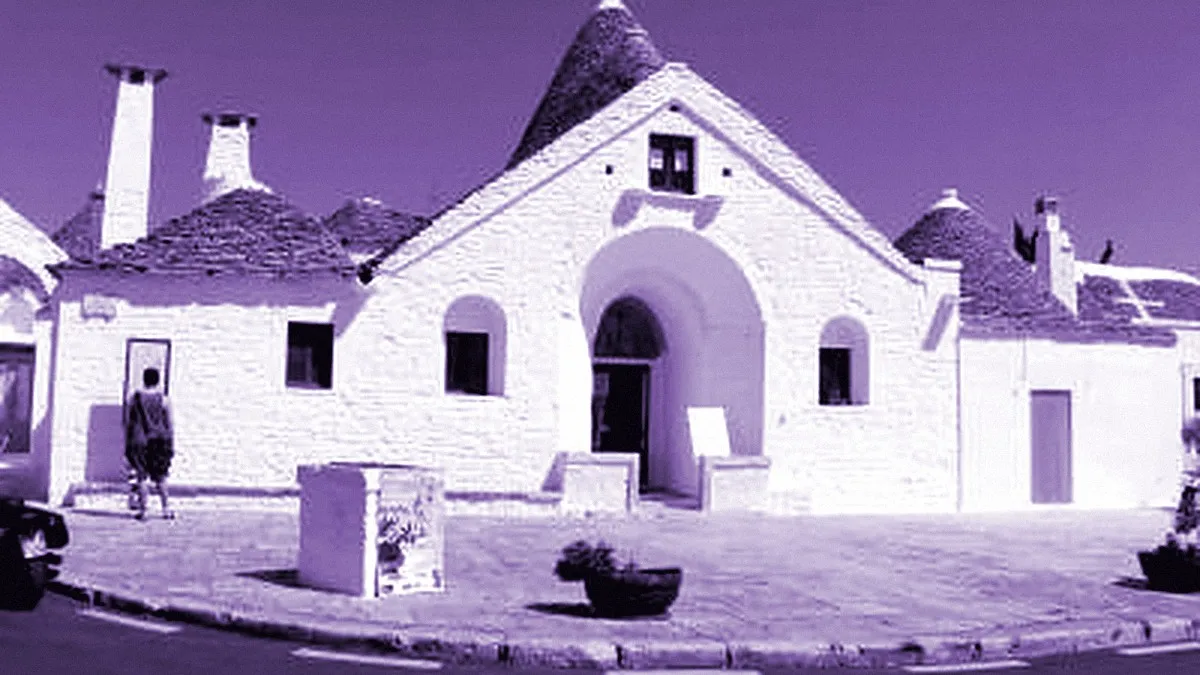
Things to do in Alberobello: what to see among the trulli
Alberobello is a town in Apulia famous for its concentration of trulli, traditional limestone houses with conical roofs. Its historic districts, unusual churches, museums, viewpoints and distinctive streets make it one of the most memorable places to visit in southern Italy. Neywo has a free audio guide for Alberobello, with 13 narrated places available in 11 languages.
What to see in Alberobello
The trulli
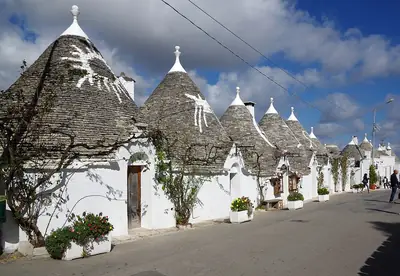
The trulli are Alberobello’s defining attraction: whitewashed stone houses built with irregular limestone blocks and traditionally constructed without mortar. Their thick walls help keep the interiors cool in summer and warm in winter, while the roofs are covered with overlapping limestone slabs called chiancarelle.
Many roofs carry symbols painted in lime wash, including crosses, planetary signs and other traditional motifs. The oldest surviving trulli date from the late 1600s, and the buildings have been recognized as a UNESCO World Heritage site since 1996.
The houses were used by shepherds and farmers as temporary shelters and permanent homes. Walking among them is the essential Alberobello experience, particularly in the two historic districts of Rione Monti and Aia Piccola.
Museo Casa Pezzolla
The Museo Casa Pezzolla occupies a remarkable complex of fifteen trulli connected under one roof. It is the only UNESCO-protected museum of its kind and offers an insight into the peasant culture that shaped Alberobello.
The complex was once the private residence of Doctor Giacomo Pezzolla, physician to the Acquaviva d’Aragona counts in the eighteenth century. Its rooms reveal two architectural approaches: older sections retain the traditional trullo style, while other parts have taller, narrower façades topped by triangular pediments. The municipality restored the ensemble to its original state in the 1990s.
Trullo Sovrano
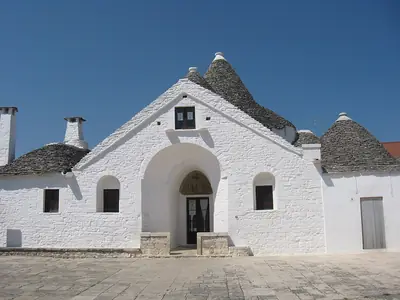
Trullo Sovrano is the only two-storey trullo in Alberobello. Its main dome rises about fourteen metres and stands at the centre of a group of twelve cones, creating a silhouette unlike any other in the town.
The original core dates from the early 1600s, while the present building took shape in the first half of the 1700s. Its expansion was commissioned by the Perta family, including the priest Cataldo Perta. Unlike earlier dry-stone structures, Trullo Sovrano was among the first trulli to use mortar.
Today, it is a living museum. A masonry staircase leads to the upper floor, and the rounded rooms have been furnished to evoke everyday life, including a bakery, bedroom and kitchen.
Casa d’Amore
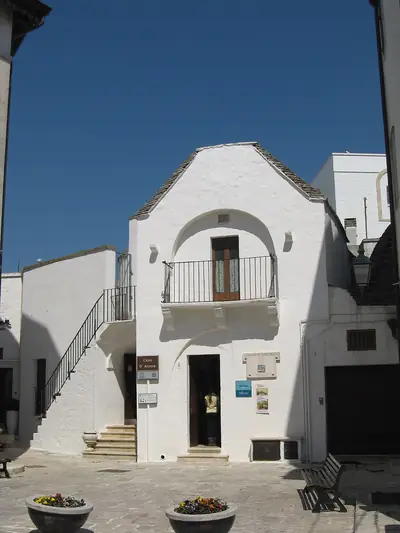
Casa d’Amore marks a turning point in Alberobello’s history. Until 1797, buildings had to be made without mortar, allowing the Count of Conversano to order them demolished. A royal decree from Ferdinand IV of Bourbon then granted local people the right to build permanent homes.
Francesco D’Amore responded by constructing this house with terracotta and mortar, making it the first of its kind in Alberobello. Its balcony bears a Latin inscription referring to its royal authorization and date, 1797. The building combines a more sophisticated exterior with interiors that still preserve the character of traditional conical dwellings.
Rione Monti and Via Monte San Marco
Rione Monti occupies the southern hillside and contains Alberobello’s highest concentration of trulli. More than a thousand conical roofs spread across the district, whose traditional character helped earn it National Heritage status in the 1920s and UNESCO recognition together with Aia Piccola.
Seven narrow lanes rise from Largo della Forgia towards the hilltop. Via Monte San Marco is among the most picturesque, retaining much of its historic layout and stone paving. The trulli along the street display the characteristic dry-stone construction and, in many cases, symbols painted on their roofs.
The district is also home to boutiques, cafés and craft shops, making it a livelier place to explore than the residential lanes of Aia Piccola.
Church of Saint Anthony of Padua
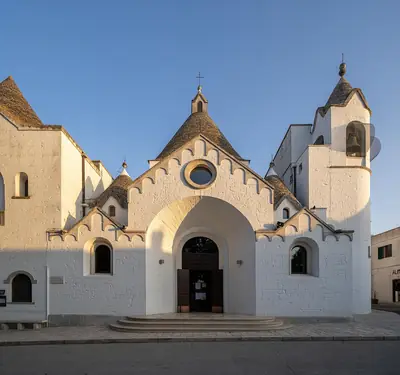
At the top of Rione Monti stands the Church of Saint Anthony of Padua, an extraordinary building made entirely in the trullo style. Its conical roofs form the walls and ceiling of a Greek-cross plan, making it the only church in the world built entirely this way.
The church was completed in 1927. Its design followed the protection granted to the Monti district in 1910, when new construction was required to respect the traditional architecture. The church also reflects the changing perception of the trulli: once associated with poverty, they later became one of Alberobello’s most valued symbols.
Basilica of Saints Cosmas and Damian
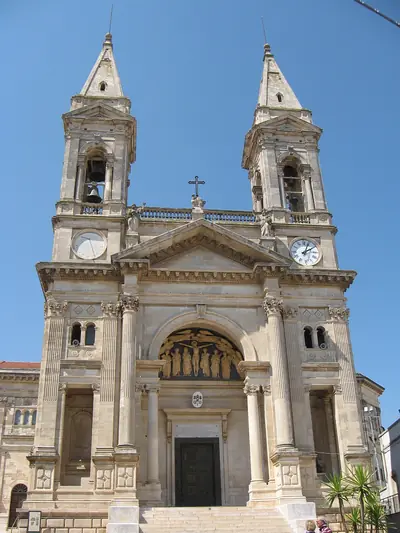
The Basilica of Saints Cosmas and Damian is Alberobello’s most significant church and a major landmark on Corso Vittorio Emanuele. Its twin bell towers rise above the historic centre, while its interior combines neo-Renaissance architecture with detailed decoration.
The basilica has served as the town’s parish church since its earliest days, within the diocese of Conversano-Monopoli. Its importance in local life is particularly visible during the annual pilgrimage honouring Saint Cosma, a tradition dating from 1782 and linked to a legend about the end of a severe drought.
Vico Il Duca degli Abruzzi and Aia Piccola
Aia Piccola offers a quieter and more residential view of Alberobello. Vico Il Duca degli Abruzzi winds through this southeastern district, where families still live in trulli and the lanes retain a calm atmosphere.
The name Aia Piccola means “small threshing floor”. Historically, the area was used for threshing grain and collecting tithes for local feudal lords. Unlike the busier Rione Monti, it was not commercialized in the same way, so its trulli retain a particularly authentic character.
Church of Saint Lucia and Piazza del Popolo
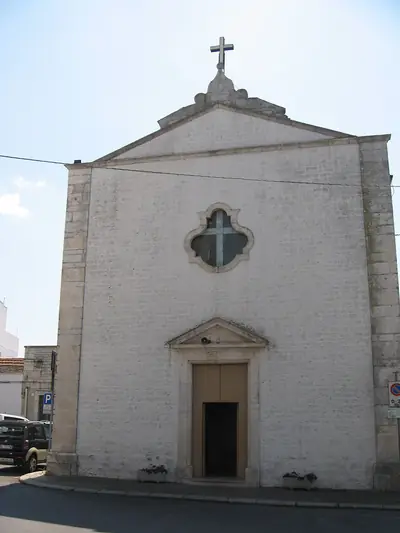
The small Church of Saint Lucia stands beside Piazza Gian Girolamo Acquaviva. It has a simple façade, a single nave and a curved mixtilinear window. The building was begun in 1834 and formally dedicated to Saint Lucia after renovations in 1856.
A relic of Saint Lucia was brought to the church in 1904. Nearby, Piazza del Popolo contains the Monument to the Fallen in Wars, an obelisk on a stone pedestal, as well as a fountain added in 1996.
Belvedere Santa Lucia
Belvedere Santa Lucia is one of the best places to view Alberobello’s rooftops. The terrace overlooks the trulli of Rione Monti, which cluster across the hillside in a distinctive pattern of white walls and conical stone roofs.
A staircase from the viewpoint leads down into the district, so the belvedere works naturally as both a scenic stop and a starting point for exploring the trulli lanes.
Corso Vittorio Emanuele II and Villa Comunale
Corso Vittorio Emanuele II connects several of Alberobello’s important landmarks. The nineteenth-century thoroughfare is lined with grander stone buildings and brings together civic, aristocratic and religious architecture.
Near the Church of Saint Anthony, Villa Comunale provides a small green space surrounded by trulli. It is a local gathering place and a convenient pause during a walk through Rione Monti.
Alberobello is an excellent base for discovering more of Apulia, with nearby destinations including Bari, Locorotondo, Monopoli and Ostuni.
Explore Alberobello with Neywo
Neywo’s free audio guide turns Alberobello into a self-guided walking experience. It includes one walking tour: a 2.48 km route lasting 64 minutes, with six narrated stops at Santa Lucia, the Basilica of Saints Cosmas and Damian, Casa d’Amore, Trullo Sovrano, the trulli and the Church of Saint Anthony of Padua.
The app tells the story of each place as you reach it, at your own pace, with no group and no schedule. Download Neywo and explore Alberobello while the town’s history unfolds around you.
Places with an audio guide in Alberobello
6 places in Alberobello with a Neywo audio guide. Each one starts telling its story as you reach it.
Self-guided tours in Alberobello
1 tour in Alberobello, free in the Neywo app. Each stop tells its story as you reach it.
- Walk
Alberobello: The Town That Learned to Build with Mortar
Follow the story of the trulli town that dodged feudal demolition orders: from the war memorial in Piazza del Popolo and the twin-towered basilica, to the first mortar-built house of 1797, the lordly two-storey Trullo Sovrano and the only church in the world made entirely of trulli. Stone cones, painted lime symbols and tax-dodging legends at every turn.
Santa Lucia · Santi Medici Cosma e Damiano · Casa d'Amore · Trullo Sovrano · Trullo · Sant'Antonio di Padova (Alberobello)
Open this tour: Alberobello: The Town That Learned to Build with Mortar
Walk Alberobello with Neywo
Neywo turns Alberobello into a self-guided audio tour. Stories arrive as you reach the place they belong to, and the route reshapes when you wander off it.

