What to See in Bari, Italy: Free Audio Guide
Things to Do in Bari: What to See in the Old Town and Beyond
The best things to do in Bari include exploring the historic old town, visiting important churches and museums, and discovering theatres, palaces and modern landmarks across the city. Bari is the capital of Apulia and a city where Romanesque architecture, religious history, art and everyday urban life come together. Neywo has a free audio guide for Bari with 23 narrated places.
What to See in Bari
Bari’s most important sights are concentrated in and around Bari Vecchia, the historic center, while other landmarks extend into the Murat Quarter and the Carrassi district. These are some of the places that best reveal the city’s history and character.
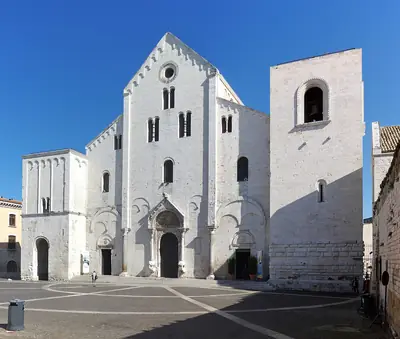
Basilica of Saint Nicholas
The Basilica of Saint Nicholas, or Basilica di San Nicola, is one of the most important places of worship in Bari and a major example of Puglian Romanesque architecture. It is also known for its connections between different Christian traditions.
The basilica has pontifical status, with responsibility for its jurisdiction tied directly to the Holy See since 1929. In 1951, it was given to the Dominican Order. Its story goes back to 1087, when sailors from Bari brought the relics of Saint Nicholas from Myra, in present-day Turkey, to the city. That event established Bari as an important center of devotion to the saint.
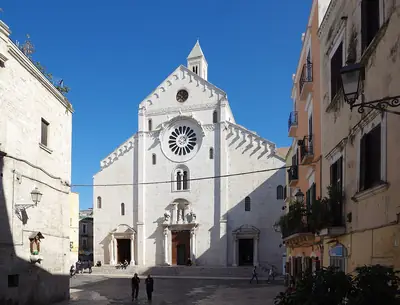
Cathedral of Santa Maria Assunta
The Cathedral of Santa Maria Assunta, commonly known as the Duomo di Bari, is the seat of the Archbishop of Bari-Bitonto. It is dedicated to Saint Sabinus, a bishop of Canosa whose relics were brought to Bari in the 9th century.
The present cathedral was built in the Apulian Romanesque style between the late 12th and late 13th centuries, largely during the final thirty years of the 12th century. It stands on the ruins of an Imperial Byzantine cathedral destroyed in 1156, when William I of Sicily attacked Bari and razed much of the city.
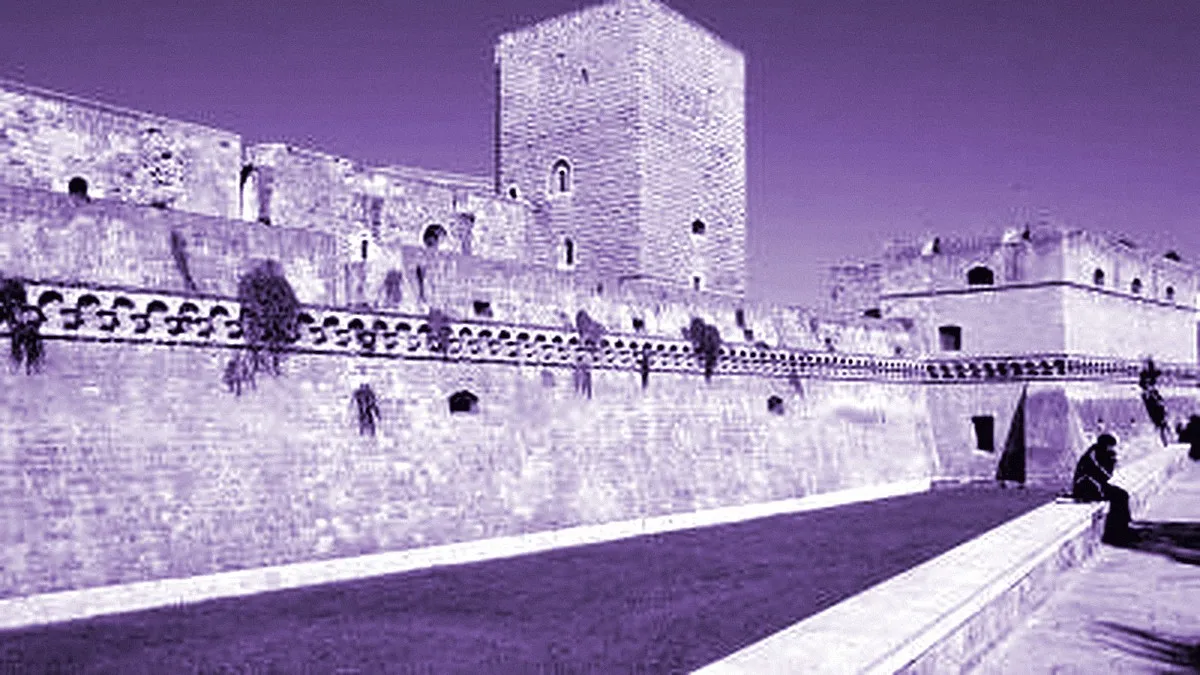
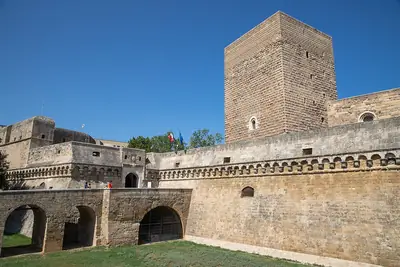
Castello Normanno-Svevo
At the edge of the old town, Castello Normanno-Svevo is one of Bari’s most symbolic landmarks. The Norman king Roger II ordered its construction around 1132, but the fortress was destroyed during William I of Sicily’s assault on the city in 1156.
Emperor Frederick II rebuilt the castle on a larger scale in 1233. The building later passed through the hands of the Angevins and Aragonese, as well as rulers of Spain and Naples, who adapted it for their own purposes. The castle is also associated with a legend about Saint Francis of Assisi, who is said to have stayed there as Frederick’s guest in 1221.
Museo Nicolaiano
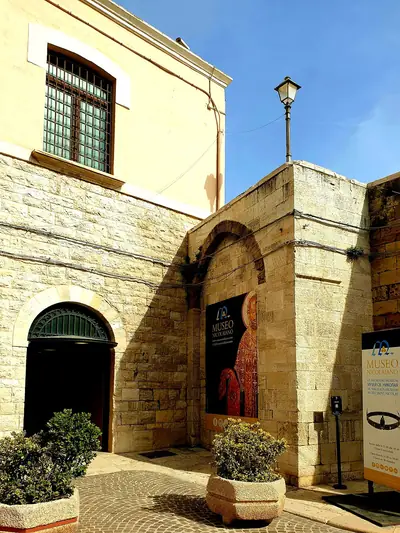
Near the Basilica of Saint Nicholas, the Museo Nicolaiano explores the cult, art and history associated with the basilica and the saint. Since 2010, it has offered a close look at Bari’s long tradition of devotion.
The museum is arranged across three levels. Its ground-floor displays trace the history of Bari and the basilica from antiquity through the Byzantine and Romanesque periods. The lower level contains ex-voto offerings, including those from the Orthodox community, while the upper level presents a treasury of offerings connected with the basilica and Saint Nicholas.
San Marco dei Veneziani
San Marco dei Veneziani is a church in Bari’s historic center, on vico San Marco. It was built around 1002 or 1003 to celebrate Bari’s liberation from the Saracens, attributed to Doge Pietro Orseolo II of Venice.
Its Romanesque façade includes a rose window decorated with garlands and small columns, a small winged lion and a round-arched portal. The church’s artworks span several periods, including the late Renaissance.
Santa Teresa dei Maschi
Built by the Discalced Carmelites between 1690 and 1696, Santa Teresa dei Maschi is a Baroque church with a Greek-cross plan. Its interior features barrel vaults, a pointed arch dome and a rectangular apse.
The walls display canvases by Andrea Miglionico, described as a pupil of Luca Giordano, along with three inlaid-wood altar frontals. Today, the church also functions as an art center and hosts exhibitions. It is the headquarters of the Bibart International Biennial of Contemporary Art of Bari and the metropolitan area.
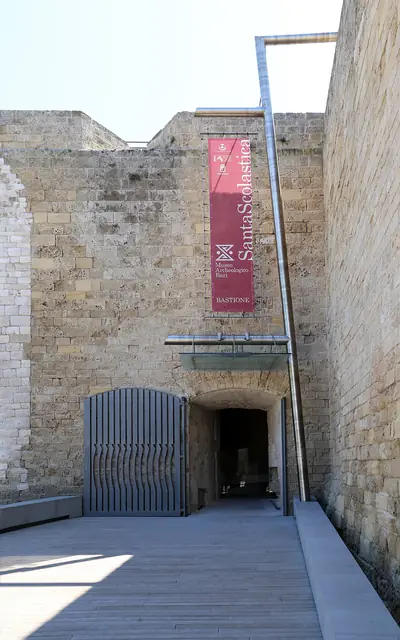
Museo archeologico di Santa Scolastica
The Archaeological Museum of Santa Scolastica occupies a former Benedictine monastery whose history includes architectural changes from its legendary foundation around the 10th or 11th century to the addition of a defensive bastion in the 16th century.
The collection began taking shape in 1875, when Professor Nitto De Rossi assembled archaeological materials. After moving into the restored monastic complex in 2001, the museum’s new exhibition spaces opened around 2018. Its chronological displays include prehistoric tools and ceramics, jewellery and artefacts from later periods of Apulian history.
Teatro Petruzzelli
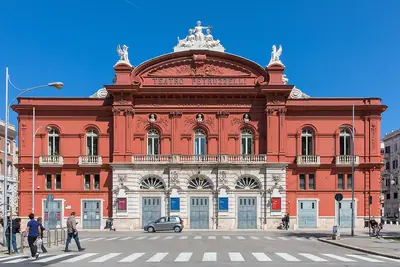
Teatro Petruzzelli is one of Bari’s major cultural landmarks. Construction began in 1898 and ended in 1903; the theatre opened on 14 February 1903 with Giacomo Meyerbeer’s opera Les Huguenots. From the beginning, it was designed as an ambitious venue, with gold decoration, heating and electric light.
The theatre later became known for important operatic debuts, including Niccolò Piccinni’s Iphigénie en Tauride and a Neapolitan version of Bellini’s I Puritani. Its history also includes a devastating fire during the night of 26–27 October 1991.
Teatro Piccinni
Teatro Piccinni, officially Teatro Comunale “Niccolò Piccinni”, was built to replace Bari’s deteriorating theatre in the Palazzo del Sedile. Construction began in 1836 and the new theatre was inaugurated on 30 May 1854 with Donizetti’s Poliuto.
It was named after Niccolò Piccinni, the 18th-century composer born in Bari. Its Neoclassical façade features columns, pediments and decorative sculptures, giving the building the formal appearance associated with 19th-century theatres.
Teatro Margherita
Teatro Margherita is a former theatre and cinema that has been repurposed as a museum of contemporary art. Its predecessor, the wooden Varietà Margherita, opened in 1910 but was destroyed by fire on 22 July 1911.
The present building was constructed between 1912 and 1914 and designed by Francesco De Giglio in the Art Nouveau style. Its façade has a wide arch, two towers with decorative pinnacles and large windows framed by pilasters with Corinthian capitals.
Pinacoteca metropolitana di Bari
The Pinacoteca metropolitana di Bari, also called the Pinacoteca Metropolitana “Corrado Giaquinto”, brings together works connected with Apulia. Founded on 12 July 1928, it first occupied the Palazzo del Governo before moving in 1936 to the Palazzo della Provincia on Bari’s seafront.
Its chronological route includes sculpture from the 11th and 12th centuries, medieval frescoes from Apulian churches, Byzantine icons and Venetian paintings from the 15th and 16th centuries.
Palazzo Fizzarotti
Palazzo Fizzarotti was erected in Bari’s city center in 1910 in an eclectic style inspired by Venetian Gothic. It was commissioned by banker and entrepreneur Emanuele Fizzarotti and designed by Ettore Bernich.
The palace is especially notable for its reception rooms, including the Hall of Arts and Crafts, the 14th-century Hall, the Pink Hall and the Fireplace Hall. A mosaic showing the winged head of Mercury, the god of Commerce, alludes to the owner’s financial activities.
Palazzo Mincuzzi
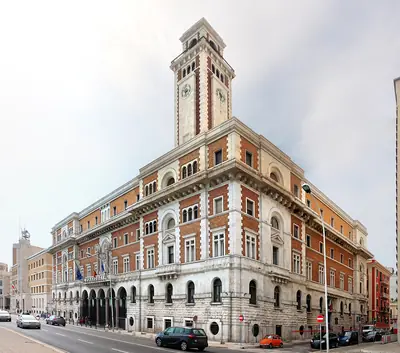
On Via Sparano da Bari, Palazzo Mincuzzi is a historic commercial building commissioned by the Mincuzzi family, owners of the Mincuzzi department store. Built between 1926 and 1928, it combines Art Nouveau and Neoclassical elements.
The ornate façade, decorated balconies and carefully crafted details reflect the building’s original commercial purpose. Inside, wide corridors and well-lit halls were designed to guide visitors through the department store.
Orthodox Church of Saint Nicholas
In Bari’s Carrassi district, the Orthodox Church of Saint Nicholas—also known as the Chiesa Russa—reflects the city’s links with Russian pilgrimage and Orthodox Christianity. Construction began in 1911, and the foundation stone was laid on 22 May 1913.
Designed by Alexei Viktorovich Shchusev, the church adopts the Pskov–Novgorod aesthetic rather than the more familiar Moscow–Yaroslavl style. It became municipal property in 1937 while retaining its sacred function, and it was formally returned to the Russian Orthodox Church on 1 March 2009.
Stadio San Nicola
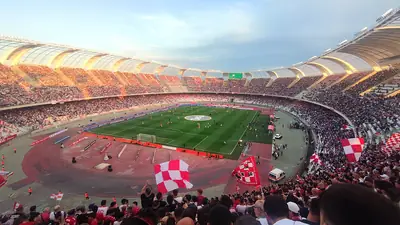
Designed by Renzo Piano, Stadio San Nicola is Bari’s largest sports facility and the home of SSC Bari. The architect nicknamed it “Astronave” because of its distinctive shape.
The stadium was built for the 1990 FIFA World Cup and hosted the third-place match between Italy and England. Its flower-like design is formed by 26 “petals”, with 8-metre gaps separating sections of the upper ring. It became SSC Bari’s home from the 1990–1991 season.
Explore Bari with Neywo
Neywo turns a visit to Bari into a self-guided audio experience. The app has 2 walking tours and 1 bus route, with routes ranging from 1.51 to 2.15 km and from 8 to 103 minutes. Together, the tours include 20 narrated stops.
The walks include a route through Bari Vecchia covering San Nicola, the cathedral and the castle, as well as a shorter route linking Teatro Petruzzelli, the castle, the cathedral and the Basilica of Saint Nicholas. The bus route connects the Murat Quarter with Bari Vecchia and includes Teatro Piccinni, Teatro Margherita, the city walls and the Archaeological Museum of Santa Scolastica.
Neywo tells the story of each place as you reach it, at your own pace, with no group and no schedule. The narration is available in 11 languages. After Bari, continue exploring Apulia or discover nearby cities such as Polignano a Mare, Monopoli and Alberobello.
Places with an audio guide in Bari
8 places in Bari with a Neywo audio guide. Each one starts telling its story as you reach it.
Self-guided tours in Bari
3 tours in Bari, free in the Neywo app. Each stop tells its story as you reach it.
- Bus ride
Navetta A: From the Murat Quarter to Bari Vecchia
AMTAB's Navetta A shuttle runs from the Park & Ride at Vittorio Veneto into the centre. Ride it past the Teatro Piccinni and Teatro Margherita to the sea wall of the old town and on to the archaeological museum of Santa Scolastica beside San Nicola.
Teatro Piccinni · Teatro Margherita · Muraglia di Bari · Museo archeologico di Santa Scolastica
Open this tour: Navetta A: From the Murat Quarter to Bari Vecchia - Walk
Bari Vecchia: San Nicola, the cathedral and the castle
The old town on its peninsula, walked in a loop. The basilica holds the bones of Saint Nicholas, stolen from Turkey by Barese sailors in 1087; from there the lanes lead to the cathedral, the merchants' square, the seafront wall and the Norman-Swabian castle.
Museo Nicolaiano · Basilica of Saint Nicholas · San Marco dei Veneziani · Cathedral of Santa Maria Assunta · Santa Teresa dei Maschi · Piazza Mercantile …
Open this tour: Bari Vecchia: San Nicola, the cathedral and the castle - Walk
The Ultimate Bari: opera house, castle, cathedral, San Nicola
A short line through everything that matters — the Petruzzelli theatre, the castle, the cathedral and the basilica of Saint Nicholas. Barely a kilometre and a half, all of it inside or beside the old town.
Teatro Petruzzelli · Castello Normanno-Svevo · Cathedral of Santa Maria Assunta · Basilica of Saint Nicholas
Open this tour: The Ultimate Bari: opera house, castle, cathedral, San Nicola
Walk Bari with Neywo
Neywo turns Bari into a self-guided audio tour. Stories arrive as you reach the place they belong to, and the route reshapes when you wander off it.

