What to See in Matera, Italy: Free Audio Guide
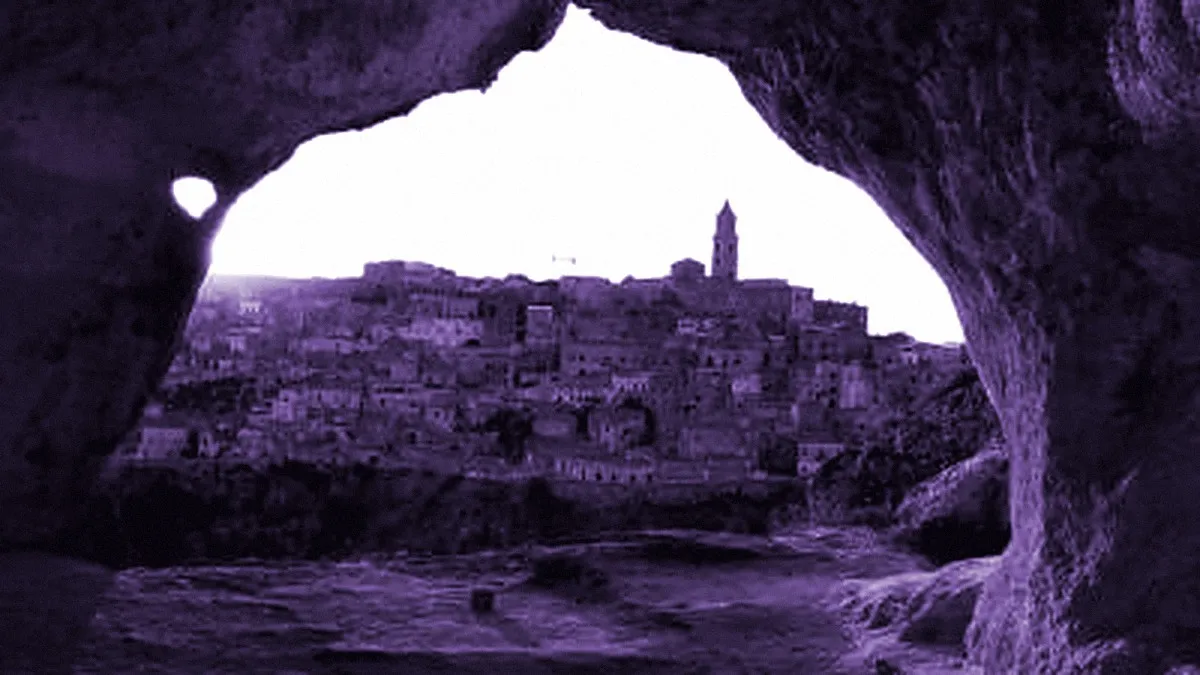
Things to do in Matera
Matera is an ancient city carved into limestone cliffs above the Gravina gorge, famous for its Sassi cave dwellings that have been continuously inhabited for millennia. Its blend of prehistoric origins, rock‑cut churches, palaces and museums makes it a unique destination for anyone interested in history, architecture and southern Italian culture. Neywo offers a free audio guide for Matera with 51 narrated places.
Key sights in Matera
Matera Cathedral
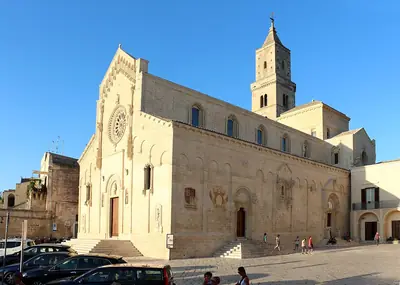
The cathedral crowns the highest ridge of the Civita, sitting between the two Sassi districts. Known officially as the Cattedrale della Madonna della Bruna e di Sant’Eustachio, its construction started around 1230 on the remains of a Benedictine monastery and was finished by 1270. The façade displays a rose window with sixteen rays, an Archangel Michael trampling a dragon, an Atlas‑like figure and twelve lemons that stand for the apostles. Inside, a thirteenth‑century Byzantine fresco of the Dark‑skinned Madonna survives beneath later painted ceilings.
Sassi di Matera
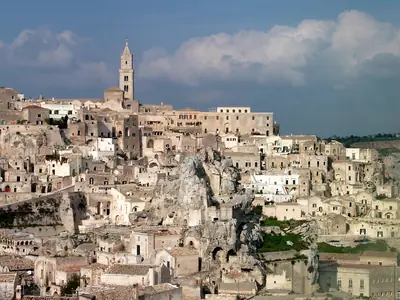
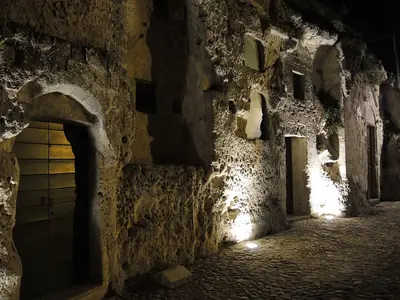
The Sassi form the historic heart of Matera, comprising Sasso Caveoso, Sasso Barisano and the Civita ridge. Inhabited since the Paleolithic, the caves evolved into a complex urban network of homes, chapels, cisterns, stairways and winding alleys. Sasso Caveoso retains more traditional cave dwellings, while Sasso Barisano shows façades and palazzi built above the rock. Open lookouts over the Gravina canyon reveal the dramatic setting, and the districts were still occupied in the 1950s without electricity or running water.
Chiesa dei Santi Pietro e Paolo
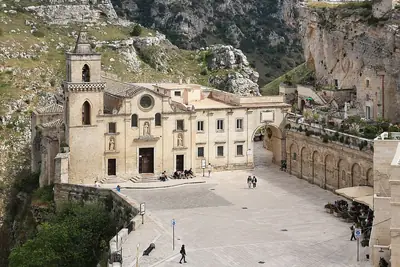
Also called the Church of Saints Peter and Paul, this building rises from the rocky edge of the Gravina ravine. Its origins date to the end of the thirteenth century when it served the Sasso Caveoso quarter; later Baroque work in the seventeenth and eighteenth centuries reshaped its appearance. The façade shows three portals with niches holding the Madonna of Mercy in the centre and Saint Peter and Saint Paul on the sides, topped by a rose window and a pyramidal bell tower. The interior nave measures about 43 m long and 17 m wide and houses paintings of Jesus and Saint Paul’s conversion, plus an eighteenth‑century altar with a wooden polyptych dated 1540.
Chiesa di San Giovanni Battista
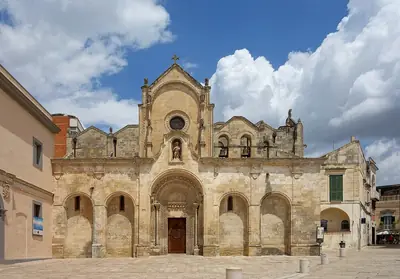
This free‑standing church was built just beyond the medieval walls, beginning in the early thirteenth century on the foundations of an older chapel known as Santa Maria la Nova. It was among the first sacred structures erected outside the city’s fortifications. Its dedication changed over time, finally honouring Saint John the Baptist. Because of its exposed position, the church was abandoned during the Ottoman advance into southern Italy in 1480 and remained unused for over two centuries before reopening in 1695. Later additions include an eighteenth‑century sacristy, a Chapel of the Blessed Sacrament and alterations to the transept domes. Inside, Romanesque and Gothic elements combine, notably the nave’s unusual Lecce vaults.
Convento di Sant’Agostino
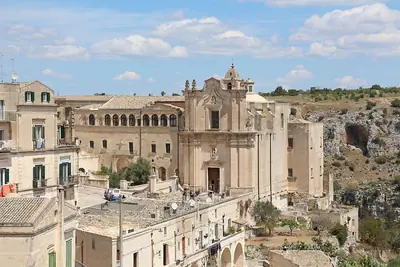
The Augustinian complex, comprising a church and a convent, was erected in the late sixteenth century on the remains of an earlier medieval church dedicated to Saint Augustine. Its elevated position at the edge of the Sassi made it both a spiritual retreat and a landmark above the Gravina ravine. The church was completed in 1595, showing a transition from Late Renaissance to early Baroque with pilasters, niches and an elegant central portal. Inside, the single nave displays altars, frescoes and sculptures that reflect local craftsmanship and broader Italian artistic trends, highlighted by a wooden statue of Saint Augustine still used in religious celebrations. Twentieth‑century restoration has preserved its historic character.
Palazzo dell’Annunziata
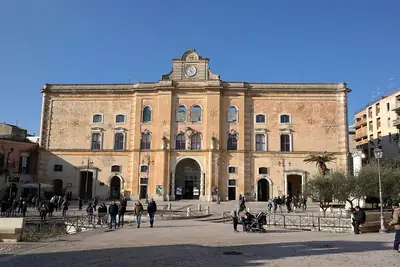
Located in Piazza Vittorio Veneto, this building began as a Dominican monastic complex before becoming a court, a school and finally a repository of knowledge. Designed by Vito Valentino for the Rome Pontifical Commission, work started in 1735 but was halted in 1739 due to difficult foundations that reached about fifteen metres deep. After Valentino’s dismissal, Mauro Manieri arrived from Lecce in 1742 with the Simone brothers to finish the project, altering the internal layout: the original central church was demolished and replaced by an inner courtyard, while a planned external church was never completed. The varying textures in the walls and vaults still testify to this change of hands.
Chiesa di San Giovanni in Monterrone
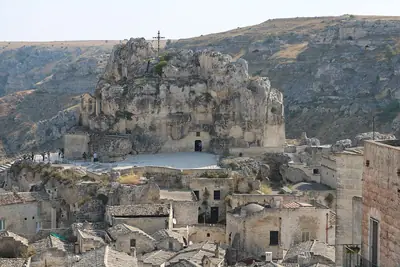
Carved into the Monterrone rock, this rupestrian church is also known as Santa Maria di Idris (Madonna de Idris). It rises above Sasso Caveoso and offers a striking view across Matera. The nave follows the uneven contour of the stone, and the altar holds a seventeenth‑century tempera painting of the Madonna and Child. The name Idris derives from the Greek Odigitria, meaning “the one who shows the way.” A short tunnel links Santa Maria di Idris to the Church of San Giovanni in Monterrone; inside the tunnel a fresco of Saint John the Baptist can be seen, while above the crypt a lunette displays a twelfth‑century Christ Pantocrator.
Chiesa di Santa Lucia alle Malve
Situated near Sasso Caveoso, this rock church was once attached to a women’s Benedictine monastery founded in the eleventh century. It was originally dedicated to Saint Agatha and later to Saint Lucia between 1217 and 1267. After the nuns moved to other monasteries, the former monastic buildings became private homes, leaving the church as the most visible remnant of the complex. The façade features three chalice sculptures from different periods, alluding to Saint Lucia’s martyrdom. Inside, the restored right aisle is open to the public; the other aisles form part of private residences. The three naves are asymmetrical, shaped more by naturally worked stone than by precise craftsmanship, and the inner walls preserve twelfth‑century frescoes discovered in 1977, including the Archangel Gabriel crushing a dragon and a Nursing Madonna.
Castello Tramontano
Perched on Lapillo Hill above the historic centre, this unfinished sixteenth‑century fortress was begun by Count Gian Carlo Tramontano, lord of Matera. Intended to help the count control the surrounding lands and populace rather than defend the city, its Aragonese design shows a central tower flanked by two round side towers with crenellated tops, arrow slits and massive limestone walls. The project was financed through heavy taxes that made the count unpopular; on 29 December 1514 townspeople attacked and killed him after he left the cathedral, halting construction. A curious detail of the revolt mentions rebels gathering behind a rock known as “u pizzon’ du mal consigghj” (the stone of bad advice) to plot their move.
Casa Grotta nei Sassi
The Storica Casa Grotta di Vico Solitario preserves a cave home exactly as it was before the 1952 relocation of Sassi residents. Unlike many cave dwellings turned into hotels, this one retains its original furniture, tools and traces of everyday life. Set in a natural limestone hollow with eighteenth‑century additions, the single chamber lacks separate walls; activities were organised by necessity, with the brighter front area used for cooking, eating and sleeping. A raised bed holds a mattress stuffed with corn, a brazier provides heat, and further inside the space was adapted for work, including a manger for a mule, a manure pit and rough stables. Tools, pottery and a loom illustrate the close link between home and labour, while rock‑cut channels directed rainwater into a cistern to preserve every drop.
Casa Noha
This fifteenth‑century house in the Civita district does not display a collection of objects. Instead, the building itself serves as the exhibit, allowing visitors to understand the city’s history through its architecture and layout.
La Casa di Ortega
Located in Matera, this museum invites visitors to discover a different facet of the city’s story, though the source notes provide only its existence as a museum venue.
National Museum of Matera
Housed in the former Santa Chiara convent, the Domenico Ridola National Archaeological Museum is the oldest museum in Basilicata. Established on 9 February 1911 after Senator Domenico Ridola donated his archaeological collections, it gathers finds from the province of Matera and the Murge ranging from prehistory to the third century BC. Exhibits include Pleistocene tools from the Murgia, arrows, javelins and axes, some from the Bat Cave (Grotta dei Pipistrelli), and remains from Neolithic fortified villages at Tirlecchia, Murgia Timone, Murgecchia and Serra d’Alto, the latter noted for richly decorated pottery. The museum also presents discoveries from the Basento and Bradano river valleys, such as tombs, Iron Age grave goods, funerary offerings, red‑figure pottery and bronze artefacts.
Museo‑laboratorio della Civiltà Contadina
Set in the ancient Sassi district, this ethnographic museum offers a direct view of traditional agricultural and artisan life. It occupies a restored sixteenth‑century lamione built above a cave dwelling (casa grotta), allowing families to live separately from their livestock at night. Inside, a network of recreated rooms shows workshops, domestic interiors and a public wine cellar called a ciddaro. Additional displays explore childhood and brigandage in southern Italian history. Objects are presented not in isolated cases but within environments reconstructed from peasant literature and the memories of elderly local residents.
National Museum of Medieval and Modern Art of Basilicata
Located at Piazzetta Pascoli inside Palazzo Lanfranchi, this museum safeguards the cultural heritage of Basilicata and the identity of the Materan community. The entrance features La Goccia, a sculpture by Kengiro Azuma. Palazzo Lanfranchi has served many roles: it was once a seminary and, from 1864, housed the Emanuele Duni classical high school before the school moved to the upper part of the city. In December 1994 the building was chosen as the museum’s future home; after adaptation work, it opened on May 6 2003, providing a venue for art and cultural memory.
Explore Matera with Neywo
Neywo’s free audio guide lets you discover Matera at your own pace, with no group and no schedule. The app offers three walking tours and one bus route:
- Piano Matera: Piazzas, Palaces and a Door of Skulls – 1.66 km, 93 minutes, 12 stops
- Civita and Sasso Barisano: Cave Churches Under the Cathedral – 1.52 km, 72 minutes, 8 stops
- Sasso Caveoso: Rock Churches Above the Gravina – 2.46 km, 91 minutes, 8 stops
- Linea 1: From Santa Lucia to the Sassi and Beyond (bus) – 9.8 km, 42 minutes, 7 stops
As you reach each point, the app plays the story of that place, so you can listen, look and move forward whenever you wish. Download Neywo to enjoy these narrated walks and rides while you explore the stone streets, caves and vistas of Matera.
Places with an audio guide in Matera
8 places in Matera with a Neywo audio guide. Each one starts telling its story as you reach it.
Self-guided tours in Matera
4 tours in Matera, free in the Neywo app. Each stop tells its story as you reach it.
- Bus ride
Linea 1: From Santa Lucia to the Sassi and Beyond
Ride Miccolis urban line 1 from Santa Lucia alla Fontana past San Domenico on the main square, down to Santa Maria de Armenis above the Sassi, then back up through the Piano past the archaeological museum, San Francesco and San Giovanni Battista, out to the modern church of Maria Madre della Chiesa.
Santa Lucia alla Fontana · Chiesa di San Domenico · Chiesa di Santa Maria de Armenis · National Museum of Matera · San Francesco d'Assisi (Matera) · Chiesa di San Giovanni Battista …
Open this tour: Linea 1: From Santa Lucia to the Sassi and Beyond - Walk
Piano Matera: Piazzas, Palaces and a Door of Skulls
Start under the unfinished castle of a hated count, then cross the elegant upper town, the Piano, that sits on top of the ancient Sassi. A square with a hidden cathedral of water, a hospital turned prison, a Baroque church with a skull-covered door and the museum that began Matera's archaeology tie it together.
Castello Tramontano · Palazzo dell'Annunziata · Piazza Vittorio Veneto · Chiesa di San Domenico · Ex ospedale di San Rocco · Chiesa di San Giovanni Battista …
Open this tour: Piano Matera: Piazzas, Palaces and a Door of Skulls - Walk
Civita and Sasso Barisano: Cave Churches Under the Cathedral
Drop from the Piano into the Sassi and climb to the Civita ridge, where Matera's Romanesque cathedral crowns the cave city. Rock churches, a farmers' life museum in old cave homes and a sculpture museum in a palace carved into the hillside show how people lived in stone for thousands of years.
Museo-laboratorio della Civiltà Contadina · San Pietro Barisano · Convento di Sant'Agostino · Sant'Antonio Abate · Chiesa Madonna delle Virtù · Matera Cathedral …
Open this tour: Civita and Sasso Barisano: Cave Churches Under the Cathedral - Walk
Sasso Caveoso: Rock Churches Above the Gravina
Follow the stepped lanes of Sasso Caveoso, the most traditional cave district, past medieval churches carved into the limestone and a palace museum. End facing the ravine, where the Park of the Rupestrian Churches begins on the far side.
Palazzo Lanfranchi · Chiesa di Santa Maria de Armenis · Chiesa di Santa Lucia alle Malve · Chiesa di Santa Maria di Idris · Chiesa dei Santi Pietro e Paolo · Sassi di Matera …
Open this tour: Sasso Caveoso: Rock Churches Above the Gravina
Walk Matera with Neywo
Neywo turns Matera into a self-guided audio tour. Stories arrive as you reach the place they belong to, and the route reshapes when you wander off it.

