What to See in Groningen, Netherlands: Free Audio Guide
Things to Do in Groningen: What to See in the Northern Netherlands
Groningen is a historic university city in the north of the Netherlands, known for its churches, distinctive museums, lively cultural scene and student atmosphere. The city centre is compact, but its landmarks reveal layers of religious, civic and architectural history. Neywo has a free audio guide for Groningen with 115 narrated places.
What to See in Groningen
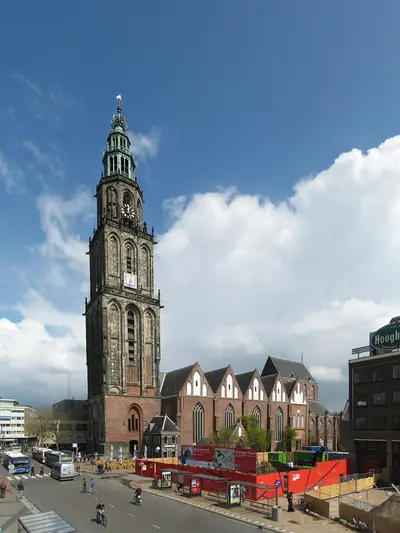
Martinitoren and Martinikerk
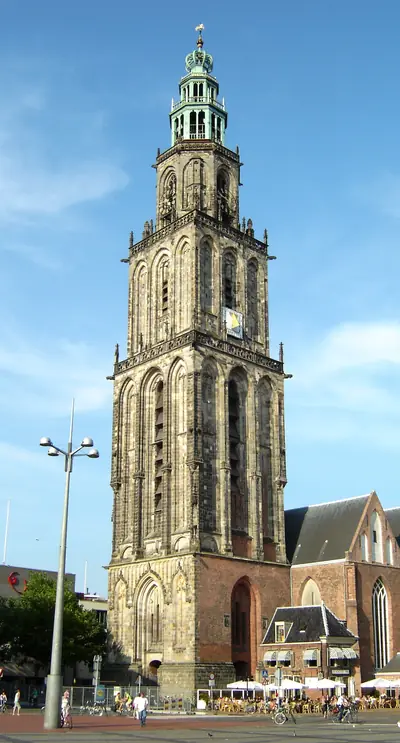
The Martinitoren is Groningen’s most distinctive landmark, rising 96.8 metres above the Grote Markt. Known locally as d’Olle Grieze, or “the old grey one”, it is the city’s tallest tower and belongs to the Martinikerk.
The tower leans by about 0.6 metres and has a foundation reported to be only three metres deep. Inside, its carillon contains 62 bells. A climb follows a steep brick spiral staircase with 260 steps and leads to views across Groningen and the surrounding area.
The Martinikerk is the oldest church in Groningen. The present building is mainly a fifteenth-century hall church, and between 1559 and 1594 it served as the cathedral of Groningen’s first diocese. Together, the church and tower form one of the city’s essential sights.
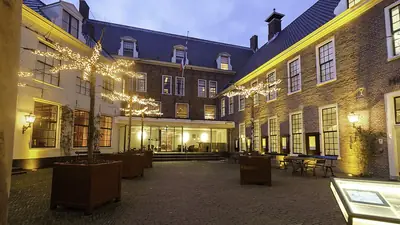
Prinsenhof and the Prinsentuin
At Martinikerkhof, Prinsenhof combines present-day hospitality with a history reaching back to the fifteenth century. The Brothers of the Common Life established themselves here before the building passed through several owners. It later became associated with Groningen’s first bishop and served as a residence for the stadtholder.
The building was transformed into a five-star hotel before 2012. Nearby, the Prinsentuin adds a historic garden setting to this part of the centre.
Der Aa-kerk and Akerkhof
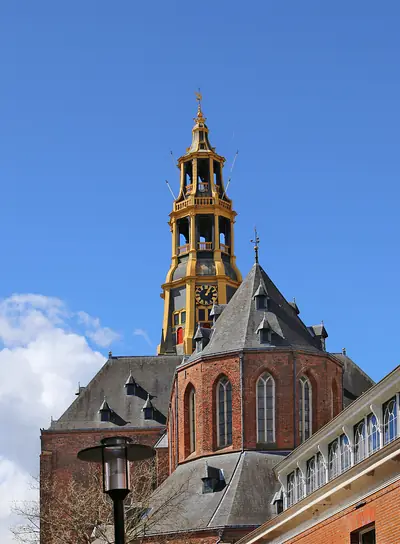
The Der Aa-kerk, also called the A-kerk, is one of Groningen’s most prominent landmarks. The former parish church rises above the centre at the Akerkhof and helps shape the city’s skyline together with the Martinitoren.
Originally built for Catholic worship, it passed to Protestant use during the Reformation. It is now, after the Martinikerk, the most important surviving medieval church building in Groningen. From the Vismarkt, the church rises behind the Korenbeurs, creating one of the city’s characteristic views.
Pelstergasthuiskerk
The Pelstergasthuiskerk was already in use by 1267 and is named after the Pelstergasthuis. Its architecture combines Romanesque and Gothic elements, while the interior includes a seventeenth-century pulpit.
Music is central to the church’s character. Its richly decorated organ was built by Arp Schnitger in stages in 1693 and 1711 to 1712. Albertus Antoni Hinsz moved and adapted it in 1774.
Lutherse Kerk
Opened for worship in 1696, Groningen’s Lutherse Kerk is the only surviving example of the city’s former hidden churches. The national monument is also known as the Swan Church because of the stone swan at the top of its façade.
Two organs tell part of its musical history: one built by the Van Oeckelen firm in 1896, and a 2017 reconstruction by Bernhardt Edskes of an Arp Schnitger organ from 1717. The church is also home to the Luther Bach Ensemble.
Nieuwe Kerk and the Hortusbuurt
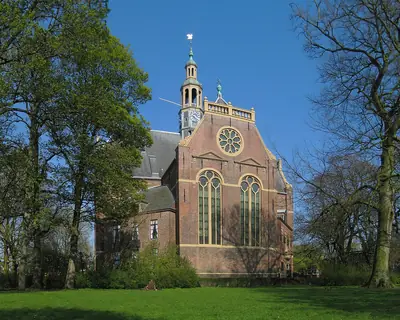
The Nieuwe Kerk is a Protestant church and protected monument in Groningen’s Hortusbuurt. It stands on the northernmost hill of the Hondsrug, known as the Noordes or Tie. Its name refers to the older Sint-Walburgkerk, while the church was also known as the Noorderkerk, or North Church, in the eighteenth century.
Built at the beginning of the seventeenth century, it was Groningen’s first Protestant church. The nearby Nieuwe Kerkhof is the centre of Binnenstad Noord and has been designated by the municipality as a Groene Parel, or special green space.
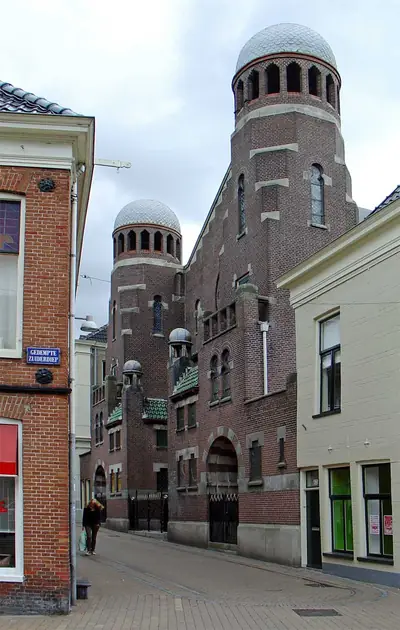
Synagogue Groningen
On Folkingestraat, the Synagogue Groningen offers a place to learn about Jewish culture, religion and the history of Jewish communities in Groningen and the province.
Designed by Tjeerd Kuipers, the synagogue was inaugurated in 1906 and remained in use until 1942. It was rededicated for worship in 1981. The prayer hall was made smaller to create space for a museum area. On the Nieuwstad side, the building adjoins the Rabbinate House from 1890, which includes a bathhouse; two of its four ritual baths can be viewed. Remains of the former Zwaantjesgang can be found behind the synagogue.
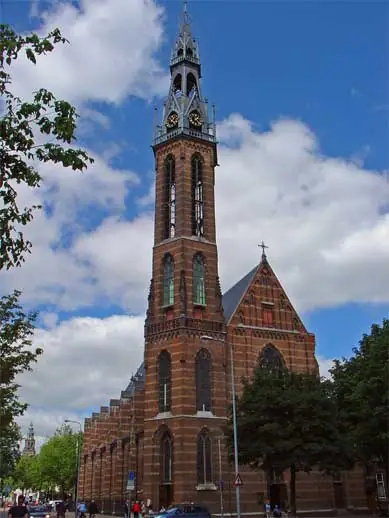
St. Joseph Cathedral
The St. Joseph Cathedral, known in Dutch as the Sint-Jozefkathedraal, is the cathedral of the Roman Catholic Diocese of Groningen-Leeuwarden. Its full name is the Cathedral Church of Saints Martin and Joseph.
The building was designed by Pierre Cuypers, with contributions from his son, Jos Cuypers. It is also part of Groningen’s St. Martinus inner-city parish.
Groninger Museum
The Groninger Museum presents modern and contemporary work by local, national and international artists. Its building is an attraction in its own right, formed from three main sections created through a collaboration between Alessandro Mendini, Philippe Starck, Coop Himmelb(l)au and Michele de Lucchi.
The central building contains the entrance, a tall gold-coloured storage tower and the restaurant. The western pavilion includes the permanent presentation of artists from De Ploeg, as well as Japanese and Chinese porcelain. The eastern pavilion hosts changing exhibitions, which range from archaeological discoveries to modern art.
City Theatre Groningen
The City Theatre Groningen, or Stadsschouwburg, is the most important theatre in the Dutch province of Groningen. Its auditorium has 750 seats, creating an intimate relationship between performers and audience.
Completed in 1883, the building was designed in the Neo-Renaissance style by Frederik Willem van Gendt and Hugo Pieter Vogel. It has been recognised as a national monument since 1994.
More historic churches and sites
Groningen’s architectural story continues beyond the centre. The Zuiderkerk on Stationsstraat dates from the first years of the twentieth century. Designed by Tjeerd Kuipers and Ytzen van der Veen, it served as a Reformed church until 1983 before becoming an apartment complex. It is a protected national monument.
De Olle Kerk, also called De Dorpskerk, stands in Hoogkerk beside the Hoendiep. The thirteenth-century church originally had a tower, which was lost in 1514 during the conflict between the city of Groningen and Saxony.
The Oosterkerk, or Eastern Church, has stood in Groningen’s Oosterparkbuurt since its completion in 1929. Farther from the central landmarks, the remains of Kasteel Selwerd lie beneath the Huppels, gently rolling grassland beside Selwerderhof cemetery. The fortified medieval stone house once stood on two raised platforms. Since 1975, the site has been protected as an underground national archaeological monument.
Explore Groningen with a self-guided audio tour
A Groningen self-guided walking tour lets you discover the city without joining a group or following a fixed schedule. Neywo offers four walking tours and one bus route, with narration available in 11 languages.
The four walks are:
- The Old Grey One and the Prince’s Garden: 1.39 km, 106 minutes and 12 narrated stops.
- Gold, Grain and Hidden Churches: 1.51 km, 93 minutes and 11 narrated stops.
- Station, Colourful Museum and Synagogue: 2.37 km, 115 minutes and 11 narrated stops.
- Scholars, Friars and the Northern Hill: 2.82 km, 113 minutes and 12 narrated stops.
There is also one bus route, Bus 19: Noorderplantsoen to the Hereplein, covering 2.5 km in 11 minutes with seven narrated stops.
Download Neywo and explore Groningen at your own pace. The app tells the story of each place as you reach it, with no group and no schedule. It is a free Groningen audio guide covering 115 narrated places, making it easy to combine the city’s churches, museum, theatre and historic streets in one independent visit.
Places with an audio guide in Groningen
8 places in Groningen with a Neywo audio guide. Each one starts telling its story as you reach it.
Self-guided tours in Groningen
5 tours in Groningen, free in the Neywo app. Each stop tells its story as you reach it.
- Bus ride
Bus 19: Noorderplantsoen to the Hereplein
A regular Qbuzz city line from Paddepoel through the western edge of the centre to the station area. Ride it from the Plantsoenbrug beside the Noorderplantsoen past the comic museum, the Cascadeplein sculpture Ultra and the Zuiderkerk to the 1906 synagogue and the Hereplein: seven sights on one cheap ride.
Plantsoenbrug · Nederlands Stripmuseum · Dreckschnabel · Ultra · Zuiderkerk · Synagogue Groningen …
Open this tour: Bus 19: Noorderplantsoen to the Hereplein - Walk
The Old Grey One and the Prince's Garden
Groningen's heart is the Martini quarter. Look up at the 97-metre tower locals call the old grey one, see Saint George slay a dragon with the face of defeated occupation, then slip behind the Prinsenhof into a Nassau prince's secret formal garden from 1626. Finish past an 18th-century almshouse and the 1883 City Theatre.
Pepergasthuiskerk · Nieuwe Markt · Martinitoren · Sint-Joris en de draak · Martinikerk · Walburgkerk (Groningen) …
Open this tour: The Old Grey One and the Prince's Garden - Walk
Gold, Grain and Hidden Churches
A walk west from one of the oldest stone houses in the city, past a Mennonite church once hidden behind a house, the old tax office and a Lutheran church that stayed hidden for centuries. See the fish market where Groningen has traded since the 1400s, the grain exchange and the medieval A-kerk, and end at the old merchants' houses of the former maritime museum.
Calmershuis · Doopsgezinde Kerk · Goudkantoor · Pelstergasthuiskerk · Lutherse Kerk (Groningen) · Vismarkt …
Open this tour: Gold, Grain and Hidden Churches - Walk
Station, Colourful Museum and Synagogue
Leave the railway station past the Horse of Uncle Lucas and cross to the colourful Groninger Museum on its canal island. Walk through the south of the old town to the 1906 synagogue, the Remonstrant church, the Hereplein and its bronze Blote Bet, then the red-brick cathedral, the Rademarkt and the love-lock bridge on the eastern canal.
Groningen railway station · Peerd van Ome Loeks · Groninger Museum · Zuiderkerk · Synagogue Groningen · Remonstrantse kerk …
Open this tour: Station, Colourful Museum and Synagogue - Walk
Scholars, Friars and the Northern Hill
Follow the story of the second-oldest university in the Netherlands, from the Franciscan friars' church to the university's founding in 1614 and its museum. Then head north past the almshouse for needy women and the Nieuwe Kerk, Groningen's first Protestant church, on the Hondsrug hill, and finish in the Noorderplantsoen park and its bridge over the Reitdiep.
Non scholae, sed vitae · University Museum Groningen · University of Groningen · Broerkerk · Franciscan monastery · Ossenmarkt …
Open this tour: Scholars, Friars and the Northern Hill
Walk Groningen with Neywo
Neywo turns Groningen into a self-guided audio tour. Stories arrive as you reach the place they belong to, and the route reshapes when you wander off it.

