Things to Do in Delft, Netherlands: Walking Guide
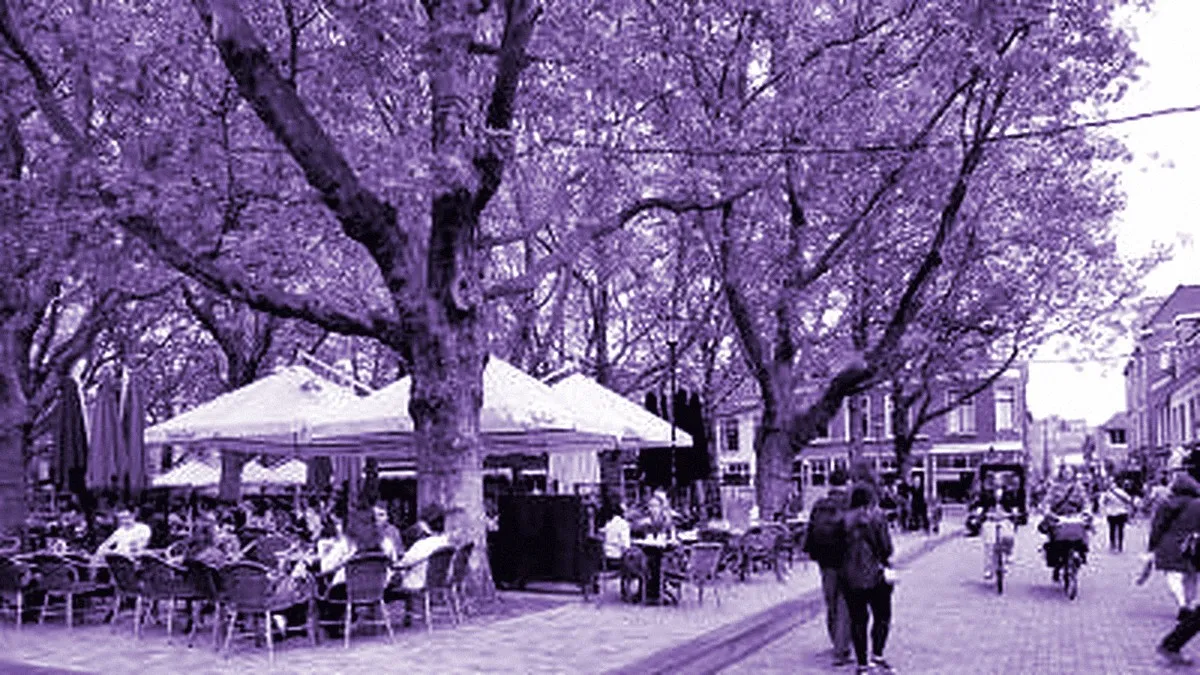
Things to Do in Delft: Historic Churches, Canals and Delft Blue
Delft is a compact historic city in South Holland, known for its canals, Gothic churches, Golden Age heritage and Delft Blue pottery. The old center brings together royal history, religious buildings, fortifications and public art, making it an excellent city to explore on foot. Neywo offers a free audio guide for Delft with 100 narrated places.
What to See in Delft
Nieuwe Kerk Delft
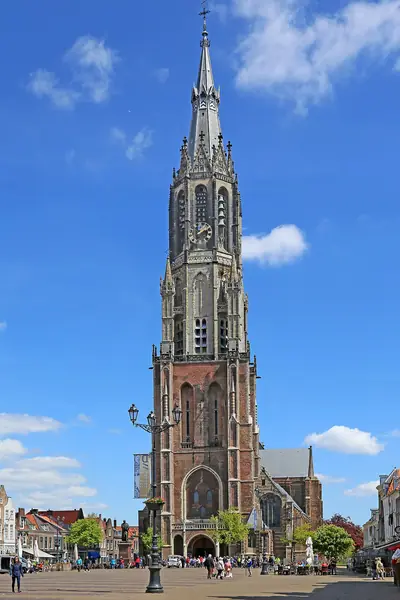
On Markt square, the Nieuwe Kerk stands opposite Delft’s City Hall. Its Gothic tower rises 108.75 metres, making it the second-highest church tower in the Netherlands. Construction took place over more than a century: a temporary wooden church was consecrated in 1382, while the stone building began in 1384 and the tower was completed in 1496.
The church contains the Tomb of William the Silent, above the burial vault of the House of Orange. Its history also includes major disasters: lightning caused a fire in 1536, the Delft Thunderclap of 1654 shattered its stained-glass windows, and another lightning strike damaged the tower in 1872. Visitors who climb to the top face 356 steps.
Oude Kerk
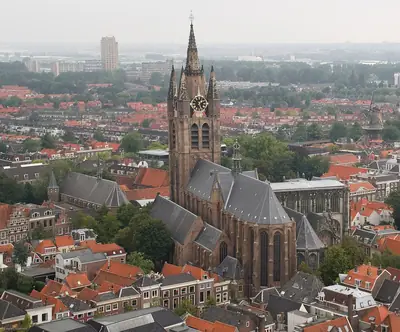
Delft’s oldest church dates from 1246 and stands between the Oude Delft and Voorstraat canals. Its 75-metre brick tower leans about two metres from the vertical, earning it the nicknames Oude Jan and Scheve Jan.
Inside, the basilica has a central nave, two aisles and three pipe organs. The massive Trinitasklok, or Bourdon bell, was cast in 1570 and weighs nearly nine tonnes. Its vibrations are so powerful that it is rung only on special occasions, including the burial of a member of the Dutch royal family in the nearby Nieuwe Kerk.
Prinsenhof
Het Prinsenhof is Delft’s municipal museum, housed in a former monastery founded in 1403 as the Catholic monastery of Saint Agatha. It later became the residence of William of Orange. On 10 July 1584, William was shot and killed here by Balthasar Gerards. The two bullet holes in the wall can still be seen.
The surviving convent spaces include the cloister, a west section beneath a barrel vault and a sacristy with star vaults. The museum’s collections focus on William the Silent, the Delft Masters and Delftware, also known as Delft Blue. The site connects Delft’s political history with its art, ceramics and scientific heritage.
Lutherse Kerk
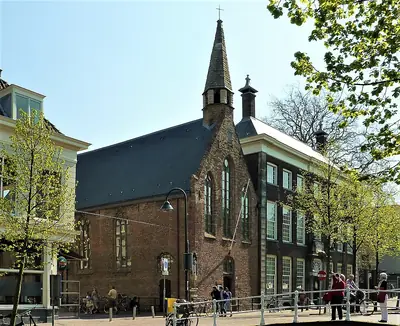
The Lutherse Kerk on Noordeinde began as Saint George’s Chapel, connected with the Saint George Hospital. Although the present building dates from the second half of the fifteenth century, documents mention an earlier church here in 1407.
The building has served several purposes. From the late sixteenth century until 1764, it was a city artillery storehouse; around 1600 to 1677, it also functioned as a dolhuis, or house for people with mental illness. In 1768, it became a Lutheran church. The later stone façade and steeples were designed by city architect Nicolaas Terburgh, while the older structure behind them includes Delft’s only wooden roof dating from before the great city fire of 1536.
Saint Hippolytus Chapel
Beside the Oude Delft canal, the Gothic Saint Hippolytus Chapel is one of Delft’s oldest buildings. It was built around 1400 for the Holy Spirit Sisters’ House and consecrated in 1412.
The chapel was badly damaged in the fire of 1536. After the Reformation, it was emptied and later used as a depot, although part of it continued to host Protestant services. Restored in the twentieth century, it has been used again as a Roman Catholic chapel since 1972.
Eastern Gate
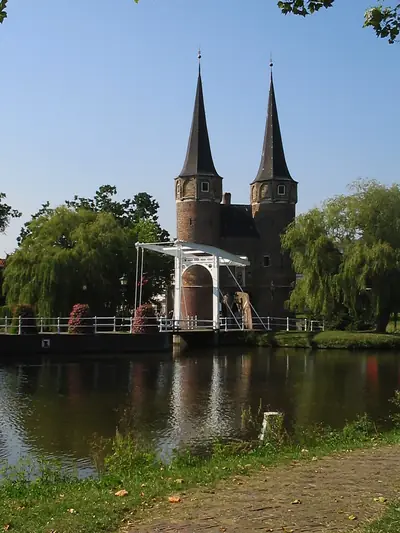
The Eastern Gate, or Oostpoort, is Delft’s only surviving medieval city gate. Built around 1400 in the Brick Gothic style, it combines a land gate and a water gate with remains of the old city wall. Openings in the lower wall once allowed defenders to shoot arrows at attackers.
The towers were raised in the sixteenth century with an extra polygonal floor and tall pointed spires. Delft’s other city gates were demolished during the nineteenth century, but the Eastern Gate remained. It was fully restored in 1964 and is now recognized as a national monument.
Klal Israël synagogue
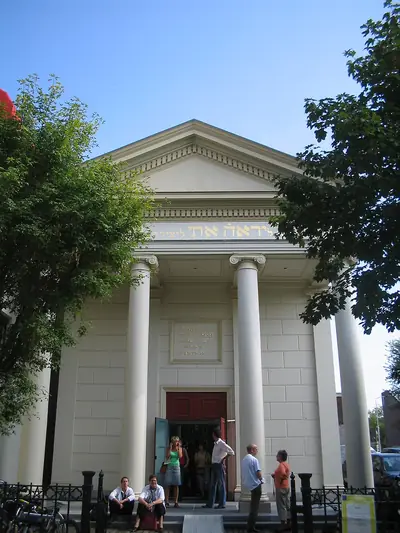
At Koornmarkt 12, Klal Israël has a white-plastered Neoclassical façade with an Ionic temple front. The synagogue was built between 1861 and 1862, and original architectural details and wooden furnishings have been preserved.
After the Second World War, it was no longer used for its original purpose. The building was restored in 1974 and later served as part of the Stedelijke Muziekschool. Since January 2006, Klal Israël has held services here. The building is also a cultural center for exhibitions, lectures, concerts and other activities.
The Blue Heart and Maria van Jessekerk
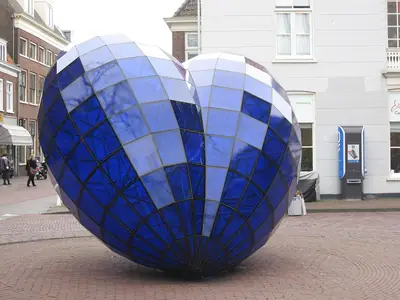
At the end of Oude Langendijk, the Blue Heart is a public sculpture made from blue glass panels set into a stainless-steel frame. Designed by Marcel Smink and installed in 1998, it links Delft’s Delft Blue tradition with the city’s technical identity and Delft University of Technology.
Nearby, the Maria van Jessekerk is a neo-Gothic Roman Catholic parish church with twin towers and a cruciform design. It was built between 1875 and 1882 to designs by Evert Margry. Originally dedicated to Saint Joseph, it has been dedicated to Maria van Jesse since 1971.
Other historic churches and buildings
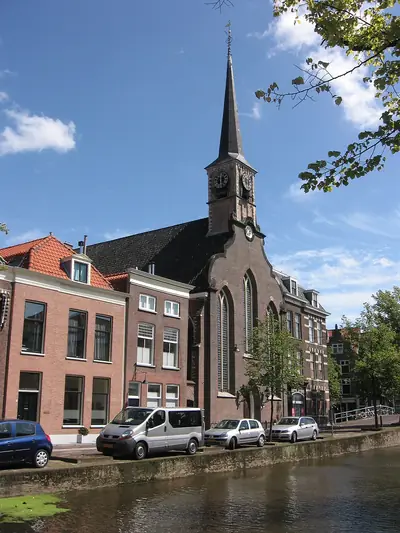
Delft’s religious history continues beyond its best-known churches. The Raamstraatkerk is officially the Church of Saints Francis and Clare and has belonged to Saint Ursula Parish since 2009. The Vredeskerk, also known as the Church of Peace or the Church of the Most Holy Sacrament, was constructed between 1938 and 1940.
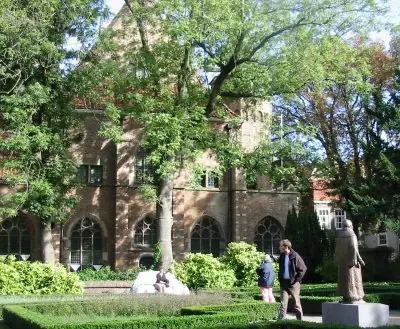
The H.H. Maria en Ursulakerk, or Schuilkerk, is an Old Catholic church hidden behind the historic frontage of the Bagijnhof. It came into use in 1743 as a concealed church. The Sint-Stanislaskapel, built in 1955, is connected with the neighboring Stanislascollege and a Jesuit community.
On Oude Delft, the Génestetkerk stands behind a gate in an inner courtyard on the site of a hidden church dating from 1638. The present building was constructed in 1896 for the Remonstrant community. Nearby, the Meisjeshuis was erected in 1769 in the Louis XV style and served as an orphanage for half-orphaned girls from Reformed families from 1578 until the middle of the twentieth century.
The Huibrechtstoren is another surviving part of Delft’s defenses. Built in the first quarter of the sixteenth century beside the Schie, it was used to store weapons and gunpowder. Today it stands beside a rowing boathouse used by De Delftsche Sport. The Immanuëlkerk on Schoemakerstraat adds another layer to Delft’s religious history and was owned by the Reformed Churches Liberated from 2013.
Explore Delft with a Self-Guided Audio Tour
A Delft self-guided walking tour lets you discover the city at your own pace, without joining a group or following a schedule. Neywo has five walking tours, one bus route and one bike route in Delft, with lengths ranging from 1.36 to 2.8 km for the walks, 1.7 km for the bus route and 2.4 km for the bike route. They last between 69 and 118 minutes on foot, 7 minutes by bus and 12 minutes by bike, and include between 4 and 11 narrated stops. Narration is available in 11 languages.
The walks cover themes including William the Silent and the Golden Age, hidden churches and hofjes, Delft Blue, the Old Canal and the TU Delft campus. The bus route follows the west side of Delft’s old town, while the bike route runs from the Prinsenhof to the Eastern Gate.
Download Neywo and explore Delft with an audio guide that tells the story of each place as you reach it. Walk, cycle or take the bus at your own pace, with no group and no schedule, and discover Delft’s history one stop at a time.
Delft is part of South Holland in the Netherlands. For more city walks in the region, continue to Leiden, Rotterdam or The Hague.
Places with an audio guide in Delft
8 places in Delft with a Neywo audio guide. Each one starts telling its story as you reach it.
Self-guided tours in Delft
7 tours in Delft, free in the Neywo app. Each stop tells its story as you reach it.
- Bike ride
From the Prinsenhof to the Eastern Gate: Delft by bike
Cycle from the Prinsenhof along the quiet Oude Delft canal and through the university quarter: a factory now a cultural building, the Zuiderkerk and the Hortus Botanicus, ending at Delft's medieval Eastern Gate. Delft is flat and cycle-friendly, and most of the ride is on cycle lanes.
Prinsenhof · Sint-Barbaraklooster · Bacinol 2 · Zuiderkerk · TU Delft Hortus Botanicus · Eastern Gate
Open this tour: From the Prinsenhof to the Eastern Gate: Delft by bike - Bus ride
Bus 53: down the west side of Delft's old town
A regular city bus that runs along the western edge of Delft's old town towards the station. Ride it past the Water Carriers sculpture and the Naundorff memorial, the last windmill De Roos, the Indië monument by the Prinsenhof and the Sint-Barbara convent on the Oude Delft canal.
Karl Wilhelm Naundorff · De Roos · Indië-monument · Sint-Barbaraklooster
Open this tour: Bus 53: down the west side of Delft's old town - Walk
William the Silent and the Golden Age
Delft's market square is where the Dutch Golden Age still feels close. Walk from the old weigh house past the Renaissance town hall, the Vermeer Centre, the Grotius statue and the towering New Church, then on to the Old Church with its leaning tower, the Prinsenhof, where the bullet holes that killed William of Orange can still be seen, and a church hidden in a courtyard on the old canal.
Waag · Town hall of Delft · Markt · Vermeer Centre · Oude Manhuissteeg · Statue of Hugo Grotius in Delft …
Open this tour: William the Silent and the Golden Age - Walk
Hofjes, Hidden Churches and the Last Windmill
Quiet canals and courtyards in the west of the old town. Visit a collector's neo-Renaissance house, a church hidden behind a house front, a medieval watchtower, Delft's last windmill, a water tower with a hidden sculpture and three of the four surviving hofjes, the almshouse courtyards that once cared for the poor.
Lambert van Meerten Museum · H.H. Maria en Ursulakerk · Hofje van Almonde · Bagijnetoren · De Roos · Water Carriers …
Open this tour: Hofjes, Hidden Churches and the Last Windmill - Walk
Gate, Garden and Delft Blue
From a loan-bank gable stone and the cattle-market square to the only surviving medieval gate of Delft, then south through the university district: a botanical garden, a mineral museum and the factory that has made Delft Blue since 1653. A longer, calmer walk through the technical side of the city.
Stadsleenbank Delft · Beestenmarkt · Oosteinde 175, Delft · Klaauwshofje · Eastern Gate · TU Delft Hortus Botanicus …
Open this tour: Gate, Garden and Delft Blue - Walk
Along the Old Canal: synagogue, convents and the city's oldest waterway
A compact walk through the south-central old town. Start at a house museum in a 16th-century canal house, pass the neoclassical synagogue, the old canal that Delft was founded on, a former convent and the Armamentarium, and end at two churches, the modern theatre and the city library.
Saint Hippolytus Chapel · Museum Paul Tétar van Elven · Synagoge · Oude Delft 38 · Sint-Barbaraklooster · Legermuseum …
Open this tour: Along the Old Canal: synagogue, convents and the city's oldest waterway - Walk
Technology City: the TU Delft campus
Delft is also a university town. Walk past a student-built concrete sculpture and the Huygens statue to the main campus of TU Delft, founded in 1842 as a Royal Academy, and finish at the old gunpowder store built outside the walls after the explosion of 1654.
Immanuëlkerk · De Vier Elementen · Christiaan Huygens · Concrete lip · Delft University of Technology · Kruithuis
Open this tour: Technology City: the TU Delft campus
Walk Delft with Neywo
Neywo turns Delft into a self-guided audio tour. Stories arrive as you reach the place they belong to, and the route reshapes when you wander off it.

