What to See in Leiden, Netherlands: Free Audio Guide
Things to do in Leiden: historic churches, museums and canals
Leiden is a historic Dutch university city shaped by canals, churches, museums and centuries of scholarship. The compact centre is easy to explore on foot, with landmarks ranging from the medieval Burcht van Leiden to the Hortus botanicus Leiden and museums devoted to archaeology, science and world cultures. Neywo offers a free audio guide for Leiden with 100 narrated places, available in 11 languages.
Part of South Holland in the Netherlands, Leiden is especially rewarding for travellers who want to combine major cultural sights with the atmosphere of an everyday Dutch city.
What to see in Leiden
The best way to discover Leiden is to follow its historic streets and canals, moving between landmarks from different periods. These are some of the most important places to include.
Pieterskerk
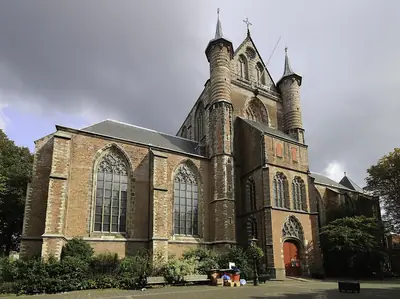
Pieterskerk is one of Leiden’s most important historic churches. Dedicated to Saint Peter, it served as the city’s main church for centuries, and Saint Peter’s keys gave Leiden both its coat of arms and its nickname, the City of Keys.
The present late-Gothic building took shape over roughly 180 years from 1390 and was completed in the sixteenth century. It became Protestant in 1572. After ceasing to function as a church in 1971 and undergoing major restoration, Pieterskerk became a venue for a wide range of events.
Burcht van Leiden
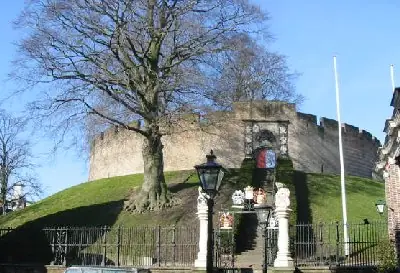
The Burcht van Leiden, or Leiden Castle, stands where the Oude Rijn and Nieuwe Rijn come together. The circular shell keep occupies a motte—an artificial hill that provided high ground in an otherwise level landscape—and is now surrounded by a public park.
An early fort was built here in 1060 by Halewijn I, the viscount of Leiden. The structure was rebuilt during the eleventh century, first in volcanic tuff and later in brick. As the city expanded around it, the Burcht gradually lost its defensive importance and became more of a historic symbol.
Hooglandse Kerk
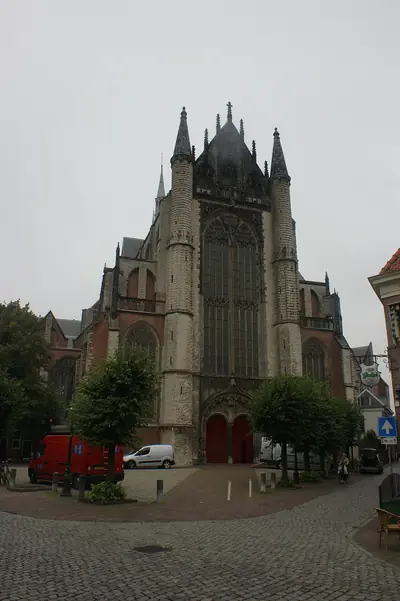
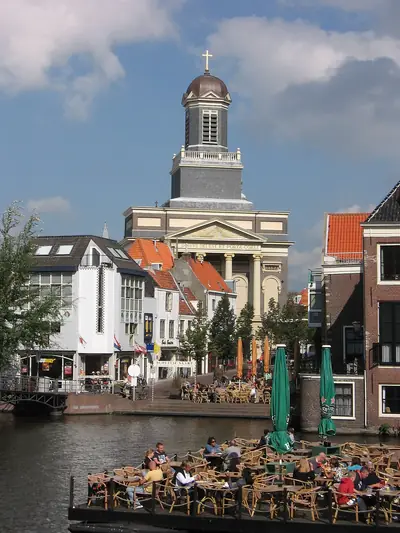
The Hooglandse Kerk is one of Leiden’s most distinctive Gothic churches. Its unusual proportions come from the contrast between the high choir and transept and the lower nave and tower.
The earliest chapel on this site was authorized in 1314 and dedicated to Saint Pancras. A stone church followed in 1377, before the larger building was developed. Although the church was intended to be grand, parts of the nave and other elements remained unfinished, helping create the silhouette visible today.
De Valk
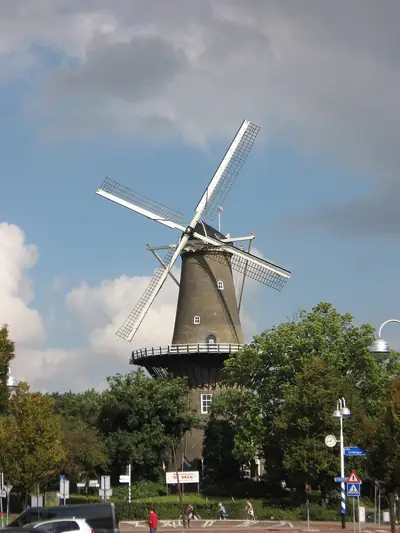
De Valk is the only surviving windmill of the nineteen mills once built on Leiden’s walls. The present stone mill was built in 1743, replacing two earlier mills on the same site.
Today, De Valk is both a working windmill and a museum. Its exhibitions explain how the mill operated, while the upper levels reveal its machinery and working spaces. The lower parts also show how the building was arranged as a home for the miller and his assistant.
Hartebrugkerk
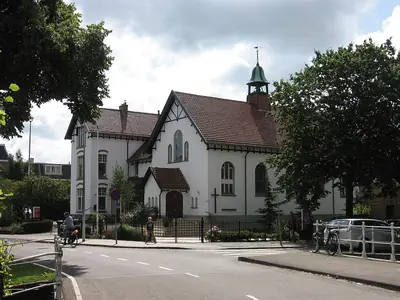
Hartebrugkerk is formally known as Onze Lieve Vrouw Onbevlekt Ontvangen and belongs to the Parish of Saints Peter and Paul. Its name comes from the Hartebrug, a bridge that once stood in front of the church.
The building is also known locally as the Coeliekerk. The nickname refers to the final word of the Latin inscription above the entrance, “Hic Domus Dei est et Porta Coeli”—“This is the house of God and the gate of heaven.”
Rijksmuseum van Oudheden
The Rijksmuseum van Oudheden is the Netherlands’ national archaeological museum and national centre for archaeology. Beside the Rapenburg, it occupies a historic complex that includes a grand townhouse, an old almshouse and a former beguinage.
Founded by King William the First in 1818, the museum grew from the collection of Leiden University. Its collections cover ancient Egypt, the ancient Near East, Greece, Etruria, Rome and the early history of the Netherlands, with more than 150,000 artefacts in five main presentations.
One of its most striking sights is the Temple of Taffeh in the reception area. About 2,000 years old and commissioned by the Roman Emperor Augustus, it was transported to the museum stone by stone.
Naturalis Biodiversity Center
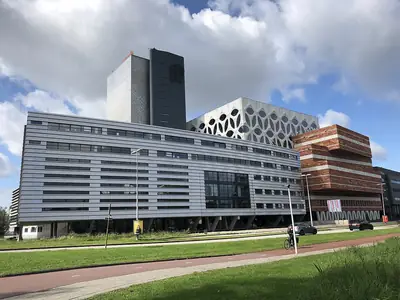
Naturalis Biodiversity Center combines a national natural history museum with a biodiversity research centre. Its collection contains approximately 42 million zoological, geological and botanical specimens, making it one of the largest natural history collections in the world.
The present facilities opened on August 31, 2019, after renovation and expansion. The museum’s collections and research connect Leiden with the study of the natural world, while its exhibitions make biodiversity accessible through specimens and scientific interpretation.
Leiden University and the Oude Sterrewacht
Leiden University is the oldest university in the Netherlands. Founded in 1575 by William, Prince of Orange, it is a public research university with buildings and facilities spread across the city.
The Oude Sterrewacht, or Old Observatory, is one of the university’s historic buildings and observatories. Together, the university and its observatory help explain Leiden’s long-standing identity as a city of learning and research.
Gijselaarsbank
At the head of the Rapenburg, the Gijselaarsbank is a symmetrical memorial bench dating from 1920. Also known as the Werkelozenbank, it was created in honour of Nicolaas Charles de Gijselaar, who served as Leiden’s mayor from 1910 to 1927.
It is a small landmark, but a useful stop on a walk along the Rapenburg, where university buildings, museums and historic architecture come together.
Wereldmuseum Leiden
Wereldmuseum Leiden is one of the Netherlands’ Rijksmuseums devoted to world cultures. Its collections bring together objects reflecting the history and material culture of communities across Africa, Asia, the Americas and Oceania.
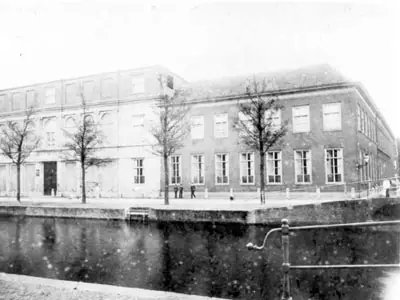
The museum opened in 1837 as the Ethnographic Museum and has been housed since 1937 in a monumental complex that previously served as an academic hospital. Since 2023, it has used the name Wereldmuseum Leiden. The collections extend beyond Japan to include objects from China, Indonesia, Korea, Africa, Latin America, North America, Oceania and other parts of Asia.
Hortus botanicus Leiden
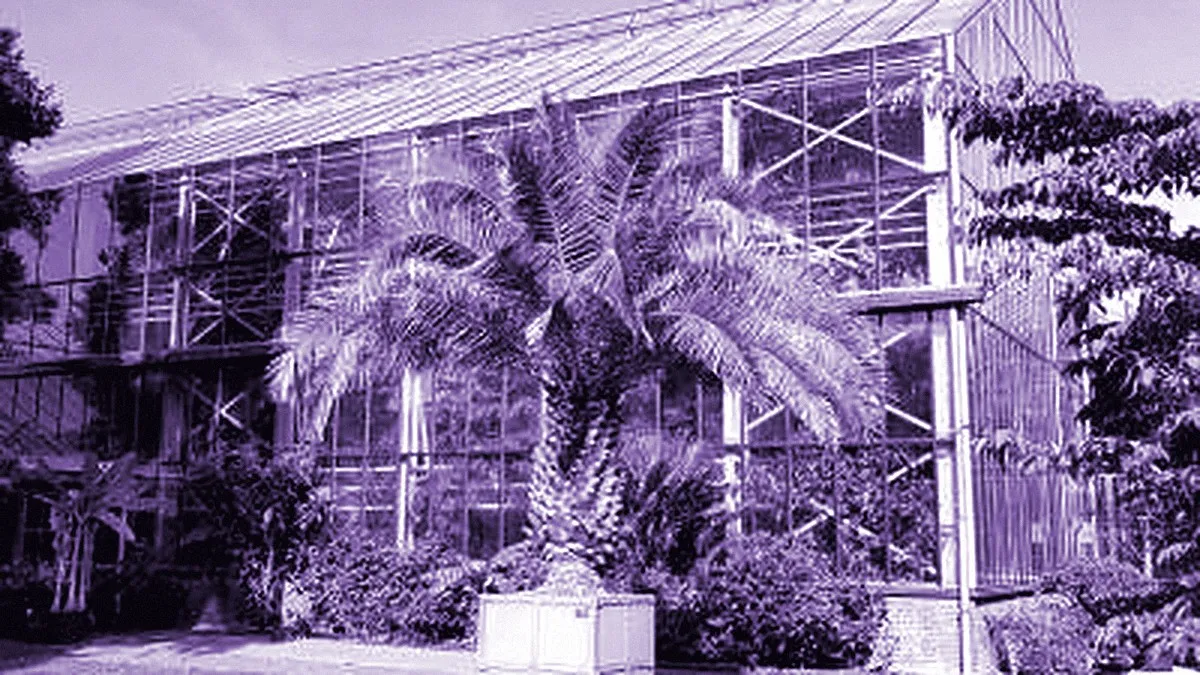
Between the Academy Building and the old Observatory, Hortus botanicus Leiden brings living plants and centuries of botanical study together. Established in 1590 for Leiden University, it is the oldest botanical garden in the Netherlands and one of the oldest in the world.
The garden was created especially to support the education of medical students and was open to the public from the beginning. Today, more than ten thousand species grow in its beds and collections. Highlights include flesh-eating plants, ancient cycads, tropical greenhouses dating from 1938 and a Winter Garden opened in 2000. A reconstruction of Clusius’s original garden, based on a late-sixteenth-century plant list, was opened in 2009.
Rijksmuseum Boerhaave
Rijksmuseum Boerhaave explores the history of science and medicine, with collections focused on medicine, physics and astronomy. Its building has served as a convent, pest house, lunatic asylum and hospital before becoming a museum.
The galleries include the apparatus used by Heike Kamerlingh Onnes when he first liquefied helium in Leiden, equipment associated with the research of physicist Wander Johannes de Haas, and an example of the Leiden jar. A reconstructed traditional anatomical theatre is another memorable feature.
Other historic landmarks
Several smaller landmarks add depth to a walk through Leiden. The Fredericus en Odulfuskerk, at the corner of Zoeterwoudsesingel and Cronesteinkade, belongs to the Old Catholic Church and is protected as a national monument. D’Heesterboom, beside the Noordman timber business on the Haagweg, is a distinctive sawmill with three saw frames, including a frame that combines sawing and ripping timber.
Explore Leiden with Neywo
A Leiden self-guided walking tour lets you follow the city’s history without joining a group or keeping to a fixed timetable. Neywo has six walking tours, one bus route and one bike route in Leiden:
- Rapenburg: The Canal of Scholars — 2.23 km, 97 minutes, 12 narrated stops
- Pilgrims, Counts and a Castle on a Hill — 2 km, 103 minutes, 12 stops
- From the Windmill to the Weigh House — 1.36 km, 84 minutes, 12 stops
- Rembrandt’s Leiden and the World — 1.87 km, 71 minutes, 9 stops
- Science, Naturalis and Western Leiden — 2.21 km, 81 minutes, 8 stops
- Weavers, Gates and the Eastern Ramparts — 3.41 km, 106 minutes, 11 stops
- Bus 54: Leiden’s Old Town by City Bus — 6.1 km, 26 minutes, 8 stops
- Leiden by Bike: Windmills, Rembrandt and the World Museum — 4.2 km, 21 minutes, 8 stops
Download Neywo and explore Leiden at your own pace. The app tells the story of each place as you reach it, with no group and no schedule.
Places with an audio guide in Leiden
8 places in Leiden with a Neywo audio guide. Each one starts telling its story as you reach it.
Self-guided tours in Leiden
8 tours in Leiden, free in the Neywo app. Each stop tells its story as you reach it.
- Bike ride
Leiden by Bike: Windmills, Rembrandt and the World Museum
A short ride along Leiden's cycle lanes from the Antoniuskerk and the D'Heesterboom windmill past the Rembrandt Bridge, the Wereldmuseum and the station to De Valk, the last windmill on the city walls, and the weavers' museum.
Antoniuskerk · D'Heesterboom · Leonarduskerk · Rembrandt bridge · Wereldmuseum Leiden · Leiden Centraal railway station …
Open this tour: Leiden by Bike: Windmills, Rembrandt and the World Museum - Bus ride
Bus 54: Leiden's Old Town by City Bus
A regular Qbuzz city line that runs from Leiden Centraal through the old town, past the Beestenmarkt, the Gijselaarsbank memorial bench, the Walloon Church, the Renaissance city hall and the synagogue, then on to the Antoniuskerk and the Joke Smit monument in the south-west. A cheap way to cross the historic centre.
Boerhaave statue · Beestenmarkt · Gijselaarsbank · Waalse Kerk, Leiden · Leiden City Hall · Synagogue, Leiden …
Open this tour: Bus 54: Leiden's Old Town by City Bus - Walk
Rapenburg: The Canal of Scholars
Stroll along Leiden's most elegant canal, where a 1590 botanical garden, a seventeenth-century library, Japanese collections and the Netherlands' archaeological museum all stand within a few hundred metres. Visit the university museum in the Academy Building, the house where Rembrandt enrolled in 1620 and the physics lab of Kamerlingh Onnes. A walk through four centuries of university life.
Gijselaarsbank · Rapenburg 10, Leiden · SieboldHuis · Bibliotheca Thysiana · Rijksmuseum van Oudheden · Leiden University Library …
Open this tour: Rapenburg: The Canal of Scholars - Walk
Pilgrims, Counts and a Castle on a Hill
Begin at Pieterskerk, where the Pilgrims' pastor is buried, then pass the Counts' old prison tower at the Gravensteen and the hidden Lokhorstkerk. Cross the corn-merchants' bridge, find the town hall where Pilgrims were married, climb the motte of the eleventh-century Burcht, and finish at the hidden Lutheran church and the last surviving stretch of Leiden's medieval wall.
Pieterskerk · Gerecht · Gravensteen · Lokhorstkerk · Leiden American Pilgrim Museum · Leiden City Hall …
Open this tour: Pilgrims, Counts and a Castle on a Hill - Walk
From the Windmill to the Weigh House
Begin at De Valk, the last windmill on Leiden's walls, and move through the city's museum quarter: the old cloth hall, the oldest theatre in the Netherlands and the science museum Boerhaave. Pass the churches and bridges of the old merchant streets and finish by the historic Weigh House on the Aalmarkt.
De Valk · Lammermarkt · Museum De Lakenhal · Scheltema Leiden · Leidse Schouwburg · Marekerk …
Open this tour: From the Windmill to the Weigh House - Walk
Rembrandt's Leiden and the World
Start at the Boerhaave statue and the station, visit a museum of world cultures set in a former academic hospital, cross the bridge named for Leiden's most famous son, see him as a boy in bronze and pass the western city gate. A short, easy walk with a touch of Golden Age.
Boerhaave statue · Leiden Centraal railway station · Wereldmuseum Leiden · Lopsen monastery in Leiden · Stadstimmerwerf · Rembrandt bridge …
Open this tour: Rembrandt's Leiden and the World - Walk
Science, Naturalis and Western Leiden
Head west from the old town to the science quarter: the anatomy museum, Naturalis with its dinosaur skeleton, the university, the ambulance museum and a mosque, a former church and a working sawmill windmill along the way.
Anatomisch Museum Leiden · Naturalis Biodiversity Center · Leiden University · Nationaal Ambulance- en Eerste Hulpmuseum · Leonarduskerk · Theater Ins Blau …
Open this tour: Science, Naturalis and Western Leiden - Walk
Weavers, Gates and the Eastern Ramparts
Walk Leiden's eastern edge: the Zijlpoort, one of the last city gates, the weavers' house and the textile research centre that recall the cloth trade, the synagogue, a lost church, the Luggage memorial and a surviving medieval wall tower.
Zijlpoort · Begraafplaats Zijlpoort · St. Joseph, Leiden · Mon Pèrekerk · Museum Het Leids Wevershuis · Middelstegracht 36 …
Open this tour: Weavers, Gates and the Eastern Ramparts
Walk Leiden with Neywo
Neywo turns Leiden into a self-guided audio tour. Stories arrive as you reach the place they belong to, and the route reshapes when you wander off it.

